On February 15, 2012, Ryan Taylor (D), a candidate running in the North Dakota gubernatorial race, held a press release at the Depot in downtown Fargo, North Dakota, and later that evening Rick Santorum, a GOP candidate vying for the Republican presidential nomination, appeared at the Holiday Inn also in Fargo. For the sake of Digital History and Web 2.0, below are two clips I captured from both events. The first is a two minute clip of Ryan Taylor, and his thoughts on the directions North Dakota might take — primarily to make the political situation more inclusive on the northern Plains. Taylor ends with some paraphrased remarks from one of his favorite philosophers, Will Rogers. The second clip is less-than 20 seconds in length, and it was taken from the east side of a room increasingly filling with individuals waiting to take in a Rick Santorum (R) appearance. While I did not get any coverage of Santorum himself, Kevin Cramer and Jack Dalrymple did provide the introductory remarks (I only captured still photographs of Cramer and Dalrymple). Here is a link to some post-stage remarks between Rick Santorum and KFGO’s Joel Heitkamp.
Electric Wine Openers: Progress As Novelty, or Novelty as Hilarity
Over the holidays this electric wine opener made it into the apartment. After several wine openings, a pattern has emerged: as it opens bottles of wine it also induces and triggers hoots and howls (especially when it is de-corking, which is what it is doing in the video). I’m uncertain how much inanimate or stored energy goes into driving the electric motor that uncorks bottles of wine in this device. But I sometimes wonder where the energy was first harnessed to do so: via huge wind turbines, or lignite fuel, or hydroelectricity at some dam, or nuke power from Minnesota. When I think of this it does not make me want to take up raging Deep Ecology, move to a shack in the Rockies and start up on some righteous tangent about how humans are or are not a part of the natural world and how I now speak for the trees and mammals (I’m fairly anthropocentric, but also ask that all mammals be treated decently). But the electric wine opener does make me both laugh and think. And then laugh some more. And then think some more about notions of efficiency and progress, or “efficiency” and “progress.” I’m going to go pour a glass and log off for the evening. Click on the video. Let me know if this triggers laughter. I digress.
Thinking About Shining Diamonds and the High Technology of Rhetoric
Some years ago I remember remarking to a professor that academics and scholars suffering from some kind of existentialist crises ought to take Jared Diamond’s publicity model and apply it to their own work. The thought stemmed from the otherwise old ideas in Diamond’s work of historical fatalism that were brought to a broad public through those even older ideas explored in Aristotle’s rhetoric.
For example (one must always provide concrete examples), in his Rhetoric and Poetics, Aristotle said that because there are malicious individuals who use rhetoric to advance their positions means it is just as important for logicians and ethically-minded folks to use rhetoric to battle those Darth Vader-types. In Book 1, Chapter 1 (at least in my Edward P.J. Corbett translation), Aristotle says there are 4 reasons why rhetoric is useful:
- 1) …because things that are true and things that are just have a natural tendency to prevail over their opposites, so that if the decisions of judges are not what they ought to be, the defeat must be due to the speakers themselves, and they must be blamed accordingly.
- 2) …we must use, as our modes of persuasion and argument, notions possessed by everybody, as we observed in the Topics when dealing with the way to handle a popular audience.
- 3) …we must be able to employ persuasion, just as strict reasoning can be employed, on opposite sides of a question, not in order that we may in practice employ it in both ways (for we must not make people believe what is wrong), but in order that we may see clearly what the facts are, and that, if another man argues unfairly, we on our part may be able to confute him. No other of the arts draws opposite conclusions: dialectic and rhetoric alone do this… things that are true and things that are better are, by their nature, practically always easier to prove and easier to believe in.
- 4) …it is absurd to hold that a man ought to be ashamed of being unable to defend himself with his limbs, but not of being unable to defend himself with speech and reason, when the use of rational speech is more distinctive of a human being than the use of his limbs.
Might may crush the annoying opposition, but that might is not automatically right, and might is also a slippery slope: pretty soon the strongest woman or man on the planet will be the only one left if they take to fighting rather than using discourse — the technology of language — to reason, argue, prove and concede one point after another. In the first half of the twentieth-century, the Might is Right crowd often had funny mustaches, raging egos and long s*&t lists. They were megalomaniacs with large industrial armies. They sucked, to put it mildly.
In any case, where was I? Oh, yes, back to the shining Diamond and his ability to use rhetoric to advance broad ecological ideas concerning global history. Whenever I think of Diamond, I immediately think of Orin G. Libby and the scholarship he completed at University of Wisconsin-Madison back in the day (June 1894). Entitled The Geographical Distribution of the Vote of the Thirteen States on the Federal Constitution, 1787-8, Libby said he put this study together based off one of his seminars (or seminary, as Frederick Jackson Turner, Libby’s adviser, called them) in American history, and it took account of the political and economic climates that played out relative to individual colonies/states, and how that figured in to the eventual vote on the broader national constitution.
In the words of Turner’s introduction to Libby’s work, he said, “Physiographic conditions have facilitated the rapid evolution of some areas and have retarded others, so that the complexity of this grouping has been increased.” Turner also used the phrase “ultra-democratical ideas” a couple paragraphs later, which for some reason is awesomely geeky. All of this broadly is a non-sexy way of saying Guns, Germs and Steel, or technology and industrial advances and biology, have caused societies to materialize and then decay, or fall away, from that materialization.
This idea works until we look more closely at, for example, Italia, or Mexico. One may say “Where did all the Romans go?!?” when in Italy just as one might say “Where did all the Incas and Aztecs go?!?” when in Mexico City. The answer is that they did not go anywhere, and you just have to look around you because Italians and Mexicans today are localized, contemporary, cross-cultural hybrids of global historical forces. They always have been the byproducts of historical globalization just like anyone reading this blog is the byproduct of historical globalization, regardless of what 19th-century nation we pay homage (or disdain) to.
Looks like Aristotle was correct, at least on the points of rhetoric. If you hear the dismissive phrase, “Ah, that’s just rhetoric!” it is okay to ask the individual who said this to expand. Maybe it is time to put Aristotle’s work more firmly on the required reading lists of public schooling? Perhaps. That will have to be argued at those individual, localized levels, and this often takes economics and physiography into account — at least that in addition to human ingenuity. These are processes that occur not through individual genius alone, but through a variety of societal causes and effects, none of which I will go into now. Yes, this is primarily rhetoric. But rhetoric in itself is a piece of high technology.
Blogging the Bakken Part 2: Settlement Patterns
Construction, population resurgence, and in-migration. These are all words and phrases that reflect what is going on up on the surface above the Bakken on the northern Great Plains, North America. Numerous settlement patterns are emerging throughout western North Dakota because of this oil boom. During my February 4, 2012 Tour de Bakken, I snapped some photos of the trailer and mobile home suburbs. Order and patterns are materializing from the chaos. The first photo is pulled from the North Dakota Department of Natural Resources GIS oil rig location map. The second is of Main Street in Watford City, North Dakota. Other photos are snap shots of the new camper and mobile home suburbs popping up here and there.
Also, while uploading these photos to this blog, two thoughts about context struck me. From the context of the individuals that lived here before the onset of the oil boom, this influx of people is considered an increase in the busyness of the place. On the other hand, when contrasted with 35-W (Minneapolis) or Las Vegas or Ulaanbaatar, Mongolia or Beijing, China traffic, this western North Dakota traffic is incredibly tame (or, to be provocative, lame; or, to be diplomatic, laid back).

A Saturday afternoon photo of Main Street in Watford City, North Dakota. Vehicles associated with oil work are plenty, but also note the semi hauling hay, a nod to cattle ranching and red meat.

Snapped toward the early evening, this photo looks south through Alexander, North Dakota. Semi trucks lined the right side of the street, and a block or two up and to the left is a "Sweet Burrito" roach coach. Perhaps a Brazilian churrascaria roach coach is on the way? Alexander is where the late North Dakota governor Arthur A. Link (1914-2010) hailed from.
Blogging the Bakken, Part 1: Man Camp in Dunn County, North Dakota
This video was taken on February 4, 2012, and it is a drive into the entry way of what was described by the security guard (self-identified as Joel) as a Man Camp in the south portion of Dunn County, North Dakota (to the southwest of the corner of 27th Street SW and the road that runs north out of Dickinson). While man camps provide quick nomadic housing, it seems that more attention is intentionally or inadvertently drawn to said camps by the emplacement of chain-link fence topped with barb-wire and security guards outfitted in fatigues and jack boots — this is sometimes referred to as “negative publicity.” The impression and imagery suggests and reflects a type of lock-down or even penal colony atmosphere. I couldn’t help but to generally think of Mad Max or post-apocalyptic nuclear-winter type films while driving in to this specific man camp. Perhaps in the future the companies that put these up might also work with public relations and landscape architecture professionals. My reasoning is fairly simple: a place that appears as a penal colony will invite attention, and this is regardless of whether or not it intentionally was designed to function like a penal colony.
As well, if a company wants the work force to behave like a professional work force, they may also consider that individuals are often reflections of their environs. This means that if architects design and put you in a built environment that suggests you are a caged and corporate animal working in an oil field for nothing more than the bottom line, then indeed you will behave accordingly to your mercenary co-workers and the locals. Perhaps we might begin considering how to develop labor housing that is more conducive and constructive to a — ahem — culture in and of western North Dakota, or the Bakken field in general. Cultures ultimately require families (which invites grass-roots governance that ultimately develops into public governance and stability). This man camp is arguably the nomadic and initial shock wave to a settlement pattern that is only just developing. Perhaps the families are just around the corner…
North Dakota Cold War Nuke Bunkers
The tentative plan for this weekend is to depart the Red River Valley in east-central North Dakota, maneuver up to the northeastern part of the state, and then work my way back down to Bismarck, taking a small detour by the abandoned Stanley R. Mickelsen Safeguard complex (SRMS complex) just outside of Nekoma, North Dakota. This complex was initially or eventually tied in with some super bunker located — as the reality and lore goes — somewhere deep in the granite mountains that are the Colorado Rockies. In any case, since 2007 I have referred to the SRMS complex in North Dakota as The Nixon Bunker.

A Google Earth image of the pyramid Stanley Mickelson complex (at left) and wind turbines and shadows (at right).
At some point between 2002 and 2005 (I have to check dates — I know at least it was between 2002 and 2008), I was assigned to a crew that conducted linear pedestrian archaeological surface investigations (aka, walking mile after mile in a straight line while looking at the ground), and these surveys fell within visual orbit of the SRMS complex. Perhaps paradoxically, or ironically — or neither or both — in the first decade of the 21st century while walking in a linear survey corridor I found myself surveying and thinking the following: while Green Energy wind turbines were on the proposed construction docket, all of this would be installed right near a former vestige or reflection of potentially imminent nuclear holocaust. Today in 2012 the SRMS complex appears as though it belongs in some kind of zombie flick. There is a thought as well that in 15,000 years, when anthropologists and archaeologists from a completely different culture come across this pyramid, they will infer that it was built for religious reasons. No doubt, conspiracy theorists will by then have asserted that aliens were ultimately responsible for it, and the Pink Floyd equivalent will hold a rock concert (or whatever they will call it in 15,000 years) at the pyramid base, complete with light show and sand (since climate change will have turned this part of North Dakota into a Hudson’s Bay beach by this point).
Pontification is fun that way. Back to reality: the steady winds in the central part of North America are as good a place as any to install wind turbines and nuke bunkers. This particular location has been a point of interest for that reason: on the one hand, it was isolated from major population centers and provided a fairly direct route over the North Pole to the now former USSR (which is why B-52 bomber wings were respectively attached to the Minot and Grand Forks air force bases); and on the other hand this local is a highway for the wind tunnel that rips where ever it wants through the northern Great Plains (or North American Steppe in general).
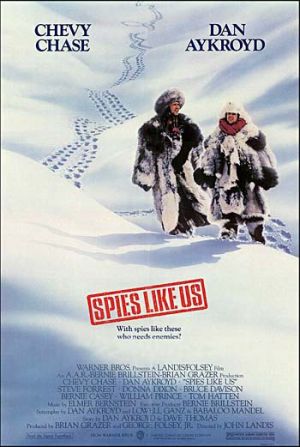
Scholarship on all of this continues. In one protracted study, Dr. David Mills recognized the monetary benefits of this installation, at least as it pertained to the immediate area. In other national contexts, several Hollywood films incorporated this late-1960s Soviet ICBM interception system into fictional screen plays. Perhaps one of the most notable (at least in my formative adolescent years in the 1980s) was the Cold War Comedy, “Spies Like Us” (1985), which made the otherwise understandable paranoid social psyche of the world manageable by couching potential nuclear armageddon in humor and ridiculousness — thank you Chevy Chase and Dan Aykroyd, true Cold War patriots.
Anyhow, future updates and photos from this reconnaissance are pending.
Reality and Myth in North Dakota’s Oil Fields
Recently the contemporary Herodotus of the Northern Plains and the contemporary Herodotus of the Eastern Med took to investigating a list of cultural and social grievances that came out of the oil fields of central and western North Dakota. Drawing from this, I couldn’t help but thinking how both North Dakota State University’s Tom Isern and University of North Dakota’s William Caraher carry on a scholarly tradition that seeks to extract a variety of meaning from one particular data set.
In the late-19th century Andrew Lang said “Tales, at first, told of ‘Somebody,’ get new names attached to them, and obtain a new local habitation, wherever they wander.” In “On Fairy-Stories,” John Ronald Reuel Tolkein remarked how truth is reflected in fiction, if not an external reality than most certainly a psychological one. Other writers and scholars come to mind, including Jonathan Swift and his Gulliver’s Travels, or Mary Wollstonecraft Shelley’s Frankenstein. The former Swift brought the reader into a new world through otherwise fictional accounts (much in the way the Rennaissance Physician François Rabelais did with his Gargantua and Pantagruel), and through this fiction readers could begin to empathize with a number of individuals and scenarios that they normally would not encounter in their day-to-day lives. In the latter case of Shelley, the mid-19th century conflict between the possibilities and real or perceived horrors of science and humanity manifested themselves in the monster created and brought together by Dr. Frankenstein — perhaps the monster is a prologue description of the modern day corporation, a cobbling together of different human parts that is brought to life through the science of electricity and rationality, and a monster/corporation that acts predictably in some ways, but starts doing strange things in many other ways. Or perhaps it’s a story about how local villagers cannot accept change and modernity, mistakenly thinking that things have been one way and one way only, and by golly they are going to stay that way if I have anything to say about it.
The point how all of this relates to circulated e-lists from North Dakota’s oil field is made, though. Fiction, or what is perceived as fiction, is a powerful window into reality. The rumors circulating in North Dakota’s Bakken oil field say just as much about the oil field as they do about the individuals who 1) composed the list(s); 2) of individuals who find components of the list agreeable or disagreeable; and 3) of individuals who circulate and forward the list (and individuals who blog the list on-line). We all carry cultural baggage — aka, value judgments — where ever we go, and this cultural baggage is what makes us human. This is why it is so necessary to have Iserns, Carahers and others of the world examine that evidence. They do so for a variety of reasons, and not necessarily to demonstrate who is Right and who is Wrong. Rather, it is to see just what kind of information can be extracted and squeezed from a particular data set, in this case a purported list that purportedly purports to describe the purported happenings taking place in the North Dakota oil field.
TransCanada’s Keystone Pipeline: Culture on the Great Plains, Then and Now
Federal politicians have lately adhered to the Loyal Opposition maxim when it comes to yelling-matches surrounding the Keystone Pipeline — the phrase “talking past one another” comes to mind. If a person thinks they are going to do some research and get the real and honest truth, they are put up against listening to the republicans, then going and listening to the democrats, and then returning and listening to the republicans, and then listening to ecologists, and then democrats, and then oil tycoons, and then entrepreneurs, and then republicans, and then capitalists who don’t know they are Max Weberists instead of Adam Smithists, and then more of republicans who sound like Marxists rather than — oh, hell, nevermind…
You’ll notice that an understandable concern in proposing this new pipeline is environmental, and the legislation responsible for elevating these environmental concerns are a byproduct of the EPA agency started by Richard Nixon. Lacking from much of the discussion, though, are cultural sites that may be disturbed and may currently be in the pipeline way. And cultural sites means anything current or past that had to do with Homo sapiens, or also what in the business we call “us.”
Between 2005 and 2009, I gladly (value-judgment alert!) worked on various survey and reporting components of the TransCanada Pipeline in the eastern Dakotas. The pipeline portion I worked on concerned the segment stretching from north of Walhalla (North Dakota) down to Yankton (South Dakota). While surveying the proposed pipeline route, our on-the-ground crew was often happy to report to the above-ground planners (the engineers in an office somewhere in non-Dakota) that they needed to re-route the pipeline in several areas. In some cases the proposed pipeline ran right through individual homes; in other cases the proposed pipeline ran right through sacred Native and non-Native American sites. The whole idea behind our historical, anthropological, archaeological, and architectural historical work was simply to get on the ground data by physically walking the landscape and the proposed route. Through this we could locate and identify culturally rich and sensitive sites and areas that the proposed pipeline touched. In the sense of the long historical duration, we did this because Theodore Roosevelt originally recognized the importance of it all at the beginning of the 20th century (see the American Antiquities Act of 1906): in short if we, as Americans, want more than a throw-away culture, then we need to understand and recognize the richness of our cultural past.
Some highlights of recognizing that past during the eastern Dakotas segment of the pipeline were:
1) With local tribal liaisons, we were able to identify sacred areas and ensure the pipeline was either re-routed; or ensure that these areas received proper documentation and mitigation. By sacred areas, I mean that we ensured the pipeline was not run through a Native American site that was no more or less religiously important as a proposed pipeline route that went, for example, underneath the Vatican, or your local church, synagogue, mosque or sanctuary.
2) Through oral histories, we ensured the pipeline avoided Euro-American burials. Two specific cases that come to mind: 2a) an old-timer walked out and told us where his still-born brother was buried approximately 80+ years ago, and through this the pipeline was rerouted; and 2b) another interview with a woman who identified a rural, countryside grave. This grave was not in a formal cemetery, but rather on a section line. Had we not chatted with this lady, the rock pile that marked the grave would almost have certainly been mistaken for a standard rock pile that farmers often create to keep the stones out of the fields and away from wrecking their implements.
3) We monitored the pipeline during actual construction, too. If there were cultural remains present, then we would figure out where they came from.
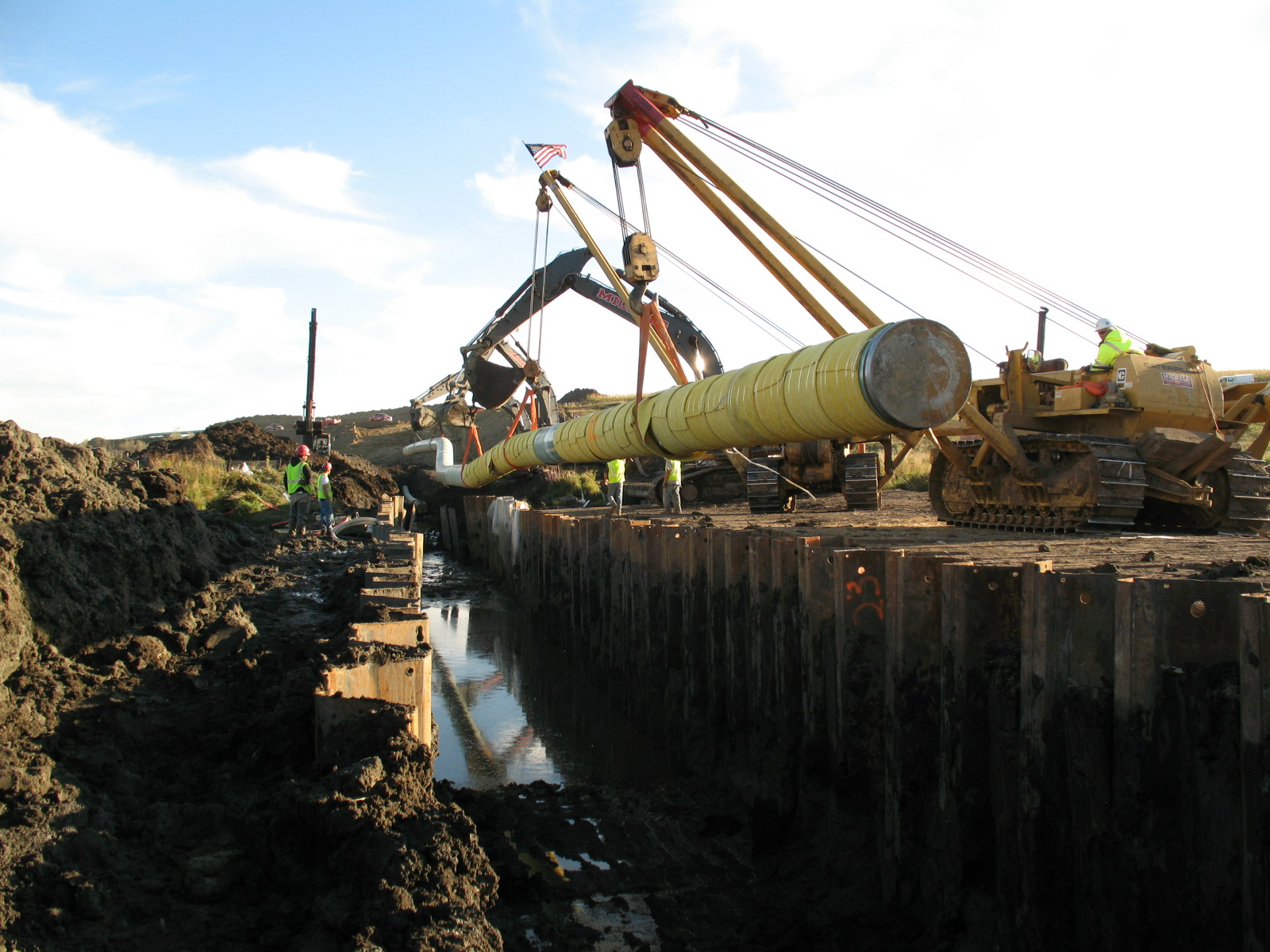
Below are some short clips taken during the September 2009 construction component of the pipeline that now runs north-south through the eastern Dakotas.
One angle of a 450D LC working its way across a creek.
The pipeline needs to be set below ground surface, and in some cases Sioux quartzite needs to be busted through…
The crane lowered a weighted vibrator down on to the metal walls, working it into place to create a trench for the pipeline. In other cases a large jack-hammer was brought in to break up the pink Proterozoic quartzite (aka, the Sioux quartzite, or the stuff numerous National Register of Historic Places buildings are constructed with in Sioux Falls, South Dakota, among others).
There is no doubt that a Keystone Pipeline creates jobs (then again, pistol-whipping someone also creates jobs, but nevermind), and that a future Keystone Pipeline will create more jobs. I am interested in getting a pipeline approved, but doing so is a fairly complex process. When this process invariably gets politicized, there is really nothing anyone can do until the Federal, State and local politicians all calm down, and until the major news sources also calm down as well. Remember: journalists move news when individuals say insane things, and a cynic might say there is reason for news sources to take politicians out of context in order to move and sell said news. It’s a good thing I am not a cynic. I am realistic enough to know the pipeline will eventually get approved, but probably not until the next presidential election is over.
Bakken Oil Issues and Law Enforcement Concerns
A generalized comment that comes from above the Bakken formation (at ground level) often goes something like, “Our entire way of life is changing out here in western North Dakota.” While those of us not above the Bakken are indeed concerned about this, we often do not understand the specifics of what exactly is changing. The following list came from a discussion that took place with the North Dakota Sheriff’s & Deputies Association in Bismarck, and they itemized many of those specifics. It is the good, the bad, the realistic, and the not so good looking. My comments and interpretations are [imbedded in brackets] like these. Props to our civil servants that are the sheriffs and deputies.
1. Currently there are a total of 84 companies involved in the oil industry in western ND.
2. It takes between 2000 and 2200 semi loads of water per well. Currently there are 258 wells in progress with so many scheduled it is hard to determine the exact amount.
3. Traffic accidents, especially fatal traffic accidents are of very high concern. At one location on Highway 85 south of Williston, a traffic count was conducted in October of 2011. In one 24 hour period of time there were 29,000 vehicles through the intersection looked at with 60% of the traffic being semis.
4. Traffic is typically backed up for ½ to ¾ of a mile. One of the guys stated that one day last week he sat at an intersection on Highway 85 for about 30 minutes to get a big enough opening to cross over.
5. They have closed the weigh scale house because it was causing such a traffic jam that it was closing the roadway.
6. Rent in Williston currently is: $ 2000 for a one bedroom to $ 3400 for a three bedroom.
7. They have no more hook ups for campers any where in the area.
8. Williams County allows three campers per farmstead; the farmers almost all have three campers on their property and are charging $ 800 per camper per month for rent.
9. Wal Mart in Williston no longer stocks shelves. They bring out pallets of merchandise at night, and set it in the isles. People then take what they want off the pallets.
10. On 1-1-12, the Williston Wal Mart had 148 campers overnight in their parking lot.
11. Willams County wrecked a pickup and ended up bringing it to Bismarck for repairs because there no available body shops to do the work. Williams County has purchased a trailer and has started to bring vehicles to the Bismarck area for repairs. Willaims County took a pickup in for ball joints and front brakes — the shop charged them $ 2800 for the repairs.
12. Williston and Williams County now produces more taxable sales than any other area in ND [including Cass County, which is huge].
13. The Williams County jail has increased booking by 150%. With a 100% increase in inmate population. Bonds of $ 5k to $ 10 K are typically paid with cash out of pocket. The Williams County Sheriff stated that a couple of weeks ago he received a $ 63,000 bond in cash carried into the jail in a plastic Wal Mart bag.
14. Williams County Sheriff’s Department has more than doubled in staff over the last two years. They are now buying trailer houses that come up for sale to rent to newly hired deputies.
15. Williams County new starting salary with the academy is $ 46,000 plus 100% of all benefits paid.
16. They are in a continuous hiring cycle and they have no set budget at this time. The Sheriff has been told to manage his office to the best of his abilities and keep the Commission updated, but do not worry about the budget.
17. The Williston McDonalds just announced that they will pay $ 15 an hour, a $ 500 immediate sign on bonus and a single medical plan paid for.
18. The restaurants are full and with limited staff to work in them. They usually just have the drive through open. The restaurants that have inside seating are now an hour wait at all times.
19. Law Enforcement in the Williams County area cannot provide training to staff due to time constraints and no location to hold training.
20. The local Motel 6 in Williston now rents rooms fro $ 129.95 per night.
21. Law Enforcement no longer does any proactive work (school programs, community services, house checks) they do very little traffic related issues as well. They just go from call to call. Bar fights are one of the biggest issues.
22. Other law enforcement issues include the strip clubs. The local clubs have now started what is called “babe buses”. These buses go out to areas and pick up people and bus them back and forth to the strip clubs. The buses have poles on them as well as live entertainment.
23. Drug problems are immense, and they are seeing narcotics that they have never seen in the area before, like black tar heroin [black tar heroin may appear in the historical record].
24. The civil process section of the Sheriff’s Department use to average 1800 papers a year. They are now doing 4500 processes a year.
25. Law Enforcement said that they make as many Driving under the influence arrest at 10 Am as they do at midnight.
26. Illegal aliens have become a huge problem, especially getting the proper authorities to remove them from the Country.
27. The current thought from the oil companies is that the area will continue to grow as it has over the past two years for the next five years and stay for ten years. At the end of the ten years they feel the communities will drop in population somewhat.
28. The current thought is that the oil companies will be drilling wells on every 1280 acres of leased land. This way they have tied up the land and do not have to release the property.
29. The Williston General Motors dealership has now become the number 1 seller of Corvettes in the upper Midwest.
30. The bigger oil companies are doing very well in hiring good people. They run checks and make sure the people they hire are drug free; it is the smaller companies that are having trouble-hiring people that will look the other way on hiring issues [it is difficult for start-up businesses to get a foot-hold in the face of competition of the huge companies].
31. They said they do not know anybody anymore. The Sheriff of Williams County used to be able to go to Wal Mart and not walk very far without knowing somebody. Now he does not know any of the people in there.
32. Many of the local citizens are taking retirement and moving out of the area.
33. They have an extreme amount of alcohol abuse going on. They have more calls than ever of drunk people trying to get into houses, to find out they are at the wrong place.
34. Minot population has grown by a projected 9000 people since the completion of the census. Minot is expecting to reach a population of 75,000 in the nest five years.
35. Trinity Hospital in Minot has just hired 115 nurses from the Philippians to work at the hospital, as they cannot get enough local nurses to apply.
The Midnight Noise Orchestra
On January 14, 2012 (a Saturday) the Bismarck-based band The Midnight Noise Orchestra (TMNO can be heard here) rolled over on the I-94 to Fargo to oblige a recording with Prairie Public studios. I couldn’t help but thinking of a lot of the recording freedoms technology affords us nowadays through devices that are sensibly priced and that pretty much ensure anyone in any basement or professional studio can capture quality audio and video. It also reminded me of one of my many favorite R.G. Collingwood passages, this one coming from his 1930s work, The Principles of Art (1938). My remarks [are embedded within brackets] like these. Collingwood:
A January 14, 2012 photo of The Midnight Noise Orchestra. The photo was orchestrated about four hours and forty five minutes before midnight in downtown Fargo, North Dakota.
…The printing-press [stay with me here] separates the writer from his audience and fosters cross-purposes between them. The organization of the literary profession and the ‘technique’ of good writing, as that is understood among ourselves, consist to a great extent of methods for mitigating this evil; but the evil is only mitigated and not removed. It is intensified by every new mechanization of art. [italics are mine] The reason why gramophone music [a cutting edge technology in the 1930s much as Web 2.0 and 3.0 is cutting edge in 2012] is so unsatisfactory to any one accustomed to real music is not because the mechanical reproduction of the sounds is bad — that could be easily compensated by the hearer’s imagination — but because the performers and the audience are out of [direct] touch. The audience is not collaborating, it is only overhearing. The same thing happens in the cinema, where collaboration as between author and producer is intense, but as between this unit and the audience non-existent. Performances on the wireless have the same defect. The consequence is that the gramaphone, the cinema, and the wireless are perfectly serviceable as vehicles of amusement or of propaganda, for here the audience’s function is merely receptive and not concreative; but as vehicles of art they are subject to all the defects of the printing-press in an aggravated form. ‘Why’, one hears it asked, ‘should not the modern popular entertainment of cinema, like the Renaissance popular entertainment of the theatre, produce a new form of great art?’ The answer is simple. In the Renaissance theatre collaboration between author and actors on the one hand, and the audience on the other, was a lively reality. In the cinema it is impossible. (Collingwood, 1938:323)
So essentially what Collingwood is saying is that it’s okay to watch TMNO on television, but it’s way better to see them live and in-person because stage actor and audience watchers actively participate in this artistic process and expression. In other words, nothing can replace live music. This as opposed to watching TMNO on television which, as television watching goes, often induces a trance-like coma in the viewer. In this vein Clay Shirky has written and talked and lectured at length on how much energy humanity expended on television watching, also noting the dangers of a society and civilization that knows Hollywood television characters better than they know the next door neighbor (I suppose there is also a danger or sadness in blogging instead of having conversations with the person in the next room). Anyhow, go see TMNO, or ask the person in the next room or text that friend just down the way to see if they want to go get a cup of coffee, real time.
Update: As YouTube continues providing the world with democratized conduit, this an ability to upload localized events and stream them to anyone with an internet connection (Totalitarian Governments are working on ways to curb this), below are some embedded videos that may or may not make or reflect or counter the Collingwood and Shirky point(s) above.
This was filmed at the Belle Mehus in downtown Bismarck, North Dakota.
This video was captured in one of TMNO’s top secret basement recording studios in Burleigh County, North Dakota. The opening remarks have a kind of Motörhead feel to them.