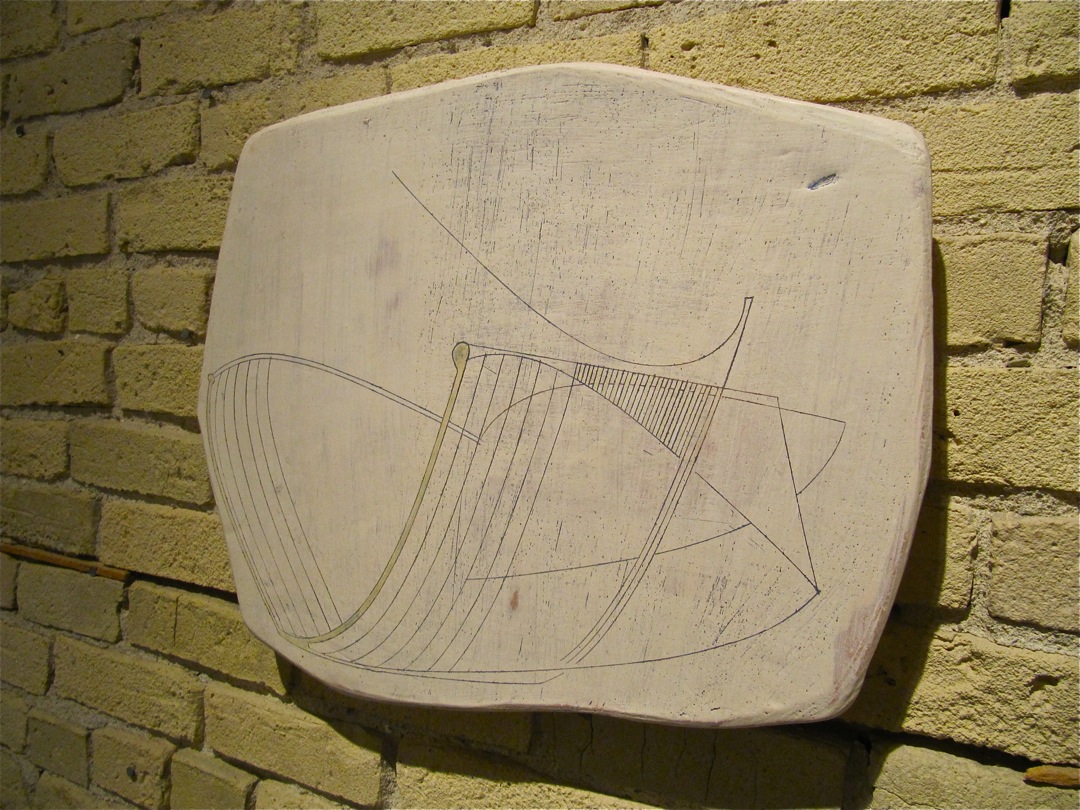
Natural Turkeys: Spring Prairie Hutterite Colony in Clay County, Minnesota

Last week I started texting friends about where they might source organic turkeys for a Thursday afternoon gorging on Thanksgiving Day. These friends rightly pummeled me with a miscellany of suggestions local to their, well, locale, this from Burleigh and Morton counties in central North Dakota. I also posted the question on social media about where folks were getting their organic turkeys, and Tom Isern (the arguable Herodotus of the Northern Great Plains) said the Spring Prairie Hutterite commune was the place to go. I should have known, since Isern has been known to distribute Spring Prairie hams around jultid. So this mid-morning I headed off to find the Spring Prairie Hutterite Colony. Below are some photos from the meat-sourcing expedition.
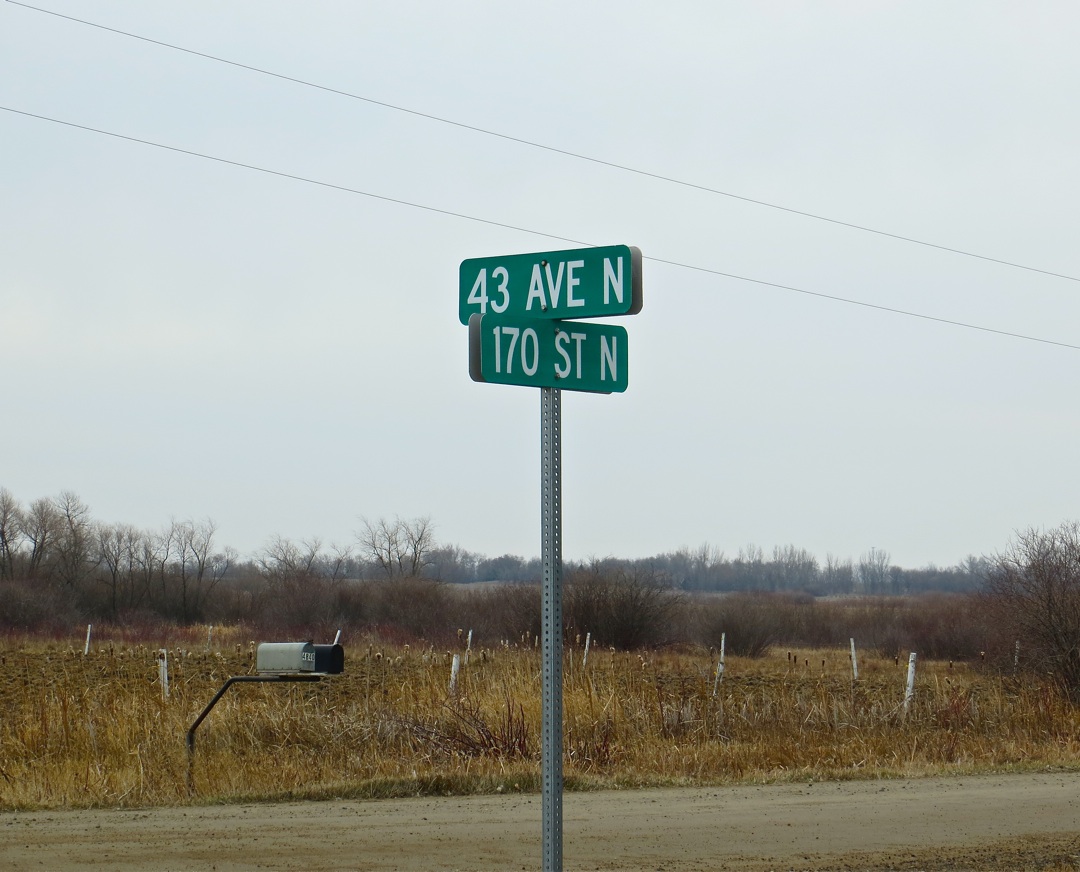
At this intersection, turn north. Drive that way for 1.5 miles to the entrance of the Hutterite Colony.

After you hit the intersection above, point the vehicle north and drive for approximately 1.5 miles to the entrance of the Hutterite Colony. At this entrance, turn west and follow a sort-of-looking main road that arcs briefly to the southwest, and then turn west again. By this time you should have the below in view. To be sure, it is a bit nondescript, the antithesis of Robert Venturi’s lament in Learning from Las Vegas. It seems Hutterites never had to learn from Venturi or Las Vegas in the first place.
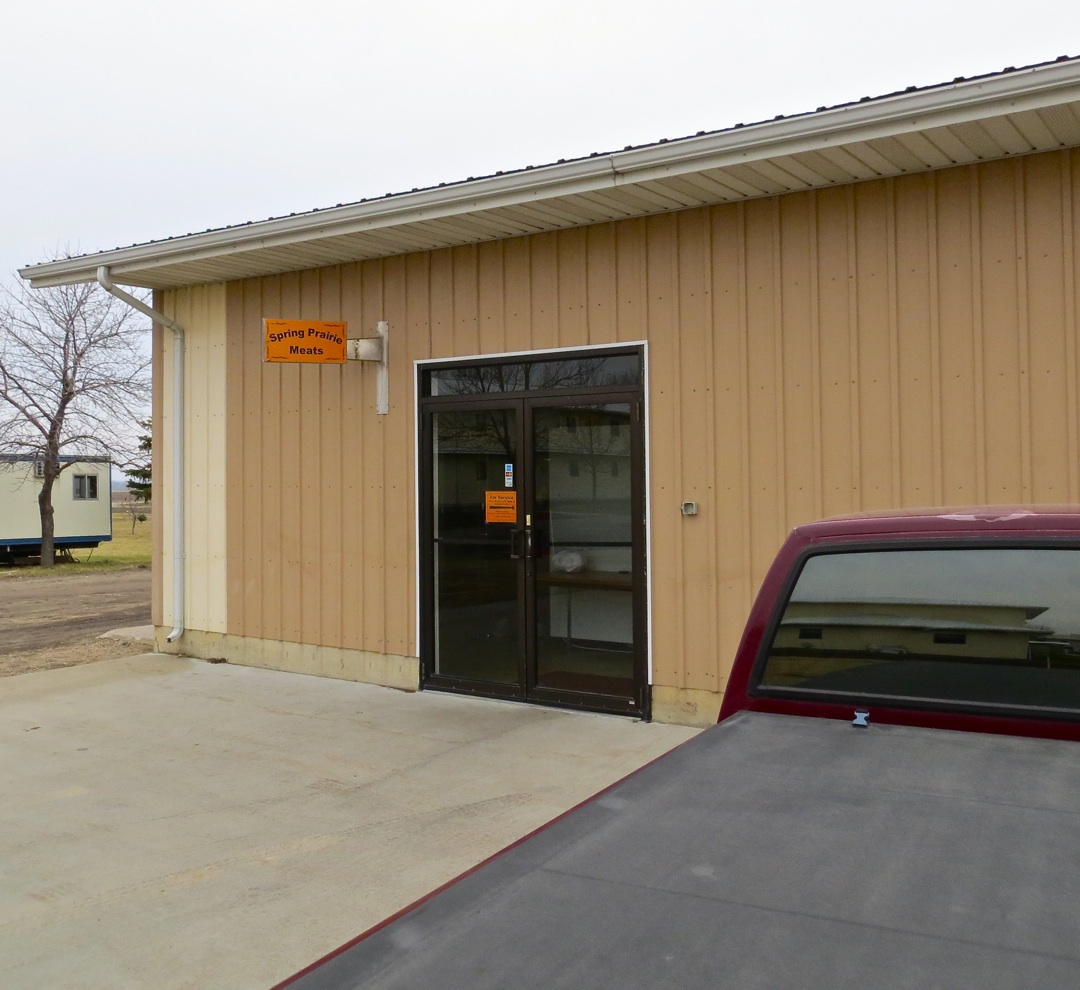
Spring Prairie Meats within the Spring Prairie Hutterite Colony in Clay County, Minnesota.

The photo above is the south entrance to Spring Prairie Meats. Note the dormitory building reflections in the automotive glass and the building’s glass door. You are in Hutterite central. This religious commune has worked hard to bring its religious and social structure into the 21st century, and they are doing great work of it. Silke Van Ness says in “The Current Status of Research on German Dialects in North America,”

The purchase of poultry, beef and pork products at a Hutterite meat bazaar.

from The American Dialect Society: Duke University Press (Vol. 70, No. 4, Winter 1995) that German language maintainence in North America results from socio-religious isolation, “the only factor which retains full force.” When you’re going over the various pork, poultry and beef products within the fridges at Spring Prairie Meats, there’s a strong chance you’ll encounter this insulated dialect, especially if unintentionally overhearing Hutterite conversation.

A Hutterite man eventually asked me in English if I needed help. I responded and told him I needed a lot of help, but for now was only interested in help finding turkeys. He laughed and obliged my turkey request. I purchased a 17lb turkey for just over $1.52/pound, or right around $25. This in addition to some summer sausage and beef sticks came to around $32 and change. Not bad at all. The label of the Prairies’ Pride turkey says it is “all natural, home grown, young turkey,” and “minimally processed – no additives – no artificial ingredients – no growth hormones (Federal Regulations prohibit the use of growth hormones in poultry)” — this latter statement I was unaware of. This labeling that requires labelers to call pre-Industrial agriculture practices “natural” or “organic” is a bit silly: the majority of sedentary human history, at least up to the turn of the 19th century, was what today we’d call “organic” farming. Why not return to just calling organic farming, farming? We could then require produce produced from industrialized and mechanized means to be labeled as such: this produce was made from industrial means, and we shot a ton of antibiotics into the mammals and anhydrous ammonia in the ground to get the stuff this big. Nevermind, though. I got my natural turkey. I will be back to the Spring Prairie Hutterite Colony. I’m glad they are around. Happy Thanksgiving, and happy brining.

Prairie Turkey label. The brining will commence within days.


Punk Archaeology: Joe Strummer on DIY

This evening I revisited the documentary, “Joe Strummer: The Future is Unwritten” on the Web 2.0/DIY platform that is YouTube. I have AppleTV jacked into a shamelessly huge flat-screen, and the AppleTV somehow allows me the ability to stream any YouTube selection through it. So by punching in “Joe Strummer: The Future is Unwritten,” YouTube’s search engine returned a series of 2008 uploads by the YouTuber named “madferrett.” Smack dab on 4:02/8:24 in the fourth of eleven installments (the subtitle is “Squatting 101’ers DAY’S”), the late Joe Strummer defines Punk as straight-away Do-It-Yourself. Of this DIY ethos, Joe in the video says:

We had the nerve to rent a room above a pub, and charge people 10 p [aka, pence] to get in. That’s how we learned to play, by doing it for ourselves, which is like a punk ethos. I mean, you gotta be able to go out there and do it yourself, because no one is going to give it to you.

Here is the Joe Strummer YouTube embed:

In the long-winded scheme of things, this is also referred to as being an autodidactic, or a self-taught learner. As fellow blogger Bill Caraher and I continue conversations with any and all about Punk Archaeology, this invariably has helped develop and shape the all-important fineries of the Punk Archaeology conference scheduled to take place in downtown Fargo, North Dakota on February 2-3, 2013 (it starts Saturday evening and is scheduled to end Sunday morning).

It seemed reasonable to post Joe’s remarks, if nothing else to continue to consider what the phrase Punk Archaeology means. In one sense, there is the localized archaeology of punk within Fargo-Moorhead, where any number of bands formed up in DIY fashion to cut loose on stage. In another sense, there is punk archaeology (or Punk Archaeology, depending on how formal one wants to be), the latter word “archaeology” not only specific to the discipline of said archaeology, but also to other DIY attitudes intrinsic to sustaining the disciplines and vocations and trades, and also as in the archaeology of knowledge. Punk archaeology is all around, and often right in front of us. Back to it on this end.


Coffee Science in Fargo

I was trying to think of something epic to blog on for this 100th theedgeofthevillage.com post. Since winter has taken over autumn on the northern Great Plains, hot coffee seems just as good a topic for analysis as any. There are a couple places around the campus of North Dakota State University to purchase cups of coffee. As of late, I have wondered about coffee temperatures. This thought came from being served super-heated coffee in paper cups with those petro-plastic lids within NDSU’s memorial union — a place that fosters memory and unity, no doubt. In the last couple weeks, I have encased the paper cup in one of those cardboard sleeves, and have had to let the super-heated coffee cool enough to sip. Once cooled, I sip the coffee, but then wonder whether the heat melted the insides of the cup: was I just tasting burnt coffee? Or was I tasting coffee infused with melted glue? And was this more damaging to my innards than, say, drinking pints of chilled energy drinks that seem to have begun replacing otherwise traditional coffee drinking? I have no idea, but this in turn led to another idea: data collection on the heat temps of coffee around the Fargo-Moorhead area. So this is the first entry of coffee SCIENCE! in Fargo, North Dakota.

The coffee reviewed in this case is not from the coffee shop alluded to above. Instead, this coffee is from Jitter’s, a coffee house located to the southwest of the intersection of 12th Avenue North and Albrecht Boulevard in Fargo, North Dakota. Here is the raw data from my field notes. Equipment used: one of those thermometers you pick up for around five bucks at the grocery store.

Coffee science.

Objective data: On November 13, 2012, at 9:30AM, the temperature reading from the medium roast coffee just pumped from a thermos into a heated ceramic mug at Jitter’s read 151° F.  The room temperature read 70° F, and the outside winter temp was 19° F (this according to AccuWeather.com). A second reading was taken after a refill at 10:25AM, this at 139° F.

Subjective data: at 151° F, I was able to sip the coffee immediately (no need to let it cool). This immediacy was important since it is necessary to intersperse coffee sips with apple fritterer bites upon the ceremonious opening of the pastry bag. Before getting my coffee, I only had to stand in line for approximately 13 minutes while waiting for the two patrons ahead of me to order some kind of double soy latte decaf with a re-caffeinated infusion loaded with Italian syrup and topped with whipped cream (this will eventually contribute to the downfall of the West to North Korea, a running hypothesis of mine here).

Contribution to Coffee Memory: The rise of the prepared sugar bomb drinks could be felt easily in the year 2000 if a person was engaged in serious coffee drinking at the Dinkydome or throughout the coffee houses in Dinkytown, Minneapolis, Minnesota. It seemed a bit more gendered, though, at least in my mind, as I remember it. Young women tended to order white cafe mochas left and right. Today, full grown men are shamelessly purchasing these types of drinks — not that there’s anything wrong with that. Nonetheless, I’m fairly supportive of nudging our culture in the direction where there are separate but equal ordering lines in coffee houses: one for straight-up coffee drinkers, and the other for sugar-bomb drinkers. More to come on objective and subjective coffee data collection throughout Fargo, ND.


Leaning Towards Great Plains and World History

The final chapter in Mischa Honeck’s 2011 work, We Are the Revolutionists: German-Speaking Immigrants and American Abolitionists after 1848 is titled, “A Revolution Half Accomplished: Building Nations, Forgetting Emancipation” (Athens & London: The University of Georgia Press, 2011). To capture the opening point of this chapter title, a Thomas Nast cartoon illustration is included from a November 20, 1869 issue of Harper’s Weekly, “Uncle Sam’s Thanksgiving Dinner.” The illustration shows a global thanksgiving table with a “Universal Suffrage” centerpiece. Surrounding the table are representative cartoons from a variety of ethnicities, including African-American, Chinese, Russian, Native America, and so on. This cartoon does not capture the realities of U.S. policy toward Native America at that time, but it does reflect Nast’s personal ideals. This tension between the ideal (or the way things ought to be) and reality (the way things are) is a crucial element to setting down a good piece of history, and in this vein Honeck delivers.

During the American Civil War, Anglo-America battled with one-another over abolition and that “peculiar institution.” This struggle between brothers and cousins is captured by the ever-growing and all-important industry that is Civil War historiography, nostalgic Ken Burns documentaries notwithstanding. If wanting to think about the Civil War in the context of the Atlantic World, or in the context of Global or World History, however, Honeck is where to find it. Numerous immigrants arrived to the United States in the years preceding the Civil War, and Honeck’s history focuses on the German element.

By the late 1840s, population dynamics contributed to the upheaval of existing institutions throughout Europe, and political factions in Germany eventually induced the revolutions of 1848 — the revolutionaries had these crazy ideas about democracy and voting on their brains. On the ground throughout the cities of

A German lithograph from 1849 depicting the Aristocratic crackdown on the democratic revolutionaries of 1848. Note the coast of western France, and the two boats loaded with Europeans preparing to cross the Atlantic.

Europe, street fighting was the norm. In order to escape this street fighting and the Aristocratic reaction to the democratic requests, individual Germans started chain migrations, or emigrations out of Germany and into the United States. By the 1850s numerous pockets of German-Americans had began settling the Great Plains, including liberal German thinkers and the North American Turnerbund throughout the continent (New Ulm, Minnesota is an example of a free-thinking Turner Society settlement). There is a paradox with the arrival of German-American idealists to settle in territories and states throughout the Great Plains, though, and Honeck only hints at it (in his defense, though, his study is mainly concerned with the eastern 3/8s of the United States and the Atlantic World). That paradox is this: while German-Americans carried with them democratic ideals, their physical settlement on the Great Plains invariably contributed to the protracted displacement of indigenous populations.

Nonetheless, many German-Americans became part of the Union Army fighting force during the Civil War. Honeck references the words of the radical Eduard Schläger who in 1871 noted how German-Americans had abandoned those — ahem — silly notions of egalitarianism and gained, “…a growing respect for ‘Anglo-American business methods,’ particularly the disagreeable ones, such as ‘the greed for the dollar.'” Schläger was particularly grumpy, in part because he felt philosophical foundations were being undermined once a little or a lot of money was put on the table. Honeck concludes with how German-America appropriated ideas of industrial capitalism, and this is a ground-level view of how Max Weber’s nineteenth- and twentieth-century industrial capitalism eclipsed Adam Smith’s eighteenth-century notions of moral sentiments, empathy, sympathy, and compassion. We are well aware what happened throughout the Minnesota River Valley in August of 1862, from Fort Abercrombie, Dakota Territory to New Ulm, Minnesota and everywhere in between and on the periphery (including Mankato, Minnesota, the site of the largest mass execution in United States history). Native America would indeed feel the brunt and shock-wave of this industrial capitalism throughout the Great Plains, and there is definitely more work for historians and archaeologists to carry out. In this way much of the past has yet to be considered and written. Honeck’s concluding chapter is an excellent starting point to push scholarship in needed directions, at least as it concerns how Anglo- and German-American ideals gave way to the nation-making processes within the continental interior during and following the American Civil War.


Archaeological Disturbances in Western North Dakota

I came across this October 29, 2012 article, “Land eyed for oil well may be on burial site,” through a colleague and friend, Richard Rothaus.  With the Bakken oil boom going full tilt, this article concerns oil drilling development near and around the Killdeer Mountains in Dunn County, western North Dakota. The part within the article that is incredible is from Lynn Helms, the director of the North Dakota Oil and Gas Division. Mr. Helms said, as paraphrased by the Forum, that “he had no doubts the proposed drilling area has no artifacts.” Once again, this was a paraphrase, but it caused in me the following thoughts: I don’t know whether Mr. Helms physically visited the lithic scatter and possible burial, nor do I know if an archaeologist explained it to him. In the event that he did not physically visit the site, there are quite a few of us that would be happy to explain to him the processes, and why they are necessary. But his lack of doubt is  disturbing. This is why.

The very nature of science and our legal system necessitates constructive and deconstructive doubt. Without this doubt, a case cannot be made one way or another. And without this kind of doubt, and without verifying one’s assertions, a statement is simply a statement sans substance (this is often captured in the saying, “You have no case here.”) Further inquiry into Killdeer is indeed necessary. Numerous archaeologists are concerned with these high profile sites, as they should be, and we are quite interested in showing Mr. Helms why and how. Education is powerful that way. That’s all. Back to it on this end.


Brewing in Bismarck: Updates from Laughing Sun Brewery

On the afternoon of October 25, 2012, I dropped in to the construction site that is Laughing Sun Brewery in downtown Bismarck, North Dakota. Laughing Sun Brewery is co-owned by two friends, Todd Sattler and Mike Frohlich (certainly pillars of northern Great Plains culture and society). When Sattler isn’t practicing law and when Frohlich isn’t practicing the digital humanities, they are thinking incessantly about how to make better beer and beer making better, and how to bring a public tavern to fruition. The first video is Todd expanding on the brewing vats from 10/25/2012. That video is here:

I continued pressing Todd for more information (the people want beer! and they want to know the processes of getting beer!) after he got down off the ladder, and he showed me some rough hewn slabs of cottonwood recently milled and donated by the Suchy family. Last year the Missouri River bottoms flooded (every where between Fort Peck, Montana and St. Louis, Missouri), and this in turn caused massive erosion and property loss, in addition to felling large cottonwood trees that typically grow in the river bottoms of the northern and central Great Plains. Todd and Mike are considering how to make this lumber work for table tops, and this will be a bit tricky. Todd expands on the cottonwood logs here:

The trick with building with cottonwood is that it is soft and fibrous. This means that when these boards

Rough milled cottonwood boards donated by the Suchy family to Laughing Sun Brewery in downtown Bismarck, North Dakota.

dry, they will certainly bend. Todd said he is looking for ways to deal with controlling some of the bending, and they may just end up fixing, latching and securing the large slabs down to a horizontal surface while they dry and — as the punk-DIY ethos goes — see what happens. There may be a way to slice up the rough hewn boards after they dry, and re-fix them with epoxy into shapes that are more conducive to holding level large mugs of tasty beer.


Changes in the Flat-Scape: Cedar Shelves and Plants in the Winter

One of the opening quotes in William Cronon’s Changes in the Land: Indians, Colonists, and the Ecology of New England (New York: Hill and Wang, 1983 & 2003) is from George Perkins MarshMan and Nature (1864), and it says,

…As we have seen, man has reacted upon organized and inorganic nature, and thereby modified, if not determined, the material structure of his earthly home.

Thank you Mr. Marsh.

Earlier this evening I thought about Cronon’s book when I decided to organize and

A new cedar shelf to elevate plants and allow them to capture the low-hanging sunlight during a northern Great Plains winter.

determine the organic and material structure of my earthly flat.  From Home Depot I picked up a couple cedar 2″x6″ and 5/4″x6″ pieces of lumber, and set to building some free-standing shelves to help plants capture the sun in the vertical, south-facing windows. This is preparation, I figure, for the eventual onslaught of a northern Great Plains winter. The thing with enjoying winters when one is not too far south of the Yukon is to simply keep busy, and keep moving.

Since it was drizzling rain outside on this cool October evening, and since water is an excellent conduit for electricity, I decided to bring the back patio wood shop into the kitchen. While Jack and Meg White belted out Seven Nation Army on the iPod and logic desktop speakers, I imagined what my very polite apartment neighbors may have thought every time the saw screeched to life at around 7:15PM — I had a back up plan, though, ready to invite them in for a cola or beer to show off my new cedar shelf idea should they come knocking. I could even offer to build them one if necessary: it’s important to be neighborly, and important for many reasons.

This indoor DIY wood shop also doubles as a kitchen.

Without making this too tedious of a blog entry, I simply cut the cedar into proper lengths to fit the bathroom window. I secured the legs to the walls with those little plastic anchors and simple screws, and capped the legs with horizontal 2x6s. It now smells like a cedar-lined sauna in there with hints of earthiness from the terra-cotta potters. The basil plants will be able to capture the sun all winter long. The tentative plan is to get rosemary in there as well.


McGovern Archaeology

Today (10/21/2012), Sunday, George McGovern died in Sioux Falls, South Dakota at 90 years of age. He had been hospitalized for a time, slipping into a coma within the last couple days. During that time I started thinking about McGovern at the local level, at least in South and North Dakota. McGovern hailed from the small town farming

George McGovern buttons from a private collection. Photo taken on October 21, 2012.

community of Avon in southeastern South Dakota. He joined up with the Airforce at 19, and flew B-24 bomber missions against Nazi Europe. After the war McGovern returned to South Dakota, and with his GI Bill he worked toward a graduate degree in history and lectured at Dakota Wesleyan University in Mitchell, South Dakota. He eventually got into politics, and the state of South Dakota elected him for 3 terms to the United States Senate. In thinking about all of this, it seemed like a good idea to upload some George McGovern archaeology, at least a photo of his presidential buttons from his 1972 campaign against Richard Nixon. McGovern lost. Big time. He carried no more than one state in the election — apparently it’s a really good idea to find out a lot about your vice presidential running mate before you ask them to be your vice presidential running mate. But that was how things played out external to the Democratic Party. Internally, McGovern ushered in numerous progressive reforms. Ross K. Baker, a political science professor at Rutgers University, has pointed out that McGovern helped revolutionize the internal workings of the Democratic Party, driving out the old guard and absorbing the times that were a changing — thank you Bob. The buttons reflect those changing times and reforms. The buttons have a variety of iconography, including a rainbow, the sign for women with parallel horizontal lines

The McGovern Library at Dakota Wesleyan University in Mitchell, South Dakota. McGovern lectured history at this campus.

that signifies equality, the dove (certainly a sign of peace and love), and the geopolitical outline of North Dakota that emphasizes the state’s Peace Garden slogan. These photos came from the private collection of Molly McLain. No doubt there are more of these buttons tucked away in the attics, storage lockers and basements of a variety of homes across the country.

Another photo is of the McGovern Library at Dakota Wesleyan University. If I remember correctly, the building (not the McGovern Library) where McGovern lectured history at DWU still stands. To a large degree these buildings help connect our discombobulated present with the past, providing a kind of stability that is both real and imagined. McGovern lectured history in Mitchell, and he was from Avon, South Dakota. If looking at McGovern, it seems that you can do anything in this country if you put your heart and mind to it. It just so happened that McGovern also had a genuine soul (not every politician or individual has this). Here’s to George McGovern, and his well played life. …well played indeed.

A Google Earth image of Avon, South Dakota, the home town of George McGovern.


Kite Photography in Western North Dakota

On the weekend of October 6-7, 2012, we (meaning archaeologist Richard Rothaus, artist Molly McLain, and myself) piled into the Trefoil field vehicle and cruised out to western North Dakota for a session of low altitude, aerial photography (“low altitude, aerial photography” is the phrase you use in fancy proposals; in lay terms it is kite photography, a do-it-yourself technique historians and archaeologists grapple with from time to time, in Omanwestern North Dakota and the eastern Mediterranean). A fortune cookie has read that you cannot control the wind, but you can adjust the sails. This is true, and when it comes to time-sensitive kite photography on super still days on the northern Great Plains, you can also expend vocal hot air, curse the gods, embrace the absurdity of said still day, and record your comrade at his finest. So while at Theodore Roosevelt’s Elkhorn Ranch site on Saturday evening (with less than 4MPH of wind), sometimes you can catch Rothaus opining on the situation:

To be sure that you caught the audio, Rothaus made an initial objective statement that gave way to the rhetorical question, and then the camera panned over to the impotent aesthetics of a pile of kite on a gravel road. BULLY!

Rothaus from the above video:

I need four miles an hour worth of wind. How can there not be four miles an hour worth of wind in North Dakota?

That is an excellent question, Richard. The gods eventually smiled on us, though, at least for a couple moments, and the wind took the kite in the air allowing the digital camera to capture the evening panoramic of the Elkhorn Ranch:

Elkhorn Ranch photo by Richard Rothaus/Trefoil Cultural, October 2012.

There are green evergreens (which is why they call them ever-green) to the right and leafless deciduous trees to the left, the Little Missouri River looking more like a creek as it should in autumn.

Another one of the problems of kite photography is figuring out what minor or major adjustments the camera needs to capture enough horizon to give the viewer a sense of direction. If you want to make an adjustment, you have to repeatedly send the kite up and down with each camera tweak (bring snacks and a cooler).

Digital cameras attached to low flying kites will not capture everything, and this is why cross-disciplinary teams are a great idea for any type of field research, foreign or domestic. For example, approximately 10 steps to the south of the Elkhorn Ranch visitor signatory signage, an oil derrick can be viewed to the east-southeast across the river. While Rothaus is putting together the kite photography apparatus, you can also capture photos of a book Bill Sewall wrote about his time at the Elkhorn. Bill and his comrade Wilmot Dow did the majority of the hard work out at

Bill Sewall returns to the Elkhorn Ranch, 2012.

the Elkhorn. In thinking about this, I suppose a cynic might say that Theodore brought Bill and Wilmot on board so he could have the time to write about how hard he was working in western North Dakota — if the technology was available, Roosevelt probably would have blogged about kite photography while his comrades were doing the actual hard work of kite photography, too (one has to be a bit philosophical about this).

Anyhow, that evening we refortified with elk burgers and steaks in Medora, and the following day set out to capture some portions of badlands undisturbed yet by precious energy development. We were made aware of these portions of lands through stories in the Dickinson Press, and through one of the missions carried out by the Badlands Conservation Alliance. So on a Sunday we drove down to the area. The wind was really blowing. It was blowing so much that I once again decided not to do any hard work, but do the all important work of capturing the hard work. Notice similarities between Richard Rothaus reeling in this kite and someone reeling in a marlin while deep-water fishing:

It almost smacks of a passage from Fear and Loathing, where kites were swooping down on Richard like huge manta rays coming from all directions out of the sky. Another peril of low altitude, aerial photography is in the photo below. You’ll eventually come across landscape shots like this. If everyone remains silent enough in the field truck, though, you can all pretend like you didn’t just see it. That you just didn’t see this here. Everyone just has to look straight ahead and talk about the weather or something. Don’t draw attention to the following…

Oil Pumps and National Grasslands signage in western North Dakota, October 2012.

BULLY!


Punk Archaeology Inspiration

Studying and thinking deep about material culture is an interesting business. It is interesting because there is both the objective object, or the thing in front of you, and then there are the ideas that we as flesh-and-blood human beings attach to that object. And the word “attach” does not mean to suggest that an idea is somehow unreal, or fake. Ideas, after all, come

A piece by Michael Strand.

from the mind, and since the mind is real, so is the abstraction that is the idea. One doesn’t have to act on the idea, but nonetheless, the idea remains real.

In the last month and a half, North Dakota State University’s Michael Strand has had at least one conversation with me about this, well, idea. One evening he explained how he worked on creating an artisan bowl for food (and Michael often asks that his artwork be physically used for family style meals, especially if they are bowls and cups, as his Ted Talk video expands on below), and he used this serving bowl at a dinner with an ethnic Kurdish family in Washington state. He is poised to take this bowl to another Kurdish dinner, this one in northern Iraq. I believe that dinner is pending, but no doubt the bowl and the individuals around it (from Washington state to northern Iraq) will serve to connect ethnicity and individuals. In the business, we often call this community.

In a separate but similar vein, on September 14, 2012, Michael expanded on some of his art at a collaborative exhibit with his colleague Amy Smith. He encouraged me to photograph and share this art, and then I asked if I could put a digital camera in his face while I questioned and he provided answers to his latest works. He said it was no trouble at all. So I will do that here:

And then contrast it with his TedX Fargo Talk that colleague Angela Smith forwarded to me here…

…Michael was and is speaking in large part to how objects, or material culture, carries with them archaeological and historical — aka, humanized — provenance, at least if we, as humans, stop to consider it. This material culture can be both 2-dimensional in form (or what historians often refer to as “primary sources”) or it can be 3-dimensional (what everyone often calls “stuff”). The notion that objects carry ideas with them can loosely be referred to as Romanticism (which is a word with a LOT of baggage, none of which I will go into here), but it can also be referred to as an archaeological school of thought known as post-processualism. In another archaeological way this is what Ian Hodder asked readers to consider in an article I am furiously searching for throughout my shelves… ah, here it is. In his 1991 piece, “Interpretive Archaeology and Its Role” in American Antiquity (Vol. 56, No. 1, page 9) Hodder said,

…new theories and the new ways of writing them often serve to make archaeological texts more obscure and difficult for anyone but the highly trained theorist to decipher. How can alternative groups have access to a past that is locked up both intellectually and institutionally? Subordinate groups who wish to be involved in archaeological interpretation need to be provided with the means and mechanisms for interacting with the archaeological past in different ways. This is not a matter of popularizing the past but of transforming the relations of production of archaeological knowledge into more democratic structures.

The more I think about all of this, the interplay of ideas with material objects, the more necessary and impending it is to have a Punk Archaeology conference on the evening of February 2, 2013, in downtown Fargo, North Dakota (insert “Grow Buzz of Punk Archaeology Conference” here)…