Category Archives: Uncategorized

Ernest Staples Osgood, “The Day of the Cattleman” (1929)

Central to Ernest Staples Osgood’s 1929 scholarship is how cattlemen in Wyoming and Montana ignored previous perceptions of the Great Plains as an uninhabitable desert, and instead recalibrated their perspective to make a life on the North American steppe. Once the cowboy got to the Great Plains, Osgood said,

The solitude of the desert passed, and men began to realize that this, our last frontier, was not a barrier between the river settlements and the mining communities in the mountains but an area valuable in itself, where men might live and prosper. (Osgood, 1929: 9)

The chapters that follow elaborate on how the nineteenth-century Euro-American pushed west of the Mississippi River to initially make their way across the Great Plains and into the Rocky Mountains and the Pacific Coast. By the time enough overland wagon trains arrived to the mountain basin, though, frontier fur traders and trappers had come down out of the Rockies to form encampments, and these settlements became stopping points and places of trade. The fur trader and trapper sold supplies to the wagon trains, swapping out locally-grazed cattle with emaciated wagon train cattle, the latter worn out from walking the hundreds of miles west. Once traded, the emaciated livestock revived themselves on the lush grasslands of the Great Plains, and they would fatten themselves up to be traded, sold or slaughtered.

Osgood LivestockThe increased arrival of the railroad supplanted the need for overland wagon trains, but the railroad itself brought laborers hungry for beef and protein. By this time, rumors about frontiersmen J.R. (Jim Bridger), Captain Richard Grant, and the firm Russell, Majors and Wadell making $15,000-to-$75,000 as cattlemen had landed in the ears of investors back east. (Osgood, 1929: 12-16) The response was profound in the post-Civil War world of the Great Plains. Texas ranchers utilized the warmer climes of the southern Great Plains as a place to breed cattle. After growing the herd, they then drove the cattle north to the lush grasslands of Wyoming, Montana and the Dakotas. After fattening up the cattle, the cowboy would drive them to railroad loading points and ship the livestock to markets in Chicago and beyond. Osgood explains a local Wyoming example of this, as in 1873 approximately 286 railcars of cattle were shipped from Wyoming to eastern markets. By 1877, only four years later, the number of rail cars shipping cattle east had increased to 1,649. (Osgood, 1929: 51)

Between 1879 and 1885, the Federal government did not care to impose legislation to manage the chaos intrinsic to the ranching industry on the Great Plains. This gave rise to local cattle and stockmen associations that sought, at least in ideal, to preserve an individual’s ownership of the herd, protect the herd, and regulate public grazing to prevent overcrowding. (Osgood, 1929: 114-115) In this vein, Osgood’s scholarship sets a stage for later works that might consider what the industrialization of the Great Plains meant for a growing world population, and this also speaks to World and Public historians. Today, non-American restaurants can be seen advertising “American” beef, and ruins of yesterday’s mining towns — Bannack, Montana included — still dot the landscape.

The ruins of the mining town of Bannack, Montana. Photo by archaeological comrade Brian Herbel of Missoula, Montana.

The ruins of the mining town of Bannack, Montana. Photo by archaeological comrade Brian Herbel of Missoula, Montana.

The big idea in Osgood’s book is that the large-scale Euro-American perception of the Great Plains had altered, once thought of in the first decade of the nineteenth century as a desert and by mid-century as an oasis for cattle and cowboy. Published in 1929, this book also reflects the language of the times, as Chapter 4 is titled “The Indian Barrier.” Whether the Euro-American understood it or not, they appropriated the positive perception of the Great Plains that the Native American already had. This is something Osgood could have drawn out quite a bit more in his work, but 1929 is far enough removed from 2013 that it makes a bit more sense to understand this piece of scholarship as history as much as it is understood as central to Great Plains historiography.

The Killdeer Mountains: Living History and Sacredness

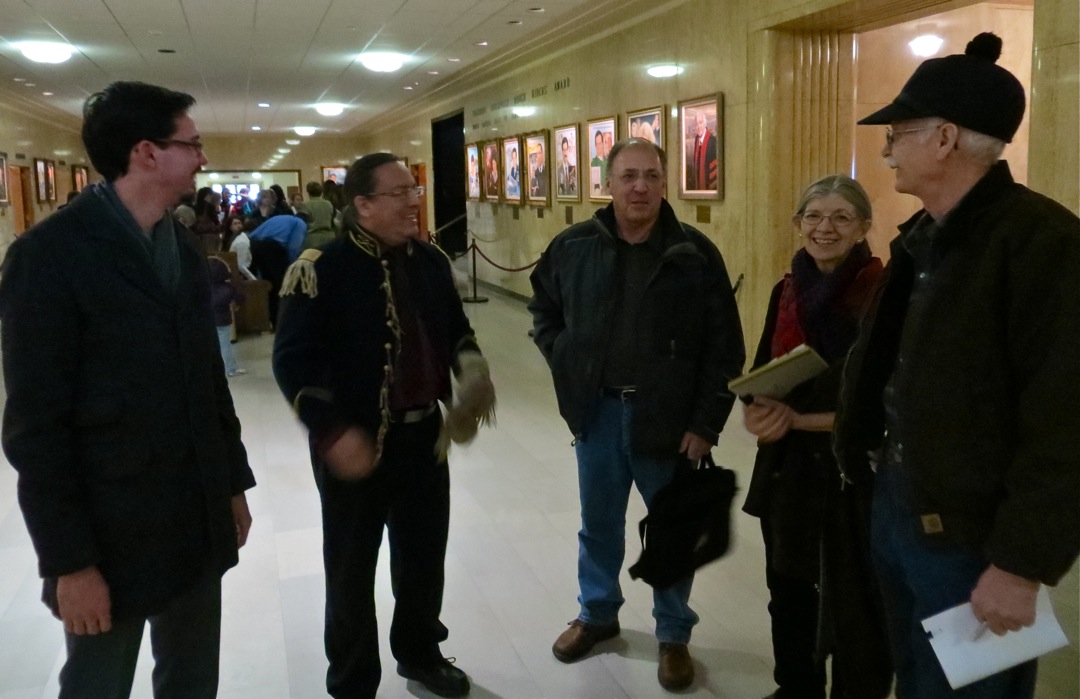
Individuals concerned about what happens to the Killdeer Mountains chat before the public hearing at the Bismarck capitol on January 24, 2013.

Individuals concerned about what happens to the Killdeer Mountains chat before the public hearing at the Bismarck capitol on January 24, 2013.

The Killdeer Mountains in Dunn County, western North Dakota have been getting a lot of attention lately, especially after the North Dakota Industrial Commission decided to, well, industrialize the area, and allow the Hess Corporation to follow through with signed leases and drill and frack for oil there. The Grand Forks Herald reported on it here, and The Bismarck Tribune here. The Industrial Commission is composed of three individuals, including Jack Dalrymple, Wayne Stenehjem, and Doug Goehring. They have scheduled meetings with the Department of Mineral Resources and Lynn Helms, the sitting Director. It is important to remember that this was a public hearing, and at public hearings the public ought not to be shy about attending. This experiment America has going, our Democratic-Republic, necessitates these local meetings that have global implications.

On January 24, 2013, at 1:00pm (CST) the public hearing for the Killdeer Mountains was held in the capitol of Bismarck, North Dakota. It was Industrial Commission Case Number 18618 concerning sections 25 & 36, T. 146 N., R. 97 W, this about 30-35 miles north of Dickinson, North Dakota. Originally the hearing was scheduled in the Governor’s meeting room, a rather closed-off and secluded place. Because of the public turn-out, though, the hearing was relocated to the larger Brynhild Haugland room in the western wing of the capitol. I drove over from Fargo to Bismarck to attend the meeting, and while there scribbled down some notes and took some audio-video as well. The high-points, I thought, were in capturing two Native voices from two disparate cultures.

The first is a video from Theodora Birdbear of Mandaree, North Dakota (Mandaree is Mandan, Hidatsa and Arikara territory). The microphone on my Canon PowerShot SX260 HS captured the audio a bit, and just in case there are those of us hard-of-hearing, I provided transcript of Theodora’s testimony below.

Transcript:

…and he expressed the impact of oil and gas development, the industrialization of an area, which impacts the quality of that spiritual experience. I guess it’s kind of equivalent to having an oil well right beside your Catholic church or something. It’s parallel to that. So I wanted the commission to know that Fort Berthold does have a living connection to that area, and to consider that in your decision making. As people have said prior to this, technology is evolving, and to keep it [oil] in the ground is not wasting it. They are going to be after it in the future. What’s the rush? The rush is quick decisions, unplanned decisions, and unplanned impacts. So I just wanted to make a comment about our relationship with that area. It is still living today.

North Dakota Industrial Commissioners listen to Natives speak about the sacredness and history of the Killdeer Mountains.

North Dakota Industrial Commissioners listen to Natives speak about the sacredness and history of the Killdeer Mountains.

Theodora remarks on how the Killdeer Mountains are a sanctuary, as sacred and sacrosanct as a Catholic Church, and to carry the analogy further, as a Lutheran or protestant church, a Synagogue, a Mosque, a Buddhist monastery, a Hindu temple, a Confucian temple, and so on. These spaces are sacrosanct in the sense that when an individual goes to the area to pray, they are really interested in having it as quiet. A library could also be considered a sacred space by this definition (libraries carry on that monastic-academic tradition of the deliberate contemplation of texts — this is arguably the antithesis of our hyper-industrial, full-throttle, 21st century world).

The other Native voice captured came by way of Dakota Goodhouse, who originally hails from the Standing Rock Sioux Reservation in south-central North Dakota (he shares the namesake of the state, which in English means ally or friend). Dakota gives some backdrop about the history of Killdeer Mountains as it pertains to the US-Dakota Wars, specifically the punitive campaigns carried out by General Alfred Sully west of the Missouri River circa 1864.

For some video context, Dakota is speaking and Lynn Helms is seated at the right. In this video excerpt, Dakota is remarking on how the encampment and battle boundaries are much larger and broader than what is delineated now (as of 01/25/2013), and how they need to be re-considered.


Punk Archaeology Practice Notes

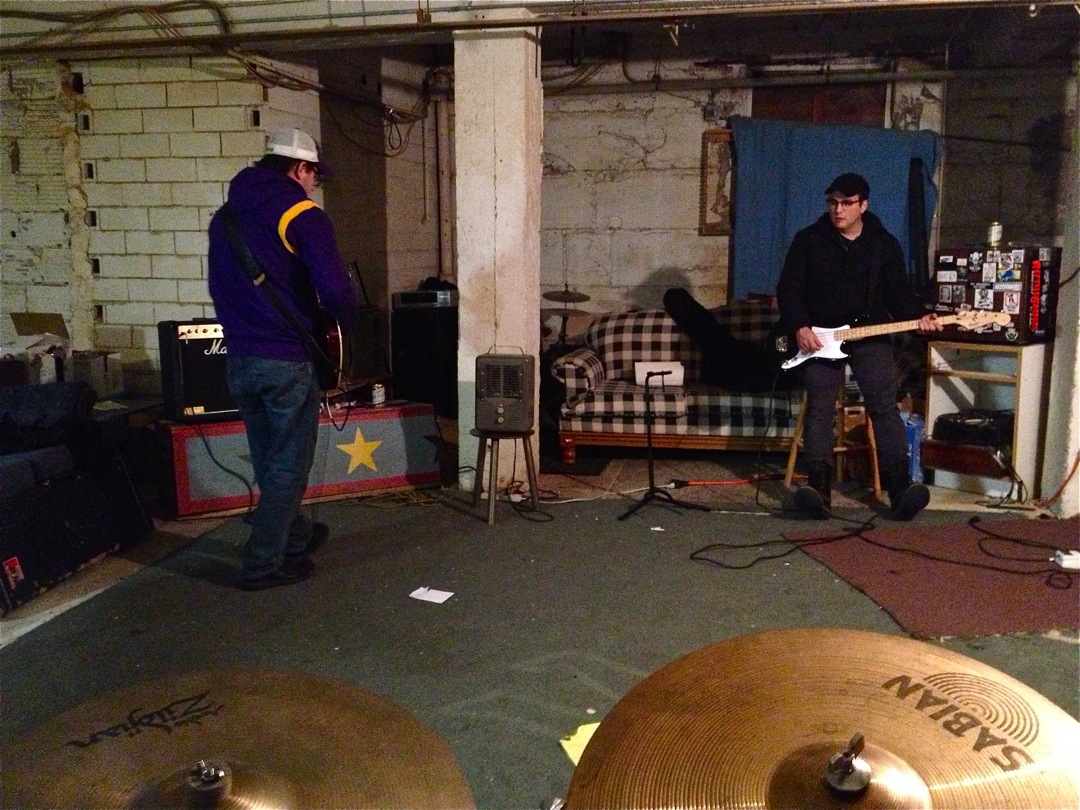
Todd Reisenauer and Troy Reisenauer of Les Dirty Frenchmen.

Todd Reisenauer and Troy Reisenauer of Les Dirty Frenchmen.

The other night, Troy Reisenauer and Todd Reisenauer invited me over to the Les Dirty Frenchmen practice space for the first of our get-together of practices, this for the February 2, 2013 Punk Archaeology un-conference at Sidestreet Grille and Pub in downtown Fargo, North Dakota. Through the randomness inherent to the music world, this assembly happened — come to think of it, every band I’ve ever played in has never been planned. It was a process that came together over a matter of several conversations and days or weeks — the important thing, though, was each individual’s willingness and desire to play for the love of playing. Todd and Troy offered to bring their slaying punk guitars to back the songs and lyrics of Andrew Reinhard, and the keyboard of Michael Wittgraf. Andrew’s original punk archaeology tunes are available here, and free for download.

As Reisenauer, Reisenauer and I bounced around from one song to another, there certainly were tunes we favored. Todd rightly pointed out that we ought to stick with a theme, though, and that Reinhard’s tunes definitely have a garage punk sound. So this helped us narrow and focus our practice, as earlier we considered other classics such as Bobby Fuller’s “I Fought the Law” and Velvet Underground, “Sweet Jane.” We decided to not play those. At least not this time.

Eventually, Team Reisenauer, Reisenauer & I decided on a short list of punk archaeology songs. Some classic go-tos include covering “Nervous Breakdown” by Black Flag, “Loser’s Club” by The Humpers, and “I Wanna Be Your Dog” by Iggy Pop and The Stoogies. We also ran through two Reinhard originals, including “History,” and “Publish and Perish,” a segment of this latter song appropriating a punk-abilly sound that might be familiar to Social Distortion fans.


Punk Archaeology Handbills

Around the Fargo-Moorhead area, here is a glimpse of some of the first Punk Archaeology handbills to go up. This one is secured to the entrance of the Rhombus Guys Pizza joint on Main Avenue in downtown Fargo in Cass County, North Dakota. For more details, click here. On February 2, 2013 (a Saturday) at Sidestreet Grille and Bar in downtown Fargo, ND, music will kick off around 7:17pm, and the panel discussion just a bit later. And like any quality un-conference time, it may start just a little before, or a little after. Swing on down if you’re in town. It is happening. And it will be awesome.

Various handbills in the entrance of Rhombus Guys in downtown Fargo, North Dakota. Punk Archaeology handbill lower right.

Various handbills in the entrance of Rhombus Guys in downtown Fargo, North Dakota. Punk Archaeology handbill lower right.


Gandolf the White Blizzard

It is the evening of January 11, 2013, and I am on the second floor of The Arts Center in downtown Jamestown, North Dakota. In the past couple days the Weather Channel and regional meteorologists have been psychologically preparing the public for the first intense blizzard of the year. The Weather Channel has subsequently named this blizzard Gandolf — yes, I’m serious. Originally I intended on making the Eisenhower Interstate 94 drive from Fargo to Jamestown after an NDSU departmental meeting concluded in the late afternoon, but eureka rattled through my brain earlier in the morning and I thought it would be better to make the drive then and there. My hope was to beat the thermometer from Fargo to Jamestown, knowing that the light rain would turn to ice as the temps dropped below 32 F. And if I didn’t make it to Jamestown, how would I be able to attend the art gallery reception for Walter Piehl on Saturday evening with Molly at The Arts Center? Yes, I needed to act.

Ice forming on the windshield and radio antenna during the early stages of Gandolf the White Blizzard.

Ice forming on the windshield and radio antenna during the early stages of Gandolf the White Blizzard.

The drive turned into a white-knuckled affair, a ’93 Chevrolet S-10 rear-wheel drive pickup providing joyous stress. I found that by keeping the speedometer at no more than 40mph, the rear wheels would stay secure to the pavement. During the drive, I also thought about how author Chuck Klosterman killed off several main characters (spoiler alert!) with a blizzard in Downtown Owl, this piece of fiction set in a small town in rural North Dakota in 1984. Then I thought about the book, Children’s Blizzard. Then I tried to stop thinking such thoughts, and I continued driving.

Note: when driving in winter rainstorms that are turning to ice, there are two opposing thoughts that bash at each other in the brain. It goes something like this: after a driver is 30 miles into a 90 mile drive, and just after the rear wheels slip a little at 50mph (the pick up will jerk a bit), the driver considers two options: turn around and endure another 30 mile drive back, or press on and gain another 30 miles. In the long term, if the driver retreats and makes it back home, they will have logged 60 miles, which, essentially means one could have been 2/3s the way to the destination. So I pushed on. Would I end up sliding off the road and into the ditch? Stop thinking about these thoughts. I did, and I made it to my destination. My advice: don’t do this. Ever. Anyhow, the photo pictured above is what the windshield looked like in the early stages of Gandolf the Grey, this between 8:30AM-to-12PM in Cass, Barnes and Stutsman counties, North Dakota.

Walter Piehl and his art.

Walter Piehl and his art.

The below short video clip is an intensified Gandolf, when a winter rain storm receives more training to ultimately become Gandolf the White Blizzard. As I re-visit the video over and over from a historic building in downtown Jamestown, North Dakota, I can’t help but thinking how 100 years ago an individual in the building would have heard similar sounds from this very vantage. Note, for example, the subtle chug-chug-chug in the audio, this coming from a train just a block north. The large grain elevator (not visible) is located along the tracks. Yup, 100 years ago it was possible during a winter blizzard to hear the same blasts of shivering whispers blow through the small cracks in commercial brick construction, and also hear the thump-thump-thump of the iron horse on the Northern Pacific Railroad.  Historically, it is important to respect White Blizzards — lest they teach us mortality instead of just humility.


Two Artistic Notes

About a week ago a group of us dropped in on the Emerson Center for the Arts & Culture at 111 South Grand Avenue in downtown Bozeman, Montana. The center has been re-adapted from its original progressive school function. Today, or as of January 2013, there are a variety of art pieces and galleries within, and two pieces of material culture caught my eye. They are machines that dispense art.

The first was a former pull-handle cigarette machine that had been converted into an art, music, writings and idea dispensing machine. Go to this website here for more details. This is what the former cig machine looked like.

Art Dispenser

The second was a paper towel dispenser that now serves as a poetry dispenser. This is what the poetry dispenser looks like:

Poetry Dispenser

I pulled a sheet of poetry from that dispenser, and here is the poem in full.

Bloodied and Humbled, by Alexis W.

Life will leave you,

If you’re lucky,

Bloodied and humbled

Now bloodied washes off

The wounds from which it came will

Mend over, scars will fade

A commentary on

The unimportance of the physical

But the humbled will stick

A commentary on

The strength of the mind

And if, for some reason, it doesn’t

If you’re lucky

Life will come to leave you

Bloodied and humbled

Again


Some Notes On Chico Hot Springs, Montana

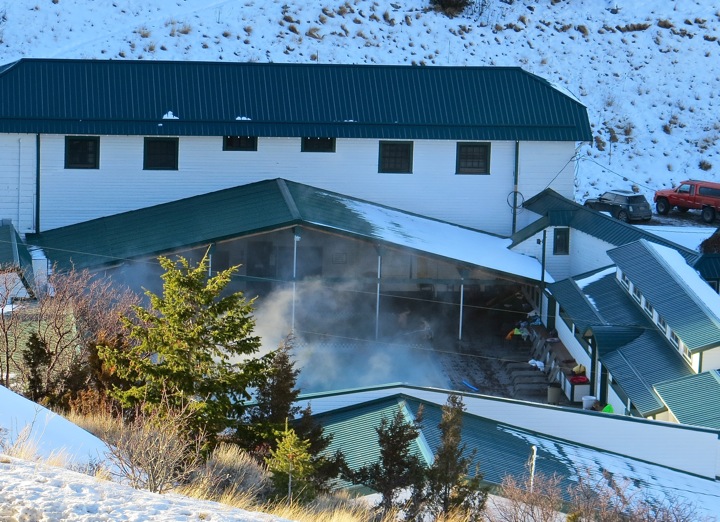
Steam rises out of the outdoor pool at Chico Hot Springs, Montana.

Steam rises out of the outdoor pool at Chico Hot Springs, Montana.

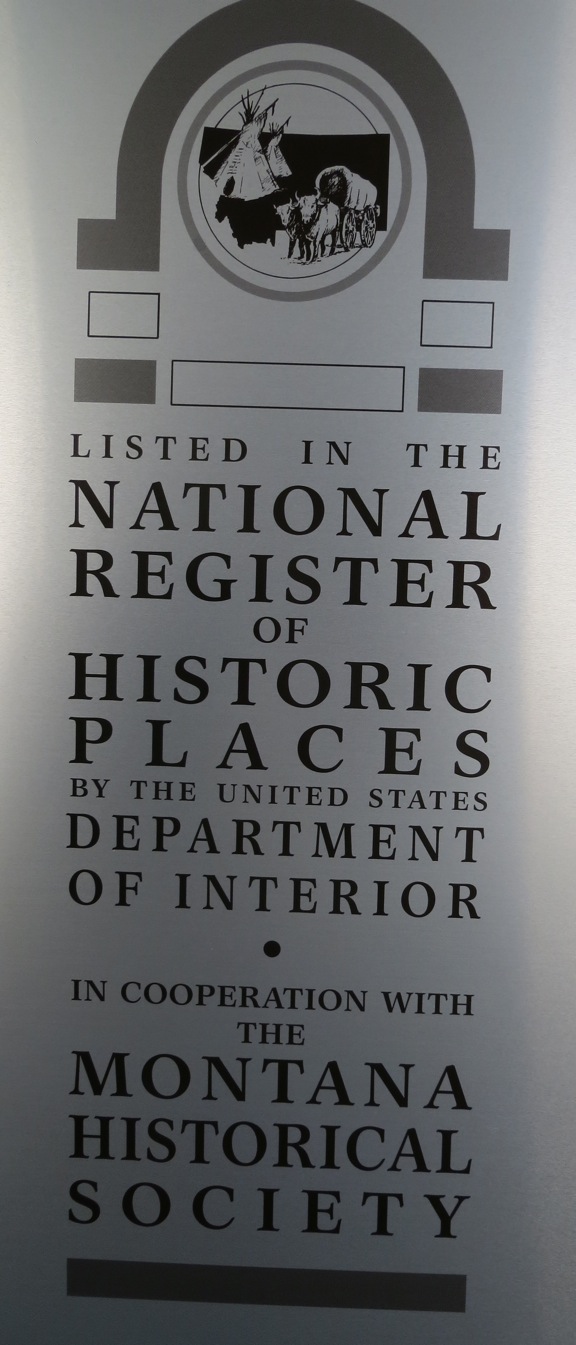
This last weekend I had the opportunity to be absorbed by a delegation from North Dakota and gladly pulled into the gravity of Chico Hot Springs, Montana. Once there, and while sauntering around the complex, I finally paid attention to a shiny placard (just next to the entrance I had been through multiple times) that noted Chico’s National Register of Historic Places status. So that compelled me to track down the registration nomination, and this is what we have.

The hot springs at Chico exist because of geology.  Water is heated sub-terra, and this eventually makes its way to the surface, flowing into places within and beyond the borders of Yellowstone National Park. At Chico, it arrives to the surface at around 112 °F. Water was first tapped and channeled at these springs as early as 1866 (10 years before Custer was shown mortality at the Battle of Greasy Grass — aka, the Battle of Little Big Horn). In 1900, a complex was built at Chico.

The historic buildings at Chico include the main hotel (1900) in the Georgian Revival style, an auto garage (1916), a smoke house (1915), a boiler house (1910) and horse barn (1916), pools, shower house and pool building (1917). Teddy Roosevelt visited the hotel in 1902 (he seems to be everywhere throughout the American West).

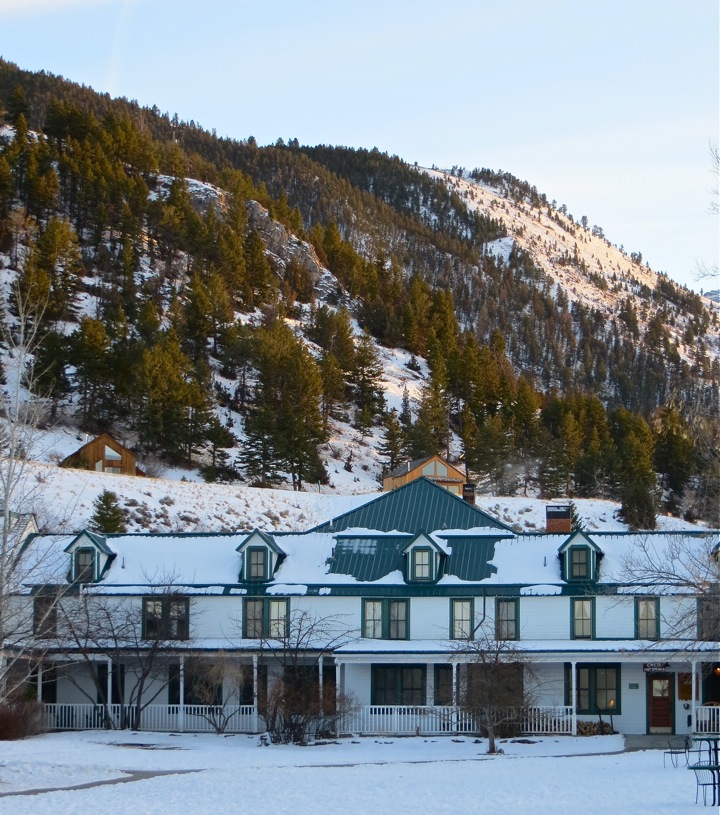
A 2013 photo of the historic 1900 Chico hotel, and mountain backdrop.

A 2013 photo of the historic 1900 Chico hotel, and mountain backdrop.

By 1969 a concrete-lined channel was added to divert hot spring overflow and regulate water temperature. Between 1900 and 2013, the owners of Chico added several structures to accommodate demand and growth. Before the Euro-American arrival on the scene, though, hot springs had been utilized extensively by Native America. The following is the description of how local Native America used the hot springs in and around Chico, this description from the National Register nomination for Chico:

…Springs, and in particular hot springs, were revered and often visited as places of spiritual cleansing and renewal. Water as a basis of life was important to Indian spirituality, as the Crow sang: bire daxua kok (water is your life).

Considering the experience had at Chico Hot Springs in 2013, it’s appropriate to say that this cleansing and renewal continues. The public placard next to the hotel lobby entrance at Chico reads as follows:

Generous verandas, period furnishings and healing waters invite the visitor to experience turn-of-the-century hospitality under the shadow of Emigrant Peak. The hot springs, long appreciated by native peoples, got their commercial start during the territorial period when miners stopped by to bathe and “wash their duds.” In 1876, an inventive settler tapped into the 112 degree water, piping it under his greenhouse to grow vegetables for local residents. A hotel was planned in the 1880s, but in 1892, there were still no facilities and families camped nearby to enjoy the springs. Percie and Bill Knowles inherited the property in 1894. They ran a boardinghouse for miners and in 1900, built the long-awaited hot springs hotel. Under Knowles’ active promotion, uniformed drivers ferried such guests as Teddy Roosevelt and artist Charlie Russell from the Emigrant depot to the springs. When Bill Chico NRHPKnowles died in 1910, Percie and her son Radbourne transformed the luxurious hotel into a respected medical facility. Dr. George A. Townshend joined the staff in 1912 and under his direction, the hospital and healing waters gained renown throughout the northwest. After the 1940s, new owners and new directions included gambling and dude ranching. In 1976, Mike and Eve Art began recapturing the once-famous hotel’s turn-of-the-century ambiance. Chico Hot SPrings, with its Georgian-inspired architecture and warm Craftsman style interiors, is one of Montana’s best preserved examples of an early twentieth century hot springs hotel and health resort.

I can only add that one ought to go to a hot spring within the continental interior of North America. It is worth your while.


Closer to Paul Sharp

At first read Paul F. Sharp’s 1955 work might look like an extension of Frederick Turner’s frontier hypothesis. Yet the intellectual turn Sharp laid out in 1955 reacted to Walter Webb’s 1931 idea about man and nature. According to Webb, man entered the environment of the American West, and then reacted accordingly. In this way environment rather than man dictated the coarse of action. Yet Sharp tested this hypothesis by considering how man entered the North American west north and south of the 49th parallel. If Webb’s earlier ideas held true, then British Canadian culture and American culture (or Anglo-American culture) would have played out quite similarly on both sides of the geo-political border. The fact remains that they did not, though, since American culture and British Canadian culture were structured in two different ways. In the American West, chaotic and localized development ruled the day. North of the 49th parallel, though, a structured British-Canadian will set the course of its western development.


My first review from December 5, 2012 was analogous to how a Canadian might have regarded Sharp — here is just another Turnerian, Frederick’s same whiskey in a different cask. Yet the closer to an object, including Sharp’s 1955 work, the more amplified the details and subtleties become. I suppose this is an excuse for anyone to reread and revisit a good novel or piece of scholarship (or a novel piece of scholarship), Sharp’s work included.


Mankato, Minnesota: 150 Years Later

Today, December 26, 2012, marks the 150th year since the largest mass execution in United States history took place in Mankato, Minnesota. This execution has been remembered and suppressed for a variety of reasons, but it seemed reasonable to post and pass on at least two pieces of public history. The first is a story put together by This American Life, entitled, “Little War on the Prairie.” Here is a link to the transcript, and another link to the recorded radio program here. It aired on November 23, 2012, and I first heard it while driving back to Fargo from having Thanksgiving in Bismarck and Valley City.

Photo by David Joles of the Associated Press.

Photo by David Joles of the Associated Press.

What is often missing from stories such as these is a kind of non-discussion about what followed this hanging. For example, it wasn’t just as though the hanging happened, and Governor Ramsey clapped his hands together and said, “Well, that’s taken care of…” Instead, it marked the beginning of annual punitive campaigns that the United States Government launched against the Sioux — against every combatant and non-combatant, or every man, woman, elder and child — throughout Dakota Territory. When we look back on it, the 19th century kind of looks like a racist primer for the industrial genocide that characterized much of the 20th century, at least the first half. The world eventually had a post-WWII convention to consider all of this. It’s sobering to think about.

In the 1860s, Total War campaigns against the Sioux were organized by General John Pope, and he in turn charged generals Henry Sibley and Alfred Sully with carrying them out. Today there are namesakes of “Sibley” and “Sully” scattered all throughout North Dakota. These names were ascribed to the landscape, and they resulted from that earlier US-Dakota War that roared up and down the Minnesota River Valley in August-September of 1862. Below is another piece of public history called “Dakota 38 [+2].” It is excellent, and the documentary was put together in 2008.

This year’s riders are just getting to Mankato, as they do every year. Here is another piece on this from the Mankato Free Press.


Red River Punk Archaeology and a Global Punk Rock Warlord

Punk Archaeology handbill produced by Joel R. Jonientz, Grand Forks, North Dakota.

Punk Archaeology handbill produced by Joel R. Jonientz, Grand Forks, North Dakota.

Ten years ago today, on December 22, 2002, Joe Strummer passed away. Joe was formative as a song writer and lead for The Clash and, later, the Mescaleros. Tom Vitale of National Public Radio did a story on Joe a couple days ago, the story linked to here. Local to North Dakota, Bill Caraher, professor of history at University of North Dakota, remarked on Joe here. And on social media, Kelly Hagen remarked on his reaction ten years ago when he first heard of Joe’s passing. He was in Fargo at the time (I think Kelly studied journalism — or, what today they call Mass Communications — at Minnesota State University Moorhead, but I better check with him first… yup, that’s what he said). Here’s what Hagen said a couple days ago on his social medias about the passing of Joe Strummer:

“I can’t believe it’s been 10 years. I remember getting home from work at Wendy’s in Fargo that evening, grabbing my stuff to get on the road to Bismarck, home for the holidays, and hearing about this on my way out the door. And how it ruined everything, because there’d been rumors that the Clash were going to reunite, and I was super psyched about that. Still bummed. Blast some Clash for Joe, from here through Armageddon. No better soundtrack to finishing off your worldly commitments.”

This is true.

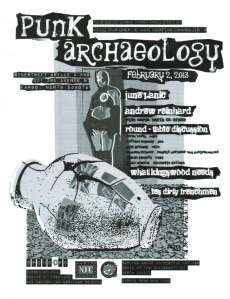
On February 2, 2013 in downtown Fargo, North Dakota, at Sidestreet (301 3rd Avenue North), the first global Punk Archaeology conference will consider stuff like this, bringing together an interdisciplinary team of Mediterranean, North American and global archaeologists and historians. The conference has 4 punk bands lined up (check out the poster above — Andrew Reinhard, with Barth on drums; June PanicWhat Kingswood Needs; and Les Dirty Frenchmen), and a round-table of discussants. Sponsors of Punk Archaeology range from the North Dakota Humanities Council to Laughing Sun Brewing to North Dakota State University’s Center for Heritage Renewal, to the University of North Dakota’s Working Group in Digital and New Media, to the Cyprus Research Fund.

Kris Groberg, professor of Art History at NDSU, is bringing a local punk archaeology perspective to the conference as well, since punk continues to grow increasingly deep roots up and down the fertile Red River Valley of the north. This, I have been told, is a point of excitement for non-local academics, researchers and scholars (from Franklin and Marshall College in Pennsylvania, to Mediterranean archaeologists from Princeton, New Jersey, to Stanford University in California): from coast to coast and beyond, scholars will be descending on Fargo, and one point of consideration is that they get to hear about grass roots Red River Valley culture.

J. Earl Miller, former associate of Ralph’s Corner Bar and current photographer for The High Plains Reader, has considered putting together a parallel campaign the day of Punk Archaeology, and this would bring together t-shirt, record and poster collectors for a day of material punk culture and history swapping.

Now I’m going to play some Joe Strummer real loud like. Here is an official North Dakota Humanities Council link to Punk Archaeology. And below is a documentary of Joe Strummer. He was known to say that the future is unwritten. Punk Archaeologists agree with that, and would only add that much of the archaeological and historic past is unwritten, too.