Author Archives: Aaron Barth

Great Plains Blizzards Now and Then

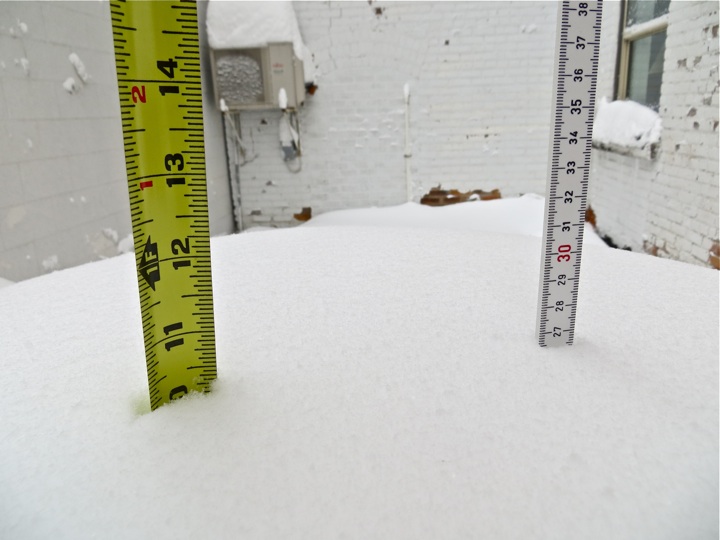
Snow measurements from February 10, 2013, at 7:00PM (CST) in downtown Fargo, North Dakota.

Snow measurements from February 10, 2013, at 7:00PM (CST) in downtown Fargo, North Dakota.

Last week I revisited Walter P. Webb’s 1931 work, The Great Plains. In the coming days, I’ll blog a bit more on Webb’s work. For now, though, Blizzard Orko (as of 7:03PM [CST], February 10, 2013) induced several departments of transportation to close sections of Interstate 29 and Interstate 94 on the northern Great Plains: north-south from Grand Forks, North Dakota to Sioux Falls, South Dakota, and east-west from Jamestown, North Dakota in to Minnesota (the MNDOT’s road condition map I found is more general than decisive about exactly what sections are closed). These closures, or specifically this blizzard, reminded me a bit about Webb’s remarks on Great Plains blizzards, or what he pulled from Clement A. Lounsberry, the Civil War veteran who started The Bismarck Tribune in the 1870s. Of blizzards, Lounsberry  (via Webb) referenced that historically they were known as a

…mad, rushing combination of wind and snow which neither man nor beast could face. The snow found its way through every crack and crevice. Barns and stacks were literally covered by drifting snow, and, when the storm was over, cattle fed from the tops of stacks. Persons lost upon the prairie were almost certain to meet with death, unless familiar with the nature of these storms… I learned of many instances where persons were lost in trying to go from the house to the barn, and of other instances where cords were fastened to the house so that, if the barn should be missed, by holding onto the cord the house could be found again (Webb, 1931: 25)

With this in mind, this evening I took some measurements of snowfall in downtown Fargo. At least 7 1/4″ of snow has fallen (it is now 7PM, CST). Tomorrow winds are expected to intensify, as is snow removal and book reading.


John Stuart Mill “The Subjection of Women” (1869)

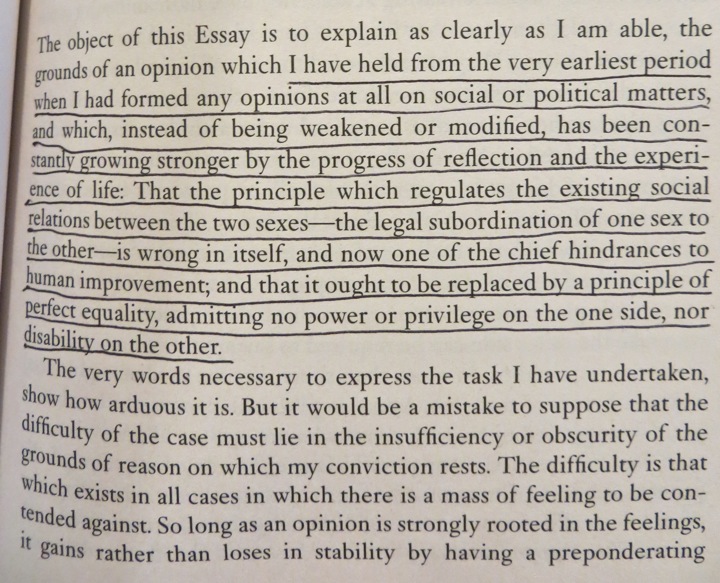
MillIn 1869, four years after the conclusion of the American Civil War and, on the other side of the Atlantic, a year after John Stuart Mill finished his tenure as a member of the British Parliament, Mill published The Subjection of Women, a philosophical volley and contribution to the history of ideas for the ages, specifically those toward individual human rights. To be short, Mill knew his languages and philosophers as well. In his opening remarks of his polemic that speaks toward the rights of women, he said,

…I have held from the very earliest period when I had formed any opinions at all on social or political matters, and which, instead of being weakened or modified, has been constantly growing stronger by the progress of reflection and the experience of life: That the principle which regulates the existing social relations between the two sexes — the legal subordination of one sex to the other — is wrong in itself, and now one of the chief hindrances to human improvement; and that it ought to be replaced by a principle of perfect equality, admitting no power or privilege on the one side, nor disability on the other.


Killdeer Mountain SB 2341 Post-Hearing Report

Rob Sand, a landowner local to Killdeer Mountains, testifies in support of SB 2341.

Rob Sand, a landowner immediate and local to the Killdeer Mountains, testifies in support of SB 2341.

A follow up to today’s hearing today at the capitol in Bismarck on Senate Bill 2341, spear-headed by North Dakota Senator Rich Wardner, and co-sponsored by a host of legislators. Individual archaeologists, Native historians, historians and local Killdeer Mountain land owners that testified in support of this bill included Tamara St. John, Dakota Goodhouse, Ladonna Brave Bull Allard, Waste Win Young, Tom Isern, Richard Rothaus, Kimball Banks, Rob Sand, Fern Swenson, Merl Paaverud, Tim Reed, and Mary Hoff (and I also testified, the synopsis of my testimony here). Private land owner issues mentioned in this article linked here are being addressed. Amy Dalrymple brings a more balanced angle to what happened here today linked here. Our conversation afterwards re-emphasized how private land owner rights are and continue to be protected throughout North Dakota, and our dutiful legislators said it may be a good idea to re-emphasize this in the bill. So there you have it. Props to all who came out today (there were many more in the crowd), and props to all of those that were there in spirit.


Killdeer Mountains 150 Years Later: Rescuing the Fallen and Forgotten Veterans from the Past

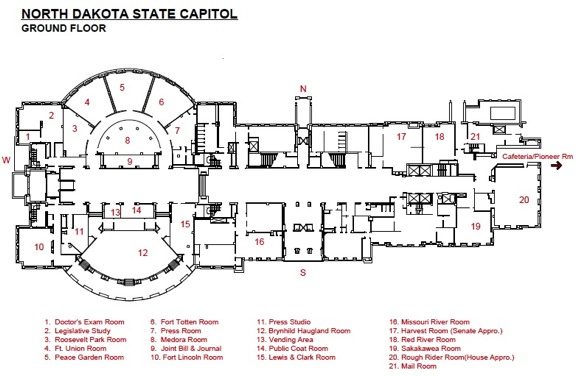
North Dakota State Capitol meeting room locations. Missouri River Room is #16, bottom-center of map.

North Dakota State Capitol meeting room locations. Missouri River Room is #16, bottom-center of map.

Tomorrow, Thursday, February 7, 2013, at 1400 hours (CST), North Dakota Senator Connie Triplett (District 18, Grand Forks) will collaboratively sponsor SB 2341, a bill that seeks to carry out an archaeological and historic-archaeological study on the Killdeer Mountains in Dunn County, western North Dakota. I’ll be attending this hearing (it will take place before the Senate Government & Veteran’s Affairs Committee in the Missouri River Room), and Triplett has circulated an e-mail asking historians, landowners, archaeologists, Natives and others for testimonies to support this bill. The Killdeer Mountains figure into our nation’s history and the US-Dakota Wars that spanned from 1862 in the Minnesota River Valley, and carried on through 1864 at Killdeer Mountains in western North Dakota.

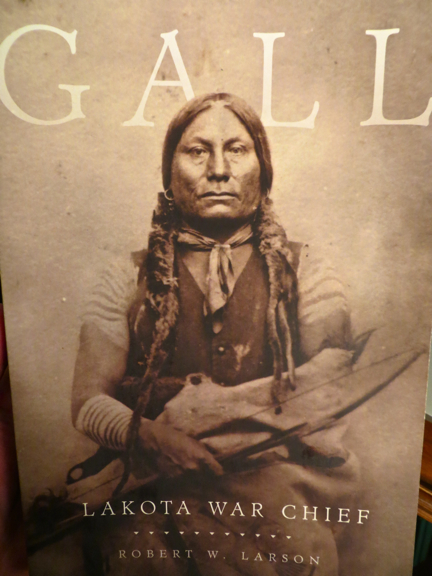
Taken from the cover of Robert W. Larson, "Gall: Lakota War Chief" (Norman: University of Oklahoma Press, 2007).

Taken from the cover of Robert W. Larson, “Gall: Lakota War Chief” (Norman: University of Oklahoma Press, 2007).

What we know right now about Killdeer from 1864 is limited (the State Historical Society of North Dakota has a nice and thoughtful write up of it here), and further archaeological and historical research is needed. It was an action between the Union Army and various Dakota nations, and some key players involved were Sitting Bull, Inkpaduta, Gall (among others), and General Alfred Sully and his Union soldiers. In many ways, just as this nation recognizes and respects fallen Union and Confederate combatants and non-combatants, this nation owes it to honor the Dakota soldiers and non-combatants killed in Dakota Territory during the Civil War. To extend this honor requires and necessitates a deliberate and culturally sensitive systematic archaeological and historical study like the one proposed in SB 2341. We understandably honor Americans that have fought and died in 21st century warfare, and we ought to also be honoring and rescuing those fallen and forgotten from the Killdeer Mountains from July 1864.

Note: according to Sioux County Veterans Service Officer Roster, today in 2013 Standing Rock has a veteran population of 357.


Willa Cather, “My Antonia” (1918)

In 1918, Willa Cather published My Ántonia. It is a novel loaded with Euro-American homesteading experiences from the Great Plains, and it demonstrates how a seemingly isolated place can in fact have international scope. Without saying it so directly, Cather gives the reader a sense of how the Atlantic World brought itself to the Great Plains, and how these individual immigrants faced an endless amount of new frontiers. After developing the characters in the countryside, Cather moves the cosmopolitans in the country from the landscape of the Burden Homestead to a neighborhood in the town of Black Hawk, Nebraska. In this way it is also a novel that considers the contrasts between the country and the town.

Because Cather was a sharp author, it is fairly easy for a reader to reconstruct the landscape of the Burden Homestead. The landscape was inundated with international settlements, with the Russian neighbors of Peter and Pavel to the north, the Bohemian Shimerda family to the west, and the German neighbors to the south. Six miles east of the Burden homestead was the post office, a vestige of an Anglo-American institution that continuously crept further and further out onto the Great Plains and Euro-American frontier. The Burden Homestead itself was a white frame house on a hilltop, and the terrain gradually sloped westward to where the barn, corncribs, and pond were located. (Cather, 1918: 12-13, 15, 20-21) While reading this work, I reconstructed the Burden Homestead landscape from the text, and sketched it out on paper with pen.

Burden Homestead My Antonia 01.30.2013 Reduced SizeOn page 42, Cather also makes brief reference to the material cultural remnants left by Plains Indians, or what may have been a potential Sun Dance. The Euro-Americans are all in disagreement over what it could represent, and this is how Cather explained it. “Beyond the pond,” west of the Burden home, Cather said Jim Burden noticed that,

…there was, faintly marked in the grass, a great circle where the Indians used to ride. Jake and Otto [two hired hands, the latter from Austria] were sure that when they galloped round that ring the Indians tortured prisoners, bound to a stake in the centre; but grandfather [Burden] thought they merely ran races or trained horses there. Whenever one looked at this slope against the setting sun, the circle showed like a pattern in the grass; and this morning, when the first light spray of snow lay over it, it came out with wonderful distinctness, like strokes of Chinese white on canvas. The old figure stirred me as it had never done before and seemed a good omen for the winter.

In this singular paragraph passage, Cather’s piece of fictional prose exposes the reader to several different Euro-American perceptions and theses. There is the stereotypical perception of the “brutal” or “savage” Indian, the wise grandfatherly ballast that considered the plains Indians and their horses, and the mystic and romantic foreshadowing that Jim Burden felt when he viewed the circle in the landscape. In this way Cather’s statement inadvertently touched on several questions raised by humanities scholars and social scientists (historians, anthropologists and archaeologists).

Novels are fantastic in that they help a reader explore the infinite range of human emotion in a way that scholarship often cannot, and this is why My Ántonia is a central piece of fiction in Great Plains and world literature. There is much more to say about this work, and it certainly compliments Ernest Staples Osgood’s 1929 scholarship, The Day of the Cattleman, and Gilbert C. Fite, The Farmers’ Fronter, 1865-1900 (1966).


Drummer’s View of a Sound Check

A quick concluding note on the punk archaeology unconference from this weekend at Sidestreet Grille and Pub in downtown Fargo, North Dakota. Since history, archaeology and life require us to put ourselves in the shoes of others, I wondered if it would be interesting for non-drummers to have access to a drummer’s view during a sound check. So here is a still photo of the stage from the vantage of the Audio-Video team from the University of North Dakota.

View of the stage from the Audio-Video sound station.

View of the stage from the Audio-Video sound station.

And here it is from another angle, a drummer’s view of the sound check (this brings up the fact that there are always more than two sides to a story, or history):


The Weekend the Music Died

"Birth of the Cool: California Art, Design, and Culture at Midcentury" (Orange County Museum of Art: Prestel Publishing, 2008).

“Birth of the Cool: California Art, Design, and Culture at Midcentury” (Orange County Museum of Art: Prestel Publishing, 2008).

This weekend marks the day the music died. I’ve been reading Birth of the Cool: California Art, Design, And Culture at Midcentury, edited by Elizabeth Armstrong and issued by the Orange County Museum of Art (Prestel Publishing) in 2008. It is a kind of work that explores the genesis (or amplification) of “cool” from southern California, and this raises a chicken or the egg question: in the post-WWII world, did southern California create “cool,” or did southern California appropriate cool, embrace it, and then turn it up to — in the words of Spinal Tap — eleven?

Armstrong says that southern California in 2008 is renowned for nice weather, a laid-back attitude, a “propensity for fantasy indulgences,” an attachment to cars, hillsides covered with suburban tract houses, sunny beaches and blondes — those seemingly perfect suburban conditions that provide a launching off point for punk rock.

It’s not cool to talk about cool, and that is a primary working definition of cool from the post-WWII world (captured in many ways by Anatole Broyard’s 1948 essay, “Portrait of the Hipster”). In Armstrong’s words, cool is “an attitude that eludes those who try too hard to achieve it.” (Armstrong, 2008: 1) In the essay “Cold War Cool” by Thomas Hine (also in this work), he says “Those who speak and write most about it — including most of those quoted in this essay — don’t have it. Truly cool people know enough to keep their mouths shut. (Nevertheless, I shall proceed.)” (Hine, 2008: 194) So shall I.

Buddy Holly in the 1950s.

Buddy Holly in the 1950s.

Anyhow, and to not get too far off the topic of Buddy Holly, here is a photo of Buddy used in Birth of the Cool. The caption beside Buddy Holly notes his influence on The Beatles and Rolling Stones, among others (including Jonathan Richman). So in thinking about all this, it’s appropriate to say that my S-10 Chevy is snowed in an alley parking spot just 2.5 blocks from the levy, and this Friday evening I’m going downtown Fargo for a bit of whiskey rye. And to think a bit about the weekend day that the music died. The world sure missed out on a lot of great tunes because of that plane crash in Iowa on February 3, 1959. They were trying to get to a show in Fargo-Moorhead. At least Buddy continues to echo throughout the rock and roll ages, whether we know it or not, aesthetics and rhythm and all. Thanks Buddy.


Some Advice on Bullhorns and Drumsets

The "Uzi" model bullhorn, useful for certain musicians and Punk Archaeology un-conferences.

The “Uzi” model bullhorn, useful for certain musicians and Punk Archaeology un-conferences.

There has been light to medium-heavy banter about a bullhorn showing up at this Saturday’s Punk Archaeology formally unformal un-conference (Sidestreet Grille & Bar, Saturday at 7:17pm, downtown Fargo, North Dakota). So I thought I’d post a pic of the “Uzi” model bullhorn, perhaps one of the best bullhorns I’ve ever owned or appropriated for music and, now, an un-conference (I have been through 3 bullhorns thus far). I haven’t yet been able to test the full range of this particular bullhorn — I don’t mind using a bullhorn or drumset in my apartment, but my neighbors and landlord sure do. So we may have to experiment a bit with it this Saturday evening during the sound check.

And here is at least one tip for potential bullhorn owners: bullhorns are a lot like drumsets in that everyone should own at least one. But never leave a bullhorn or drumset out at get-togethers or soirées. The bullhorn is much like a drumset in that someone will always invite themselves to sit down behind it to show everyone what they are made of. The first 3 seconds are kind of fun: whispering through a full-throttle bullhorn for your friend to get another beverage from the fridge has a certain charm the first time. But after about 4-to-7 seconds it goes from being annoying to being intolerable. So hide the bullhorns and drumsets before the company arrives. Everyone will thank you, as will your apartment neighbors.


Winter Memories

Speaking of winter in My Ántonia (1918), Willa Cather noted that “man’s strongest antagonist is the cold.” As I type (on 01/31/2013, just before noon), the dry temp in Fargo, North Dakota registers right around -9 F, around -9 in Grand Forks, -17 in Jamestown and Dickinson, -18 in Towner, -13 in Valley City and Bismarck, -20 in Williston,  and, for international scope, -11 in Irkutsk, Russia (a Siberian city with a population of over 1/2 million).

On the walk to work today I was thinking back to some of my elementary school days in the context of cold winter weather. The phrase “blizzard warning” often triggered the following thought — with an anxious question mark at the end — of “school closings due to severe winter weather?” in my earlier elementary school mind. When superintendents and sometimes governors yielded to the winter and Boreas, and they finally decided to shut institutions (sometimes the entire state) down for a day or two, the next thought that went through my elementary school mind was, “With school canceled, now I’ll have time to try and convince my mom that it’s still not bad enough for us to get outside to go sledding, work on that winter fort…” and so on.

Winter driving on Interstate 94 in North Dakota, February 2013.

Winter driving on Interstate 94 in North Dakota, February 2013.

In a big way, winter is dealt with by getting out in it (bundle up, of course).

The large snow piles heaped in the middle or on the edge of parking lots also reminded me of first grade “King of the Hill” matches on playgrounds. For whatever reason, students who partook in these matches had recess privelidges revoked (at least for that recess), and they got a stern talking to. What never made sense to me, though, was how an elementary school student was supposed to look at a giant heap of snow piled high in the middle of the playground and not feel hard-wired to climb it. I don’t know how today’s elementary schools deal with snow removal and snow piles. But looking back at it, I suppose those early piles of snow taught me some rudimentary basics of Darwin, and the blowback of cultural and institutional regulations imposed by those watchful recess supervisors.


Being Punk Archaeology: A Voice from Cultural Resource Management

The following is a short essay reposted from e-mail correspondence between Barth HQ and archaeological colleague and comrade Jennifer Harty. It has been declassified and reposted with Harty’s permission.

In Harty’s words:

“Punk Archaeology… it’s happening… and I wish I was there”

by Jennifer Harty, punk archaeologist of the Americas and Northern Great Plains

Jennifer Harty, archaeologist of the Americas.

Jennifer Harty, punk archaeologist of the Americas.

What does it [punk archaeology] mean, though?  I think we are all probably asking ourselves that, and there probably isn’t even an answer. What I do know is that it’s people coming together to talk about archaeology and do what archaeologists do best- drink a beer and listen to great music.

Does that seem frivolous? Maybe to a university president in the ivory tower or even to those who tout themselves as business professionals who seem to have lost touch with what archaeology is all about.  Sure, you have to make money; sure, it’s studying the past through material culture, but isn’t it more than that? Isn’t it really discovering who we are and why we are? Isn’t it about asking questions about the past in order to make today more relevant? And to that point, aren’t the best paradigms the ones that come from a relaxed atmosphere and friends bullshitting with friends about what they’re thinking?  Then again, isn’t PUNK about being different and going against the stereotype? How can punk archaeology be punk if it’s about sitting in a bar drinking with friends and listening to great music if that’s the stereotype?

Here’s how – punk is really about being yourself and doing what you want to do. It’s not about being punk, it’s about being you. It’s about interpreting things the way you see it, not the way you’re told to see it. It’s about putting that off the wall spin on your work that draws groans from your peers but that you know is important to include. It’s about not trying to impress everyone else. It’s about writing a rambling, barely cohesive piece to be read at a bar where a bunch of people are getting together and being punk archaeology.