Author Archives: Aaron Barth

Neighborhood Historical Research: Some Initial Thoughts on a Grand Forks Micro-History

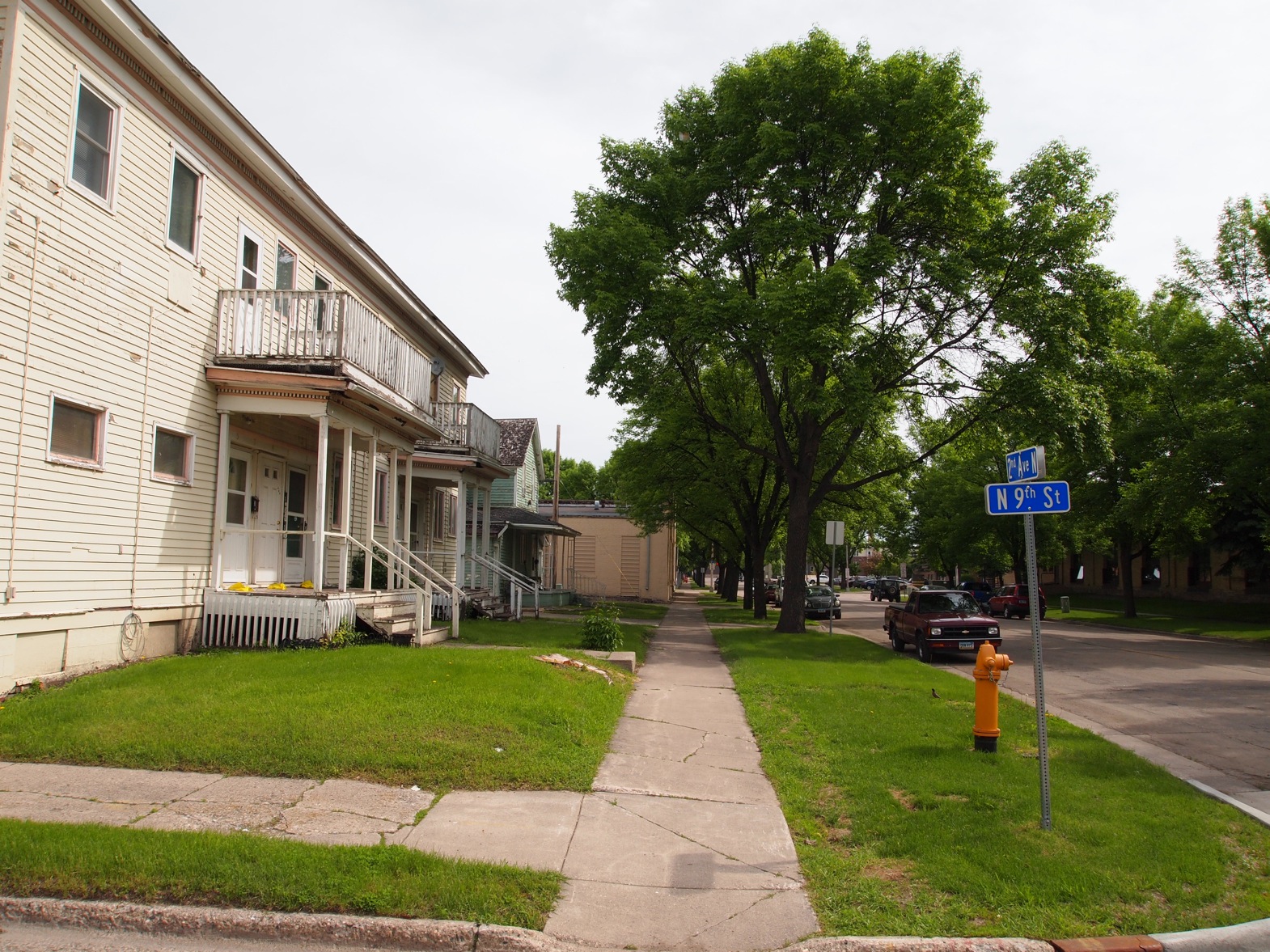
The intersection of 2nd Avenue North and North 9th Street in Grand Forks, North Dakota. Photo from June 12, 2013.

The intersection of 2nd Avenue North and North 9th Street in Grand Forks, North Dakota. Photo from June 12, 2013.

Last week I had some historic preservation detail that took me up to Grand Forks, North Dakota, this along the Red River of the North which in turn is within the Hudson Bay watershed. While I tended to one project, I also found a bit of down time to engage another project.

Some months ago friends Bill Caraher and Bret Weber (professors at one of my — ahem — alma maters, this the University of North Dakota) asked if I would be interested in making a contribution to their Neighborhood History series in Grand Forks. Even before Caraher finished the sentence, I remember saying, “Yes, yes. I’ll do it. I would love to.” So after paying my research location a second visit, I started thinking about how I would outline my research area. The primary area concerns 824 2nd Avenue North, and this falls just a few blocks beyond the boundaries of the Grand Forks downtown historic district.

During the actual field work visit, I not only took photos of this primary area of focus, but I also decided it would be good to saunter around the entire area. So I walked up and down the street a few times and then around the block, photographing each structure and taking in a lot of the overgrown foliage. The northwest side of this block has gone really green (perhaps more-so out of owner neglect than owner ethos — of course, not mistaking

The foundation of 824 2nd Avenue North is brick.

The foundation of 824 2nd Avenue North is brick.

that neglect could be an ethos). The primary area of focus, the southwestern side of the block, tends more toward the concrete jungle. The southeastern portion of the block remains commercial and industrial (Cole Papers), and the northeastern portion of the block has a few residences amidst vacant lots with manicured lawns.

After this fieldwork, and once home, I pulled up Google Earth, and organized three areas I would study with different intensities. Then I decided I’d just approach these areas with the first three criteria laid out by the National Register of Historic Places (no sense in trying to re-invent the NRHP). But instead of cobbling a micro-history together in the otherwise clunky National Register Nomination or Site Form format, I decided to use a hybrid combination of a blogging voice and academic narrative complete with the rigors of U of Chicago footnoting and see how that goes (everything has shortcomings).

I’ll be able to draft architectural descriptions of exteriors and façades, and secondary local, regional and national sources will contribute to showing how this neighborhood reflected broader, national themes. But the true grunt work, as I see it, will be tracking the various chains-of-ownership within each structure. I’ve done this numerous times, and the only way to go about it is within a County Courthouse. I’ll be sure to track the primary residence (824), and from there I’ll see how much more data would be needed for a simultaneously thorough but concise micro-history.
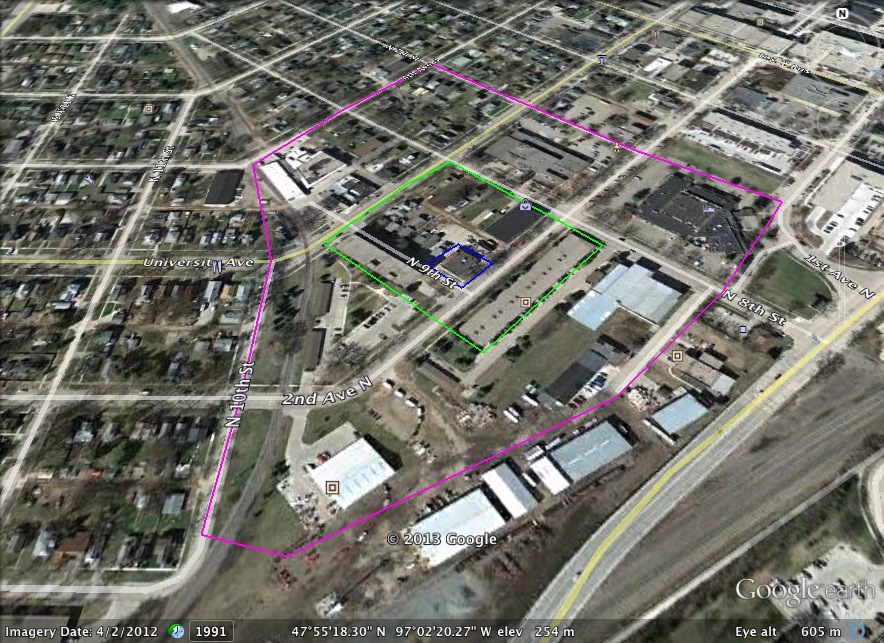
The research boundaries for a micro-history of a neighborhood in Grand Forks, North Dakota.

The research boundaries for a micro-history of a neighborhood in Grand Forks, North Dakota.

So with that said, here is the research triage model I imposed on this neighborhood. Don’t worry: historians impose on the historical record all the time — we wouldn’t be humans if we did not consciously or subconsciously impose on any data set. Just remember to be very suspicious of anyone who says they have found some kind of research design or reporting scheme that ensures absolute objectivity. This is why I tend to use the phrase “subjective objectivity” or “objective subjectivity,” but only in conversation.

Within Google Earth I outlined three areas. The first is of the residence in question, which is outlined in blue. The second is more peripheral, an area outlined in neon green, and the third is (yeah) outlined in neon purple. No doubt, depending on what I can track down during the research process, the study areas may shift a bit here and there. But the idea this last weekend was to delineate some kind of research boundaries so I’m non trying to herd historical cats. More updates as they come in.


Historic Scandinavian Log Cabins: Then and Now

Yesterday I visited a project area in the Sheyenne River Valley in southeastern North Dakota, and on the way back from fieldwork I stopped by some static public historical signage and historical Scandinavian-American log cabins on one of America’s Scenic Byway routes. I snapped some photos, downloaded them in the computer last night, and then started to do a bit of research on the archaeological project area: history often informs the archaeology, since much happens with the history of an archaeological site before archaeologists have a chance to descend on it.

While looking through a series of digitized photos, I came across a historic photo in the Digital Horizons/ND Institute for Regional Studies archive. The photo is titled, “Building at Fort Ransom, N.D.,” and it is a log cabin today located some miles north of Fort Ransom, N.D. I compared the historic with the modern this morning. Below are the photos I’ve looked at: one is a 1950s photo of the cabin, and below that is a June 16, 2013 photo. Note the gable-end elevation, and compare the shapes of the logs, and the seams of the logs. You’ll notice that they match one another.

A photo of the Slattum cabin in the 1950s.

A photo of the Slattum cabin in the 1950s.

A June 16, 2013 photo of the Slattum Cabin. Note the gable end elevation, and compare the seams of the log cabin with the seams of the gable elevation in the 1950s photo. They are the same.

A June 16, 2013 photo of the Slattum Cabin. Note the gable end elevation, and compare the seams of the log cabin with the seams of the gable elevation in the 1950s photo. They are the same.

As the public historical signage said, this cabin was built in 1879 by Norwegian immigrant Theodore Slattum, and he originally hailed from Christiana, Norway. He immigrated to Fillmore County, Minnesota in 1870, and he and his wife, Jorgine, relocated to the Sheyenne River Valley in 1879, where they built this cabin. They also raised nine children in the cabin (they modified the original cabin from what it looks like here in the photos). In 1945, this cabin was moved to the Fort Ransom Historic Site, and then moved back to this original location at some point around the turn of the 20th century (this is likely why the description of the cabin’s provenience is what it is within Digital Horizons/NDIRS; and this is also an example of how history informs archaeology, and not the other way around).

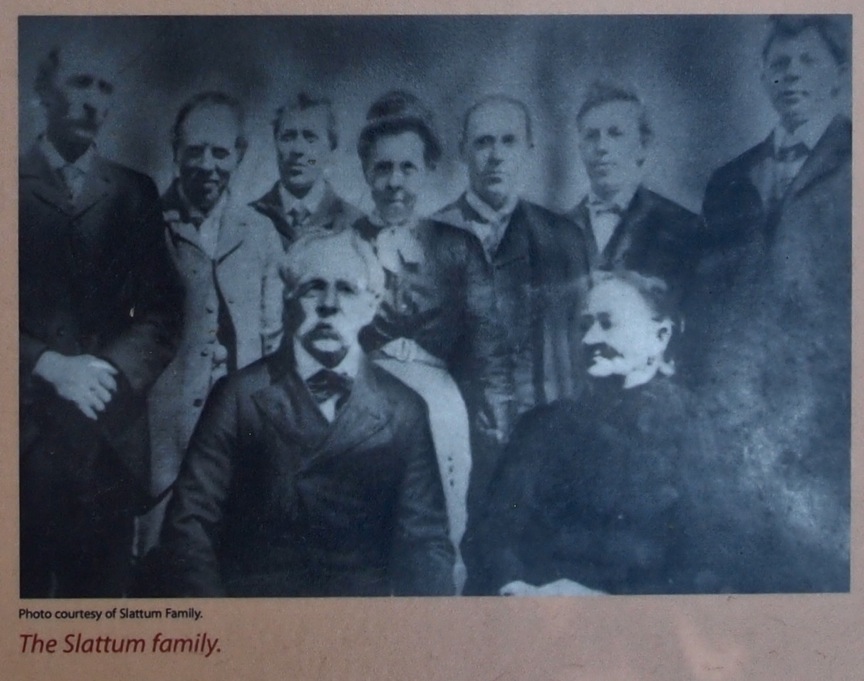
The Slattum family, this photo from the public historical signage at the cabin site. Photo taken on June 16, 2013.

The Slattum family, this photo from the public historical signage at the cabin site. Photo taken on June 16, 2013.


Grand Father’s Day Memories

Mooringstone Pond view to the north-northwest, just west of Fort Ransom State Historic Site, Sheyenne River Valley, North Dakota.

Mooringstone Pond view to the north-northwest, just west of Fort Ransom State Historic Site, Sheyenne River Valley, North Dakota.

It’s Father’s Day, and I’m on the northern Great Plains and my dad is visiting his grandchildren in the desert southwest that is Las Vegas, Nevada. I will schedule a make-up grilling session with my dad when we’re within range of another soon enough. I called him earlier today to give him props. He has worked at the locally-owned automotive parts store for longer (over 40 years) than my folks have been married (something like 42 or more years), and his dad (or my Grandpa Barth, along with his brother) worked at Hedahl’s as well. It’s one of those family operations, as Dick Hedahl’s dad hired my grandpa back in the day (or something along those lines: it may have been Dick Hedahl’s grandpa that hired my grandpa. You get the idea, though).

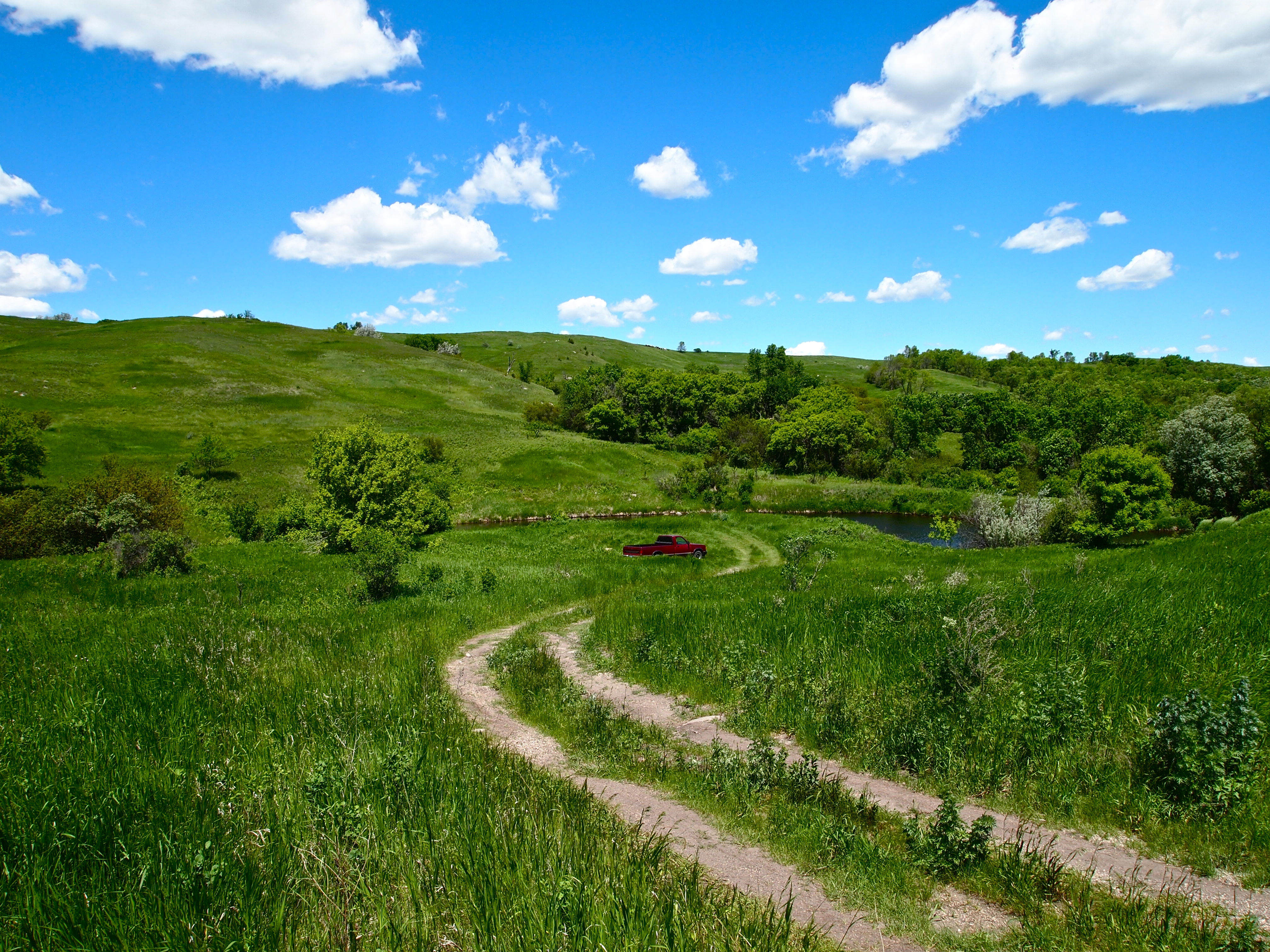
I thought I’d post this photo I took this afternoon, an overview of a project area I was working in just west of Fort Ransom State Historic Site in the Sheyenne River Valley, North Dakota. Note the greenery (like I need to tell folks): this is the result of about two or more weeks of pretty sustained rain followed by about 5 or 7 days of intermittent sunshine. I snapped this photo overview of the project area (among others), downloaded it, and took a look this evening (I’m in Jamestown at Molly’s right now). Snapping photos is a peculiar business: when I looked at this photo, my trusty S-10 is visible. That pick up is 20 years old, first purchased by my late Grandpa Barth at a rural dealership (either Linton or Hazen). I remember he rationalized this purchase by saying, “Now I’ll be able to transport 8-foot boards and 4’x8′ sheets of plywood from Menards to my shop.” That seemed reasonable to me.

An archaeological dry screen, built on June 15, 2013.

An archaeological dry screen, built on June 15, 2013.

That pick up in the photo has transferred hands from my grandpa to my dad and mom, and they eventually passed it along to me. It is starting to show rust, this emerging up out of the paint, and the A/C has long since been shot. I love it. My cousin (Josh Christy) and I replaced the spark plugs, distributor cap and plug wires over a year ago. And a couple weeks ago I had a shade tree mechanic replace the waterpump, alternator, cab mounts, belts, and 2 or 3 pulleys. I like working with my hands. I tend to think that I got this ethos from my Grandpa Barth and Dad. The pick up runs very well. In the summer, I deploy what is known as the 2-by-75 A/C: two windows down at 75mph. Eventually I’ll need to purchase another vehicle, but this 20-year-old pick up still gives memories of driving to and from Menards with my grandpa. I posted another photo of an archaeological dry screen I built this weekend as well: my Grandpa Barth was the first one to show me the ways of woodworking. One day we drove from his place to the Woodhouse in Bismarck, and my grandpa confessed to me that he was so glad he survived his 1975 heart attack because, in his words, “I got to see you grandkids born and grow up.” He passed away on November 23, 2003. That’s what I’ve been thinking about on Father’s Day. I’m gonna call my other Papa now, Grandpa Christy.


Iconic Railroads on the Great Plains

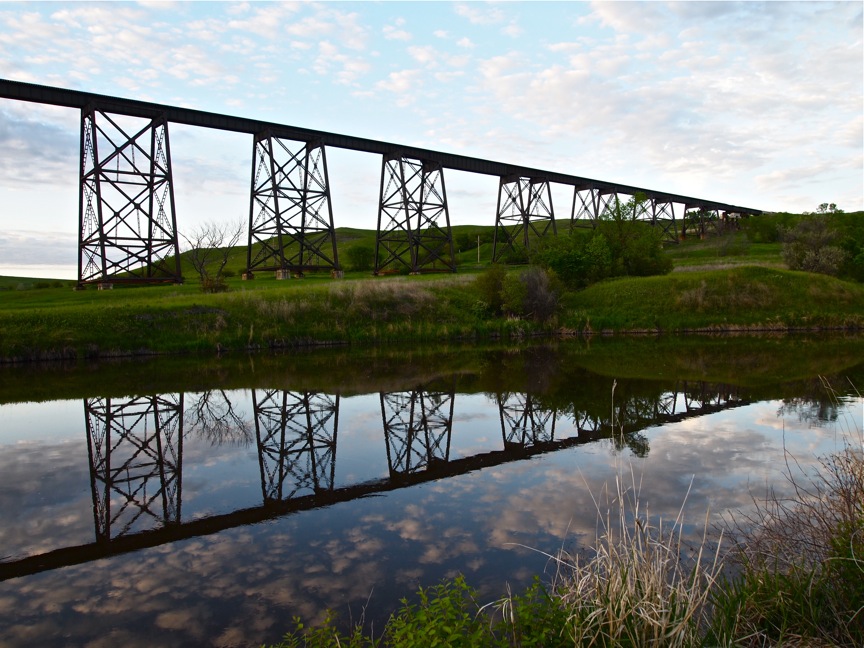
High Line BridgeA couple days ago I snapped some photos and a video short in Chautauqua Park, Valley City, North Dakota. While looking at the High Line railroad bridge (built in the first decade of the 20th century), I was kind of thinking about how elder Euro-American frontiersmen (or frontierspeople? — what the heck is the non-gender form of frontiersmen?) might have been thinking about this and railroads around the turn of the 19th century, especially as younger industrial laborers swarmed into the area.

The idea of history is to understand understanding, or understand how others understood their world. To apply my historical sense of place, a frontiersman, along with Natives in the area, would have looked at this industrial expanse of railroad as something out of place; or as a way to populate the Great Plains and American West with non-Natives; or as a new industrial icon supplanting a time and place that had passed (Fred Turner rambled on about this at great length in Chicago in 1893).

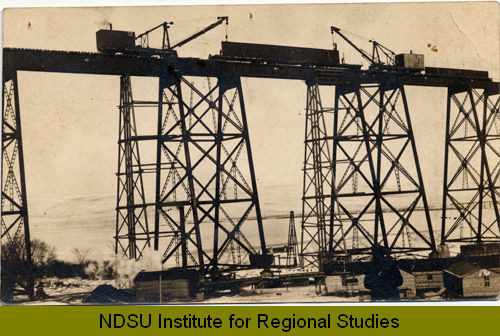
A historic photo of the construction of the High Line. Photo from Digital Horizon's, NDSU Institute for Regional Studies.

A historic photo of the construction of the High Line. Photo from Digital Horizon’s, NDSU Institute for Regional Studies.

Today, though, there are many that say Valley City wouldn’t be Valley City sans the High-Line bridge. History is both complex and universal that way: the sensibilities of younger generations will supplant those of the older generations — both might presume or assume that the way they grew up and the time they lived in was and always had been. (this is often captured in the phrase, “Things just aren’t like they used to be…”)

If you overnight, and it’s a pleasant enough evening to have the windows open (or even closed), you’ll be woken up by the thumping cha-chunk, cha-chunk of today’s diesel locomotives playing the Hi-Line bridge like an instrument. I find the noise soothing.

Here is the link to the historic High Line photo from NDSU’s Institute for Regional Studies. The video short and another photo below.

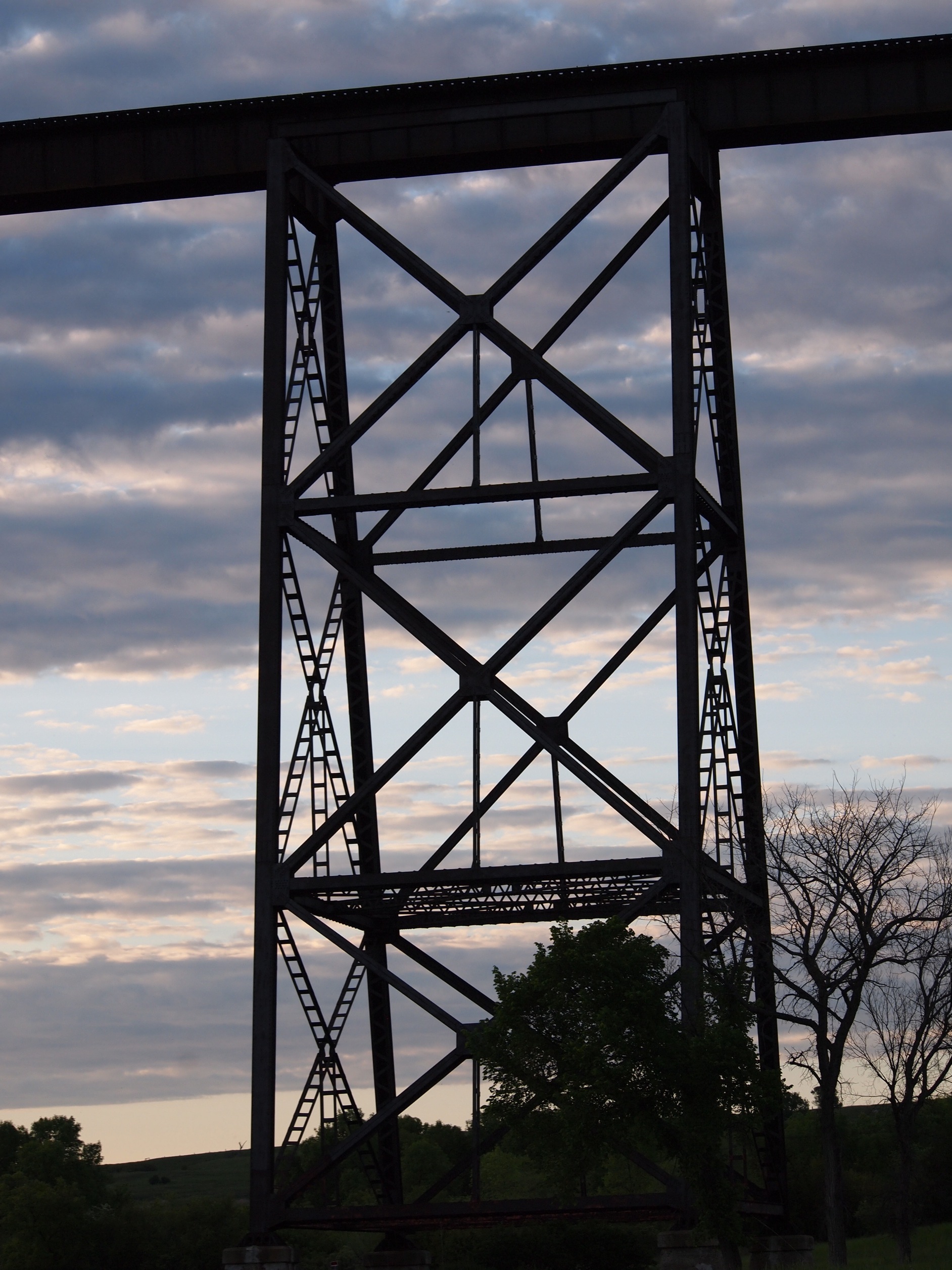
A detail of the High Line substructure.

A detail of the High Line substructure.


One Longue Durée of Mosaic History

Molly is finalizing the mosaic grouting process on a reused terra-cotta potter.

Molly is finalizing the mosaic grouting process on a reused terra-cotta potter salvaged from someone’s trash pile.

It is the weekend and projects are happening: plans have been set in motion to slow-smoke some baby back ribs, and Molly is out front of her sister’s Valley City home, toiling away at a mosaic project. I’ve busied myself with reading James Belich, The Victorian Interpretation of Racial Conflict: The Maori, The British, and the New Zealand Wars (McGill-Queen’s University Press, 1986 & 1989), but have set it down to do a bit of immediate chores.

So while taking the trash out from the kitchen to the dumpster, I passed by Molly’s ongoing mosaic project. Then I started thinking about how Molly’s mosaic project today reminded me of the Late Roman mosaics I saw a year ago in the historic archaeological village of Kourion, Cyprus. Then I started thinking about how historians and archaeologists — depending on what cultural settings they were born into, and depending on what previous experiences they have had — bring individual and disparate meanings to the stuff they come across. (This may be getting a bit too self-absorbed, so if you’ve noticed it, and it offends you, please stop reading here if you already haven’t. I will not take offense. But it is a line of thinking with universal application.)

So without slamming out any more dialog (we are packing up and readying to go, which is timely to end this short entry), I will upload a couple pictures I snapped a year ago in Kourion, and a couple pictures from today in Valley City. Taking massive leaps through space and time, this is what I call a global and local longue durée of mosaic history, from Kourion, the Roman Empire, to Valley City, North Dakota.

Close-up mosaic detail from Kourion, Cyprus.

Close-up mosaic detail from Kourion, Cyprus.

A mosaic from a Roman gladiator's home in Kourion, Cyprus. Mosaics are not for cowards.

A mosaic from a Roman gladiator’s home in Kourion, Cyprus. Mosaics are not for cowards.


Thoughtful and Respectful Disagreements

Before I return to the coding and data entry before me, I wanted to jot down some quick notes on this latest piece from The Atlantic Monthly by Larry Alex Taunton, “Listening to Young Atheists, Lessons for a Stronger Christianity” (June 6, 2013). Whether Christian or atheist, the specific note comes in the form of this quote by Taunton:

I find talking to people who disagree with me much more stimulating than those gatherings that feel a bit too much like a political party convention, and the exchanges with these students are mostly thoughtful and respectful.

This is why we have institutes such as the Prince Alwaleed bin Talal Center for Muslim-Christian Understanding and why we support and fund thinkers such as John Voll, among others. The words “thoughtful” and “respectful” are crucial, though, because these exchanges (the ones I have viewed) can easily turn into reactionary diatribes. To get a bit pedantic: in many ways — whether one is reading or thinking about Darwin or grand theological thinkers — individuals throughout time have been searching for the origins of humanity. We want to deeply know locally and globally where we came from, because this will give us a bearing on why we are here, and also direct us to what we ought to be doing in preparation for tomorrow. Only through thoughtful and respectful dialog with one another will we be able to sharpen that knowledge, and who knows where it will lead.

This, of course, is why certain thinkers in the 20th century Western World held up the ideal of the free and open exchange of ideas (whether this was real or mythical is important but not of concern here). One final thought, ancillary but somewhat related, is this: while one of those free market thinkers in the first half of the 20th century fatalistically charted a future road to serfdom (see F.A. Hayek, The Road to Serfdom [March 1944]), it seems like there is room in the 21st century for someone to consider a fatalistic monograph with the tentative title, The Corporate Road to Serfdom. (side note: I’m not much for fatalism, so I would be interested in reading this for the sake of conversation rather than belief). I haven’t the time to consider something like this now. But I’m sure it would get the attention of large ideological factions.

So here on the memorial of D-Day, we might ponder this one final-final fatalistic piece of fiction: a future world war will not require the tank divisions, navies and airforces to be labeled with flags of nation-states, but rather they will have multinational corporate labels such as “Google,” “GE,” “Dupont,” “ADM” and “Monsanto.” This, of course, is extremely dangerous to humanity, because corporations are beholden to generating industrial profits for shareholders rather than upholding ideals of liberal, democratic-republics. But again, that’s another point of long conversation that will not be settled in a simple blog entry (perhaps it is better for a graduate seminar in political philosophy and business school). Nonetheless, back to my data entry…


Some Archaeology of Food

Pheasant and BarthSome years ago I decided to take up bird hunting for this main reason: if I was going to purchase saran-wrapped chicken legs, thighs and breasts in the refrigerator section of the grocery store, I thought it was more respectful to at least experience what it was like to kill wildlife — in this case pheasant, doves and grouse — for the purpose of feeding family, friends and myself. This decision required me to purchase a bird gun (in my case, I bought a double-barrel, side-by-side 12-gauge shotgun), shotgun shells, and the necessary hunting permits. Since then I have hunted with at least four friends, including Rod Austin (accompanied by Grizzly, his beagle), Tayo Basquiat, Ed Stine, and Bob Shannon.

After identifying suitable areas to hunt (in ND, PLOTs land provides excellent public hunting grounds), walking several miles, spooking pheasant from the brush, identifying the roosters from the hens, and then downing a rooster, one of the first impressions I had (and I’m presuming I’m not the only one here) in picking up a recently-killed pheasant rooster was the warmth. This stands in contrast to the cold feel of a saran-wrapped chicken breast in the grocery store, or the increasingly ubiquitous appetizer called “bone-in” and “boneless” chicken wings (culturally, we shovel these into our mouths, kind of on autopilot, as we watch the 37 flat-screen televisions broadcast UFC fights and sporting events, and as additional juke box and video game machines drown out any kind of conversation that could have been had in our drinking warehouses throughout America).

A local plate of food. Slices of bison (medium-rare) from south-central North Dakota, this topped with a sauté of locally-harvested morel mushrooms. The origin of the salmon is unknown, but comes from Valley Meats in Valley City, North Dakota. The remaining vegetables were organic, or from what I call historic farming practices.

A local plate of food. Slices of bison (medium-rare) from south-central North Dakota, this topped with a sauté of locally-harvested morel mushrooms. The origin of the salmon is unknown, but comes from Valley Meats in Valley City, North Dakota. The remaining vegetables were organic, or from what I call historic farming practices.

No doubt, authors such as Michael Pollan have tapped into a growing social structure that concerns itself with the technics of how and philosophies of why food is produced. As an observer of this growing movement, international and local journals have also turned attention to reporting on these stories. Or at least the stories that involve individuals who want to know where their food comes from. These groups are bringing attention to multi-national corporations, and the stories have been picked up by The New York Times, CNN and, locally, WDAY News in the Red River Valley of North Dakota and Minnesota.

In this latter story, the reporter focused on something North Dakotans are very aware of: heritage. This heritage is in turn used to consider how our grandparents and great grandparents produced food on family farms in contrast to how the Agricultural Industrial Complex produces food today. I remember when I was 10 or 11 years old (or thereabouts) in the kitchen of my late Grandma Barth. She had just sliced up a tomato, and in putting it on the table in front of me she said, “Here is a tomato, although they probably gassed it just a couple days ago.” My grandmother was communicating something to me that has been lost (and what I’m trying to recover by hunting): a connection with the land, and the landscape, and the food we eat that comes from that land. Although she didn’t say it directly, she was also concerned with what a gassed tomato (which is how the Agricultural Industrial Complex turns a green tomato into a red-colored tomato to simulate ripeness) might do to physiological early childhood development of her grandchildren.

The main point of this, though, is that individual consumers continue to consider and ask questions about where the food is coming from. (I’m a bit amazed by this point, too: if Monsanto made this great bio-tech seed that is going to feed the world, why aren’t they proud about labeling it so you and I can easily identify it when in the grocery store?)

Another note: North Dakota legislators recently said it was okay for individuals to purchase unpasteurized or raw milk, so long as they owned a share in the cow. Below is the local WDAY story, and also the CNN story too.

The CNN story:

The WDAY story, which won’t imbed for some reason, so you have to just click on this link here.


Garages Then and Now

Governor's MansionThe Former Governors’ Mansion of North Dakota (1893-1960) in Bismarck. This is the southeast elevation. The carriage house is a separate structure behind the house, built in the days before garages became permanent attachments in the design of homes. Carriage houses and garages were often not attached to the homes, and were hidden (this in contrast to garages being the central foci of the home today — friend, colleague and fellow blogger Richard Rothaus has some more thoughts on that linked to here). One hundred years ago, horses were smelly (or organic) and automobiles were noisy and they produced exhaust and smelled of petroleum and they leaked a lot of oil. If you were elite-elite, you would install a carousel in your carriage house to rotate your automobile 180-degrees since said automobiles didn’t yet have a reverse function (this is a feature of the carriage house/garage at the American-Swedish Institute in Minneapolis). There was always a chance (or thought) that automobiles would or could catch fire. So it was better to keep them separate from the house. As well, you’ll often see kitchens from elite late-19th century homes as separate structures from the rest of the house for this reason too: if the kitchen went up in flames, at least the house would be spared.


Hermetically Sealed Hotels

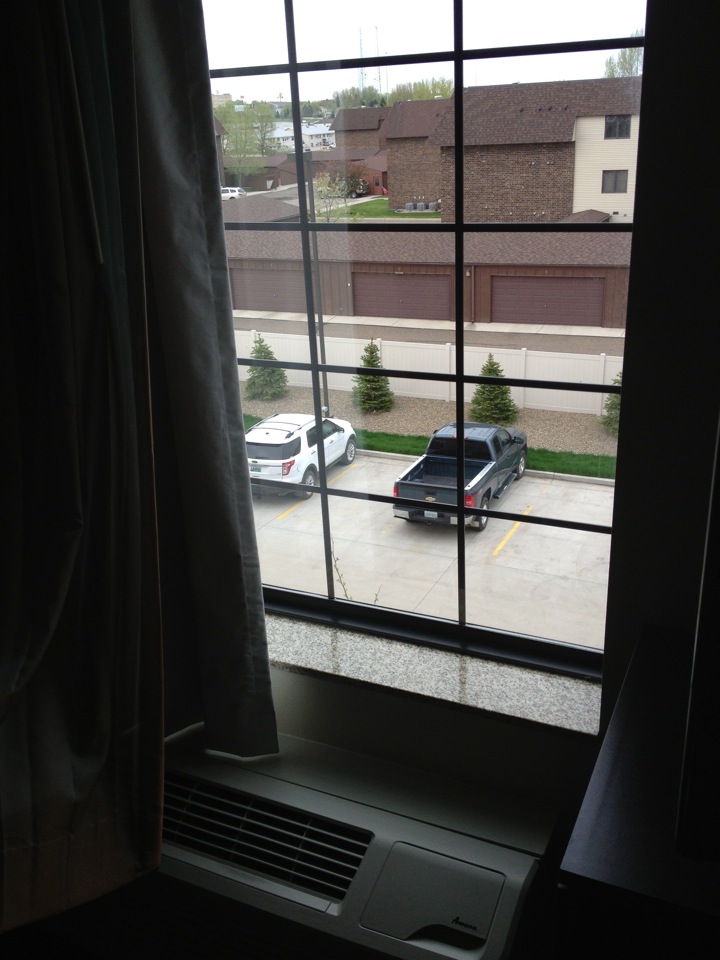
A hermetically sealed hotel room in a spiffy new hotel.

A hermetically sealed hotel room in a spiffy new hotel. Note how there is no device on the window to open said window to the outside world.

In the last month and a half, I have stayed in several hotels, two of which were very spiffy and new, and completely sealed off from the outside world. By this I mean that there was no way to circulate outside air directly into the hotel room. Sure, they have these conditioned air units, but I’m a little weary of these suckers since it doesn’t take long for imperial fungus to start colonizing said A/C units — then, when we turn them on in hermetically sealed hotels because we’re human and animal and we like some kind of air movement, the A/C units are just blasting us with some potential super fungus, this shooting directly down into the capillaries of our lungs.

When it comes to the layouts of these spiffy new hotels, I’m sure there are reasons for the engineering or, at best, architectural design of such structures. I sure would like to see the arguments for the designs (perhaps intended for super smoggy places). But if I’m sitting in a hotel situated in a place on the planet that has comparatively good to great air, and especially if it is during a fresh rain or thunder storm, I would rather have the option of cracking a window open (preferably on a sliding track or pane rather than with a brick). For now, oh well (this is where I insert the obligatory Jeremy Bentham, Panopticon reference).


Some Philosophies of Histories

In a couple hours I will be taking what is called the oral component of the comprehensive exams. This is the business of academia, what I sometimes think of as the codification of intellect (everyone is sharp, or has potential to be sharp, and universities are designed with a goal of proofing and validating that sharpness). In that case, I am engaged in my morning ritual of visiting, revisiting and reading through some broad conceptual thinkers in final preparation for this upcoming, mid-morning fun.

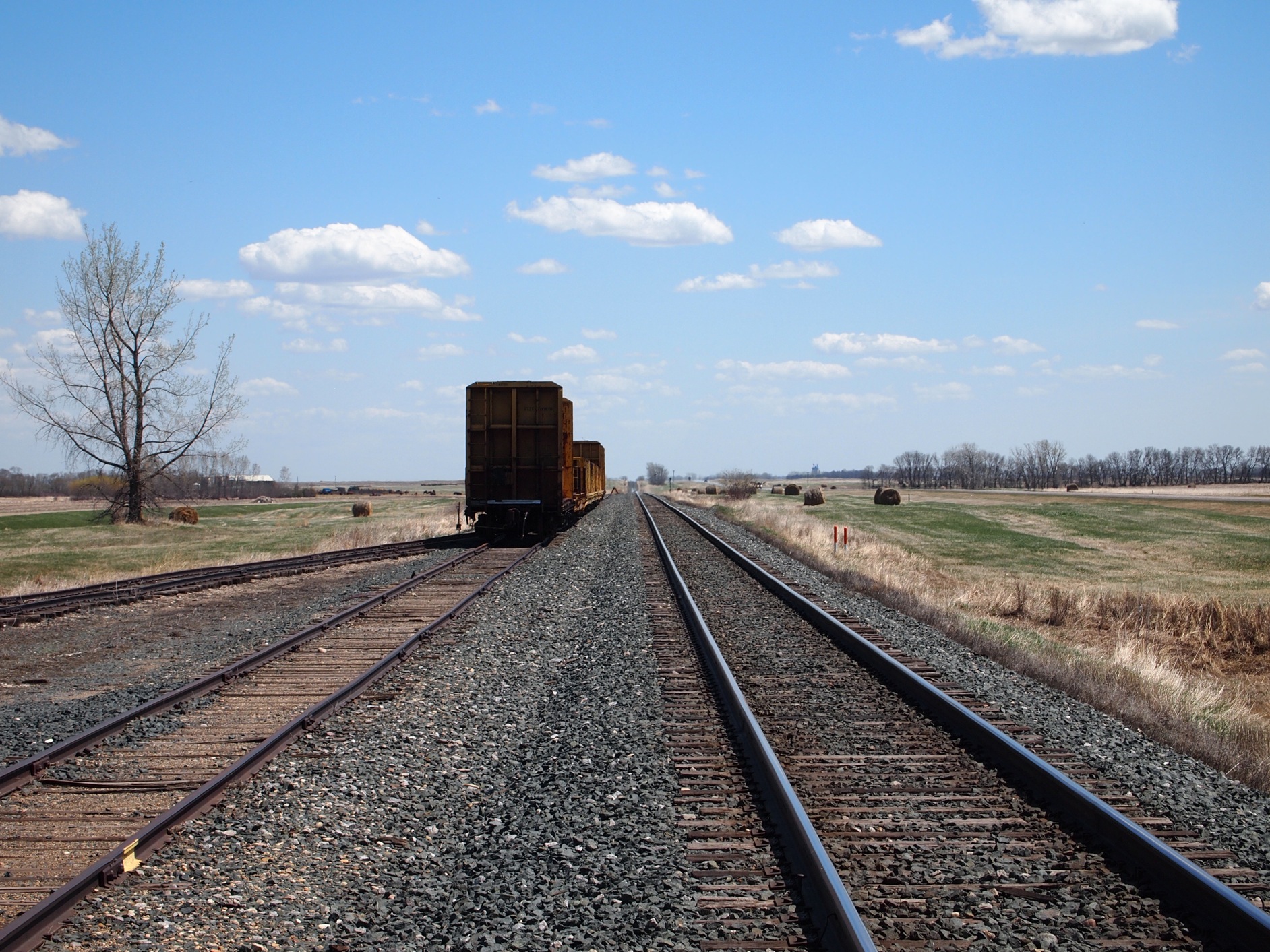
A potential railroad metaphor for the various and competing tracks of time cultures and societies are hurtling along. This, we historians argue, is why world history is increasingly important in our increasingly global age.

The railroad as metaphor for the various and competing tracks of time cultures and societies are hurtling along. This, we historians argue, is why the study of history and the philosophies of histories is increasingly important to study in our increasingly global age.

In the largest scheme of things, these big-picture thinkers — from R.G. Collingwood to E.H. Carr to John Lewis Gaddis to Michael Shanks — force a reader to contemplate not just the technical hows of a discipline, but also the philosophical whys: for example, why would anyone be engaged in the efforts of history or archaeology or, more broadly, any discipline or trade for that matter? To contemplate this provides a variety of conceptual frameworks in which to filter data through, and these are the substructures of any discipline and trade. While keeping this in mind, it is also important to keep in mind that the disciplines and trades are by and for an infinite variety of culture and subculture and subaltern culture (and so on). Whether conscious of it or not, the collective memory within these groups influences to varying degrees the ways the substructures are built (if looking at the archaeology of language, for example, it quickly becomes apparent that languages are built out of previously established bodies of presumptions and assumptions).

With that said, in revisiting R.G. Collingwood, The Idea of History, (1946) R.G. says in his introduction that “Philosophy is never concerned with thought by itself; it is always concerned with its relation to its object, and is therefore concerned with the object just as much as with the thought.” This entire idea pertains to developing philosophies that disciplinarian doctors (which, to be pedantic, is Greek for “teacher”) train cadets and recruits with, so the latter understands that two thinkers can take the same body of evidence and can arrive at completely disparate conclusions. In the case of history, this is what 18th century Voltaire called a “philosophy of history,” and what 20th century E.H. Carr referred to as a dialog with the past. This philosophy and dialog is important — at least I’ll make the argument here — since the world has and always will be in a perpetual state of crisis. If met with crisis, we have to get used to the idea of re-calibrating and re-adjusting. This is not necessarily to accept the crisis, but to figure out ways through and around it. In some of Carr’s concluding remarks in chapter 5 of What Is History? (1961), he identifies three types of history (using the Royal “You” to bring his case home):

[1] You can, if you please, turn history into theology by making the meaning of the past depend on some extra-historical and super-rational power. [2] You can, if you please, turn it into literature — a collection of stories and legends about the past without meaning or significance. [and 3, which is where Carr is at his best, a proper definition of the historian.] History properly so-called can be written only by those who find and accept a sense of direction in history itself. [and in the copy on my shelf, the following is what I underlined] The belief that we have come from somewhere is closely linked with the belief that we are going somewhere. A society which has lost belief in its capacity to progress in the future will quickly cease to concern itself with its progress in the past.

Thus, for Carr (and myself), to engage in history proper is to engage in the faith of the future of society, and the discipline of history itself. This as well is why history is never “complete.” If history was complete, society would be complete, and both that society and history would be finished and at an end with itself. This, of course, is only theoretically possible, since nothing is ever truly at end. Rather, we humans impose the boundaries and limitations, demarcating a beginning and end for what is otherwise quite gradual and transitionary. This is why in the first two decades of the 21st-century we are having conversations about how we humans engage 2- and 3-dimensional objects. In the words of Michael Shanks, “the past has to be worked at,” (Hunter Thompson sometimes referred to journalism as analogous to chopping wood) and it is just as important to look at the past as it is to look at the way historians have sought to make sense of the past.

I keep thinking that, to use metaphor, as we stand on the 21st century dock and watch the 20th century Cold War — that barge of history — drift further and farther away from us, a host of new crises will continuously arise. Our ability to react to them will be predicated on not just how we know the past, but also of how and why those before us knew the past. And how and why they understood the past is also filtered through the ways in which we remember and know the past, and so on, ad infinitum.