Author Archives: Aaron Barth

Central Asian Shashlyk

Shashlyk on the grill during the 237th American Independence Day. Note: photo does not show the eagles bursting through American flags just above this patio grill out.

Shashlyk on the grill during the 237th American Independence Day. Note: photo does not show the eagles bursting through American flags just above this patio grill out.

I want to do whatever I can to encourage the preparation and spread of shashlyk — Central Asian or former-Soviet state kebabs, the wikipedia link here — on the northern Great Plains. Considering how the landscape is infused with German-Russian and Levantine (among others) ethnicities, and considering how North Dakota was a frontline of the Cold War, a person could easily make an argument for themselves as to why they should be preparing shashlyk for their families and friends this weekend. So here are a couple photos of what I did for America’s Independence Day, July 4th (237 years and still kicking).

Last Wednesday I grabbed a half bottle of grapefruit juice from the fridge (this leftover from the Kingsley Amis-style salty dogs I prepared the week prior), dumped this in with olive oil and raw lamb chunks. To that I added a whole bunch of herbs and spices that dominate Central Asia and the former Ottoman Empire (I’m not going to list them all, but just think cumin and curry and paprika and rosemary and even a dash or two of ground cinnamon). Skewer these with the bamboo, and also add to that red bell peppers, onion, tomatoes and mushrooms.

For grilling: use a charcoal grill if you have one handy. If all you have is a propane hibachi (which is what I had at the time), then obviously that is what you’ll have to use. During the actual grilling process, douse or spritz the shashlyk skewers with some apple cider vinegar. This will enhance the end flavor, and also get everyone’s taste buds roaring from the smell. The important thing about shashlyk preparation: first, think about this at least 2 days prior, because you’ll need the prep time. Also, the citrus and/or vinegar as central to the overnight soak for the lamb meat.


Cultivating the Humanities

This morning I am sitting down to my usual coffee, and thinking about several responses to the latest report issued by the American Academy of Arts & Sciences, “The Heart of the Matter: Report of the Commission on the Humanities and Social Sciences,” that of which is linked to here. I was checking in with my buddy Bill Caraher’s blog today and I noticed he linked to a few responses to this report as well, here and here, and another Wall Street Journal piece here. While reading all of these, a sort of anxiety started building up in me, this resulting from the following thought: why not read a scholarly monograph or a novel instead of reports on whether or not the humanities and social sciences is in a fatalistic state of decline?

I also thought about how the humanities are everywhere, and then I wondered how people who complain about having gotten nothing out of college spent the majority of their time in said college. Were they doing keg-stands, or were they in the library stacks, perusing used book stores, reading-reading-reading, having coffee and conversation and beer and more conversation about interests with others, writing, re-writing and looking over the papers of one another or, once again, strictly doing keg-stands? Did their schooling look like this, as in Bluto from Animal House? Or did it look more like this, as in Max Fischer from Rushmore? (Max Fischer, of course, was in preparatory and private school, but the idea is there: he received mediocre marks, but he was involved in an endless amount of extracurricular activities).

I also wondered about the state of communities immediate to university campuses. For example, I stumbled into an undergraduate program (at the University of Minnesota in downtown Minneapolis-St. Paul) where the humanities (not even defined as such) were happening arguably more outside of the classroom and off campus than they were on campus. At least between 1999-2002, Dinkytown had two to three used book stores, at least two coffee shops (the Purple Onion was one of them), several hole-in-the-wall taverns, a used CD/record store with an endless selection of everything, a liquor store, pizza shops, an Afghanistan cafe, and so on. And this didn’t include the other stretch of coffee shops and cafes and taverns immediate to the intersection of Washington Avenue and Harvard Street. I did the majority of learning outside of class, and I figured out that you take these ideas into classroom discussions, at least those classrooms where professors allowed it (there are, of course, professors that command students to strictly focus on the required readings and nothing else, which is a different tangent all together).

What isn’t addressed in this Harvard-published work is how universities might work with their local community planning boards to develop an immediate off-campus culture(s) that allows students to explore said humanities on their own. Historic preservationists might get involved for sure, as this would require the renovation of those pre-WWII homes (please don’t tear them down for 2013 asphalt strip mall construction) just across the street from campuses to be converted into those excellent used book stores and coffee shops and hole-in-the-wall diners, local and ethnic. Make sure students can walk to these places rather than drive. If need be, use Dinkytown as a model or framework.

Also notice that the board of this Harvard report lacks students and graduate students. Every contributor to the board is some kind of established, high-powered professional. They are required to fatalistically bemoan the disappearance of the humanities and social sciences (I’m not big on fatalism, to be fair), and they should be doing this because that is what they see at their professional level. It’s important to keep that in mind. A future report would benefit from bringing more voices in from individuals who are in that liminal space between getting their undergrad and graduate degrees in the humanities and social sciences, and figuring out how to locate jobs or start entrepreneur-ing (not a word) themselves.


Ideas of Fermentation and Distilled History

On this 4th of July morning (which, in America, is a secular holiday, or holy day), I finally got around to one of my short reading lists that concerns the scholarly study, specifically, of beer, and broadly of fermentation, booze and alcohol (or what academics sometimes refer to as ethyl). The four books in front of me include The Oxford Companion to Beer (Oxford University Press, 2012), two monographs by Patrick McGovern including Ancient Wine: The Search for the Origins of Viniculture (Princeton University Press, 2003) and Uncorking the Past: The Quest for Wine, Beer, and Other Alcoholic Beverages (University of California Press, 2009). The fourth work is The Archaeology of Alcohol and Drinking (University Press of Florida, 2008) by Frederick H. Smith, and this is perhaps the one that speaks most pointedly to the July 4, 2013 day since it is a part of The American Experience in Archaeological Perspective series.
Some booze studies scholarship.

Some booze studies scholarship.

Of all these books, the Oxford companion is put together like an encyclopedia rather than a narrative or anthology, and Oxford sensationalized it a bit by asking Tom Colicchio to write the short forward. Because I am in the dark on many facets of contemporary culture (it all moves and changes so fast, though; and Tom would have to Google our names as well), I had to Google Colicchio’s name, but when an image of his face appeared I recognized him immediately as one of those celebrity chefs. Tom noted how as he matured from his teens up to 2012, so did his appreciation toward beer. Of this work, though, I thought Oxford would have benefitted more to get a brew master to write the forward, or even a monk at a monastery that is renowned for beer. Tom works in the trade of acquiring James Beard Awards, culinary rage and sensationalism (which is how you make it in that business) whereas a monk devotes time to brewing, reflection, and self-reflection (in large part for humanity and the sustainability of the abbey or monastery). Brooklyn Brewery brewmaster Garrett Oliver drafted the preface to this work, and he speaks a bit more to the beer trade.

The Oxford companion is huge like an encyclopedia, numbering 919 pages, or around 2″ thick. I think the only way you’d go about using this book is to check up on a pointed question with the index, look at the topical features just after the preface, or to open it up to a random page. On page 674, the entry “public houses (pubs)” appears, noting that the institution of the pub did not have much renown outside of the U.K. until business owners decided to bring Irish Disneyland to the world with Irish-themed pubs (I suppose the idea was that not everyone can make it to Ireland to visit a pub, so might as well bring the Irish-themed pub to the non-Ireland world). It is moderately surprising to not see Kingsley Amis referenced in the index of this work, but I suppose if a person is building a scholarly library on beer and booze, they already know about it (Amis knew his booze, and he could be accused of being just as interested in its effect as he was the flavor and body of the stuff).

On the first page is the entry “abbey beers,” and this expands on the brewing expertise of the Belgian Trappist monks, and the established “appelation (controlee)” which lets everyone know where the monastic beer originated (time, space and chronology is important to the monastic tradition for many reasons). In reading and writing about this passage, for at least a couple years I have hoped that the monks of Assumption Abbey in Richardton, North Dakota, might at some point down the line consider brewing beer with North Dakota grains, barley and hops. And even better, sharing it (but that’s totally up to them).

As for the works by McGovern, I first came across his name in a popular history of booze put out by the Smithsonian in July-August 2011 (the great article linked to here). McGovern focused on fermentation in Western Civilization (the region of Mesopotamia is the cradle of fermentation), and he also made the case that we today are part of a long fermentation process (the long durée of beer drinking). In McGovern’s scholarship, he is a bit heavy-handed in his testimonies to the irrefutability of the archaeological record or the interpretation thereof (“There is no hidden bias lurking in a pottery sherd or a stone wall, as there might be in a written document.” [McGovern, 2003: 5]). But that sophomoric understanding of philosophy and theory is outweighed by a broad knowledge of the history of beer and wine.
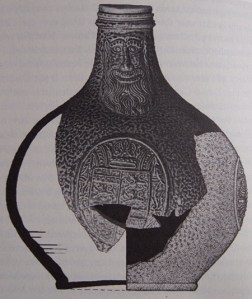
German-produced Bartmann wine bottle from the British settlement site of Jamestown, Virginia. (Smith, 2008: 12)

German-produced Bartmann wine bottle from the British settlement site of Jamestown, Virginia. (Smith, 2008: 12)

Of the four books, the best on the subject is by Frederick H. Smith. And I define best in the sense that it is an academic treatment of the subject that tracks both the subject itself and what other scholars from the academy have said about it (like brewing, the origins of this tradition is monastic in and of itself). The first chapter to this work alludes to numerous scholars in alcohol studies (a kind of subfield in history and anthropology), and the subsequent chapters go on to discuss the Iberian storage vessels first used to transport the sauce throughout the Atlantic World, from the Old to the Jamestown colony in the New, and here to the production of alcohol to its trade and consumption and so on. By the 16th and 17th centuries, hand-blown glass bottles surpassed the ceramic vessels, and Smith notes that when these bottles are recovered, so is the booze. For example, an early 17th century glass bottle of wine was once recovered by marine archaeologists, and it turned out that the Dutch warship had wine at 10.6% alcohol content, this within the same range as the content of wine today.

The final chapter in Smith’s monograph stems from a 2005 study he did on the role alcohol played in the 1816 slave revolt in Barbados (four decades after elite Anglo-America got its start). These case studies are a more effective way to explore the social history of booze in all of its variety and nuance. Specific to this are the caves on Barbados, a place where self-liberated slaves could escape to on an island and carve out an underground existence. Without going too much further into these works, it seems that on July 4th it is important to acknowledge the philosophical substance of America’s Declaration of Independence, but more importantly to know that it was a document prepared by an elite minority on the backs of an enslaved majority.


Getting Pickled On the Northern Great Plains

Getting pickled with jars of local farmer's market pickled vegetables.

Getting pickled with jars of local farmer’s market pickled vegetables.

A culinary note: the season of the pickle is here, well established, this on the eve of July 1, 2013. It’s not just a cucumber, folks. This jar was picked up from Becky at the Valley City Farmer’s Market in downtown Valley City, North Dakota. In the past the family has locally raised and sold Christmas/jultid trees, and today they pickle vegetables.

This jar includes chili peppers, cauliflower, broccoli, garlic, carrots, and sturdy dill sprigs. The recommendation is that it be paired and digested with a good dose of Summit Ale. I have to go put the wild rice brats and salmon on the grill now. The onion and garlic saute is already happening (with butter and a shot of course ground mustard). Happy Sunday evening. July, here we come, glorious farmer’s markets and all.


The Dakota, Nakota and Lakota Namesakes

This sunny afternoon, I’ve had a chance to make some reading lists and also take a closer look at two pieces of scholarship, including Paul Beck’s, Columns of Vengeance: Soldiers, Sioux, and The Punitive Expeditions, 1863-1864 (Norman: University of Oklahoma Press, 2013) and Clifford Canku (pronounced Chan-ku), Nicolette Knudson and Jody Snow, Tokaheya Dakota Iapi Kin: Beginning Dakota (St. Paul: Minnesota Historical Society Press, 2011).

Here are three thoughts that struck me in bouncing Beck’s contribution to the existing body of knowledge of General Pope’s punitive campaigns in the Dakotas, circa the American Civil War, off of the work by Canku et al. Note: Ancient Historian friends sometimes ask me to clarify which Civil War when I say, “The Civil War…” For someone versed in The Battle of Actium and the Peloponnesian Wars and all that other Ancient Mediterranean stuff, the phrase “civil war” — which are wars that are never civil — can mean any number of things:

  1. As Beck says in his introductory remarks, this is a Euro-Ameri-centric work from the bottom-up, soldiering perspective. What this means is that Beck worked all sorts of data from soldiers on these punitive campaigns into this 2013 history. When thinking about this, it’s interesting to consider how the professionally-trained soldier perceived of their duties and the Dakota they were charged with campaigning against vs. how the volunteer soldiers mustered in locally from Minnesota and the area perceived the Dakota.
  2. With this known, readers shouldn’t get upset that this is, well, another Euro-Ameri-centric work of the punitive campaigns (also a Euro-Ameri-centric phrase) in Dakota Territory.
  3. Even though the NCAA banned the use of the word “Sioux,” (and as a North Dakotan, I am fine with that) Beck and the editorial staff at the University of Oklahoma Press have not. I suppose the title is reflective of the view this history takes. Some thoughts on that below.

CankuAs Canku and company point out in Tokaheya Dakota Iapi Kin, and as more and more increasingly become aware of, the word Sioux was developed by the Algonquian to the east. As the French were making their way around the Great Lakes region, they encountered these Algonquian, and when the said Algonquian were asked, “Hey, who is to the west of you?” they responded with the Algonquian name for the Dakota, which was “Sioux.” The definition of Sioux is “those who live near the snaking river.” More pejorative variations on this have taken the name of “Snake in the grass.” But the problem of the word “Sioux” in and of itself is that it has been elevated to the known name of a people who did not author it as their known name. It’d be akin to asking a Russian what you call folks in the region of Poland vs. asking Poles what they call themselves.

For the sake of identity (which is the important stuff of being human, having and developing character and a constructive and collective image of oneself and the world) it’s important to keep hammering away that the Sioux are not in fact “Sioux.” Rather they are Dakota, Lakota and Nakota. More specifically, the Dakota are composed of the Mdewakantonwan, the Wahpekute, the Wahpetonwan, and the Sisitonwan (this is where the namesake Wahpeton, North Dakota comes from, also the hometown of the Erdrich family, among others). The Lakota are the Ti’tonwan, and the Nakota are the Ihanktonwan and the Ihanktonwanna (where the name Yankton comes from). The word Dakota means ally or friend.


Human Puzzles: Peruvian-pan-North Dakota Art

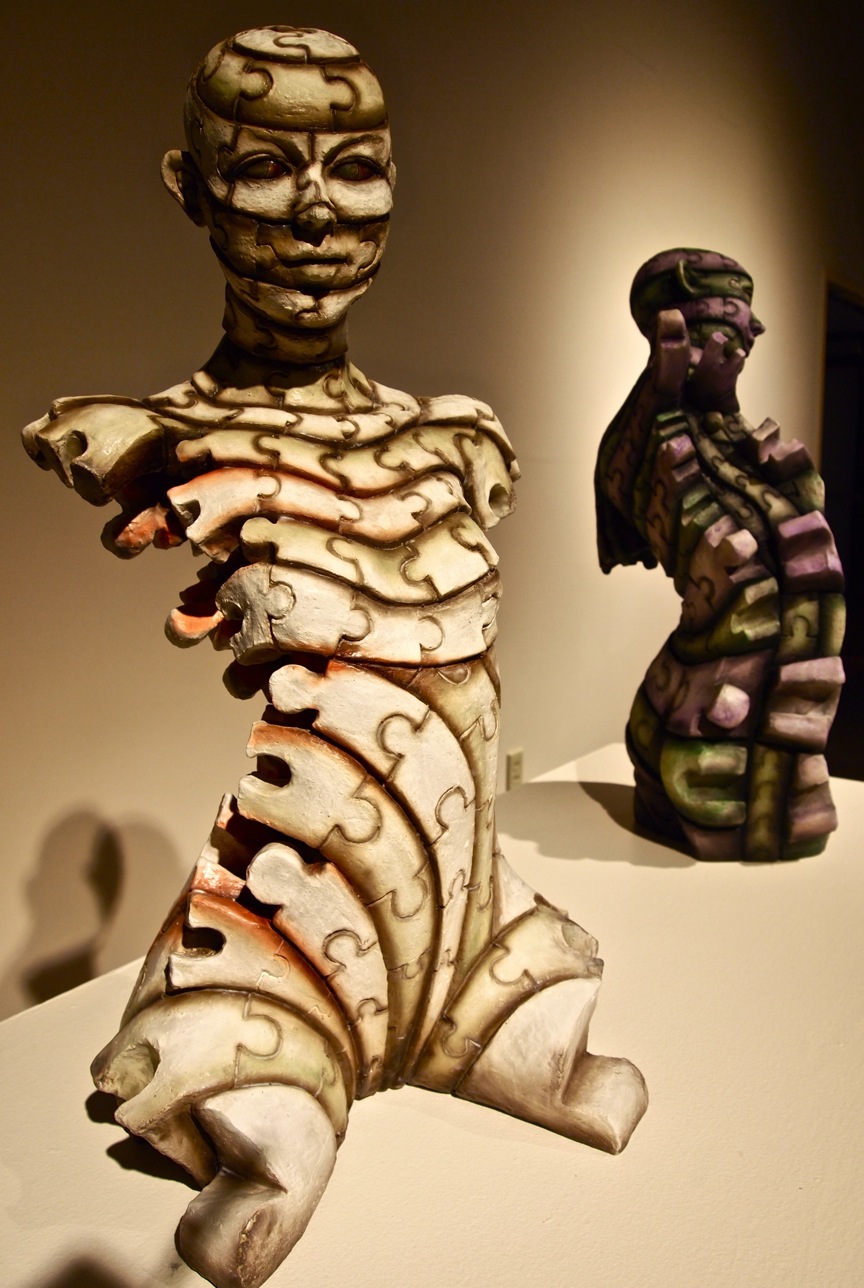
Sculptures by Guillermo Guardia.

Human puzzle sculpture by Guillermo Guardia. Note the sculpture in the backdrop as well.

I just snapped a bunch of photos of Guillermo Guardia’s (the Peruvian-North Dakotan artist, not the Costa Rican football striker) exhibit on display at The Arts Center in downtown Jamestown, North Dakota (the exhibit is sponsored by the North Dakota Art Gallery Association with support from the North Dakota Council on the Arts). Guardia hails from Perú, and did his MFA at the University of North Dakota. In 2009, he started working for the North Dakota Museum of Art as an Artist-in-residence. Guardia’s exhibit will be on display in Jamestown until July 6, 2013.

The pieces, specifically the puzzle-human pieces, got my mental gears cranking. Below is the narrative Guardia put together to accompany these pieces. As you enter the gallery, the narrative is just to your left.


Guillermo Guardia, “3 Truths / 3 Verdades: Puzzle Pieces”

When I began my Masters of Fine Art degree at the University of North Dakota, I knew I wanted to continue depicting the human figure and using it as my main subject and form of art. After building numerous figures in clay, I concluded I was failing at creating the figure I had envisioned. This was very frustrating. I was not pleased with any of my new works. It left me unsure of what direction to take my artwork. My frustration was compounded by the fact that it was my first time in the United States, and my first time out of Perú. At that time, everything was new for me. I had problems communicating with my peers, as it is different to learn English in a Spanish speaking country than practicing it in the United States. Some days I went home with painful headaches.

Two more human puzzles by Guillermo Guardia.

Two more human puzzles by Guillermo Guardia.

In 2003, I turned my attention to building clay figures that looked as if they were thinking (The Thinker by Rodin was a big influence). I quickly finished my first new figure. The new work looked good, but again, it didn’t match the image I had in mind. I sat in front of it, contemplated for a while, took a carving tool, and began to draw some lines over the surface. Eventually those lines crossed each other and became patterns. It made the figure look as if it was built of individual pieces, becoming the inspiration for my current puzzle piece series. The first figure in this series was filled with these puzzle pieces. This puzzle figure was holding a single piece in his hand as if pondering where it fit or where it came from. Perhaps the image of the puzzle piece came from a childhood memory as I remembered my sister always playing with puzzles, something that was beyond my abilities and patience.

Most of us have felt the sensation of something missing and not knowing what it is. We have felt that uncomfortable feeling of emptiness and are unable to describe it. I don’t believe life is a walk in the park anymore. It is difficult and complex. The puzzle pieces represent those little parts of everyone’s life and shape us as human beings. I never thought of myself as a real artist until 3 years ago. So many things have happened since I arrived in North Dakota making me what I am today.


Remembering Greasy Grass in World History

I remember the first time I started piling over the historiography of Greasy Grass/Little Bighorn at some point in 1999 or 2000, this with a short historical article included in one of those military history readers. This article happened to be by the late Stephen Ambrose (I think he published it sometime in the 1970s), and as a reflection of the scholarly times, it focused exclusively on what we call white military history. Looking back on it, and considering how even by the 1870s the American military was such a small cross section of elite Anglo-Americans that guided policy (as opposed to the lot of our non-English-speaking immigrant great and great-great and great-great-great grandparents who were entering the country at the time), it is much more accurate to refer to the traditional historiographic body of white 19th century American history as Anglo-American or Victorian Military History. This is not meant in a conspiratorial way. Rather, it is meant to point out how institutions are composed of individuals, and if the individuals within those institutions have certain outlooks on the world, then the institutions are going to operate accordingly.

For at least a couple decades, now, enough individual scholars within the academies have created a social structure so that they can shift the direction of the scholarship (archaeologists are sometimes calling this “counter-modern” while other historians refer to it as multivocal). For example, instead of once again combing over what happened on June 25, 1876 at Greasy Grass, scholars have taken to looking at the conflict as a broader segment that needs to be contextualized in World History. James Gump has a work out there entitled, The Dust Rose Like Smoke: The Subjugation of the Zulu and Sioux (University of Nebraska Press, 1994), and it considers how the Anglosphere mythologized themselves after a confederation of Lakota, Cheyenne and Native America decimated the 7th at the Little Bighorn in 1876, and after the Zulu wiped out a British force of 1,500 at Isandhlwana on January 22, 1879. Check out the Zulu monument to the fallen Zulu at Isandhlwana with this link here.

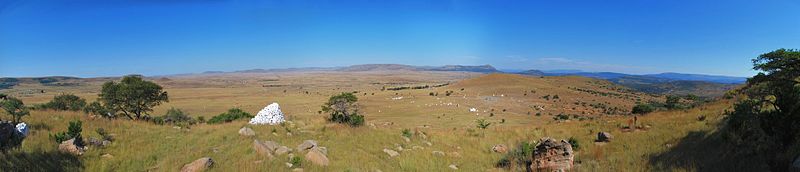
Isandlwana landscape from the Wikipedia public domain page.

Isandlwana landscape from the Wikipedia public domain page.

These broadened world historical treatments help pave the way for other scholarship (for example: so we’re not incessantly sitting around wondering what Custer did wrong; but rather what the Lakota and Cheyenne forces did themselves to bring about George’s demise). The latest and greatest public historical treatment of Greasy Grass comes by way of Debra Buchholtz’s The Battle of the Greasy Grass/Little Bighorn: Custer’s Last Stand in Memory, History, and Popular Culture (Routledge, 2012). This work gets the reader to think secondarily about the actual events of June 25, 1876, and primarily about how the public has remembered the events since 1876. It was, after all, a centennial year (from 1776 to 1876), and the general Anglo-American reading public was nonplussed and aghast to think that Custer (or anyone Anglo-American for that matter) would be capable of losing a battle within the interior of the American nation, and this so close to the centennial anniversary of the nation’s declaration of independence.

Greasy Grass/Little Big Horn from the Google Earth imaging.

Greasy Grass/Little Big Horn from the Google Earth imaging.

So this is where a lot of the contemporary scholarship is at these days: not just looking at the historical event itself, but also looking at what the popular press and academically trained thought about the historical event in and of itself (for example, William Blair and David Blight, among others, have taken a hard look at Civil War memory and memorialization in this way too). And that’s what I’ve kind of been thinking about on this 137th anniversary of the day the Lakota and Cheyenne (and others) stuck it to George at Greasy Grass in eastern Montana.

In closing, I leave you with a paragraph quote from the 1986 work of James Belich, The Victorian Interpretation of Racial Conflict (McGill-Queen’s University Press, 1986 and 1989). This is so you don’t have to lug around numerous books while you’re taking in the various Lakota and Cheyenne holiday celebrations that commemorate the defeat of Custer at the Battle of Greasy Grass — Aaron Barth Consulting does this work for you.

Okay, to quote Belich, and to consider it in the context of Custer as a trained Victorian operative for Anglo-America:

“Racial ideas are not just images of others, but of one’s self and one’s own society. Superiority and inferiority, inevitable victory and inevitable defeat, higher faculties or the lack of them; each are two sides of the same coin. To question one is to question the other, and thereby cast doubt on an individual and collective self image. Victorians, like other people, were not eager to ask such questions.” (Belich, 1989: 327)


The Archaeology of Refrigeration

Plans to a root cellar from Summer 1976, No. 68, North Dakota State University Extension Service.

Plans to a root cellar from Summer 1976, No. 68, North Dakota State University Extension Service.

The ability to both produce and store food is a central component to the sustainability of any society. I got to thinking about this while reading Grand Forks Herald article earlier this morning on root cellars, and this in turn got me thinking about depressions archaeologists come across during pedestrian surveys. At first, a depression in the landscape simply looks like that: a depression. But this is why it is important to look to the written and oral history of a place, lest a former root cellar or a cache pit continue to go unnoticed.

Before the Second World War, and prior to the post-WWII shift of artificially conditioning the air to our homes and refrigeration devices within the homes (this is all connected with the cultural inertia that today has us searching and exploiting the world for petroleum), our grandparents and great grandparents kept food and drink cool with root cellars and cache pits. Using a subsurface pit (or a cave, which is how Europeans refined and perfected the wine and beer processes) for storage takes just a bit of planning, thought, and foresight. It can be done, though. Some call them root cellars while others call them cache pits (those bell-shaped subterranean pits used by Mandan and Hidatsa cultures).

After reading the Herald piece this morning, I shot an e-mail to a North Dakota State University extension agent to see if I could get a digitized copy of a 1976 plan for a root cellar. Within the hour the extension agent responded with “Electric Farm Power: Vegetable Storage” (Summer, 1976, No. 68), this prepared by the NDSU Agricultural Engineering Department, Cooperative Extension Service, and North Dakota Power Use Council Cooperating (yes, note the keyword “cooperative,” as cooperatives and cooperation are central to getting things done).

The illustration here is the design of a root cellar, and these also dub for tornado shelters in the summer. This is something to increasingly think about considering how Oklahoma has taken on serious tornados already this year, and also how a tornado came close to hitting the Denver International Airport not but a week ago. Anyhow, here above and to the left are the unadulterated plans to a root cellar.


Learning from a Digital Un-Conference

What it looks like when for the first time attempting to gchat an unconference talk from Cyprus in the eastern Mediterranean to Fargo, North Dakota.

What it looks like when for the first time attempting to gchat an unconference talk from Cyprus in the eastern Mediterranean to Fargo, North Dakota.

This last Friday the board of the North Dakota Humanities Council met for a regular meeting, and after a solid morning’s work (sweat on everyone’s brow, of course), we thought we would experiment at lunch with an attempt to beam Ancient Historian Bill Caraher (his blog here) from the Levant/Cyprus (for context, Cyprus is approximately 140 miles from the coast of Syria) into our meeting room at the Ramada in Fargo, North Dakota (for context, Fargo, North Dakota is 140 miles from Bemidji, Minnesota), this to give a short talk on some modern archaeology of man camps in western North Dakota (stay with me here).

Of course, before any idea becomes a reality, experimentation has to happen (this is where I start to explain what went wrong). Remember: all those polished talks are the result of a lot of experimentation and planning. In our case, the talk was cut short due to lack of band-with. While I’m uncertain what the band-with strength was like in Cyprus, I can say that on the Fargo Ramada conference room end of things it was dodgy — at best.

So what happened was this: while trying to establish a gchat connection with Bill Caraher in Cyprus, I texted and instant messaged back and forth a bit. While gchat struggled to keep up with beaming the powerpoints from Cyprus to the Ramada in Fargo, I messaged Bill to explain how things looked on our end (this in contrast to how things looked on his end: note, this is a metaphor and reality for life). Here is an excerpt from the messaging:

Aaron to Bill:

Your audio cuts in and out. You sound like a droid. And the power points aren’t synching on our end. Other than that, everything is great.

So the next time around, here is what needs to happen, at least beyond abandoning this technology all together (we have to keep trying: technology is supposed to save us from ourselves someday, right?). Establish relationships with the IT people at conference room establishment. Get a secure internet connection with heavy band-with. Use that. Also, what we did right in this case was exactly what we did: we experimented with it in an informal setting (at lunch) to see how it would work. Bill is scheduled to appear real-time at the next board meeting. The council, no doubt, will have more questions and thoughts for him then. As they say in the digital humanities, to be continued…


Punk, the Humanities and Academia: Some Analogies

Bret Weber and Bill Caraher prepare to present man camp findings to NDSU in the Spring of 2013. Tom Isern pictured at right saunters back to take a seat.

Bret Weber and Bill Caraher prepare to present man camp findings to NDSU in the Spring of 2013. Tom Isern pictured at right saunters back to take a seat.

This coming Friday the board of the North Dakota Humanities Council (or humanities council, however one prefers) will convene for one of its regular meetings. The council meets every three or four months in various locations throughout the state to conduct the business of a board. A primary function of these meetings is to consider a variety of outstanding proposal submissions. In addition to this, and at this Friday’s meeting, we will officially or unofficially welcome aboard — the board — some new members. One of these new members is Bill Caraher, a crack Ohio State University-trained jet-setting ancient and modern historian and archaeologist with University of North Dakota’s prestigious department of history. Bill is also a Punk Archaeologist without borders, much like our friend and colleague Andrew Reinhard.

Because Bill’s summer field season regularly takes him to Cyprus and the greater Levantine world, he physically cannot be with us in eastern North Dakota for this specific meeting. But because it’s the second decade of the 21st century — and even though we don’t have flying cars or flux capacitors, yet — we will digitally beam Bill from Cyprus in the eastern Mediterranean to conduct a short presentation in Fargo, North Dakota. The topic is a presentation on our modern archaeological and sociological research of man camps in the petroleum booming Bakken of western North Dakota. I just returned

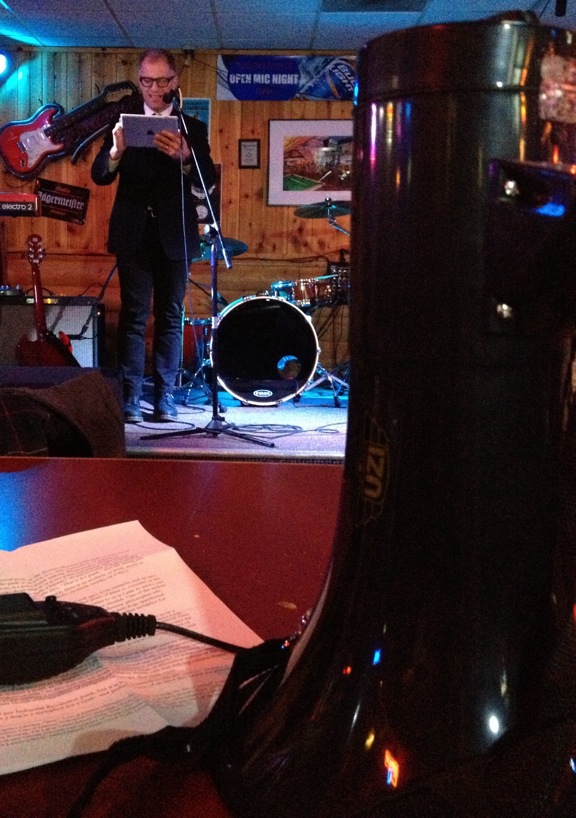
Dr. Kostis Kourelis, punk archaeologist and art historian with Franklin and Marshall College (Pennsylvania), gives his thoughts on punk archaeology through a PA after being introduced with a bullhorn.

Dr. Kostis Kourelis, punk archaeologist and art historian with Franklin and Marshall College (Pennsylvania), gives his thoughts on punk archaeology through a PA after being introduced with a bullhorn.

an e-mail to Bill this morning, letting him know the technology I’ll bring to the NDHC board meeting so that we can pull a kind of joint half-hour presentation off in good order.

Doing something like this is akin to playing in a band. Professors and teachers: encourage your students to start or join bands. Here are some analogies between the two: there is the processes of research and preparation (or what a band calls making songs and then rehearsing those songs), locating the technology to transmit that research (the band refers to this as instruments, including voice, guitars, harmonicas, drums, banjos, cymbals, sound boards, timpani, PAs, speakers, cow-bell[s], monitors, lights), finding the specific meeting room and location and coordinating with the executive director (this is what a band calls finding a venue, and “chatting with a bar owner”), and then executing the entire thing within the span of 30 minutes (this is what a band calls a “set”). Doing this over and over and over again, too, ensures that researchers and lecturers (or individual band members) will simply refine the process and get better and better.

Another note: while we can digitally bridge the spatial gap between the northern Steppe of North America and the eastern Mediterranean, there is little we can do about the temporal gap: it’s not that big of deal, though, since when it is noon Central Standard Time in eastern North Dakota, it is roughly 20:00 hours in Greeco-Levantine time (or about 8:00pm). This will be fun. Long live modern archaeology, the digital humanities, and punk.

Some modern archaeology of a punk archaeology set.

Some modern archaeology of a punk archaeology set.