Tag Archives: northern-plains

Era Bell Thompson Local and Global: Windshield Reconnoiter in Driscoll, Burleigh County, North Dakota

A week or so ago (August 3, 2025), I pulled off a section of Interstate 94 in North Dakota, I-94 Exit 190, in eastern Burleigh County. I’ve been reading the two published works by Era Bell Thompson, American Daughter (Chicago: University of Chicago Press, 1946), and Africa: Land of My Fathers (Garden City, New York: Doubleday & Company, Inc.: 1954).

Published in Post-WWII America, in a span of 8 years, these works take the reader from the Iowa to the Northern Plains to Chicago, and across the Atlantic Ocean to Thompson’s attempts at ancestral genesis locus. While reading the latter, last night Thompson was navigating 1950 (or thereabouts) Dar es Salaam, Tanzania, and layers upon layers of colonization that arrived to the present.

At page 201, Thompson republished verbatim the slip of paper that prevented her from being able to freely see this section of East Africa:

“NOTICE TO PROHIBITED IMMIGRANT

…Take notice that I have decided that you are a prohibited immigrant on the grounds that your entry in Zanzibar is undesirable. You are hereby ordered to remain on board and to leave Zanzibar by the aircraft in which you arrived at Zanzibar.” 

Thompson says it was signed by an agent of the Principal Immigration Officer of Zanzibar. Reading this felt like similar wine, but different bottle. History resonates that way.

It also got me thinking about how, as the time barge continues pulling us into new iterations of the present, how historians might think of ways to communicate the past to present and future generations. And provide theoretical models in which to understand those infinite pasts. How does one, for example, teach the long nineteenth century to, say, a 4th or 8th grader? It can, at that last sentence, initially feel just completely overwhelming. I mean, so much happened: empires (British, French, Spanish, Portuguese, Netherlands) duking it out. Locals and globals on the ground, perhaps carrying the flag of their dwindling empire, or hoisting a new flag of this or that nation or nation state. And all this, trying to navigate the rubric of global capitalism, locals with traditional barter trade systems that remained relevant for generations upon generations, these same barter systems now swimming in similar waters as industrial global capitalism. 

But getting back to it: this is where sense of place really matters. A person should pick up Era Bell Thompson’s books. Read them. And then consider relocating themselves, in the present, as approximately close as they can safely and legally get to her global and local footprints. I’ll keep on that course. 
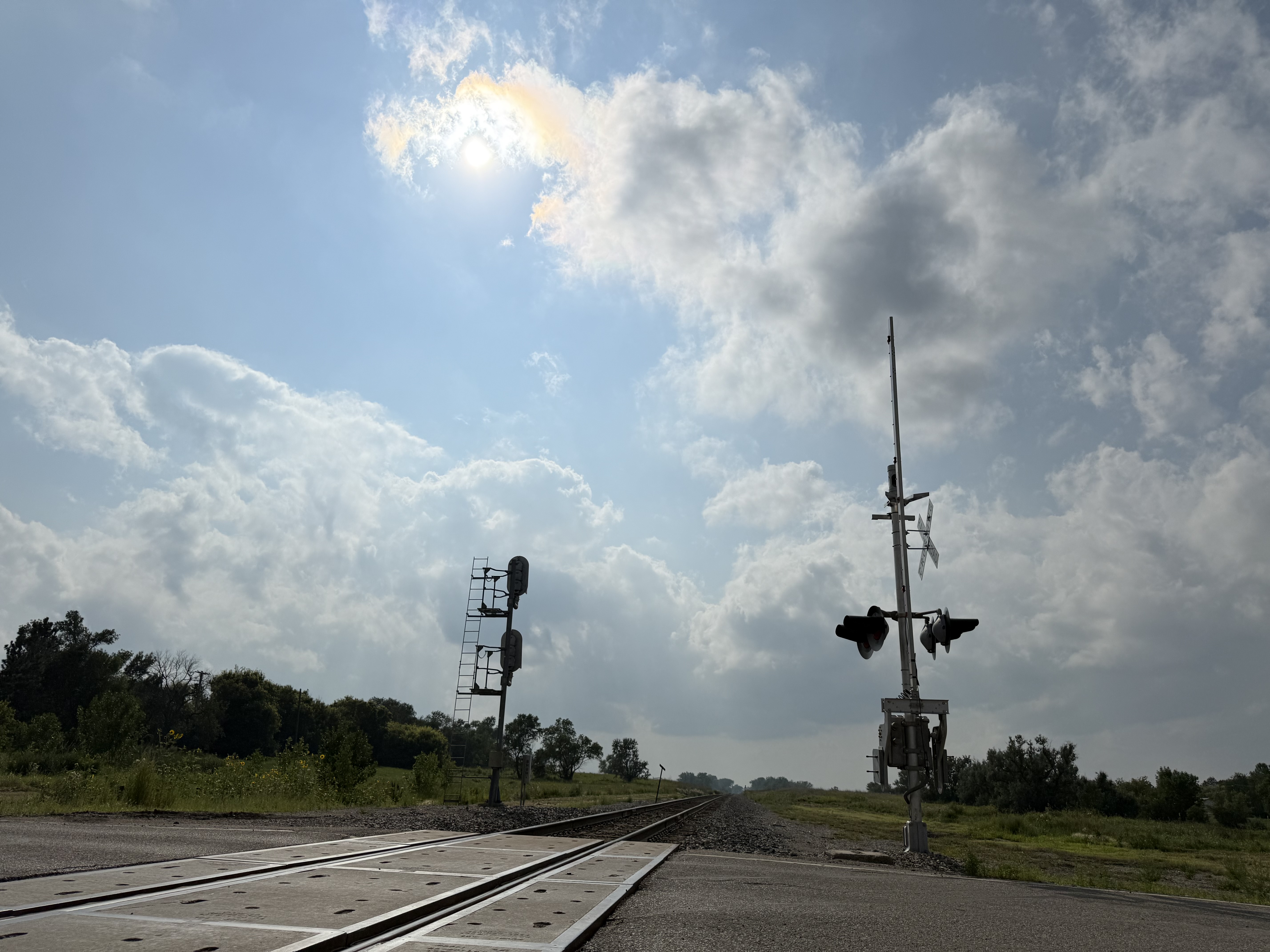
View to the west, at Driscoll, along a section of the historic Northern Pacific Railroad, the historic linear corridor that would have been used by passenger rail car and brought Era Bell Thompson’s family to this area of Driscoll, Burleigh County, North Dakota, in the 1910s.

Northern Plains, Urbs in Horto, Era Bell Thompson

Three days ago it was my intent to blog some analog (lots of hand writing) notes I’ve been taking while digesting Era Bell Thompson’s 1946 memoir, American Daughter (University of Chicago Press). In 2025, doing anything analog is radical, aka, returning to the roots. So I picked it back up this late afternoon, June 22, 2025. The June 20, 2025 Summer Solstice derecho that ripped across central and eastern Northern Plains dropped 13 documented tornados (this one just east of Jamestown, near Spiritwood, video here) had everyone occupied with setting up temporary sleeping quarters in basements, and, later, trimming downed trees, along with checking in with loved ones from beginning to end from Bismarck to Jamestown to Valley City to Fargo to Grand Forks. Tragically and sadly the derecho’s violence took three to the other side.

Back to Era Bell Thompson. Two themes (non -exhaustive or -definitive) emerge from American Daughter:

Thompson narrates Northern Plains landscape beauty which, unless you as a reader don’t know this already, is part of the Great Plains literary canon. I imagine her narrative could apply to all grasslands ecosystems throughout the planet. But, specifically of eastern Burleigh County, North Dakota, in the vicinity of Driscoll, circa 1910s, have a look at this passage:

    “It was a strange and beautiful country my father had come to, so big and boundless he could look for miles and miles out over the golden prairies and follow the unbroken horizon where the midday blue met the bare peaks of the distant hills.

    No tree or bush to break the view, miles and miles of prairie hay-lands, acre after acre of waving grain, and, up above, God and that fiery chariot which beat remorsely down upon the parching earth.

    The evenings, bringing relief, brought also a greater, lonelier beauty. A crimson blur in the west marked the waning of the sun, the purple haze of the hills crept down to pursue the retreating glow, and the whole new world was hushed in peace.

    Now and then the silence was broken by the clear notes of a meadow lark on a near-by fence or the weird honk of wild geese far, far above, winging their solitary way south.

    This was God’s country. There was something in the vast stillness that spoke to the man’s soul, and he loved it.

    But not the first day.”

    Which leads to a second non-chronological theme: while on the farm in Driscoll, everyone but a few seemed to be in debt. The land was rented. Dwellings were rented. Money was borrowed to purchase equipment. Yet, while banker notes lingered over the heads of everyone, all farmers were still free. In her narrative leading up to page 49, Thompson lays the foundation for the lead up to farming working class revolution that swept the 1910s Northern Plains. Thompson speaks to her father’s perception of the 1916 rise of the Nonpartisan League on pages 50-51, teasing out the tension between the urban and rural:

    “In 1915 a growing rebellion against ‘big business’ and the ‘city fellers’ resulted in the formation of the Nonpartisan League, a political organization composed entirely of farmers. The League swept the country like a prairie fire… My father was cheered by this odd turn of events. When he left politics back in Des Moines, [Iowa] a rock-bound farm in the middle of North Dakota was the last place in the world he expected to find it again; but there it was, all about him, on the tongues of everyone, for the farmers were up in arms, drunk with their sudden strength and powers… That Saturday Pop went to Steele with Gus and Oscar Olson and August Nordland for a political rally at the Farmer’s Union hall. Something about Townley, the dynamic little organizer, inspired Pop, set him to thinking. Two weeks later, when Lynn J. Frazier, the League’s gubernatorial candidate, came through Driscoll campaigning, Pop was the first to shake his hand.”

    I’ll continue to analog my way through American Daughter. On chapter 4, now. I got to texting a bit about Era Bell Thompson with Bernard Turner with Bronzeville-Black Metropolis National Heritage Area (BBMNHA). It turns out Thompson’s papers are with the Chicago Public Library, linked here. Bernard and I are optimistic about developing a BBMNHA and Northern Plains NHA talk. Thompson was a part of both the urban and rural in Great Plains and Midwest history, and all the comparisons and contrasts and tensions that entailed. My next scheduled stop will be to get on the ground in and around Driscoll, to revisit the Era Bell Thompson sense of place. Be like Herodotus: also plan visits to go where the history was made, urban or rural. More to come on that.


    Metal & Welding & Rural Art of the Northern Great Plains

    On April 6, 2024, Bill Oberlander and I sat down to chat in real time about Oberlander’s increasing push into recycled metal and welding sculpture art on the northern plains. We arrived at a good spot for a future collaborative commission.

    But equally intriguing was Oberlander’s handheld metal frog that he crafted and brought as a gift. When he started describing the origins of each recycled metal piece within the frog, it occurred to me that that — the narrative of the origin pieces — was where one of the many public interpretation components needed to go (once the piece was finished).

    All of the metal came from agricultural or rural metal that was discarded or not being used. Or used up. It has an art of the rural, or art of the agricultural western Americana, to it. Thru and thru.

    The frog eyes came from ball bearings of a combine. The back legs from a pulley that locks onto a shaft. A bicycle roller chain made up the back feet. Buckets of old nails on the farm were raided for the two front legs. And the body and mouth was made from the spades of a vertical till machine. More to come on future sculptures from Mr. Oberlander.