
Over the weekend, I was able to attend the Norsk Høstfest, a long running annual festival in Minot, North Dakota that, as the self-descriptor says, is a celebration of “Scandinavian culture and heritage of the five Nordic countries of Denmark, Finland, Iceland, Norway, and Sweden.” This is a good descriptor (descriptors are difficult when trying to communicate in very short and sweet verbiage what one is trying to communicate to potential readers who don’t have a lot of time to sit and read long form or short form journalism, let alone slopped out blog posts on diaspora theory).
I’m not entirely satisfied with this interpretation just remaining as is. While at Høstfest, I texted a bit with a friend of mine in Helsinki (yes, Finland, not Minnesota). He texted back a couple times (when I texted him, it was around 2-3pm central standard time, which with the 8 hour difference, meant it was 10-11pm Helsinki/eastern Baltic Sea time).

We got to a bit of spirited back and forth on authenticity: always a theme in any kind of cultural experience. Like when you return from an experience, sometimes the question was, “Was it authentic?” or the statement assertion is that, “That experience was authentic.” The text message exchange got me thinking about authenticity, the perception thereof, and trying to tease out a universal definition of what authenticity could mean. The word authenticity appears to me to be related to authority, and the word author, too. But these three words — authenticity, authority, author — are interconnected in the capacity that they assert through one (or a collective) of past memories and present experience the way things are or ought to be. Which when an author is asserting something, here’s a way in which to experience that: it’s okay to accept the author’s assertion. But one doesn’t have to agree with them.
Anyhow, texting with my friend in Helsinki, it appeared a bit odd how Finland was reflected in Minot, North Dakota (stay with me, here). So that returned to the topic of diaspora: peoples who have been spread from what they call their “original homeland” (but in the long history of people migrations, what does “original homeland” even mean), and the peoples who retain slivers or linear board sections of the culture they departed within the new spaces they settle and occupy.
Here’s where the cultural Instapot gets weird: the culture that left the homeland continues in the mindset of the migrating people, but the homeland culture continues to evolve in its own, new directions. So the Helsinki friend of mine, this morning, said something similar: he left Finland over 25 years ago, and when he returns he cannot seem to see the country he left behind. So the Finland he knows is in his mind. The present Finland, isn’t that. Because he recalls Finland in 1999 or so. The Finland today in 2024 is something different. Here we have two mental Finlands: the past memory of a Finland in the mind of the person that doesn’t live regularly in Finland, and the Finland Finland of today.
Here’s an historical case study on that, too: in The Multilingual Anthology of American Literature: A Reader of Original Texts with English Translations, edited by Marc Shell and Werner Sollors (New York and London: New York University Press, 2000), the section on Swedes, the opening page looks like this:
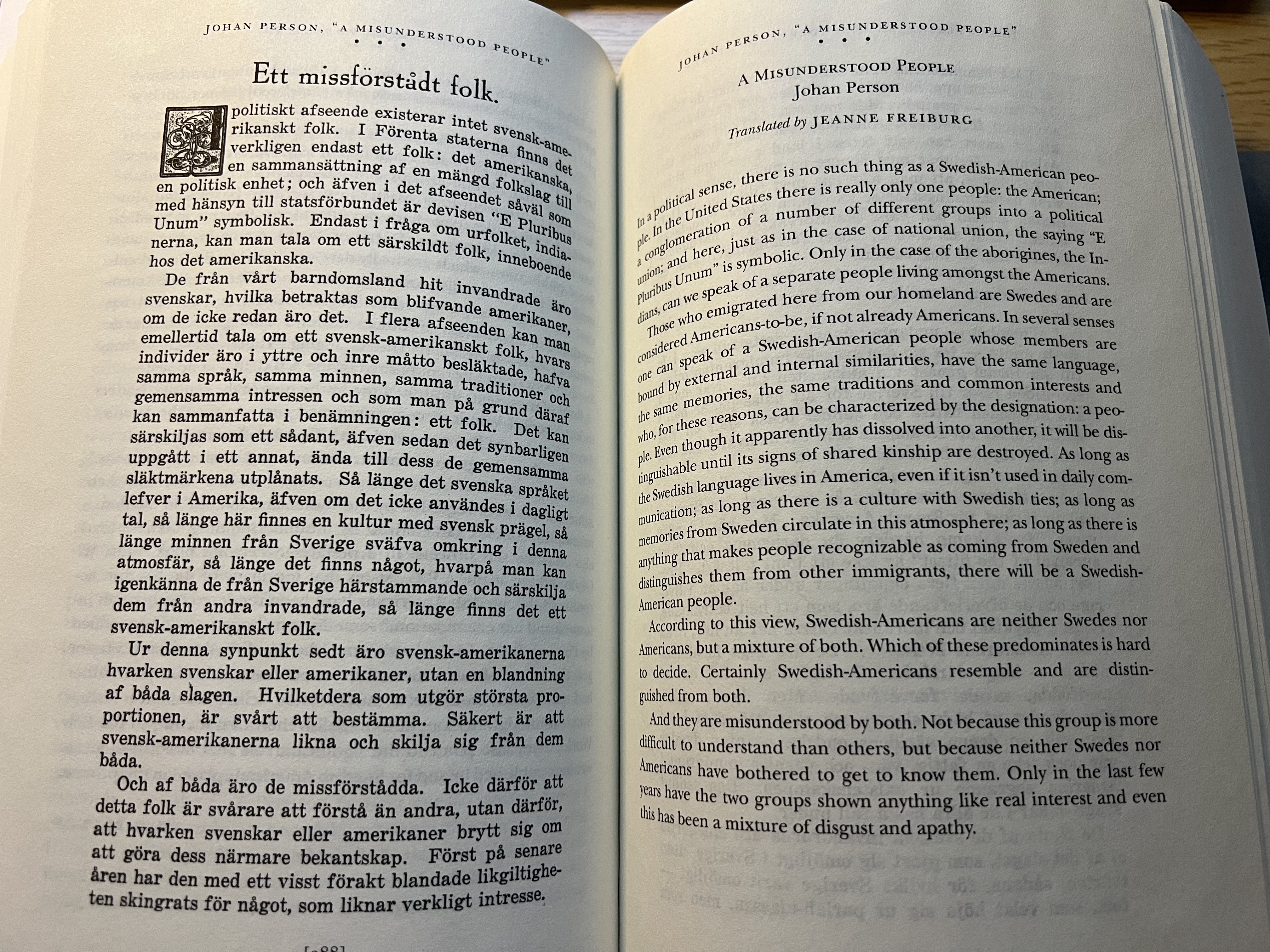
The third paragraph in reads this: “…Swedish-Americans are neither Swedes nor Americans, but a mixture of both.” So the diaspora cultural barges continue to float and evolve in their own directions and ways. And so do the host countries of their origins. Does it mean one group gets to really get in the face of another group and let them know, “This is how it is supposed to be!!!” I suppose. But it seems to reflect more of the insecurities of the assert-er than it does about anything else. And insecurities are okay, too: no human is human without them. It would appear the assertions are more grounded in a person’s or people’s want to have a cultural anchor of some sort, especially in a present that perceptively seems so out of control. Perceptively. Okay, that’s all I got on that. On with my day.

 The Edge of the Village