Tag Archives: Grand Forks

Northern Plainsing Summer 2024

I’m on site at the University of North Dakota this week for professional work and research. While on site, walking across the campus mall, it was a pleasure to see the memorial tree of the late Joel Jonientz, professor of art and design who, in the inscription of his eternal self descriptor, always “loved a bad plan.” Other phrases that come to mind when recalling Joel (he and I interacted directly like 2-5 times in the course of us walking the earth at the same time): “You wanna know how you accomplish something?” This was a rhetorical line of questioning from Joel. He said this to me in like February of 2013 while we were at a high top table at the used-to-be HoDo, now the remodeled BlarneyStone in downtown Fargo. This as we were ramping up with collaborators to carry forward the first global Punk Archaeology Un-Conference at the historic and since bulldozed Sidestreet Tavern (one finds as the decades proceed, one is saying “the old one, not the new one” a lot more and more). He’d follow this by saying something to the effect of, “Ninety-eight percent of it is will power. That’s it.” Not all in one big shot will power. Like sustained will power. Willing power, making incremental gains, sometimes of the magnitude that could be similarly gauged by clipping a hang nail.
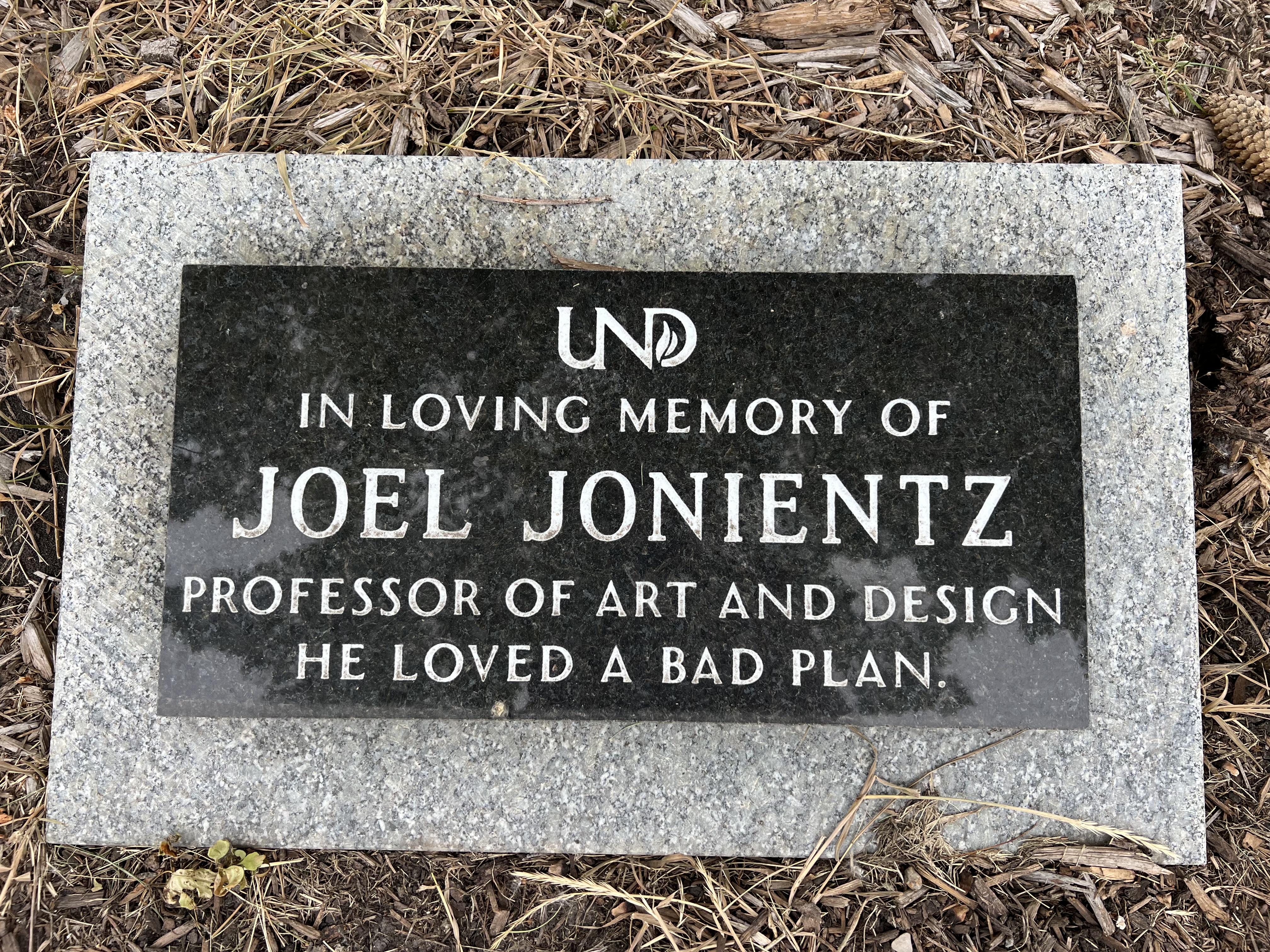
Anyhow, some description of the landscape architecture and my own mental point of entry where Joel’s memorial tree resides. The tree itself is a silver maple. I rant the tree image through the PictureThis app on the iPhone. Joel (and the ripple effect of his collaborators) liked detail. So here is some detail. The silver maple is also known as soft maple, water maple, river maple, white maple, creek maple. The latter name, the creek maple, is fitting, as his memorial and this tree is planted near English Coulee (aka creek; and aka “English” as in a departmental discipline) on UND’s campus. The Latin (“It’s a dead language!”) name is Acer saccharinum. It is one of the most common deciduous tress in the United States and southeast Canada. So hardiness zones of 5-9, sustaining Fahrenheit temps from -4 to 100 degrees. It can get vertical from 5-9 stories high. I looked up and snapped this photo of the canopy that arches out over the sweet granite memorial to Joel. It’s okay to lay in the grass and look up at tree canopies.

Also, there are several families of geese with their teenage geese offspring hanging out around the English creek. This just east of the Hughes Fine Arts Center (same Hughes namesake fellow of the Hughes Junior High I attended in the early 1990s in Bismarck — he invented or popularized some kind of electric stove for the world).


Punk Archaeology Updates

Before getting after some technical writing this morning (only to be later usurped by some Dakota language studies), I thought I’d link to some forthcoming scholarly analyses on the cultural movement of Punk in all of its unadulterated filth and fury. You can read about the soon-to-be-realeased Punk Archaeology anthology here, and about a work of Punk Sociology here. It was great this morning to come across a local story of a proto-punk Jonathan Richman, who is getting ready to play the Aquarium in downtown Fargo, North Dakota this next week too.

On this single-chord punk note, it’s appropriate to mention the passing of one of the first proto-punks, as memorials and obituaries on Lou Reed have been popping up all over the place (here, here, here and here). This shouldn’t eclipse the passing of folk punk hero Phil Chevron (aka, Philip Ryan of The Pogues or The Popes, depending on the year) in early October 2013. A sad reality for sure, and a time for reflection and contemplation.

An October 19, 2013 photo of Modern Times Cafe.

An October 19, 2013 photo of Modern Times Cafe.

And although we are losing our original punk heroes, punk culture continues pushing in a variety of directions today. Here is a photo from some boots-on-the-ground punk (lower case “p”), this coming from the delicious Modern Times cafe in Minneapolis, Minnesota. A couple weeks ago Molly and I had a chance to make a quick jaunt down the I-94 block from Fargo to MSP to visit a couple friends, and the next morning we hit up this cafe. It’s at the intersection of Chicago Avenue and E. 32nd St. in Minneapolis, and everyone should go here. It’s a place where punks either are parents or a place where punks bring their parents to engage in politely brash conversation and society. A couple more photos below, one of the delicious breakfast meal, and below that a photo of a post card from the fine by-and-for establishment. The only thought left was this: “When will Modern Times open up in downtown Fargo and Grand Forks?”

Delicious, sensibly priced breakfast from Modern Times Cafe.

Delicious, sensibly priced breakfast from Modern Times Cafe.

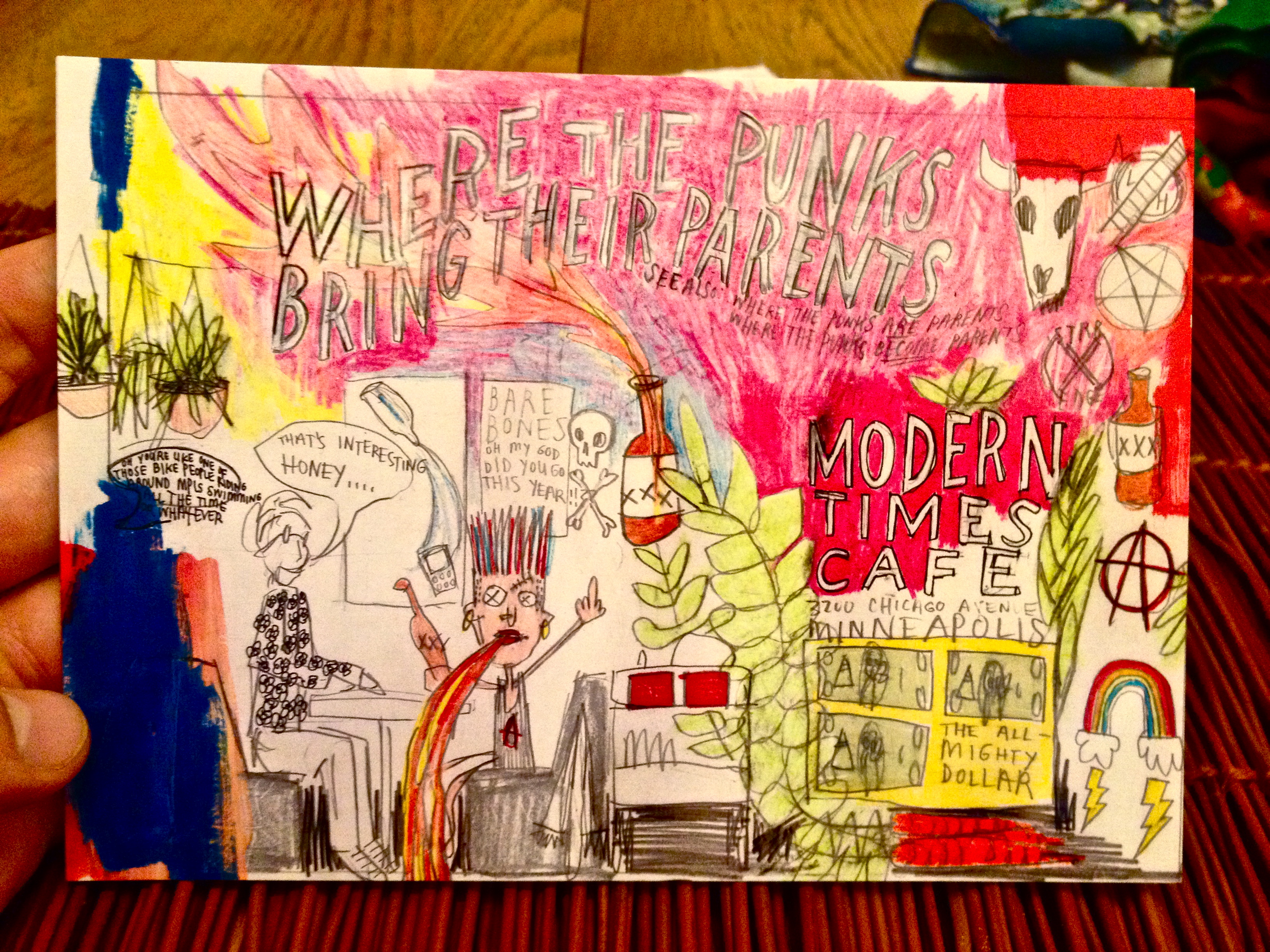
A Modern Times Cafe postcard indicating that this is a place where punks bring their parents.

A Modern Times Cafe postcard indicating that this is a place where punks bring their parents.

At the right, the viewer is informed with the icons that Modern Times is anti-establishment. This includes an anarchist logo, a rainbow with lightning bolts, a pentagram (suggestive of neo-pagan revivalism or acceptance), a phrase that mocks “The All-Mighty Dollar” (strongly suggestive of a counter-capitalist culture), and so on. At the top is a descriptive banner that says, “Where the punks bring their parents; see also: where the punks are parents, where the punks become parents.” Seated in the lower left are two individuals, presumably a mother and her son. Impressionistically, the son is advertising to one and all that he doesn’t care (this indicative of his hoisted left-handed single digit and a “xxx” booze bottle in his right). His mother, like all loving mothers, is just happy to see that her son is engaged in activities of all sorts. She is responding to her son, saying, “That’s interesting honey…”


Neighborhood Historical Research: Some Initial Thoughts on a Grand Forks Micro-History

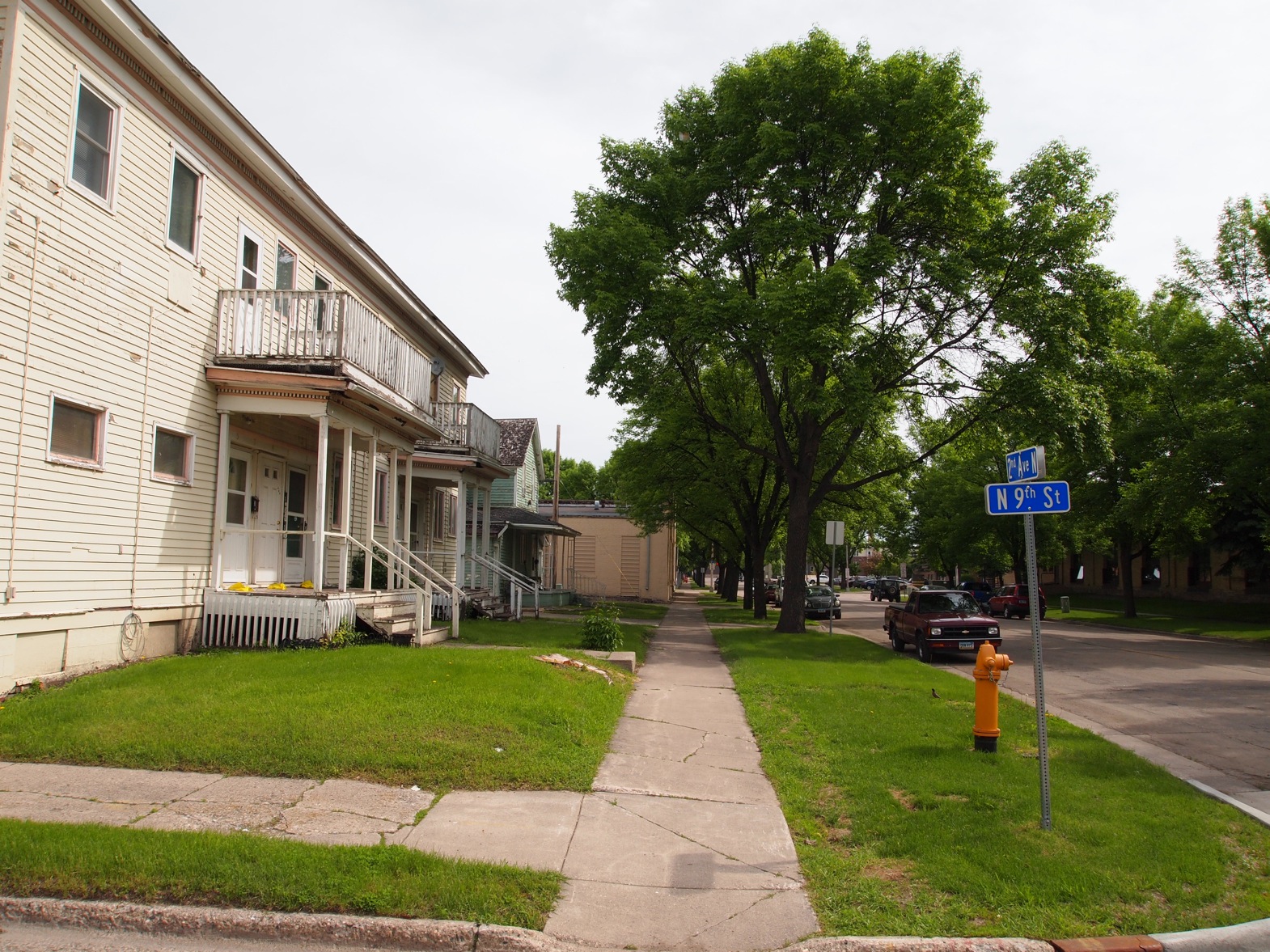
The intersection of 2nd Avenue North and North 9th Street in Grand Forks, North Dakota. Photo from June 12, 2013.

The intersection of 2nd Avenue North and North 9th Street in Grand Forks, North Dakota. Photo from June 12, 2013.

Last week I had some historic preservation detail that took me up to Grand Forks, North Dakota, this along the Red River of the North which in turn is within the Hudson Bay watershed. While I tended to one project, I also found a bit of down time to engage another project.

Some months ago friends Bill Caraher and Bret Weber (professors at one of my — ahem — alma maters, this the University of North Dakota) asked if I would be interested in making a contribution to their Neighborhood History series in Grand Forks. Even before Caraher finished the sentence, I remember saying, “Yes, yes. I’ll do it. I would love to.” So after paying my research location a second visit, I started thinking about how I would outline my research area. The primary area concerns 824 2nd Avenue North, and this falls just a few blocks beyond the boundaries of the Grand Forks downtown historic district.

During the actual field work visit, I not only took photos of this primary area of focus, but I also decided it would be good to saunter around the entire area. So I walked up and down the street a few times and then around the block, photographing each structure and taking in a lot of the overgrown foliage. The northwest side of this block has gone really green (perhaps more-so out of owner neglect than owner ethos — of course, not mistaking

The foundation of 824 2nd Avenue North is brick.

The foundation of 824 2nd Avenue North is brick.

that neglect could be an ethos). The primary area of focus, the southwestern side of the block, tends more toward the concrete jungle. The southeastern portion of the block remains commercial and industrial (Cole Papers), and the northeastern portion of the block has a few residences amidst vacant lots with manicured lawns.

After this fieldwork, and once home, I pulled up Google Earth, and organized three areas I would study with different intensities. Then I decided I’d just approach these areas with the first three criteria laid out by the National Register of Historic Places (no sense in trying to re-invent the NRHP). But instead of cobbling a micro-history together in the otherwise clunky National Register Nomination or Site Form format, I decided to use a hybrid combination of a blogging voice and academic narrative complete with the rigors of U of Chicago footnoting and see how that goes (everything has shortcomings).

I’ll be able to draft architectural descriptions of exteriors and façades, and secondary local, regional and national sources will contribute to showing how this neighborhood reflected broader, national themes. But the true grunt work, as I see it, will be tracking the various chains-of-ownership within each structure. I’ve done this numerous times, and the only way to go about it is within a County Courthouse. I’ll be sure to track the primary residence (824), and from there I’ll see how much more data would be needed for a simultaneously thorough but concise micro-history.

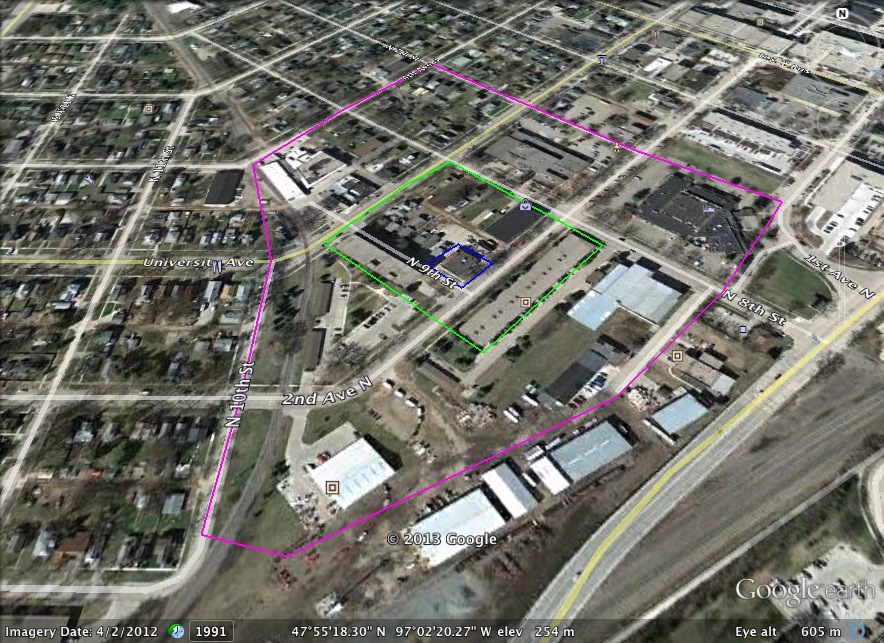
The research boundaries for a micro-history of a neighborhood in Grand Forks, North Dakota.

The research boundaries for a micro-history of a neighborhood in Grand Forks, North Dakota.

So with that said, here is the research triage model I imposed on this neighborhood. Don’t worry: historians impose on the historical record all the time — we wouldn’t be humans if we did not consciously or subconsciously impose on any data set. Just remember to be very suspicious of anyone who says they have found some kind of research design or reporting scheme that ensures absolute objectivity. This is why I tend to use the phrase “subjective objectivity” or “objective subjectivity,” but only in conversation.

Within Google Earth I outlined three areas. The first is of the residence in question, which is outlined in blue. The second is more peripheral, an area outlined in neon green, and the third is (yeah) outlined in neon purple. No doubt, depending on what I can track down during the research process, the study areas may shift a bit here and there. But the idea this last weekend was to delineate some kind of research boundaries so I’m non trying to herd historical cats. More updates as they come in.