Tag Archives: Fargo

Thoughts on the Fargo History Project: An NDSU Public History Initiative

As Dr. Angela Smith and a cohort of digital public historians prepares this week for Friday’s grand unveiling of the Fargo History Project at the Plains Art Museum in downtown Fargo, North Dakota, I thought I’d pull a couple titles off the shelf and revisit them to work up some thoughts for opening and/or closing remarks later this week at that event. The class has benefitted from the scholarship of Carroll Engelhardt, Gateway to the Northern Plains: Railroads and the Birth of Fargo and Moorhead (University of Minnesota Press, 2007), from visiting the primary sources within the North Dakota Institute for Regional Studies, and from first-hand visits to the physical places throughout Fargo. Each individual scholar honed in on specific segments of Fargo history between the years of 1871-1893, and they developed short blog-style entries on these topics. In almost every case, digitized historic pictures either compliment the stories or contribute to the analysis, context, and content.
Urban HistoryBringing all of these seemingly disparate and compartmentalized mini-histories under an umbrella of sense requires us to think about cities in the American West as distillations of the resources pulled in from the countryside’s natural, renewable, and non-renewable resources. So what this means is that when we drive by a grain elevator in a rural setting, we should look at the landscape for the linear, abandoned railroad bed. Then we should think about how this was built by a variety of immigrant laborers, and how that provided a route for grain to make its way to larger elevators in urban areas with population concentrations, such as Fargo-Moorhead, Minneapolis-St.Paul, or Chicago. We can then think about how northern Great Plains agriculture is the reason there is a James J. Hill mansion in St. Paul, Minnesota, and how a state Bank of North Dakota, a state elevator in North Dakota, and regional co-ops were historic responses to fat cat Twin Cities bankers and urban industrial areas. Metropolitan bankers in the Twin Cities were not responsive enough to the needs of rural northern Plains farmers and ranchers. Rural farmers and ranchers decided to, in North Dakota, form a state bank.

It is also possible to think about the historic archaeology of dairy cooperatives as responses to large centers of eastern industry. The industrial, assembly-line manufacturing centers (sometimes called Fordism rather than Capitalism) flooded the market with cheap dairy products. They didn’t do this in some cynical or conspiratorial way. But they did it out of their own self-interest. Historical actors in the upper Mid-West and on the northern Great Plains had to figure out ways to make a living, and they in turn responded. They were not going to wait around for industrial assembly lines to become “more ethical.” This is why large local swaths of Scandinavian immigrants in Wisconsin, Minnesota and North Dakota formed rural dairy co-ops. Through these co-ops, they could once again compete with industrial centers. The architecture of the dairy co-ops still occupy our urban and rural landscapes, and in some cases — at least in Fargo — they provide punk rock bands with basement practice space.

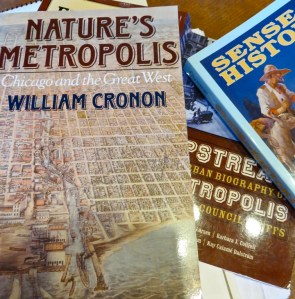
That is the interplay, the push and the pull between urban and rural. Again, making sense out of all of this gets a historian thinking about historiography. Here is what William Cronon said in “Kennecott Journey,” Under an Open Sky: Rethinking America’s Western Past (1992):

Mapping out the geography of gender, class, race, and ethnicity remains one of the most important but least studied aspects of environmental history. (Cronon, 1992: 45)

It has been two decades since Cronon said this, and as it pertains to our history of Fargo project, it is important to keep in mind how the individual cultural actors within the history of Fargo perceived the natural and urban world, and also how they acted and reacted to ecology, or nature’s metropolis.


Raw Field Notes: A Punk Archaeology Meeting with J. Earl Miller and Phil Leitch

Notes scribbled down during a punk archaeology meeting with J. Earl Miller and Phil Leitch on November 26, 2012 at Sidestreet in downtown Fargo, North Dakota.

On November 26, 2012, around 6pm at Sidestreet Grill & Pub in downtown Fargo, North Dakota, I met with J. Earl Miller and Phil Leitch. A couple days ago Miller texted me and said Phil and I should meet and chat (one never knows what one is going to discover with a chat). So we did that.

Phil told me many things. One of these things had to do with dark house spear fishing. I thought it sounded like a punk band, but Phil said it’s something his father does during the winters on the northern Great Plains. Phil’s dad wrote a book about this practice, that of which you can purchase at this link here. I just ordered mine.

At top left are the rest of the raw notes I scribbled down. J. Earl Miller also said he wanted lard instead of cream cheese used in all frosting, both foreign and domestic. That is where the eventual phrase, “Fistfull of Crisco” within the notes came from. And then the word “Lardcore” was dropped, this a slight variation on hard core.

Anyhow, the left side of the page is what I took down while we had our hour long conversation. The right side is the follow up notes I took just after J. Earl Miller and Phil Leitch left to continue their dart league circuit (I think they played at Rooter’s this evening).

It’s a good idea to scribble down notes during and immediately after, and any archaeologist will tell you the same. Especially if this is data or a memory (objective or subjective) you want to, well, remember. Don’t trust your instincts weeks later to somehow magically recall everything that you did, this as you sit in front of a computer monitor trying to recall how it all played out. Just jot it down then and there. Then look at it two weeks from then, this when you are sitting down and trying to remember what happened. The notes will jog your memory. Seriously.

Note: Sid Vicious died on February 2, 1979. Leitch noted this early on during our meeting, and he also noted that the Punk Archaeology round table will take place on that day, February 2. Leitch also said to visit the Fargo Band Family Tree website, which is linked here.


Punk Archaeology: Joe Strummer on DIY

This evening I revisited the documentary, “Joe Strummer: The Future is Unwritten” on the Web 2.0/DIY platform that is YouTube. I have AppleTV jacked into a shamelessly huge flat-screen, and the AppleTV somehow allows me the ability to stream any YouTube selection through it. So by punching in “Joe Strummer: The Future is Unwritten,” YouTube’s search engine returned a series of 2008 uploads by the YouTuber named “madferrett.” Smack dab on 4:02/8:24 in the fourth of eleven installments (the subtitle is “Squatting 101’ers DAY’S”), the late Joe Strummer defines Punk as straight-away Do-It-Yourself. Of this DIY ethos, Joe in the video says:

We had the nerve to rent a room above a pub, and charge people 10 p [aka, pence] to get in. That’s how we learned to play, by doing it for ourselves, which is like a punk ethos. I mean, you gotta be able to go out there and do it yourself, because no one is going to give it to you.

Here is the Joe Strummer YouTube embed:

In the long-winded scheme of things, this is also referred to as being an autodidactic, or a self-taught learner. As fellow blogger Bill Caraher and I continue conversations with any and all about Punk Archaeology, this invariably has helped develop and shape the all-important fineries of the Punk Archaeology conference scheduled to take place in downtown Fargo, North Dakota on February 2-3, 2013 (it starts Saturday evening and is scheduled to end Sunday morning).

It seemed reasonable to post Joe’s remarks, if nothing else to continue to consider what the phrase Punk Archaeology means. In one sense, there is the localized archaeology of punk within Fargo-Moorhead, where any number of bands formed up in DIY fashion to cut loose on stage. In another sense, there is punk archaeology (or Punk Archaeology, depending on how formal one wants to be), the latter word “archaeology” not only specific to the discipline of said archaeology, but also to other DIY attitudes intrinsic to sustaining the disciplines and vocations and trades, and also as in the archaeology of knowledge. Punk archaeology is all around, and often right in front of us. Back to it on this end.


Coffee Science in Fargo

I was trying to think of something epic to blog on for this 100th theedgeofthevillage.com post. Since winter has taken over autumn on the northern Great Plains, hot coffee seems just as good a topic for analysis as any. There are a couple places around the campus of North Dakota State University to purchase cups of coffee. As of late, I have wondered about coffee temperatures. This thought came from being served super-heated coffee in paper cups with those petro-plastic lids within NDSU’s memorial union — a place that fosters memory and unity, no doubt. In the last couple weeks, I have encased the paper cup in one of those cardboard sleeves, and have had to let the super-heated coffee cool enough to sip. Once cooled, I sip the coffee, but then wonder whether the heat melted the insides of the cup: was I just tasting burnt coffee? Or was I tasting coffee infused with melted glue? And was this more damaging to my innards than, say, drinking pints of chilled energy drinks that seem to have begun replacing otherwise traditional coffee drinking? I have no idea, but this in turn led to another idea: data collection on the heat temps of coffee around the Fargo-Moorhead area. So this is the first entry of coffee SCIENCE! in Fargo, North Dakota.

The coffee reviewed in this case is not from the coffee shop alluded to above. Instead, this coffee is from Jitter’s, a coffee house located to the southwest of the intersection of 12th Avenue North and Albrecht Boulevard in Fargo, North Dakota. Here is the raw data from my field notes. Equipment used: one of those thermometers you pick up for around five bucks at the grocery store.

Coffee science.

Objective data: On November 13, 2012, at 9:30AM, the temperature reading from the medium roast coffee just pumped from a thermos into a heated ceramic mug at Jitter’s read 151° F.  The room temperature read 70° F, and the outside winter temp was 19° F (this according to AccuWeather.com). A second reading was taken after a refill at 10:25AM, this at 139° F.

Subjective data: at 151° F, I was able to sip the coffee immediately (no need to let it cool). This immediacy was important since it is necessary to intersperse coffee sips with apple fritterer bites upon the ceremonious opening of the pastry bag. Before getting my coffee, I only had to stand in line for approximately 13 minutes while waiting for the two patrons ahead of me to order some kind of double soy latte decaf with a re-caffeinated infusion loaded with Italian syrup and topped with whipped cream (this will eventually contribute to the downfall of the West to North Korea, a running hypothesis of mine here).

Contribution to Coffee Memory: The rise of the prepared sugar bomb drinks could be felt easily in the year 2000 if a person was engaged in serious coffee drinking at the Dinkydome or throughout the coffee houses in Dinkytown, Minneapolis, Minnesota. It seemed a bit more gendered, though, at least in my mind, as I remember it. Young women tended to order white cafe mochas left and right. Today, full grown men are shamelessly purchasing these types of drinks — not that there’s anything wrong with that. Nonetheless, I’m fairly supportive of nudging our culture in the direction where there are separate but equal ordering lines in coffee houses: one for straight-up coffee drinkers, and the other for sugar-bomb drinkers. More to come on objective and subjective coffee data collection throughout Fargo, ND.


Punk Archaeology Inspiration

Studying and thinking deep about material culture is an interesting business. It is interesting because there is both the objective object, or the thing in front of you, and then there are the ideas that we as flesh-and-blood human beings attach to that object. And the word “attach” does not mean to suggest that an idea is somehow unreal, or fake. Ideas, after all, come

A piece by Michael Strand.

from the mind, and since the mind is real, so is the abstraction that is the idea. One doesn’t have to act on the idea, but nonetheless, the idea remains real.

In the last month and a half, North Dakota State University’s Michael Strand has had at least one conversation with me about this, well, idea. One evening he explained how he worked on creating an artisan bowl for food (and Michael often asks that his artwork be physically used for family style meals, especially if they are bowls and cups, as his Ted Talk video expands on below), and he used this serving bowl at a dinner with an ethnic Kurdish family in Washington state. He is poised to take this bowl to another Kurdish dinner, this one in northern Iraq. I believe that dinner is pending, but no doubt the bowl and the individuals around it (from Washington state to northern Iraq) will serve to connect ethnicity and individuals. In the business, we often call this community.

In a separate but similar vein, on September 14, 2012, Michael expanded on some of his art at a collaborative exhibit with his colleague Amy Smith. He encouraged me to photograph and share this art, and then I asked if I could put a digital camera in his face while I questioned and he provided answers to his latest works. He said it was no trouble at all. So I will do that here:

And then contrast it with his TedX Fargo Talk that colleague Angela Smith forwarded to me here…

…Michael was and is speaking in large part to how objects, or material culture, carries with them archaeological and historical — aka, humanized — provenance, at least if we, as humans, stop to consider it. This material culture can be both 2-dimensional in form (or what historians often refer to as “primary sources”) or it can be 3-dimensional (what everyone often calls “stuff”). The notion that objects carry ideas with them can loosely be referred to as Romanticism (which is a word with a LOT of baggage, none of which I will go into here), but it can also be referred to as an archaeological school of thought known as post-processualism. In another archaeological way this is what Ian Hodder asked readers to consider in an article I am furiously searching for throughout my shelves… ah, here it is. In his 1991 piece, “Interpretive Archaeology and Its Role” in American Antiquity (Vol. 56, No. 1, page 9) Hodder said,

…new theories and the new ways of writing them often serve to make archaeological texts more obscure and difficult for anyone but the highly trained theorist to decipher. How can alternative groups have access to a past that is locked up both intellectually and institutionally? Subordinate groups who wish to be involved in archaeological interpretation need to be provided with the means and mechanisms for interacting with the archaeological past in different ways. This is not a matter of popularizing the past but of transforming the relations of production of archaeological knowledge into more democratic structures.

The more I think about all of this, the interplay of ideas with material objects, the more necessary and impending it is to have a Punk Archaeology conference on the evening of February 2, 2013, in downtown Fargo, North Dakota (insert “Grow Buzz of Punk Archaeology Conference” here)…


The Archaeology of Fargo’s Hotel Bison

In preparation for the transition from summer to winter (which, on the northern Great Plains, is often preceded by at least two solid weeks of autumn), it is necessary to pull all a/c units from the windows and take them to hibernate, usually in basement storage rooms. While doing that this evening, I decided to photograph the hand-painted signage next to my storage space, a grand piece of commercial radio artwork that reflects some of the

Early and undated Bison Building signage, when KVOX 1280AM occupied the building.

earlier years of Hotel Bison, or the Bison Building, this located about the 400 block on Broadway Avenue in downtown Fargo. The angle the art portrays is of the northwest corner, and the Art Deco facade affixed to this commercial brick building reflects what had to be one of the earliest phases of modernization to the original Bison Hotel. In the painting, the facade and marquee notified passersby of the good food and coffee within. That marquee, at least in 2012, has long since been removed, as have any large or small KVOX radio towers on its roof. A quick search and cursory sampling this evening of the North Dakota Institute for Regional Studies (Fargo) database for “Bernie Ostrum” did not yield any specific results (just a broad barrage of digitized daily papers from North Dakota Agricultural College’s The Spectrum, among other items). You’ll note the radio persons on the painting as well, “Rod” the Disc Clerk, Manny Marget, Bernie Ostrum and Loehle Gast (quite likely radio namesakes).

Then and today, the Hotel Bison is situated immediate to the railroad passenger train in Fargo (this just across the parking lot to the north), and a person can imagine how many Fargo arrivals and outgoing passengers utilized the hotel. For a variety of reasons, the historic private and public economic and city forces of Fargo decided to continuously re-adapt and re-use Hotel Bison, so as of today it stands as one of the recognizable building-marks in the downtown area. In many ways this sign can be thought of in the same way as a cross-section of stratigraphy is in an archaeological test unit. The signage preserves particular perceptions in space and time, and so long as it is around (either in material or digitized form), we can glean information from it. I’ve been meaning to digitize that signage for a while, and it’s fascinating to capture how this building was used — and perceived — at a particular place and time in history. Finally got around to doing it in preparation for winter.


From Athens, Greece

As I type, the sturdy MacBook Pro has 29% battery power left. This is not because I forgot to purchase those handy power converters (I have two in my bag), but rather because I don’t think it would be a good idea to cut off that third prong on the MacBook Pro power cord just so I can get it into the two-prong outlet converter (I’ll figure this out once in Cyprus, or so I tell myself).

Some quick updates, a sort of on-line journal file:

Getting there, and the psychology leading up to traveling to a destination are in dispute. For some, the arrival to the destination signals the beginning of the vacation or, in my case, the archaeological

When you’re driving from Fargo to Rothaus’s in Sauk Rapids, Minnesota, your windshield starts looking like this.

fieldwork in Cyprus. Yet it seems more reasonable to consider the point at which the tickets are purchased as a type of prologue, or introductory transition, that signals the eventual beginning of a trip. Life is one gradual push out of one situation and into another, and the only way to distinguish between one event and the next is to psychologically impose order on it. Sometimes students will say (and I understand why they say this), “This isn’t how we did it in high-school.” Often I tell them I know, but I counter by explaining that it is no longer high-school, and this in turn is part of pushing out of one situation in life and transitioning into another. In many ways this is called reconditioning one’s behavior. In lay-terms it is known as getting one’s crap together. Much of life is about getting there, about getting one’s crap together to get there.

Anyhow, on May 14, 2012, I loaded two bags into the ’93 Chevy S-10 and drove from Fargo to Sauk Rapids, MN. Richard Rothaus, a friend and colleague, shuttled me from his home down to the MSP-International. We talked about past and future archaeological, historical, ethnographic, genealogical and anthropological fieldwork. I told him I had been reading up on Zeno of Citium, and Rothaus openly considered Zeno’s paradox — that is, when an arrow is fired at a tree, it invariably

From London, tell the pilot to head east-bound across the channel, and then hang about a 45 degree right at Brussels. Eventually you’ll get to this.

reaches a point where it is half way there. Then it is half-way to half-way there. Then half-way to half-way to half-way there, and so on, and the question remains: how does the arrow ever get to the tree if it is always half-way there? He said, “Zeno did not have calculus technology yet.” I said, “Yeah, eventually I’d have to tell Zeno that the arrow will get there when it gets there.” Rothaus eventually got me at that top-tier roadway at MSP International.

The line at the airport wasn’t much of a line. Instead it was the standard mob of confusion and misdirected energy, as it normally is at airports. Numerous individuals are dropped off, and they are all looking to be in a hurry and get where they need to get. A confluence of human energy shuttled through the check-in lines and security, all preparing to board planes that take them to different regions, different parts of the nation, or on some international travel, perhaps even a relocation or re-settlement. Airlines are hybrids of government (for the people, by the people) and corporations (a few making money by providing a service to the many), and they do what they can to manage this grand confluence of energy.

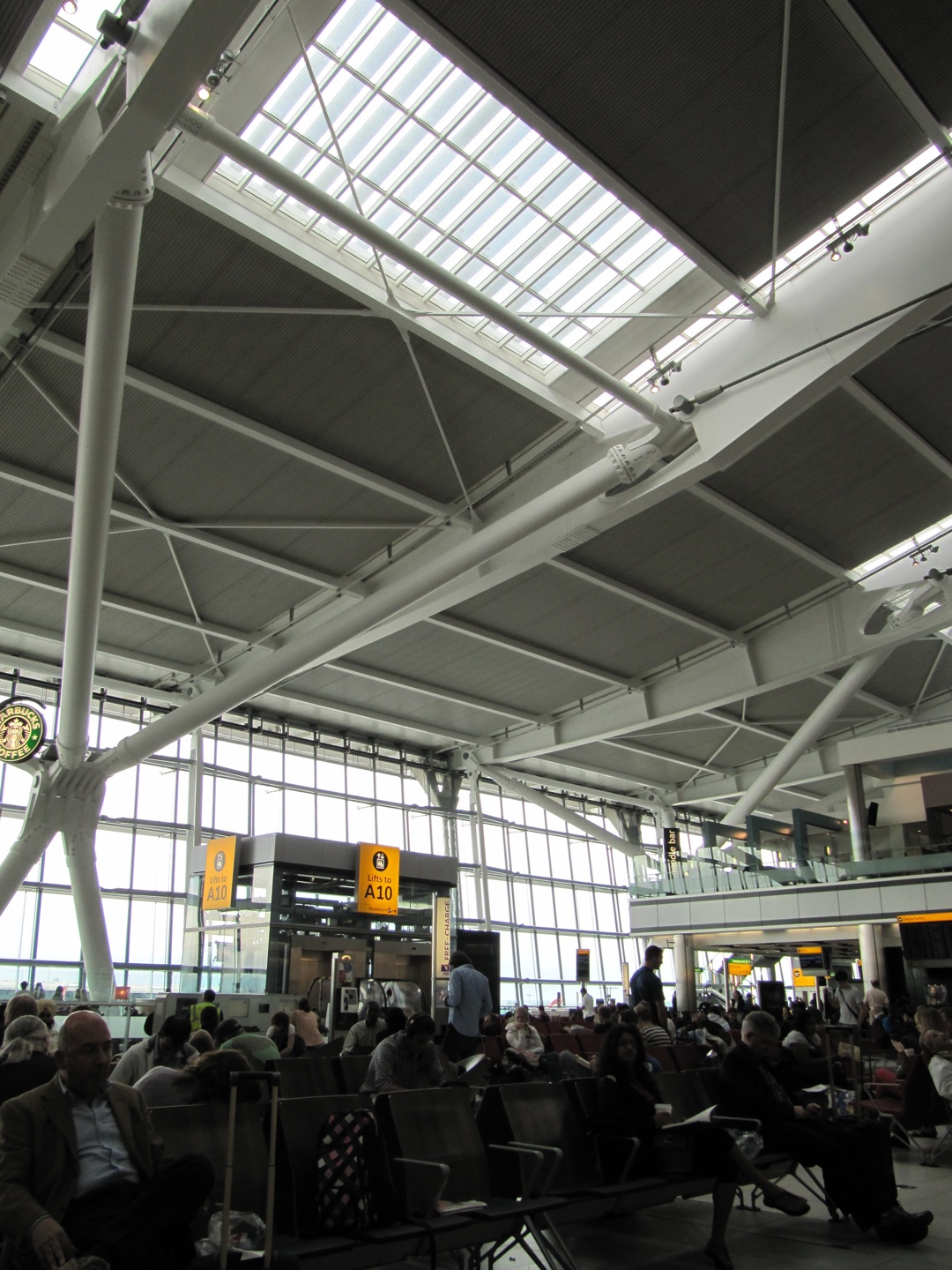
Terminal 5, the correct terminal at Heathrow, and the obligatory Starbucks and some clear-span interior architecture. The airport’s architecture gives the feeling that one is inside of an airplane wing.

At the terminal gate I had about 28 minutes to kill (or, if you’re French, 28 minutes — or time — continued killing me). An airport tavern that sells those over-priced beers was within meters of my terminal, so I decided to imbibe and refortify. The bartender, it turned out, originally hailed from Bulgaria. He immigrated to the United States some 20 years prior as a university exchange student. He said he studied veterinary science and technique at the University of Minnesota, the St. Paul campus. “My family has lots of animals back in Bulgaria!” he said over his shoulder to me, while walking away to pour another draft beer. Two bar-stools to my right was a woman drinking a half-glass of white wine. Eventually she confessed to the bar tender that she was unprepared to return home to Virginia as she had been having such an agreeable time with her family in the Twin Cities. The bar-tender wanted to chat about the famous borderlands rivalries of eastern Europe, vestiges of the Ottoman Empire, the Balkans, Greece (and so on and so forth). I reframed the conversation and asked him if he heard about Zeno of Citium, especially about Zeno’s awesome beard (pointed out to me by a friend from Missoula), something Chuck Klosterman may be aspiring to as well.

I boosted the exposure on this in order to see the early morning lights in Athens a bit better. This photo was taken about 2:30AM on the inbound flight.

Then it was from MSP to Dallas/Ft. Worth, north to south across the Great Plains, to join up with a connecting flight from said Dallas/Ft. Worth across the Atlantic to London. If I had to do this all over again, I think I’d try to avoid another 8 or 9 hour layover in Heathrow. The hours pile up, and eventually when you’ve entered into a type of time vacuum continuum (which is common when spending large amounts of time in airports), and all the hours seem to revert and jump forward and then revert again, and you’re trying to purchase your second power converter, the merchant will invariably check your ticket and inform you that you need to be in Terminal 5 rather than purchasing power converters, eating panini sandwiches, and thinking you’re in the correct terminal while people watching for hours on end in Terminal 3. Thank the merchant after she or he points this out for you.

Out of all the airports, the personnel in each one must have some kind of Aaron Barth Management Training. They are certainly ready for us. They are all extremely pleasant, from MSP to Athens. The power level in the MacBook Pro is at 18%. Time to post and shut down.


An Evening Stroll in Downtown Fargo

Often times a Wednesday evening walk is in order to counter or shake off the protracted sitting incurred throughout the day (Homo sapien is at a peculiar time in history, the most sedentary we’ve been since emerging out of east Africa some 150,000 to 200,000 years ago). To recap my

A May 2, 2012 photo of Rick Gion in one of his natural habitats.

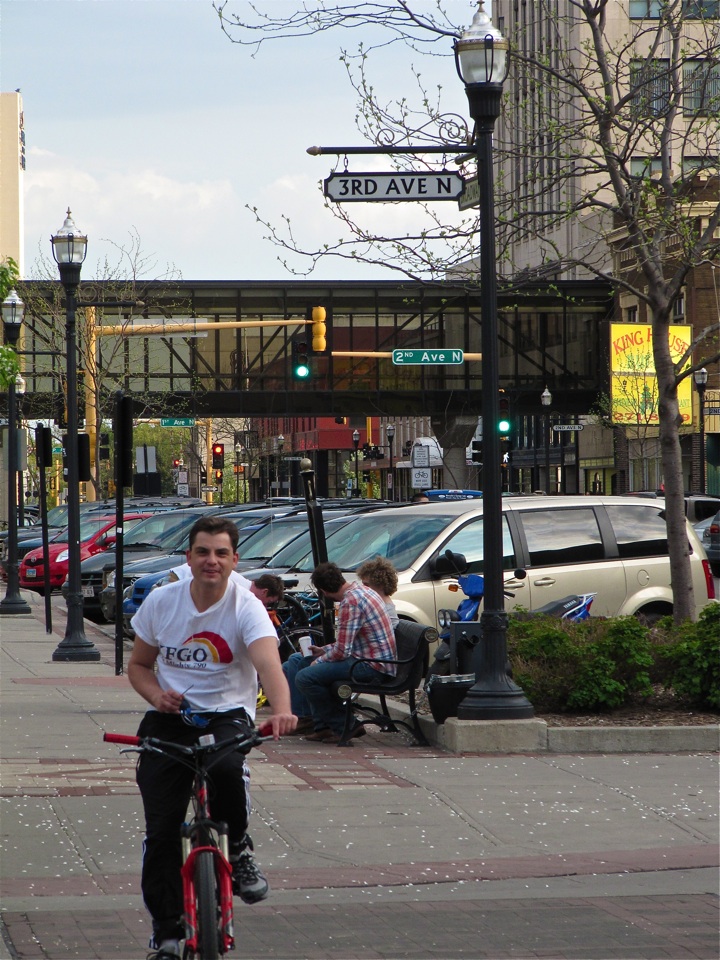
walk from May 2, 2012, about the 7:30PM hour, I set out from 4th Avenue and Broadway in downtown Fargo and headed south toward Island Park. Along the way I noticed that groups of two-to-five or more gathered here and there, folks wanting to be outside with the short-sleeve temps and all. They tended to station themselves on the sidewalk benches installed at the ends of each block. About a block south of where I started my walk I ran into Rick Gion (or Rick Gion ran into me) to, as we often say, shoot the breeze. After busting each-other’s chops a bit (which is a North Dakota thing to do), Rick rode off to the north and I continued south. After that I called my father on my cell phone, and also thought of the mobility cell phones allow us. Not that many years ago a chat on the telephone required that we seek out a telephone which in turn was attached to a telephone line: this arguably required more social commitment, since you had to call someone, plan on being at a set location, and then do everything possible to make it to that location at the designated time. Today the convenience of cell phones and text-messaging ensures that you will receive something like 3 to 17 texts from the party you intend to meet, first canceling the meeting, then rescheduling the time and location, and then informing one another that you are within 2 minutes of arriving via text. Cell phone technology influences our behavior, but technology does that often. It shifts how we behave throughout time, and tracking this otherwise gradual change is one of the businesses of historians. Phone booths are nearly if not entirely obsolete, now, and I often wonder if in two or three decades (or even sooner) we will look at the 20th century as the Age of the Telephone Land Line. Anyhow, I phoned my dad because before setting out on my walk a couple

About Main and Broadway in Fargo on May 2, 2012. Photo looks west toward the storm dumping rain on central North Dakota.

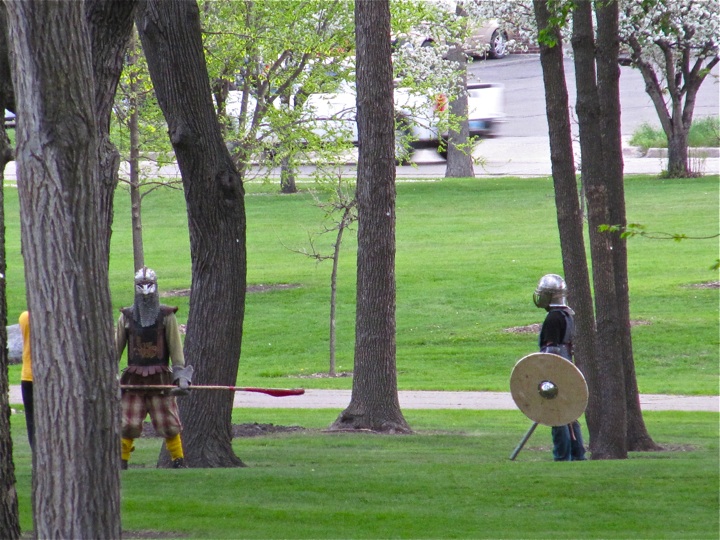
friends from Bismarck updated their social media web site with information about rain and possible hail. I wanted to check up on that, chat with kin, and since the weather is a very neutral topic, it is a great way to have a conversation with basically anyone in or outside of North Dakota. I stopped just north of the intersection of Main Avenue and Broadway, looked west, and snapped a photo of the eastern tops of the cloud system that was saturating Bismarck. I communicated this to my dad, and then moved on to other neutral topics such as the price of gas, how the Twins are doing, and so on. Eventually I got into Island Park, and visited the Henrik Wergeland statue, which has been a monument for quite some time, a video-history of which can be seen here. I circled the monument, and then to the west noticed a chivalrous scene playing out. I snapped a photo of that as well. “So this is what some people do on Wednesday evenings…” I thought. “Interesting…” By the time I rounded the park, the cell

Knights at Island Park in downtown Fargo, North Dakota.

phone conversation had ended and another couple folks spotted me. So more light banter ensued, and I remember asking the two if they had yet seen the Cold War Comedy, “Spies Like Us.” This was the third time in 24 hours that I’ve asked groups of two or more if they had viewed this movie. Each time the groups have responded with no. For some reason I think it’s important for people to watch it. After that, the final stretch of my walk took me back up Broadway, and I inadvertently ran into Den Bolda, perhaps one of the most accomplished Civil War reenactors in the tri-state area. I say this only after learning that Mr. Bolda had just finished attending another knitting class, this so he could reproduce vintage (aka, knit) Civil War wool socks to wear at all the 150th anniversary mock-battles back east. Nice work, Den. Nice work indeed.