
The last couple days I have been on a text message thread with a descendant of settlers who activated and ran Driscoll, Burleigh County, North Dakota, in the first couple decades of the twentieth century (let’s say from 1900 to 1920s or so). The text message thread came about as many months earlier I had been reading and blogging Era Bell Thompson’s memoir (some more here), one of two she wrote and published, American Daughter (University of Chicago Press, 1946).
In 1946, Era Bell, on page 21, provides a description of how she remembered Driscoll in the 1910s:
“Driscoll was a typical small North Dakota town, population about one hundred. Main Street, a broad, snow-packed road, was lined on both sides with frame store buildings, and its few homes were scattered out to the west of Main and south toward the Lutheran and Protestant cemeteries. A four-room consolidated school sat upon a hill, midway between the cemeteries and town.”
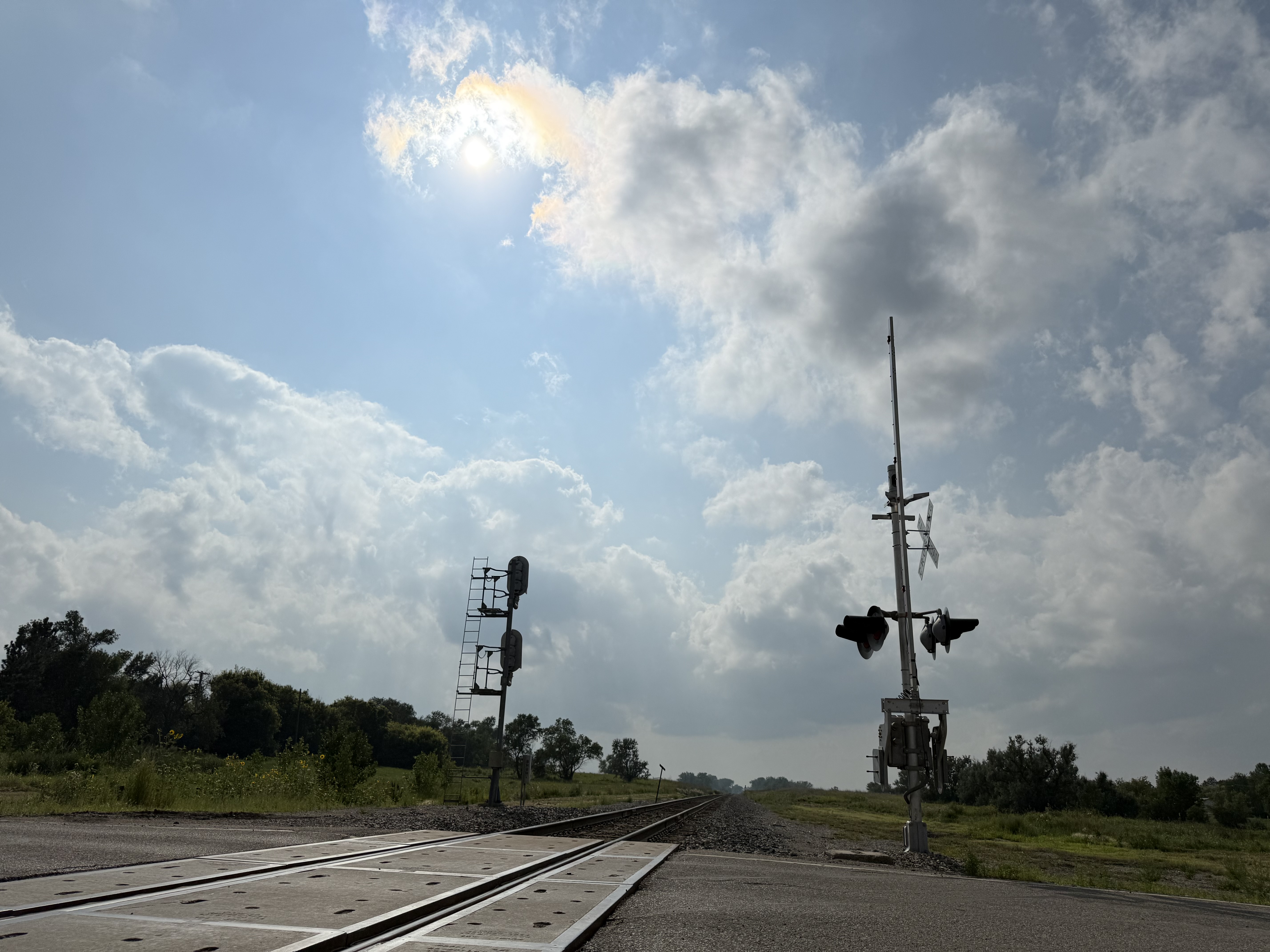
On August 3, 2025, I had a chance to stop along where the north-south automotive road crossed the east-west railroad tracks at Driscoll in an attempts to better acquaint myself with the landscape, and imagine what had been 110 years prior. Fast forward to this week of December 14, 2025, and the text message thread: Kate Herzog (also a commissioner for Bismarck Parks & Recreation District) mentioned some of her great grandparents owned the Grand Palace Hotel, she thinks in the 1910s. Perhaps a bit later. Now cut back to Era Bell Thompson’s 1946 memory of her family relocating from a house “to the empty hotel on the edge of town” (page 26 of American Daughter). Was this the same hotel? I mean, how many hotels could have a town of approximately 100 people supported in the 1910s?
Of the hotel, Era Bell said,
“The hotel was an old, eighteen-room barn of a building, bare and cold, but we set up living quarters in the spacious kitchen, and that night Pop made southern hoecake on top of hte gigantic range and fried thick steaks in butter. The tightness was gone from the corners of his eyes as he threw his head back and sang, ‘I’m so glad, trouble don’t last alway, Oh, I’m so glad, trouble don’t last alway.'”
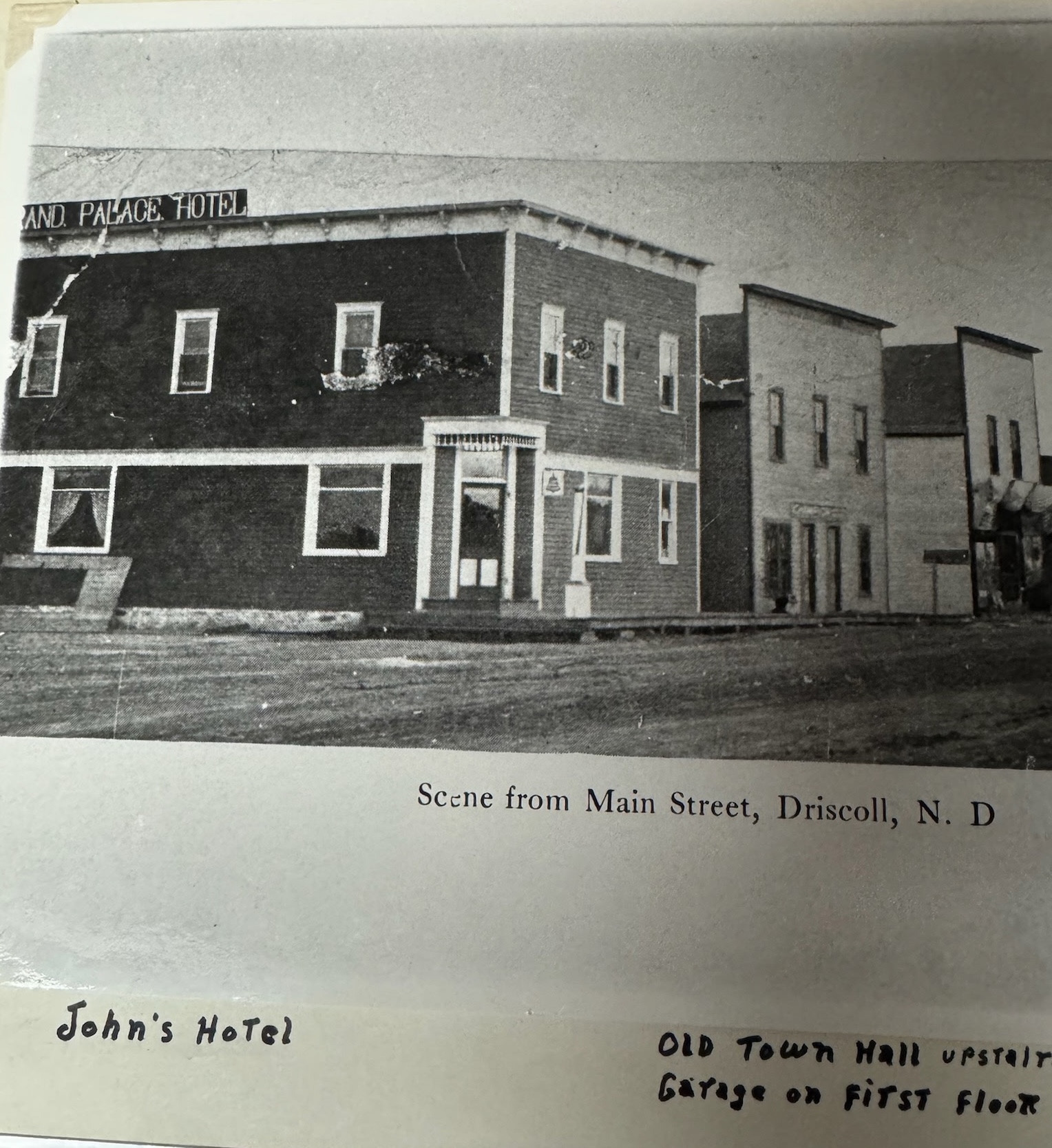
Also within Era Bell Thompson’s memoir is a Norwegian store owner and clerk identified as “Old Lady Anderson.” Herzog mentioned she had Norwegian kin in Driscoll with the surname Hanson. Are these interconnected somehow? Era Bell also mentioned an Oscar Olson, and a Hank Hansmeyer, the local blacksmith who offered the Thompson family land to share crop on a quarter section that had yet to be picked clear of glacial rock deposits. Era Bell recounted the agreement (page 29): “Hank… would furnish the land, the buildings, and the horses if we… would furnish the seed, do the work, and give him half the profits.”
There’s nothing definitive from this blog entry of mine. Only a continued fascination of the layers of meaning on a particular landscape. A landscape that could otherwise feel “like nothing is HERE!!!” We’ve heard this all too many times from visitors of our rural, or “rural.” Without this meaning, without the intentional and sustained want of us in the present to incrementally scratch the layers away to find out what has happened here in the written, published, and oral historical record, it may well remain a superficial place of “nothingness.” But there’s a lot going on here. A lot today. A lot from yesterday. It’s a model used by the fancier Simon Schama in his Landscape and Memory (Vintage, 1996). I’ll keep chugging on this. But for now, at least I’ve been able to locate in the present the person (Kate Herzog) who will help lead any real or imagined future landscape memory bus tours to Driscoll in eastern Burleigh County, North Dakota.


 The Edge of the Village