
Over the course of the last 100 years, Armistice Day evolved (things evolve, it’s okay) into the November 11 day that is called Veterans Day. I really do enjoy re-centering Veterans Day by returning to the sort of pieces of the past that pulls from its origins as Armistice Day. Earlier today, I texted this to a friend:
…the 11th hour of the 11th day of the 11th month, the machine guns fell silent and the cease fire was put into place. The geopolitical axes would continue to grind against the sharpening wheel, as the ‘surrender’ terms were too intense and could never have been accepted by the German-speaking people. The Austro-Hungarian Empire had imploded. In its wake, all sorts of nations emerged, and with that ethnicities that started asserting themselves as having the “birthright” origins of those nations. “No, my people were here first. Here’s a history that proves it.” All kinds of insanity like that. This also gave rise to internal political infighting, creating a power vacuum that allowed for the rise of insane political groups.
The above is where my mind drifts on the 11th hour of the 11th day of the 11th month. It was the Great War (there wasn’t supposed to be a second Great War, just the First).
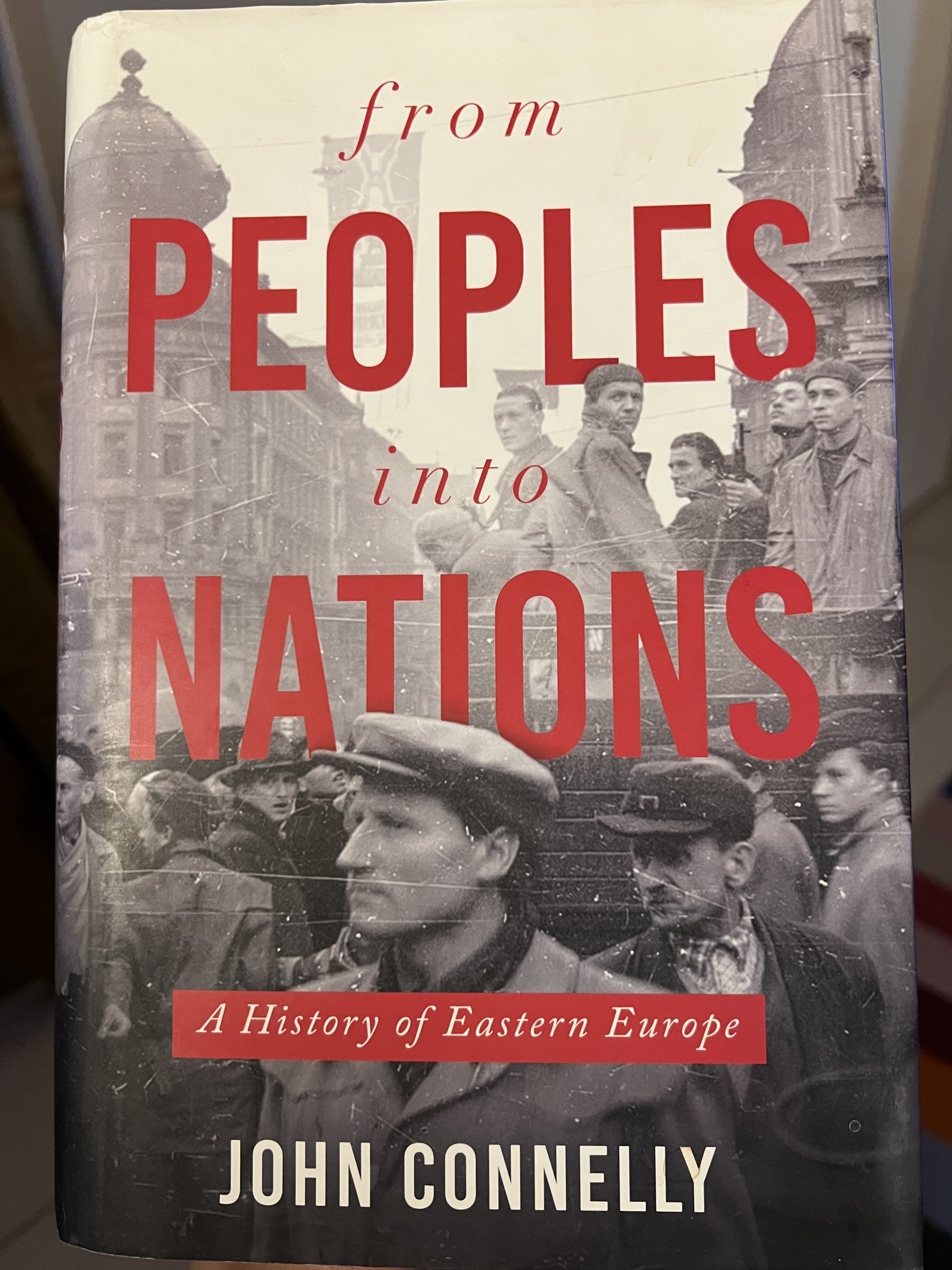
Of the First World War, one rather particularly good monograph (and recent) that I’ve gotten into the first couple introductory pages is John Connelly, From Peoples Into Nations: A History of Eastern Europe (Princeton University Press, 2020).
An excerpt below:
“War broke out in Europe in 1914 because of a deed carried out in the name of a people no one had previously heard of. That June, after years of internecine turmoil and armed conflict in southeastern Europe, a Bosnian Serb named Gavrilo Princip shot and killed Franz Ferdinand, heir to the Habsburg throne, in Sarajevo. The assassin said he was acting to defend the interests of the Yugoslavs, or South Slavs, who were seeking independence from the Austro-Hungarian monarchy.”
Connelly pulls the reader paragraph after paragraph through the decades following 1914:
“When the war ended in 1918, statesmen and revolutionary activists made a new Europe, drawing on the impulse that had taken hold of Gavrilo Princip and his friends: that peoples should govern themselves. Clothed in the words of national self-determination, this impulse was raised as a high political standard by both Bolshevik leader Vladimir I. Lenin and US President Woodrow Wilson, denoting socialism for the first, liberal democracy for the second.”
Ideological lines, whether they existed in reality or not, were drawn in the geopolitical sand. Here’s another zinger from Connelly:
“…nationalists are no more resistant to understanding than any other actors in history. They are guided by motives that are open to reconstruction and analysis. What seemed rational to one side of the nationality dispute usually seemed irrational to the other, and in fact their deeds confound any attempt to divide reason from unreason. Take Gavrilo Princip. On one hand, his act is easy to understand. When Austrian authorities apprehended him, he said he knew ‘what was happening in the villages.’ Thanks to education provided by the Austrian regime, which had ruled Bosnia since 1878, he knew that Austria had done little to alter traditional patterns in the countryside according to which poor Christian sharecroppers — like his parents — worked on properties owned by Muslims and were condemned to second-class lives. He was one of nine children, but five of his siblings had died in infancy. His father worked several jobs, one of which was lugging heavy bundles of mail up and down mountains, even at an advanced age.”
It just goes on and on like this, unpacking the late 1910s until he pulls us up into the 1970s. Get Connelly’s book on your shelf. Or in your local library shelf. Each reader gets to kind of tease out how to bring it from the 1970s into the 2020s.
During Armistice Day, my brain also (invariably) wanders toward The Pogues rendition of “Waltzing Matilda.” It poetically unpacks the global scope of the Great War. Lyrics of it all below:
“When I was a young man I carried my pack
And I lived the free life of a rover
From the murrays green basin to the dusty outback
I waltzed my matilda all over
Then in nineteen fifteen my country said son
It’s time to stop rambling ’cause there’s work to be
Done
So they gave me a tin hat and they gave me a gun
And they sent me away to the war
And the band played Waltzing Matilda
As we sailed away from the quay
And amidst all the tears and the shouts and the
Cheers
We sailed off to Gallipoli…”




 The Edge of the Village