Some months ago, I laid out a three tiered plan for North Dakota’s Future here. That plan is fairly simple: 1) build refineries in North Dakota or on the northern Great Plains capable of refining everything pulled out of the famous Bakken and anything that comes down from Canada (some of those refineries are being built; more are needed) so North Dakota receives dollars instead of nickels for the inevitable destruction that comes with petroleum extraction; 2) North Dakota’s public and private leadership works with Minnesota’s public and private leadership to figure out a way to pipeline the refined stuff to world markets through the deep-water port of Duluth, Minnesota 3) with those dollars, North Dakota can build a multi-billion dollar research library, and one of the R&D mission statements of this library would be to foster the future development of green sources of energy.
Oil derricks in northwestern North Dakota, August 2012.
Instead, today you’ll notice this story that again calls for the construction of a huge pipeline through our North Dakota living rooms (it’s not in our backyards — it’s running right between our coffee tables and bookshelves). If you go with — ahem — my plan, it’s unnecessary to even have to build more pipelines (several already exist) north-south across central Great Plains aquifers. We’ll build refineries here instead, and pipeline the stuff out through the Great Lakes St. Lawrence Seaway.
A substructure of industry is required to support the superstructure of culture, including huge multi-billion dollar research libraries. If you build it, they will come. Build the refineries. Then build the huge research librariesin North Dakota. This instead of more plans from our private and public leadership that call for pumping our northern Great Plains non-renewable resource down to the oil barons of the southern Plains. A TransCanada pipeline is a money tube that runs from our northern Plains pockets down to the pockets of already wealthy oil barons in Texas and Oklahoma. Those nice folks already have their Gulf of Mexico oil fields. Why do they need to suck on ours? Let’s keep it here.
Memo: Two coffee lines in every coffee house. The first line is for straight-up, black coffee drinkers — no room for cream, just black coffee, that’s my crew. The second is for non-coffee drinkers — for the syrup-ladened, whip-topped, sugar-fixed drinkers, the baristas having to execute at least 12 wrist-twists and several Brazilian Jiu-Jitsu chops, impossible to execute in less than four minutes and 37 seconds for even the most skilled baristas in the history of humanity. Without two lines, the coffee drinkers and baristas are punished, since baristas know there are traditional coffee drinkers buried somewhere in that line. You can cut the tension with a knife.
Two lines would make America more efficient, and we would be that much more ahead of North Korea’s military industrial complex. Until this happens, totalitarianism gains a little on our Democratic-Republic, and coffee drinkers are forced to suffer the fourth position in line, un-caffeinated (muttering to themselves with forced smiles, “the horror… the horror…”), waiting at least 18 minutes for the non-coffee drinker orders to be filled. This is not the fault of the baristas. It’s just a matter of managers making appropriate adjustments, and creating two coffee lines. Send this memo up to the top coffee brass. That’s all. Carry on.
Media outlets have picked up on our study in western North Dakota that brought archaeological, anthropological, sociological and architectural models to bear on documenting man camps. The study was led by University of North Dakota’s Bill Caraher and Bret Weber, and they charged me with collecting interviews from the camp inhabitants (Weber also collected interviews). I thought specifically about two laborers I chatted with in a type II man-camp, a type of trailer park. They, Polo and José, identified themselves as Mexican-Americans, and their scuffed work boots, coarse hands, and sturdy frames reflected a life of labor they had already put in. José offered me a chair and hospitality, and Polo offered me a beverage. They did not care to waive their right for me to digitally record their stories (mainly because they wanted to read an information waiver, but in Spanish — I only had English on me, and no one wanted to try translating legalese English into Spanish), but we sat and chatted for almost an hour. Their families are back in the American southwest, and Polo and José labor on the northern Plains and occasionally make it back to their families to visit.
I was thinking about Polo and José this last weekend at the Four Souls Symposium, specifically at a talk put on by Luis Alberto Urrea. During his talk and while fielding audience questions, Urrea said we might all visit or revisit our country’s immigration law which can be found in legalese hypertext here. This 21st-century hypertext link stands in stark contrast to Emma Lazarus’s nineteenth-century sonnet, “The New Colossus,” mounted inside the lower level of the Statue of Liberty. In any case, check out Luis Alberto Urrea, The Devil’s Highway (2005). It humanizes the legalese, and captures the flesh-and-blood stories of a borderlands area.
Some day down the line, perhaps decades from now, I plan on assembling a monograph with the rough title, “The Benefits of Historical Misinterpretation.” It will cover a series of case studies about how professional historians got things wrong, and it will also address the philosophical why. If an historical actor was wrong, there was a reason why. It will also flesh out the lasting effects of historical misinterpretation.
This idea came to me after chatting further with Naomi Shihab Nye about the purported flat where Louise Erdrich purportedly lived in Fargo during the 1970s. Naomi said she had further discussions with Louise about her time in Fargo, and that Louise said she did not, in fact, live above Arctic Audio (where you should still go because they have super cool McIntosh amps for sale there). I’m still uncertain where the story started, and I’ll have to chat with the Fargo Forum reporter who originally published this purported fact. But this is why scholars do what they do: research, research, research, triangulate data, see what agrees and disagrees, think long and hard about all the angles, and so on. It’s an exercise in forensics, no doubt.
In thinking about the thinking of this, I was also thinking about how the State Historical Society of North Dakota misinterpreted Menoken Village in 1964. If you read La Vérendrye’s journals, he notes how he got lost wandering around in a large village of earth lodges in AD 1738. When visiting Menoken Village, though, there are only a hand full of earth lodge depressions — certainly not enough to get lost in. In the 1930s, local area lore held the Euro-centric view that Menoken was the La Vérendrye site. Perhaps Orin G. Libby and subsequent leaders of the State Historical Society of North Dakota thought a good chunk of the earth lodges were washed away by Apple Creek erosion? I don’t know. But since the 1990s and on, the SHSND and Stan Ahler and company brought techno-archaeology to bear on Menoken Village, and the data revised the interpretation. Through radio-carbon dating, we now know Menoken Village was bumping and going full-tilt with activity around AD 1200.
On August 22, 2012, Naomi Shihab Nye took a walking tour of downtown Fargo, North Dakota. Inspired by an article in the Fargo Forum on Louise Erdrich, Naomi set out to locate two buildings connected with Erdrich’s time in Fargo during the 1970s. The first was the building where Erdrich lived, and the second is where Erdrich worked. Below are two short video clips of Naomi’s impressions, first of the location of Erdrich’s Fargo flat, this above Arctic Audio at 14 8th Street South…
…and the second on the north sidewalk of deLendrecies at 620 Main Avenue, what used to be the location of Erdrich’s office…
Buildings are stories on so many levels.
Thanks, Naomi, for advancing historic preservation…
As we lean closer and closer to November, and since the political rhetoric is going to get even more insane than this, it seemed necessary to revisit Aristotle’s Nicomachean Ethics (the David Ross translations from Oxford World Classics) a couple days ago. As is the case when wandering around in the history of ideas, any number of said ideas will barrage the brain and apply themselves to contemporary conundrums, situations, and topics. Instead of focusing on or responding any further to said insane political rhetoric, a more constructive use of time came by way of coming across Aristotle’s remarks on academic or professional training. In Book VII, Part 3 of his Nicomachean Ethics, Aristotle said,
“…those who have just begun to learn a science can string together its phrases, but do not yet know it; for it has to become part of themselves, and that takes time…”
Today, 20 August 2012, at 4:00PM, the North Dakota University System mobilized and started the autumn semester, North Dakota State University included. I was thinking how tens of thousands of incoming and returning students will begin or continue professional training within the state, and sometimes it is worth remembering that this professional training takes time. No one wakes up one day, picks up a skate board for the first time, and flawlessly executes an ollie impossible — I stick to walking for these reasons, as I found it is safer for society and myself. Ollie impossibles and any kind of technical and theoretical training requires repetition and practice, similar to what Aristotle mentioned above, or what Zeno of Kitium knew — rail slides and all. Professional training takes time. I think it’s important to remind students of that.
Glad to start the semester, get my head back in the books, the studies, the reports, and in conversation and seminar. Off to it…
This last weekend Dr. Bill Caraher and Dr. Bret Weber invited me to join a research crew that
The petroleum industry (a total of four wells in this photo) dropped in amongst an ocean of industrial agriculture, or wheat fields, in northwestern North Dakota.
Anyhow, the first video captures a green horizontal cylinder with a vertical pipe attached — even if you’re familiar with the oil fields, this first video might capture a slice of what it will sound like when Homo Sapiens attempt to colonize Mars (and sans golden wheat fields as a backdrop). The camera pans to the southwest and then to the southeast, and captures the grasshopper-like derrick smoothly rising and lowering the counterweights.
While standing there the project’s architect and art historian, Dr. Kostis Kourelis (during the tour, he was often known as “Kostis the Greek”), noted to me that in a 21st-century world, this type of industry provides serious relief to assertions that this country only produces digital and virtual instead of tangible and material. I don’t mean this in a celebratory or conspiratorial way, but it’s important to remember that plastics and automobiles and drinking straws and pace makers and Curiosity rovers and good beer and running shoes and punk rock necessitates petroleum.
The second video almost doesn’t even seem like our fault. While heading back from Alexander to our lodging in Watford City, we (John Holmgren, Kostis Kourelis, Richard Rothaus and I) looked to the south of the east-west running road. And we didn’t really look ourselves so much as have the vertical 30′ (or more) natural gas flare streaming up out of the prairie pull our eyes in that direction. How would a full size pick up full of four adult males not be drawn to a 30′ flame shooting up and out of the prairie?
I was going to say the stack was belching, but the flare wasn’t quite reflecting the irregularities associated with a belch. A belch, for example, is quite sharp and abrupt, and it has a definitive beginning and end (the Oxford American Dictionary defines the verb as “emit gas noisily from the stomach through the mouth.”). The natural gas flare, on the other hand, was more of a steady stream of orange and yellow that illuminated the surrounding wheat fields in a pulsing glow. More of that glow is captured below, and again the video is required because a single still photograph is incapable of showing change through time like successive photographs (which is what video is).
We took these photos from a section line road which, in turn, is public. One of the oil worker supervisors came over to interrogate us, but he and we were quick to acknowledge that we were indeed on public land.
It was a bit curious that during our entire 4 day tour of the oil fields in western North Dakota, the most intense security and interrogation came at an oil well rather than any of the labor, crew, or man camps. Nonetheless, before the supervisor left, he made sure to reassure us that our way of life relied on the stuff coming out of the ground. Of course, platitudes are impossible to dispute. When I conveyed this story to Dr. Caraher the next morning, he reminded the table that the vehicles and technologies and ever-changing philosophies that the planet uses result from the intense debates that carry forth within the arts, sciences and humanities. At its best, the mission of universities and colleges is, broadly, to un-dumb the planet (and we are constantly having to un-dumb one another).
On August 4 (a Saturday evening), the Suchy family played the Bohemian Hall, this just south of Mandan, North Dakota on Highway 6. According to Chuck Suchy (a Bohemian Hall specialist) music has been played at this venue since the building was put up. For a deep history on this theme, check out Willa Cather’s My Ántonia. At least I couldn’t stop thinking about how these sorts of novels strike at the heart of cultural truths.
Chuck Suchy ripping it up with accordion on the north elevation of Bohemian Hall.
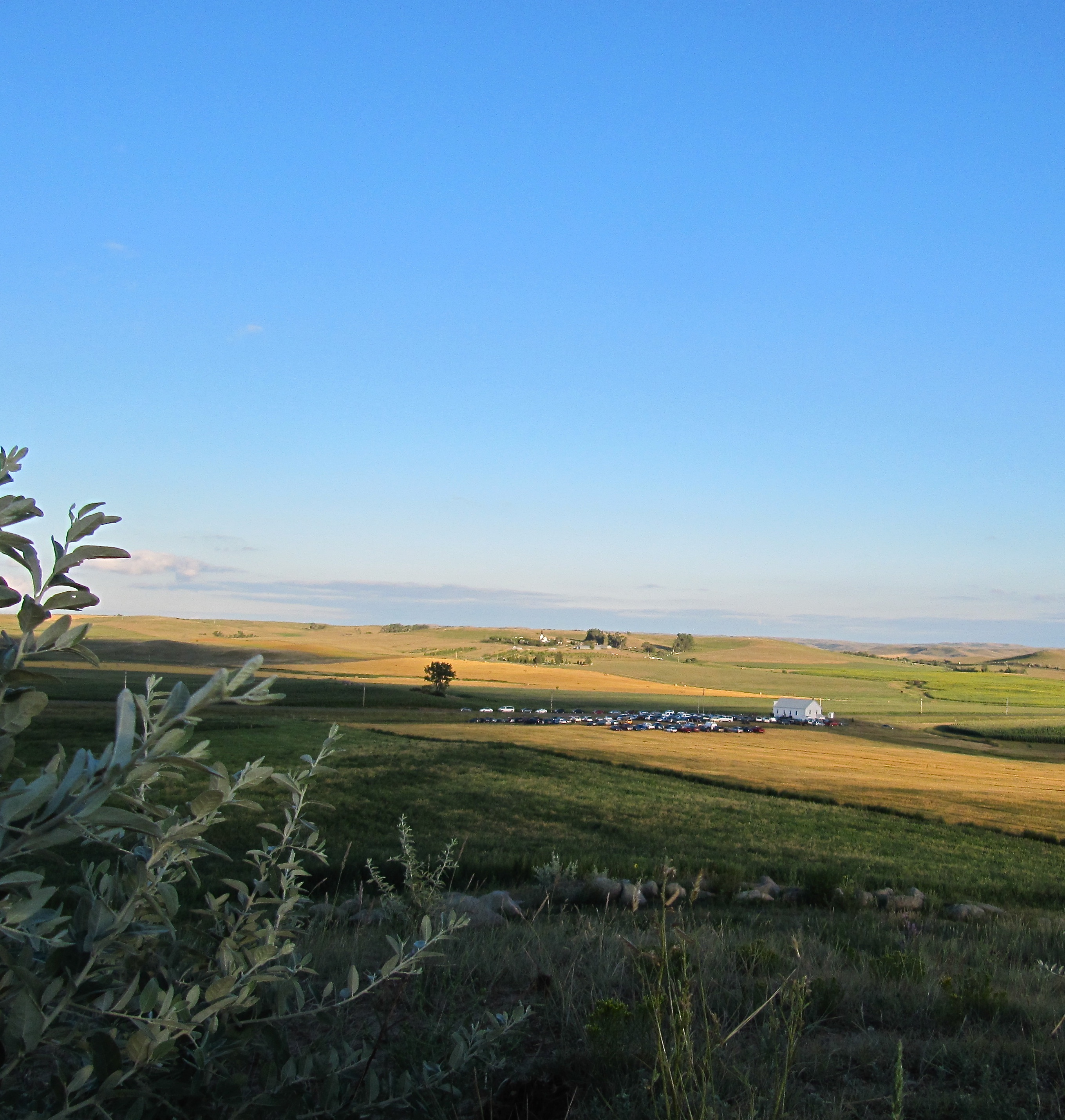
When sitting there listening to Chuck belt out according licks in front of the north elevation of a historic prairie building called Bohemian Hall, the mind wanders through time. Pretty soon you have what in the business we call that “sense of place.” Tall corn fields to the southwest and cut wheat fields immediately north of that. Just to the east is a small village and a rehabilitated church. The shadows get taller as the music plays on and the sun sets in the west. There were two just-off-the-boat Czechs in the audience. The remaining Bohemians (at least the performing musicians) were just a generation or two removed. This hall means something to the Suchy family, and pretty much to anyone that has come within its range. It means something because we’ve decided to make it mean something. We didn’t wait for a financial analyst to come in and tell us whether it would be viable or not (but I suppose one might be handy when it came to crunching numbers about how many pulled pork sandwiches to supply). We gather around because we want to do this.
Bohemian Hall is the white building center-right in the photo. This view looks to the east-southeast.
The Suchy family not only captures the exact identity of what it means to be Bohemian artists, but they are in fact reflections of it to the core. We associate art and music with ethnic Bohemians because of families like this.
During the final couple songs, the late evening gave way to night, and a burning moon rose up out of the prairie.
The weather was remarkable on this evening. No wind (which is unusual for the Plains) and temps that required a light jacket. A horse whinnied during one of Chuck’s tunes, and toward the end of the entire set a burning moon rose up out of the prairie.
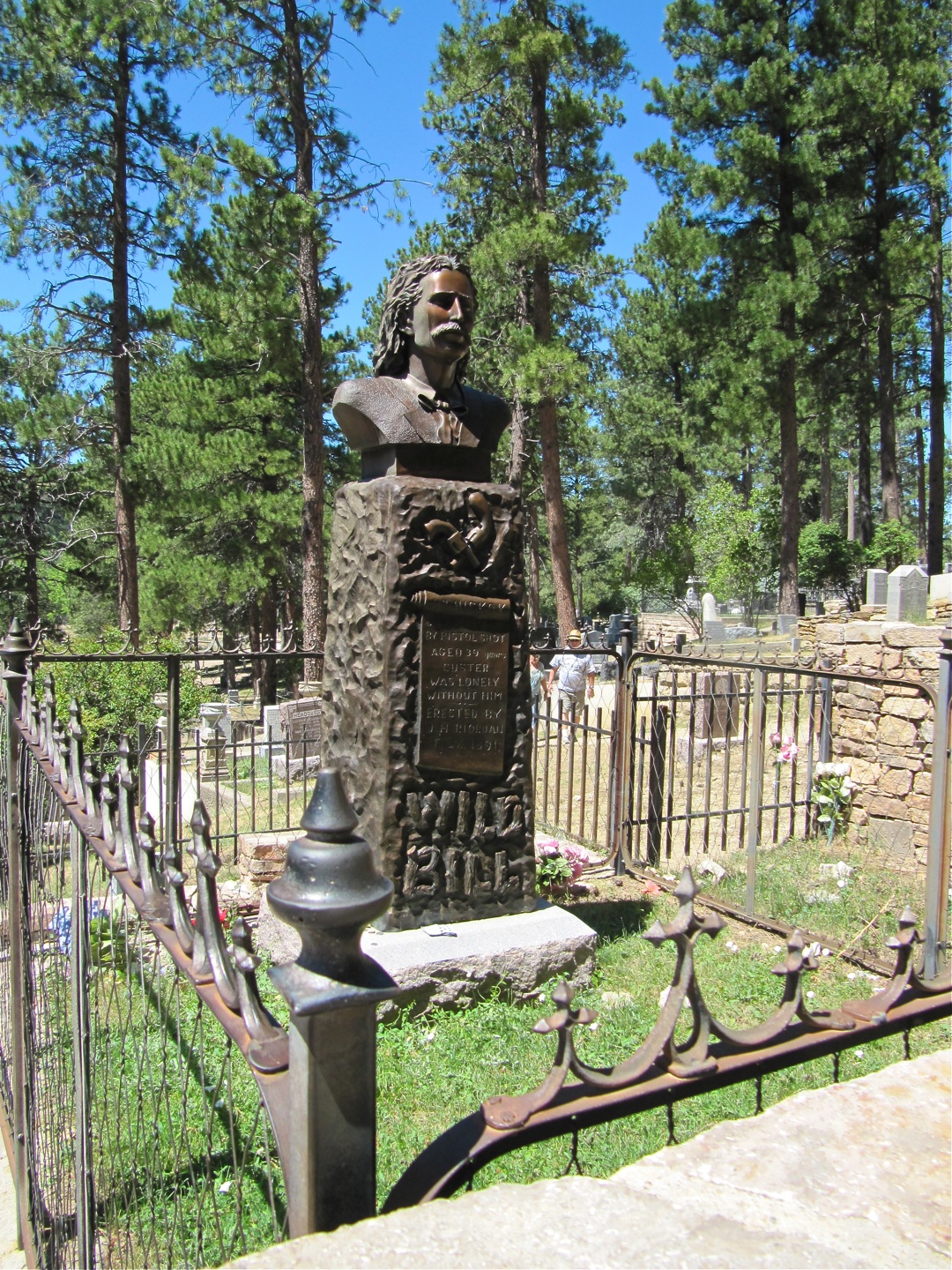
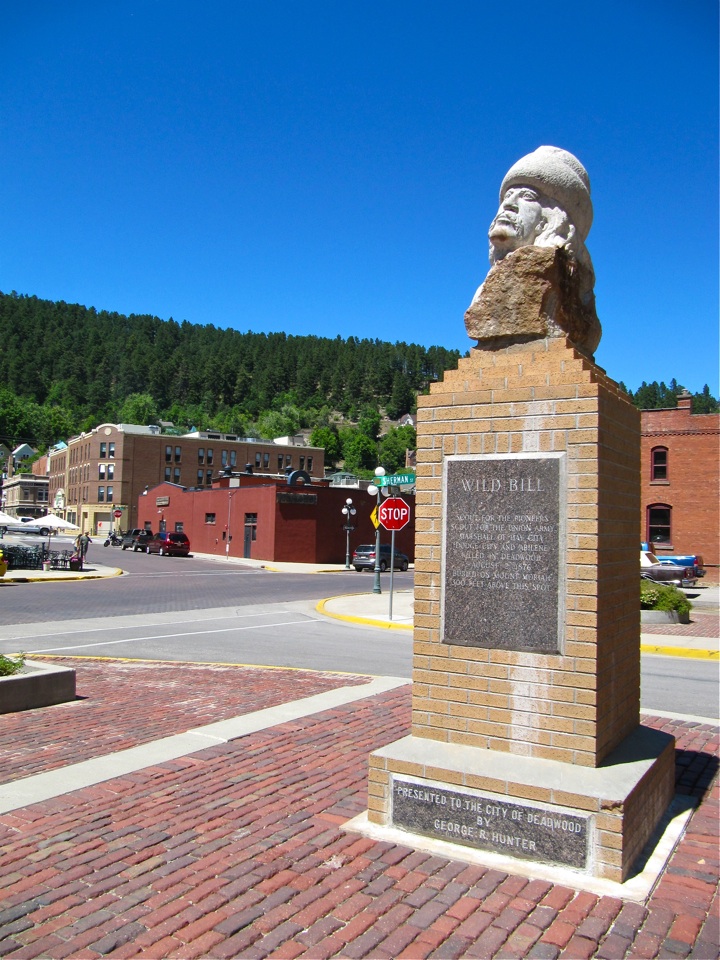
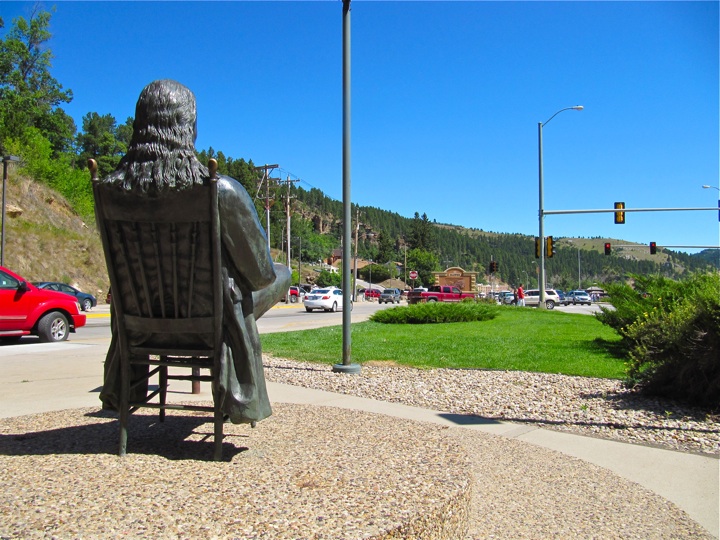
On August 2, 1876, Jack McCall forever immortalized himself and Wild Bill Hickok when said McCall shot and killed Wild Bill in Deadwood, southwestern Dakota Territory. Since then, any number of statues have been created to memorialize and deify Hickok. In Deadwood today, at least as of July 2012, there are numerous signs and busts of Hickok. His heroic and tragic story was popularized even further by the HBO series Deadwood (this is similar to the how Shakespeare popularized the story of Julius Caesar, too). Below is some of the Hickok iconography throughout Deadwood, South Dakota:
Wild Bill Hickok’s grave site at Mt. Moriah Cemetery in Deadwood, South Dakota.
Offerings at Wild Bill Hickok’s grave in Deadwood, South Dakota.
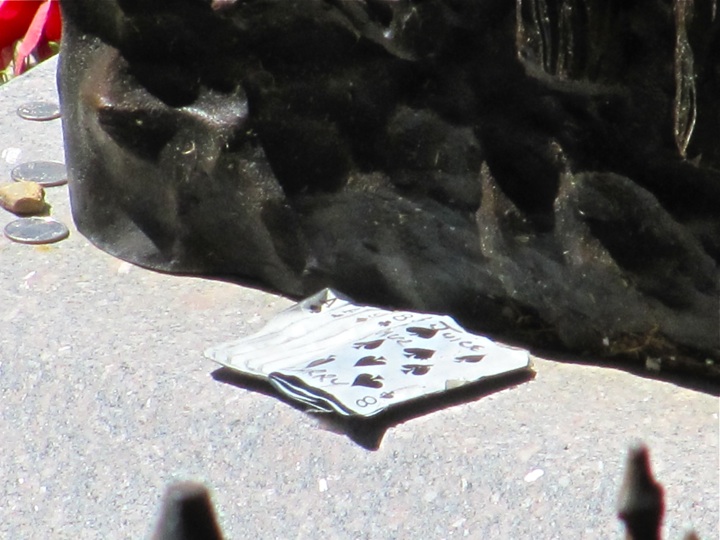
The “Dead Man’s Hand” at the base of Wild Bill Hickok’s grave in Deadwood, South Dakota.
Saloon #10 signage in downtown Deadwood.
Bust of Hickok in downtown Deadwood.
A 19th century bronze Hickok greets 21st century motorists entering Deadwood, South Dakota.
Brothers from Braddock, North Dakota: David Barth and Charles Barth. Photo taken in 1943.
I have since loaded up the digitized oral history from Charles “Bud” Barth, this curated for public dissemination (amongst hundreds of thousands of other oral histories) with the State Historical Society of North Dakota. In the previous post I noted how Charles was a medic in the 103rd Infantry Division, European Theater, Second World War. Here are a couple lines I transcribed from the audio, at least what Charles recounted from his time on the front lines. Charles said:
“…I was not on the front line all the time. I was what they call a medic recorder. I took care of all the guys who were hit, who were killed, who were prisoners of war, and stuff like that…”
And then he recounted one of the particulars in the broader, global war that resulted in millions of deaths. While in the Western European Theater, Charles said this:
“…I remember one incident, this guy was shot, two shells in his upper chest. And he knew he was going to die. I grabbed him, held him in my arms, gave him a [morphine] shot, and he said, ‘Would you… tell mom… and dad…’ and that was the last he said. Now I don’t know what he was going to say… I looked at his dog tags and they were so shot up I didn’t know where he was from.”
Charles transcribed these final words, “Would you… tell mom… and dad…” in the context in which he heard them, and then he attached them to the killed soldier. Days and weeks went by, and one of Charles’s commanding officers eventually tracked him down. His officer asked if he was the medic who wrote the note about the soldier who was hit and killed. Charles said that was the only identification he could make out since the dog tags were so shot up. The officer said they had the killed soldier’s home address, and they gave it to Charles.
Eventually Charles drafted a letter to the soldier’s parents who lived in Wisconsin. He told them he cared for their son just before he was killed in action, and he wanted to pass along his final words. This induced a correspondence between this soldier’s parents and Charles, and they sent letters and Christmas cards back and forth until they just stopped one day. Charles suspected that the soldier’s parents had passed away, and he never was able to track them down.
Nonetheless, these North Dakotan oral histories are a part of the larger picture that is the national Veteran’s History Project. It seemed more than worthwhile to share this bit of digitized history. War is ugly. It is horrible; in fact the most horrific. Yet embedded within this horror are singular stories of selflessness, empathy, appreciation and compassion. These individual stories humanize those larger historical narratives that can seem so rote and distant. The individual stories are all around, just so long as we are ready to sit down and listen.







 The Edge of the Village