Category Archives: Uncategorized

Training Historians for Tomorrow

On December 13, 2011, Dr. Tom Isern (North Dakota State University) held his annual senior seminar presentations for his students (seminarians) at the Kringen Lodge in downtown Fargo, North Dakota. This is a chance for seminarians to get on-the-job training in a formal setting where they fold about four months of theoretical ideas and practice into a research paper to be delivered before an audience of their peers, colleagues, family and friends.

North entrance to the Sons of Norway Kringen Lodge #25 in downtown Fargo, North Dakota.

Because historians are extremely interested in how societal perceptions and values change over time, Isern directs his seminarians to focus on otherwise forgotten monuments on the northern Plains. The seminarians, in turn, select a monument and start assembling the historical processes that contributed to its construction. The seminarians scrape below the surface of it all, and through oral history and archival research they begin tracking how the monument’s memory group either 1) held on to notions of the monument’s original intent; 2) shifted the way in which they perceived the monument; or 3) became atomized or fractured over time, and through this dispersion lost a segment of group consciousness all together.

This latter case is perhaps one of the most important, since it means a segment of historical culture was lost (perhaps to be recovered). Culture might be thought of in the form of its root word cult, which came from the Latin word cultus, this originally meaning “adoration” or “to care.” (this is also connected to the word agriculture). The research project also allows the historian to provide the connective tissue that links the bits and pieces of memory about a particular monument together. The story by which a monument came about can then be revived, and this story can be received and accepted, critiqued or refuted by the public. This is why the methodologies used to craft the histories are scrutinized throughout the research and writing processes. Much in the way that an artisan requires training to learn how to shape a blunt sword between hammer and anvil (and grind and sharpen its edge with whetstone and leather), a historian and a history does not become sharp unless it receives intellectual scrutiny and critique.

Dr. Tom Isern and his seminarians deliver and critique research papers at the Kringen Lodge in Fargo, North Dakota.

This also means the processes of research need transparency, since the historian’s business is to demystify the past. Epistemology is another name within the larger game. Through this demystification the past is made accessible, or at least brought out of the archives and democratized for a broader public.

Theoretical models about monuments and memory have near universal points of departure. The directions collective memory takes, however, remains unique, and this is where the Center for Heritage Renewal‘s public history archive allows for increased dissemination throughout the digital world. Click here to be directed to the database of completed projects within Isern’s senior seminar.


Digital History Localized: Heavy Water Radio and Bismarck’s June 2008 Ribfest

If one is a geek, the phrase Digital History is indeed familiar. It sounds even a bit sexy, the combination of a semi-conductor Silicon Valley word with a traditional discipline (historians like to use the word “traditional” and “contemporary”). To see how I could put together a short memory from the summer of 2008, I decided to use Google’s algorithm, or what we commonly refer to as the Google Search Engine (here is a heck-of-a discussion on the algorithms that power Google). By typing in the name of a band I used to drum for — Heavy Water Radio (HWR) — and the name of the city most-associated with this band (Bismarck, North Dakota), Google returned several results.

One of the results consulted was the “Ribfest 2008 Schedule” put out by Nightlife Music, and this listed all the bands for the the 3-day line-up. HWR played toward the tail-end of it all, on a Saturday evening (June 21, 2008) from 6:00-to-7:30PM, the stage set up just south of the Civic Center in downtown Bismarck. This is one example of what the south side of the stage looked like, the Bismarck Civic Center to the north behind the stage.

This is a Google Earth map of the Bismarck Civic Center and surrounding area, asphalt parking lot included.

The Bismarck Ribfest came about through broader historical forces (as all events do), ultimately fusing the blues and slow-cooked ribs, the origins of which either realistically or mythically came from the geographic area that is the American South (a Romanian friend once insisted that bbq originated in Romania — whatever). Today this fusion is appropriated by organizers and projected across the world, the northern Great Plains notwithstanding. The blues and heavy blues (which was the business of HWR) often articulate feelings of melancholy and subtle distress, even oppression, yet the output is lively and celebratory — “I got the blues!” is often said as a kind of boast, sticking it to the real or imagined Man, letting them know they cannot keep one’s spirit down.

Anyhow, to show how this story benefits from the vehicles of Digital History calls for a bit of reflection. First of all, Digital History allows an individual to share individual experiences and contextualize them with broader events through various platforms of Social Media: so long as a person has an internet connection and a computer, they are outfitted to become active participants rather than passive recipients of history. Things do not, after all, happen in a vacuum, and the interconnectivity provided by the mobile web is increasingly realized (globally, the influence of the mobile web has been demonstrated in Libya and Egypt, throughout various occupy movements, and as of December 2011 in Moscow).

As for HWR’s performance on June 21, 2008 in downtown Bismarck, I remember the evening as being all the warmer due to the event being held in an asphalt parking lot. A chain-link fence surrounded the parking lot as well, and its purpose was to keep out individuals who did not pay. It inadvertently had the effect of also making the drummer for HWR (that’s me) feel as though he was readying to play in some kind of penitentiary courtyard on a hot summer evening.

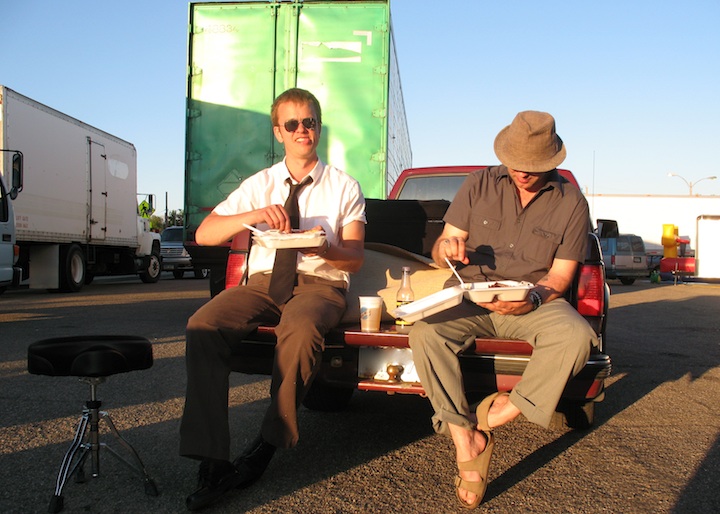
Members of Heavy Water Radio eat ribs from styrofoam containers in an asphalt parking lot that felt like a penitentiary courtyard. The HWR drummer is at left and the bass player at right (June 2008).

After scrolling through some of my own digital photos, it also became clear that at some point after the event, HWR received some ribs — always negotiate a complimentary food/drink tab with the organizers (don’t be afraid to politely assert yourself: we all need to front our dignity every now and then). Do this especially if you are a thirsty blues band like HWR.

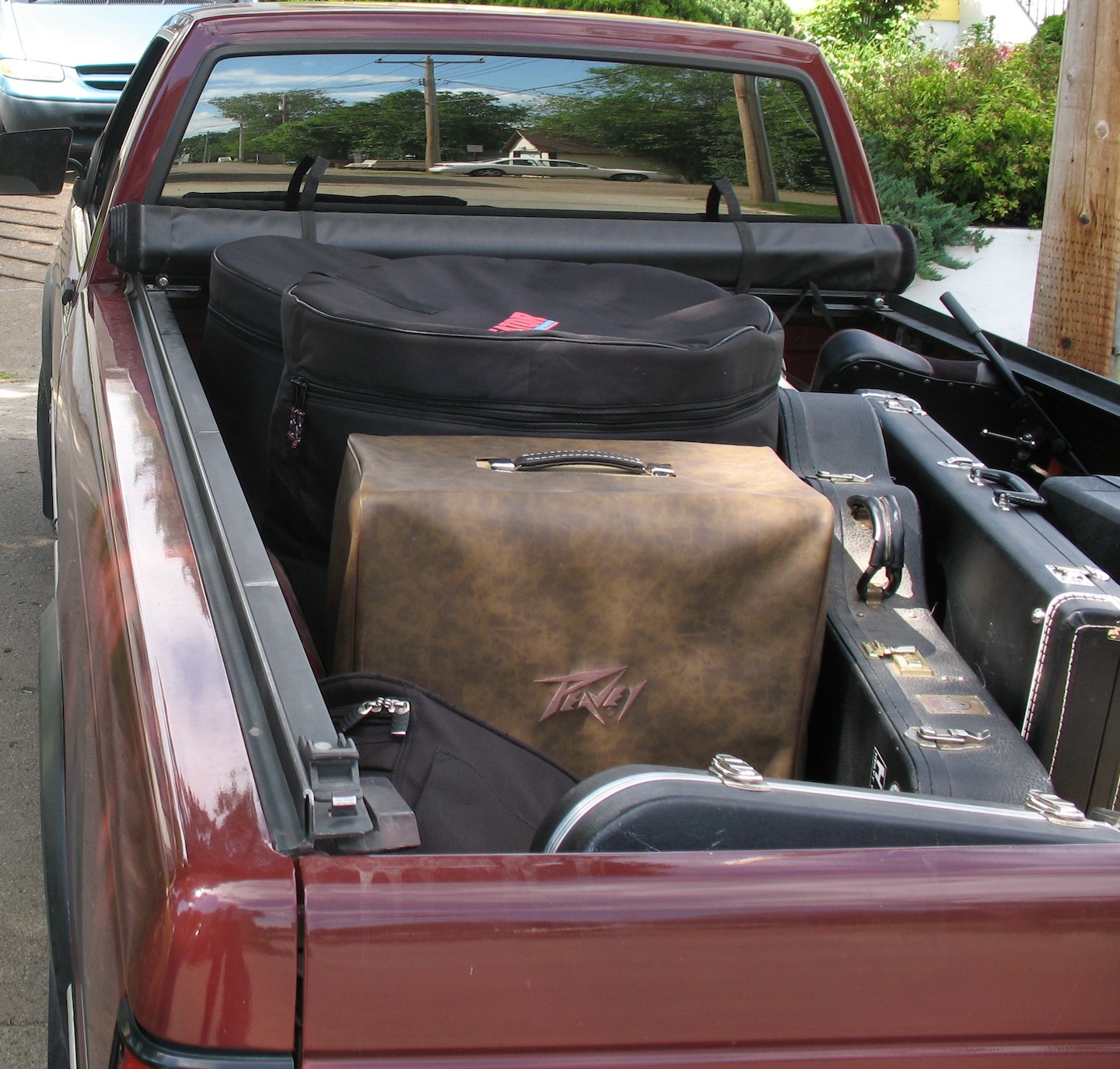
And because live music requires gear, and a place to store and practice with that gear, the personal photos also revealed a snapshot of what it is like just before a band leaves the studio (aka, your friends sweet basement playing room) for the gig, gear packed into a pickup, this equipment ready to receive amplification and — if the band pulls it off with enough success — accolades.

A segment of gear that your local musicians have to purchase and haul and set up before and then play and then tear down after each gig. Because we're tearing down gear after a gig is often why we cannot join you for celebratory drinks immediately after said gig.

With numerous events getting digitized the world over, and with super algorithms that provide researchers with near-instant digital data and results, it is important to remember that analysis (and analysis of that analysis) are fundamentals to all history: a singular event can be and is viewed and understood in numerous contexts. So if you think a history you are a part of is missing something, then it is okay to say so and offer your perspective. At the very least this gives historians and publishers job security, since a new edition will need to be published to account for the new data and information. Also, because societies evolve and change over time ultimately means that history evolves and changes over time. What was once un-important and left out may at some point become important and significant to this or that person or group.

These little snippets of mine are but one amongst many, as everyone who attended invariably had a take on their own experience. This little essay seemed like a good enough reason to briefly talk about digital history, and upload a couple personal photos to the collective web.


Installing RAM In a MacBook Pro

At some point in November 2011, while working on a graduate paper in a seminar course entitled, “Problems in Modern Chinese Historiography,” the MacBook Pro in front of me started slowing down. The annoying pinwheel whirred at the user, and this created all sorts of technical problems in writing papers on the problems of historiography and China (there are more problems than one would at the outset think).

After contacting Josh (honestly, I don’t always just contact him when I need something), he said let’s have a look at the laptop. After a few key strokes he quickly diagnosed the problem: not enough RAM, or random access memory (Josh and I discussed this while eating sandwiches). Initial groans reflected the stereotype I had toward RAM upgrades, yet these groans gave way to enlightenment, especially after realizing how easy Steve Jobs and Company made it to upgrade the stuff. Better yet, Chinese manufacturing must be cranking RAM out left and right because it is incredibly affordable.

Installing the RAM in a MacBook Pro.

The first step is to find RAM. There are several companies that deal in it. After hearing back from Crucial that MacBook Pro RAM was on backorder, I went through another company, Kingston, found through Amazon.com. Kingston shipped the RAM from where-ever they ship RAM, and it arrived within a couple days.

A MacBook Pro screw next to a pistachio for scale.

I also used this as an excuse to purchase a set of small phillips head screwdrivers, since the MacBook Pro’s aluminum frame is held together with tiny screws. A pistachio next to the screw gives a person a sense of scale.

So, to replace RAM in a MacBook Pro, turn off your computer (I inadvertently left mine on during the process). Flip the computer over, and with a tiny screwdriver start unscrewing (righty-tighty, lefty-loosey). Keep the little screws on the table next to where you removed them, because they go right back in once this minor computer surgery is complete. Next pull off the lid and locate the RAM. There are two little clips that need to be pulled back for the existing RAM in the computer to be released. So do this. One chunk of RAM sits on top of another, so remove that too. Then put the new RAM in, gently pushing it into its slot and pressing down on it to seat it. Once it is seated, put your aluminum cover back on, secure it with the screws, and push the button to turn on your MacBook Pro. Your are done with the RAM install. You can keep reading if you’d like.

Since humans decided to write stuff down (rather than us just blathering on uncontrollably), numerous technologies have preserved our thoughts — on tortoise shell, papyrus, in book technology form, then in increased numbers with the Gutenberg Press, then the typewriter, and now semiconductor-driven computers. The technology of language first had to be created (processes in and of themselves). I found that in order for someone to put the technology of language into Microsoft Word eventually requires an individual to understand the technology of computers as well. Also, humanity first produced history in the area we know of today as China, and China today cranks out RAM so that I can update my computer and continue writing about the problems inherent to modern Chinese historiography. At least that was my take-away.


Fargo and a Wood Chipper Outside of Putnam Hall

Wood chipper outside of the south side of Putnam Hall, North Dakota State University, Fargo, on December 7, 2011.

I suppose it is only fitting that necessary tree trimming and — more important to Fargo — full-throttle wood chipping goes on just outside of where speaker phone conferences and meetings are taking place. Yes, a large yellow wood chipper (center photo) is approximately 5-to-7 meters south of the second floor windows, this glass providing the buffer between the necessary forestry work and our nice little conference. Thanks for making that afternoon funny (both funny “ha-ha” and funny “peculiar”), Coen Brothers. This is what the original Fargo wood chipper looks like. The one at left in the photo is a more intense model.


Google Returns Religious Perspectives on Aliens

Recently NASA came across Keppler-22b, a planet with an ecosystem much like our own. The planet is approximately 600 light-years away. This means that if someone could travel at the speed of light — 186,282 miles per second for you imperial weights and measurements readers — it would take 600 years to reach Keppler-22b. Because I am curious about various perceptions, a question that surfaced when first reading this article was, “I wonder how different religions would regard the discovery of Keppler-22b?”

No doubt, practitioners of the religion of science and technology are ecstatic about such a discovery, as religion requires an institutionalized system of attitudes, beliefs and practices (this, for example, is why the Roman military was both an institution and a religion, replete with gods and demigod leaders, Julius Caesar notwithstanding). The word religious, in turn, is defined as anything “relating to or manifesting faithful devotion to an acknowledged ultimate reality or deity,” and “scrupulously and conscientiously faithful.” So if you’re protractedly wound up pretty good about something, that is effectively your religion. In the most general terms. At least in this context.

Without traveling too far down the theoretical road of objectivity and subjectivity, and how objectivity can never be achieved but how we must constantly pursue it, the discovery of Keppler-22b is going to produce conversations from different religious quarters. I did a quick google search to pinpoint the major religious quarters and how they perceive such discoveries, and following are the results.

The results are listed in chronological order from when the major religion formed. The methodology for finding the articles stemmed from how I punched in (using Google) the first inquiry, which read, “Pope on life in universe.” To keep it standardized, “Pope” is replaced with “Hinduism,” “Buddhism,” “Judiasm,” “Pope” (for Christianity), and “Islam.”  A cursory sampling of the first 15 articles (with the exception of wikipedia links — until I amend this as well) google produces will be consulted and referenced.

This list represents the major religions, and a major religion is defined as one that has the largest following. The below list relies on whatever computational algorithm google was using as of December 6, 2011.

Hinduism: The phrase “Hinduism on life in universe” yielded the normal wikipedia links, and it also brought up this prophetic or teleological piece on Hinduism and world cycles. The conclusion said,

“There is no scientific support for the Hindu theory of world cycles. Further, current scientific theory contradicts Hindu theory in many respects. It is best to begin by acknowledging this truth, as such an acknowledgement can form the basis for interesting discussions of the different ways of knowing that underly the more specific differences. Such, however, must be the substance of another paper.”

Fair enough. Hinduism relies on cycles (predictive modeling is a scientific phrase analogous to “cycles”), and there are some projections from this wikipedia sublink (the methodology was slightly revised for Hinduism). Nonetheless, Hinduism seems to allow for an analysis of analysis (which is described above as forming “the basis for interesting discussions of the different ways of knowing that underly the more specific differences.”).

Buddhism: when “Buddhism on life in the universe” was entered, google returned this article on “The Ten Worlds” of Buddhism at the top. An article that keeps the methodology in mind while being pertinent to the question on religious perceptions of life in the universe came in the form of this 2008 piece by Walter Jayawardhana entitled, “Scientist says Buddhism showed there’s life in space.” Chandra Wickramasinghe (a Cardiff University Mathematician and Astronomer) said (or is quoted in the article as saying), “Buddhism talks about a multitude of planetary systems and an infinity of ‘inhabited worlds’.” Okay, so that squares up the (or one of the) Buddhist perceptions.

Judaism: when “Judaism on life in the universe” was entered, the google algorithm listed this piece number 13 in order (again, in an attempt to bring substance to this blog posting, the methodology was tweaked a bit). The site says the Torah provides some metaphors for life on other planets, and the website’s interpretation of it gives the reader quite a bit of confidence about one’s place in the cosmos:

…man is endowed with a divine soul that towers over even the highest angels. [and] One of the first to discuss the question of extraterrestrial life in general was Rabbi Chasdai Crescas (Or Hashem 4:2). After a lengthy discussion, he comes to the conclusion that there is nothing in Jewish theology to preclude the existence of life on other worlds. As possible evidence for extraterrestrial life, he quotes the Talmudic teaching (Avoda Zara 3b) that “God flies through 18,000 worlds.” Since they require His providence, we may assume that they are inhabited.

Okay and got it. Judaism, at least in this interpretation, is okay with aliens.

Christianity: by typing in the phrase, “Pope on life in universe,” google produced this article, listed in 5th place. Published May 15, 2008 the article is entitled, “Pope’s astronomer insists alien life ‘would be part of God’s creation'”. Up until this point, I did not know that the pope had an astronomer (but I suppose it makes sense). As of 2008, the Pope’s astronomer was listed as José Gabriel Funes, unsurprisingly a Jesuit (the Jesuits are the undisputed intellectual shock-troops of the Catholic Church — historically they have occasionally gotten too smart for the Vatican, and have here and there had to physically be put down). Anyhow, Funes says “one cannot put limits on the creative freedom of God… They [the aliens] would be part of creation.”

Islam: by typing in the phrase, “Islam on life in universe,” google listed this following site as 3rd. It was produced by Al Islam: The Official Website of the Ahmadiyya Muslim Community and this website interprets the Quran as predicting that “man shall one day make contact with extraterrestrial life.”

Sounds good to me.

Seems like exploring that final frontier has some kind of unifying thread or thematic continuity that runs through all the major religions. I’ll end it here (since months ago I made promises to explore the final frontiers of dead-line driven reports that are due in the coming weeks).


Free Pens: The Context, Left In Situ, Interpretive Provenance, and Origin

A month or so ago Jay Krabbenhoft of Gate City Bank sent items to distribute at random around North Dakota State University’s department of History, Philosophy and Religious Studies. I inscribed a short phrase at the top of a box, “FREE PENS,” all in caps — presumably to draw more attention — and below that a “HELP YOURSELF” with an arrow pointing to said pens. Only after Dr. Dennis Cooley walked by, saw the sign, and said, “Who is ‘Pens’?” did we begin a short discussion on the need for context, provenance, origin, and leaving items in situ. To Cooley (a philosopher of ethics), the sign immediately conjured up in his mind an idea of someone mistakenly or unjustly incarcerated. “‘FREE PENS’ sounds like someone’s last name who is locked up,” said Cooley, more or less. In reality, though, the sign asked visitors to take a pen (since there is a relatively low frequency of office visitors, I have since mandated that visitors leave with no-less than three pens per visit).

This in turn got me thinking about how some years ago Dr. Melinda Leach assigned her methods and theory in archaeology and anthropology class to read several American Antiquity essays, specifically those by the late Lewis Binford and the still-chugging Ian Hodder. Both perceived that they have (or had) a completely different way in which they viewed the archaeological record (Binford asserted “Processualism” and Hodder “Post-Processualism”), but the general idea is that artifacts, or material culture, are 1) left within the context in which they are found because this effectively allows the researcher to glean information from the artifacts; and 2) anyone who approaches evidence brings a certain degree of known or unknown cultural baggage and value-judgements to bear on said evidence (David Hume rambled on about this important subject at length in the 18th-century).

These two points are demonstrated when individuals engage and interact with any piece of evidence, and it is something archaeologists and historians incessantly talk about and try to communicate to collectors who hold up their collection of material culture and invariably ask, “What do you suppose this is worth?” Archaeologists and historians only know what it is worth in terms of knowledge (aka, Indiana Jones, “This belongs in a museum!”), while collectors tend to put it in bottom-line, Wall Street terms: MONEY (I am not sure, but this either is a reflection of American culture where money is fortunately and unfortunately king; or it is a universal reflection of the human condition, because unless we philosophically check ourselves we invariably gravitate toward perceptions of money which is analogous to power which is analogous to control and perceptions of prestige, fame, and so on and so forth — John Acton is attributed with the phrase, “Power tends to corrupt and absolute power corrupts absolutely.”).

This latter theme also deals with context and perception, and it is thrown into relief when looked at more broadly: if something is perceived as valuable, then it is valuable. If a lot of people perceive it as valuable, then that something is going to be more valuable (historically, this was famously represented by tulips in Western Europe). Anyhow, oftentimes branding pens as free induces two responses: an individual either thinks they are not worth much; or philosophers of ethics think you are on some kind of moral ACLU-inspired crusade. Thus the perpetual need for continued dialog that provides context, provenance, and interpretations of origin by leaving items in situ (at least until we can get there, document it, and eventually say, “Pull it!”).


NASA, the North American Steppe, Jon Rask and Chess

On November 26, 2011, a local Bismarck (North Dakota) television station aired a story concerning Jon Rask. A google search turned up Rask’s cv, and it turns out he is North Dakota’s premier space farmer — or “astro-biologist” for you scientists in the crowd.  Rask is putting in time in Antarctica with NASA in order to push our (this is the Royal Our, or Royal Us, or Humanity — which is why Scientists and Scholars are willing to transcend contemporary geopolitical borders and shirk short-term money-making schemes for the sake of scholarship and making contributions to knowledge) understanding of plants and hydroponics in new directions. Information gained in Antarctica will in turn help us get to Mars for the duration.

To quickly make this relevant to capitalists (and I say this non-pejoratively), this is one of the reasons we are taxed today, and one of the reasons those tax dollars go to NASA: some day this will allow said capitalists to mine Mars for minerals and who knows what else. Yes, everyone likes money, and it just so happens to be one of the chorus lines repeated in the movie “Idiocracy.” But we also like WD-40 and plastics and calculators and jokes about Tang.

It turns out North Dakota winters and Antarctica are perfect places to perform studies that give us insights toward eventually planting ourselves on Mars, and eventually planting plants on Mars.

The chess reference in this subject line refers to Jon and his dad, Richard. The Bismarck Public School system charged the latter with educating battalions of 5th graders at Grimsrud Elementary School (I was one of them). Perhaps one of the most important components of Richard’s (or Mr. Rask, as I still think of him) class was that he required all of his students to learn chess. I know (or at least I think) Richard’s son (Jon) and daughter (Lisa) were subject to one chess match after another. Chess is important in that it requires each player to not only think about the short-term, but the long-term as well: not just one move, but several down the line. So the takeaway here is to learn chess in your early years. Either learn it in the 5th grade, or have your dad or mom sit down with you when you are in the 2nd grade and teach it to you (this is how it worked in my youth, as my father taught me chess when I was in the 2nd grade — by the time you’re in the 5th grade, you’re ready to crush the local competition).


Revit and Digital Documents

A couple months ago I finished a historical case study that concerned an airport in the Red River Valley (in central North America to geographically position you international readers), and throughout the course of this study the project benefitted tremendously for two reasons. This included the cross-disciplinary cooperation that is central to completing a project on time and within its budget; and the increased digitization of all things, historical documents included.

Only after the case study was complete did I correspond with an engineer who in turn made this historian, archaeologist, anthropologist, and historic preservationist privy to the latest and greatest Web 2.0 (or perhaps a prologue to Web 3.0?) engineering software. This is known as Revit, a program that brings traditional drafting techniques into a type of digital matrix. This matrix, in turn, provides digitized centralization for everyone involved in or working on a project. So far, the wikipedia entry on Revit has been the best source for getting familiar with it. YouTube’s search engine produces numerous Revit tutorials as well.

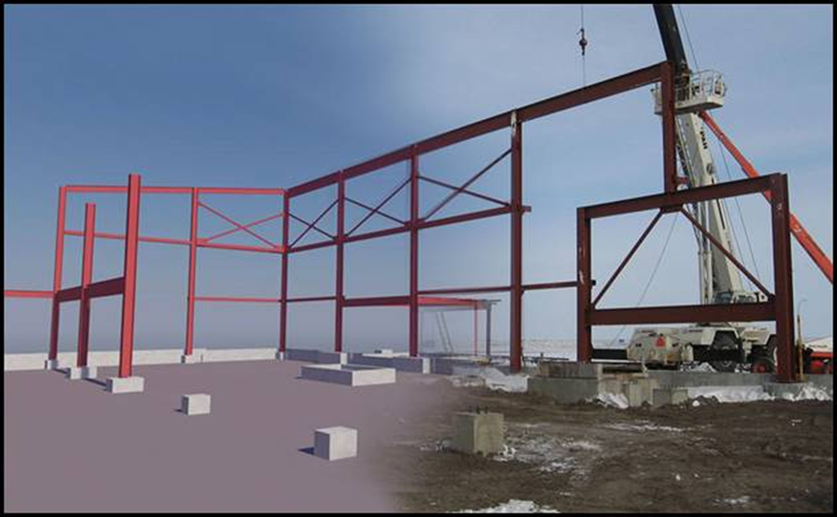
Ulteig Engineering Revit graphic (left) synthesized with (right) 2011 construction of the Grand Forks Byron L. Dorgan International Airport. Thanks to Jon Scraper of Ulteig Engineering for passing along the graphic.

In the realm of history, and through state and private collaboration, the Grand Forks International Airport (GFIA) in 2007 received scanned copies of newspaper articles from the Chester Fritz Library (University of North Dakota), which is in its 50th winter and undergoing its own digital revolution. The GFIA’s website provides visitors with a history sub-link, and here with the ability to download newspaper articles from the years of 1959 to 1968, and from 1968 to 1984. This digitization of the documents allows professional and non-professionals to access them simply by having an internet link, and it also provides an individual with the ability to circumvent the understandable time constraints traditional archives are forced to keep.

The takeaway from digital technologies that seem to “make life easier” is never to undermine the need for future engineers and historians to be trained in the way of systematic analysis. In order for someone to properly use and understand Revit requires that individual to properly learn and understand the advanced mathematics the program requires. This also means historians need to sit down with a stack of digital or 3-D documents and carefully analyze them (this certainly requires hours, and more usually days) before they can deploy the writing styles that they took years and decades to develop as well. The engineer and the historian, after all, has to figure out a way to communicate this information to broader, non-specialized audiences.

[note: I sliced off the last paragraph of this entry on 11/25/2011 4:35PM CST as it seemed to be important but a bit disconnected. Also an Ulteig Engineering Revit graphic was added on 11/26/2011 12:10PM CST.]


Porterhouse Steak: Central Asian Dry Rub

Below are the following directions for a Central Asian dry rub for a porterhouse steak.  I e-mailed this to a friend (I’ve ascribed to him the name Yeoman, or the Lakota name conjou, since he is both a professor of philosophy and an organic farmer in northern Dakota). He asked about my thoughts on how to prepare a porterhouse steak, at least something different from the standard olive oil, fresh ground pepper and kosher salt.

Porterhouse and T-Bone Steaks with Central Asian-style Dry Rub

So the other day I issued to him the following (altered only slightly) in e-mail correspondence:

Conjou,

Get a bowl out.  Into it add: heavy on the paprika, and less heavy on the ground cayenne and ground pepper.  Put salt in there too.  Then add a couple pinches of ground cloves, ground allspice, ground cinnamon, ground turmeric, a bit more of ground cumin (essentially anything that tastes like Central Asia or the Levant).  I added a bit of ground thyme to mine as well. Lick your finger and stick it in to the rub, and then taste what sticks to your finger.  If it tastes good, then it’s good.  Then rub it on the porterhouse.  Then let it sit for about an hour while you guzzle half a bottle of Malbec and devour some goat cheese you picked this up at one of those bulk stores for something like $6/lb.  Also prepare some of your organic potatoes, boil water and toss in a couple of ’em with a couple cloves of garlic (mash this later with milk and a bunch of butter). Maybe chop up that iceberg lettuce in the fridge, too, since you’re going for a kind of American West Cattle Country Meets Central Asia and the Levant here. Hit the iceberg lettuce with the blue cheese dressing.  Also have plenty of icy cold beer on hand in the fridge, too, because that wine isn’t going to last forever.
Hope this helps.  Mine turned out glorious.  Having typed and re-read this, my mouth is pouring right now.

I followed this up with subsequent text-messages as further directives about the perfect Central Asian steak rub solidified in my brain.  The first message said, “After removing porterhouse from heat, let it rest for 5 min and spread goat cheese on top of it.”  I offered this advice since the goat cheese adds an element of Central Asian free-range that we come to expect from that part of the world (goat cheese has a subtle type of gaminess taste to it; much like what we taste when lamb hits the palate).  My second text transmission said, “And don’t cook it past med-rare. If you do, don’t tell me.” Yes, ignorance is bliss.  He promised not to cook it past med-rare, and then he inquired about another technical matter.  Does a person use a grill, a broiler or a cast-iron skillet?  In this case, any one of these would work. Instead of potato mash, Conjou did fingerling potatoes roasted, sans iceberg lettuce.  The rest, he said, “went off as directed.”


Modern With a Lower Case “m”

Here’s a recent piece from Slate.com that asserts the rise and fall of Postmodern. It got me thinking about how it’s another one of those movements that many feel a part of, all while no one can really agree on a definitive, well, definition. This is why everyone looks confused (or if not, suppresses the feelings of confusion) when the word Post Modern is used. Post Modern is, of course, predicated on the notion (and acceptance) of Modern as a systematic framework as well, and that Modern was somehow a reaction against another systematic framework, and so on, ad infinitum. I still prefer to take my modernity with the lower case “m” and in the vein that it is perpetual and never ending, a type of tension between existing structures and the evolution necessary for society to breath in the present and theorize about how to project itself into the future (a quasi fancy way of saying “planning for tomorrow”). I suppose this recent Post Modern piece from Slate.com can be considered fairly modern.