Within the archives of the State Historical Society of North Dakota’s Veteran’s History Project you can track down any one of the veteran oral histories. So upon hearing this morning that Charles Eugene (“Bud”) Barth passed away sometime last night at 92 years of age, I thought it would be good to track down the oral history he and I put together some years ago. I’m in the process of obtaining the entire file of his history, and it seemed reasonable to reflect a bit on exactly what he did in the Second World War.
Charles was known as “Bud” by any number of people. He hailed from a farmstead just outside of Braddock, North Dakota, and was called to serve not too long after the U.S. entered the Second World War. Charles was rolled into the 409th Infantry Medical Detachment, 103rd Infantry Division, and he served as a front line medic in the Battle of the Bulge. I did a bit of checking around to see about this division’s feats during the Second World War, and it also turns out that Charles along with the rest of the 103rd Infantry Division liberated one of Nazi Germany’s concentration camps, the details of which can be found in the link here.
I think it has been approximately 10 years since Charles and I recorded this conversation about his time in WWII. I remember that he gave me the stories primarily because he was getting up there in age and he thought it might be important to set this information down. I agreed with him. After the interview, at least after the tape recorder was shut off, I also remember Charles saying that he wanted to tell me a bit more about the war, but sans recording device. Vets carry the raw elements of war with them throughout life, and as Charles mentioned to me, every vet deals with it differently. I remember Charles telling me how guilty he felt for making it out of the Second World War while so many others perished. This feeling of “Why not me?” is not at all uncommon, and even quite normal as well.
Later this afternoon I will listen to the interview with Charles that was recorded some 10 years ago. I remember that for a short time he was captured but then escaped from the German Army. When he found his way back to the Allied front lines, his commanding officer told him to get back to work: no time to sit around and celebrate one’s escape after being captured. After all there was a war going on out there.
On the morning of July 19, 2012, at the Fort Clark State Historic Site on the western side of the upper Missouri
W. Raymond Wood and others at the Fort Clark historic archaeological dig on July 19, 2012.
River in North Dakota, Mark Mitchell took time to describe the archaeology and systematic excavations that had taken place up to that point in time. Due to advances in technology — geophysics, and more specifically remote sensing, geomagnetic, electrical resistivity, electromagnetic induction, ground penetrating radar, among others — contemporary archaeology, or “techno-archaeology,” allows for archaeologists to garner a glimpse of what had gone on underneath the ground surface before they punch holes in the said ground. It takes an art and artist, though, to manipulate the controls of these devices and read and interpret the results. The results, in turn, allow archaeologists to drop excavation units down on focused areas, and some of the interpretive results of that are below.
The goal of this project is to discern whether or not the anomalies reflected by the geophysics are part of the broader North American fur trade that characterized much of the first half of the nineteenth-century. Mark explains how this archaeology may be the Fort Clark fur trading post built by James Kipp (note: temps on July 19, 2012 reached 101° F, or 38.3° C — nonetheless, the archaeology pushed on-ward):
During the first week of July 2012, I sat down with my grandmother, Vivian Marie (“Larson”) Barth, and we started chatting about genealogy. We, as in the Royal Humanity We, are interested in genealogy for several
Vivian points to a Google Earth map focused in on the near historic archaeological townsite of Bremen, North Dakota. Her father, H.T. Larson, and his brothers and relations settled in and around Bremen and throughout Valhalla Township.
reasons. One of the reasons has to do with identity, or explaining who we can identify with, and how we identify who we are when asked by others. Large genealogical thinkers are often reflected in the form of theologians and naturalists (such as Charles Darwin): they have thought long and hard about where humanity came from, or might have come from.
Another reason we are obsessed with genealogy has to do with trying to explain to ourselves and others with better detail where we came from (when we know our origins, it gives us a feeling — delusional or not — that we know exactly where we are going, a way in which to push into the future). It’s a fallacy to think that those in the past had such clarity of vision and that they new exactly where they were going. It is only the present, or present mindedness, that imposes this view on the past.
Anyhow, while chatting with this 96 year old Swede, I was able to capture some more focused familial history that invariably reflected a broader historical pattern (migration patterns and that thing we call diaspora). Vivian’s father (or my Swedish great grandfather, Hans Theodore Larson, or “H.T.” as he
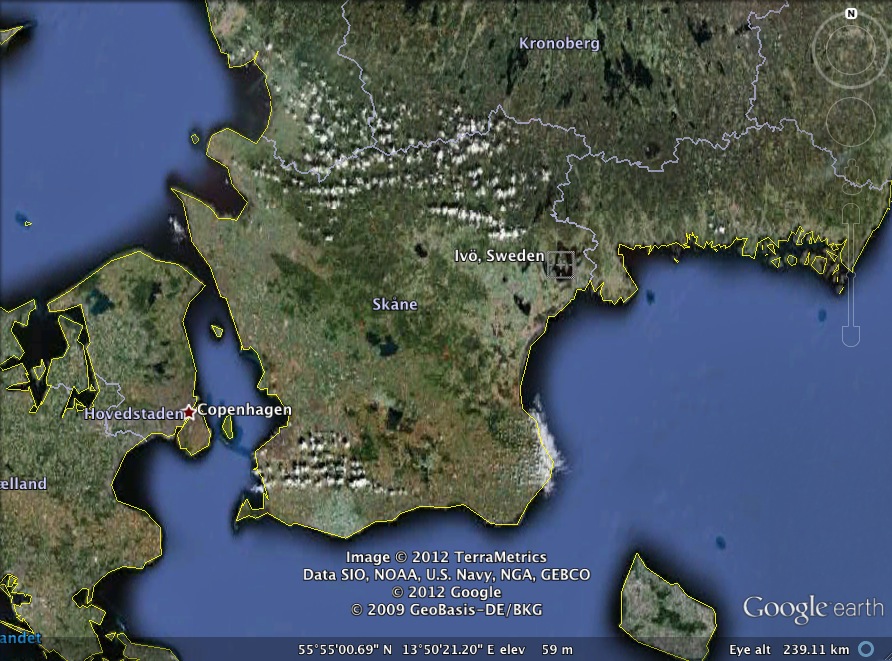
Ivö, Sweden on a Google Earth map.
preferred to be called), came to the United States with his Uncle Pehr in 1889. H.T was 13 years old at the time, and he eventually found himself in Willmar, Minnesota (amongst other folks who talked his talk as well). I knew H.T. came from Skåne, but I did not know he came from the eastern portion of Skåne called Ivö. While sitting with Vivian, I pulled Google Earth up on the laptop and typed in “Ivö, Sweden” and hit “return.” The Google Earth map went from the now nearly historic archaeological townsite of Bremen, North Dakota (in northeastern Wells County), zoomed out, and then back in to the rural Ivö setting in southern Sweden. Below is a short clip of Vivian recalling where her father came from. One more ancillary note: does anyone else see a likeness in facial features between my grandma and the sitting Swedish King? Yeah, you’re right, I’m probably just projecting.
On July 7, 2012, I departed Bismarck for western North Dakota to take in another sample and slice of the industrial labor boom that comes with being the #2 oil producer in the United States. I left Bismarck, traveled down I-94 to Dickinson, turned north onto Highway 22, looped around through Watford City, up through Alexander and then into Williston. A sample of that is in the video below, the intersection of Highway 22 and the Green River just north of Dickinson, North Dakota.
This was taken on a Saturday (presumably a more toned down day of labor than a weekday?). From the cab of a ’93 S-10, semis whipping by give the impression of this. And that is tempered by the realities of real life stories, this one by Scott Grote when he confronted a truck dumping salt water on a road (presumably around Tioga, yes?):
“I found a truck dumping salt water on the road. Just open the valve and they drive down the road. I followed him into location to have a little talk with him. He was going to have a talk with me with his hammer. And I had my .45. That’s how I got away from that one. It’s not much fun. Wherever you go, you got one eye open looking for what’s coming.” [The full story is linked here, and I came across this through Mike Frohlich.]
North Dakota has hit the big time whether we like it or not. While some of us enjoy Mad Max movies and labor industrial environs, there are many who understandably want a slice of the way things used to be (and this phrase, “the way things used to be,” is forever changing, since what’s different today will tomorrow be the way things used to be — once again, historians love tracking change throughout time).
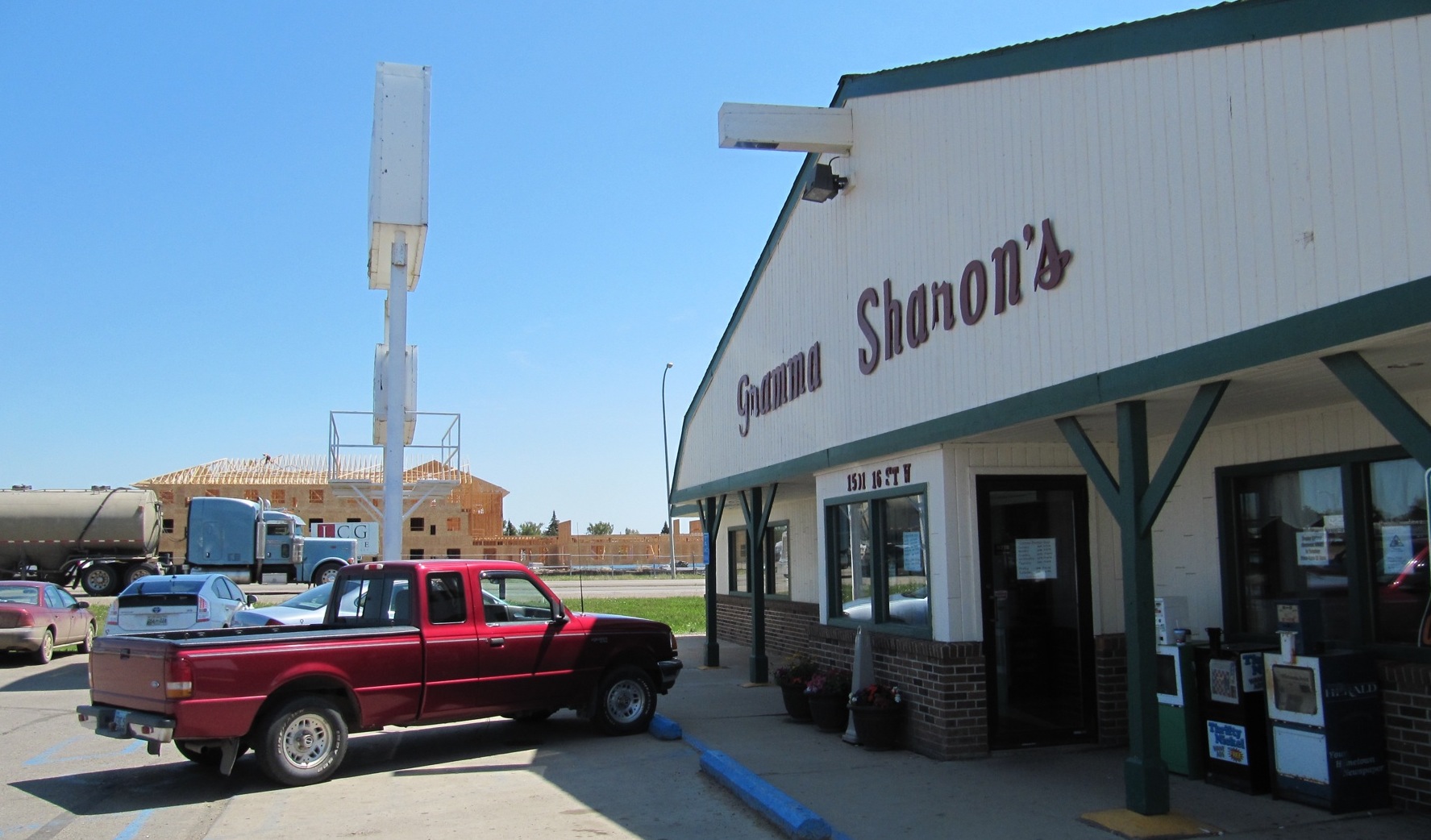
A July 7, 2012 photo of Gramma Sharon’s in Williston, North Dakota. Note the oil truck at left, and the wood frame construction in the back-drop. As for the BLT when you get here.
When I arrived in Williston, I arguably had a bit of normalcy, at least in the form of one of the best BLTs I’ve had in the last 5 years, this at Gramma Sharon’s — even in the Mad Max series there are segments of normalcy. For a BLT, some potato chips, a couple pickles and about a gallon of icy cold ice tea, I was charged $6.97 (If you prefer unsweetened tea, it might be worthwhile to say, “Do you have unsweetened tea?” I do this since the southern migration into the northern Plains will invariably bring sweet tea
This is how they log complaints at Gramma Sharon’s in Williston, North Dakota.
along with it). They are also into self-empowerment at Gramma Sharon’s, and they communicate this in a way typical to North Dakota. If you have a complaint for management, you’re free to fill out an application to become a solution instead of contributing to the problem.
Of course, the pendulum swings back the other way, since everything is not a sustained normalcy. (Note: “sustained normalcy” is a fallacy in any time and age of human history; it’s probably a good idea to think what we mean by “sustainability” when we say it.) After lunch, I had a conversation with a white collar worker, and she said her lodging had to be subsidized since there was no way her salary could accommodate how the oil boom has inflated monthly apartment rates. This even came on the heels of some kind of 10% raise to her said salary. Ouch.
How to manage all of this change is a huge topic of conversation. And it’s nothing to be addressed in full in any singular blog posting. But this is just another contribution.
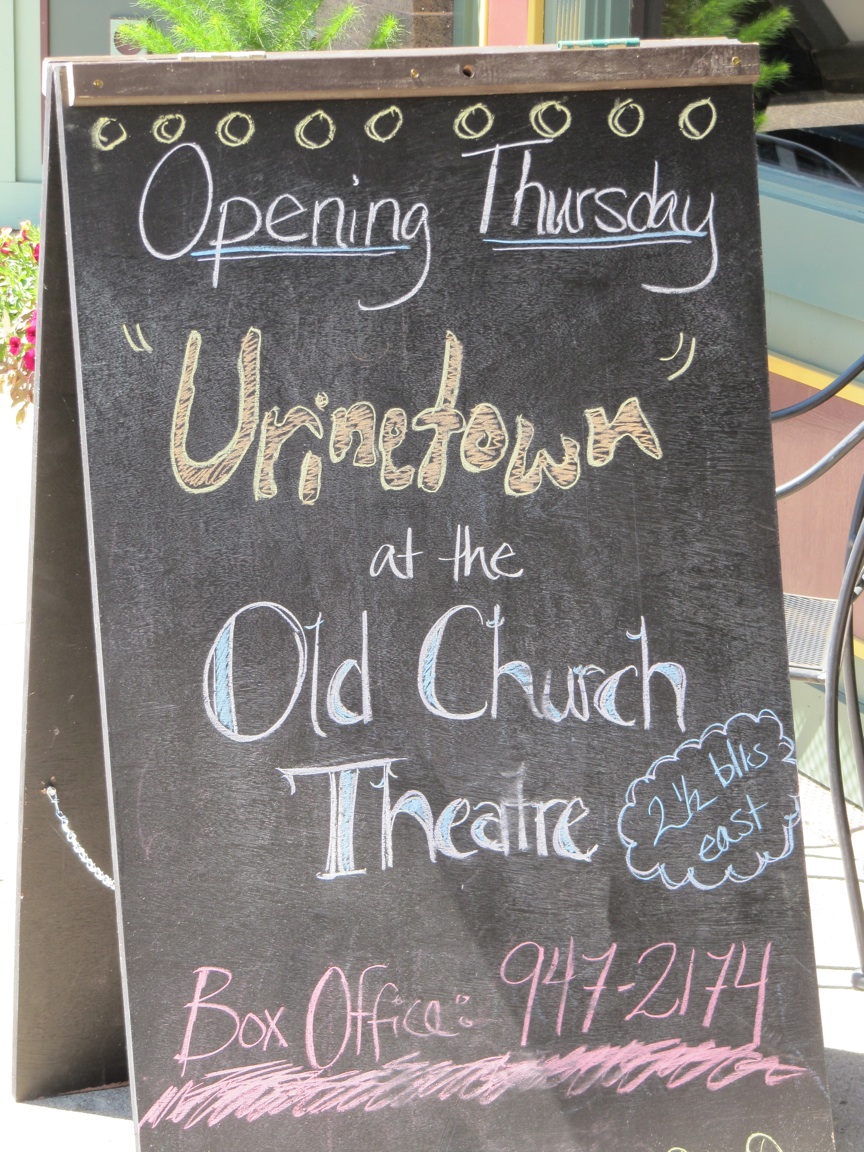
In the introductory remarks to “Urinetown: The Musical,” Director Deb Belquist says, “A few have questioned my sanity for choosing this show, URINETOWN.” With this opening statement and with her following remarks, Deb lays out one of the reasons we have and support the humanities
Urinetown signage in downtown New Rockford, North Dakota.
and the arts: to provoke, to disrupt, and therefore clear the mental cobwebs and encourage thinking outside of our cerebral boxes.
This is the description of Urinetown:
In a Gotham-like city, a terrible water shortage, caused by a 20-year drought, has led to a government-enforced ban on private toilets. The citizens must use public amenities, regulated by a single malevolent company that profits by charging admission for one of humanity’s most basic needs. Amid the people, a hero decides he’s had enough, and plans a revolution to lead them all to freedom!
This theme smacks of several works of political economy, art, and theater, at least since Thomas Malthus (which Deb mentions in the pamphlet) laid out his ideas in the early 19th century that concerned population dynamics. As the planet becomes increasingly populated, it’s always interesting to hypothesize how private and public institutions will manage all of us locally and internationally (life is one big private and public protracted exercise in management). “Urinetown” also reminded me of “Soylent Green,” starring the late Charlton Heston. Put out in 1973, “Soylent Green” was set in the future, in 2022 (or a decade away), and this perhaps is one of the most memorable and understandably recycled lines from the flick.
The drawback of “Soylent Green,” though, is that it’s a movie, and as with all movies, the viewer or movie-goer cannot have the real-time attachment to the actresses and actors as they can when they take in live theater. With the movie, only the viewer can develop a delusional engagement and one-sided friendship with the Hollywood actor on screen (the Hollywood actress or actor simply could not have friendships with the volume of people they attract). With live theater, though, the actors and actresses get to respond accordingly to the audience. There is an interplay, a continued back and forth.
The Urinetown stage set in the Old Church Theater in downtown New Rockford, North Dakota.
This is something the philosopher, historian and archaeologist R.G. Collingwood was deeply concerned about in the first half of the twentieth-century, especially as art became increasingly mechanized (now, for example, we put money into electronic Jukeboxes to hear music instead of bringing in live bands; or we often expect live bands to simply play cover songs; and just yesterday a friend used an iPhone ap to communicate with the electric Jukebox across the room and select songs without even having to get up from his table — this simultaneously didn’t surprise me while blowing my mind).
But enough of my ramblings. Go to New Rockford and see “Urinetown.” Click here for the schedule.
Since it’s July 3, 2012, and since I’ve been flipping through Ambrose Bierce, The Unabridged Devil’s Dictionary (Athens, Georgia: University of Georgia Press, 2000), it seemed worthwhile to do at least two things. No, wait: three things. The first thing to do is to upload the following photo for some patriotic visual.
An American flag next to American daisies with a backdrop of an American brick pattern.
So above is, as the caption reads, an American flag next to American daisies in front of arguably an American brick design. It is not uncommon for nations to assert and lay claim to certain architectural styles, soccer teams, beers, automobiles, and so on.
Anyhow, the second thing to do on this July 3, 2012 is to provide Bierce’s definition of patriotism: “Combustible rubbish ready to the torch of any one ambitious to illuminate his name.” (Bierce, 2000:179) If you made it in and out of the realities of the American Civil War, you too may have grabbed hold of the Skeptical Outlook (One of Bierce’s fantastic short stories on the Civil War is about a hanging).
So we can rage patriotic, or rage skeptical, and this brings us to the third thing to do today. In the paraphrased words of Voltaire — something I heard one of those crack Navy SEAL troopers say on the television some years ago — to be a human and American means that we stand up for the right for others to tell us how wrong we are, to disagree with you and me, to carry on this grand human project and to speak our minds. Yes, even if we’re speaking mindlessness. All the better if we’re speaking sense.
Wait! I will leave you with a fourth (of JULY!) thing, some fanfare for commoners. Take that, Great Britain and you Tory loyalists — or I guess this was written prior to the Second World War, so take that Nazis!
In Robert Sumrell & Kazys Varnelis, Blue Monday: Stories of Absurd Realities and Natural Philosophies (Actar, 2007), the architect Reinhold Martin says in the “Peripheral Vision” preface,
…For it seems these days that not enough architects watch enough TV or listen to enough music or read enough stories. Maybe they are too busy with the serious business of designing buildings and cities. Whatever their reason, their diligence in attending to the harsh “realities” of clients and construction seems, all too often, to leave precious little time to understand how these realities are manufactured. That job, it seems, is left for thinkers with time on their hands like AUDC[Architecture Urbanism Design Collaborative]. (Sumrell & Varnelis, 2007:9)
As I read further into this book at a coffee shop, five Verizon Wireless reps are discussing the most effective ways to route High Definition (among other Web 2.0 media) throughout the Red River Valley of the north. They discuss things like “software,” “phase 2 or 4 routers,” “ALU configuration,” “generic loads,” and all of the understandable engineering necessities required to get this information in. The social and philosophical implications of bringing HD and 600+ channels to the public at large are a bit lacking (aka, non-existent). It’s something covered or hinted at by Chuck Klosterman, at least how a group of Verizon Wireless reps are inadvertently paving the course for the digital ideas that are eventually going to make it to rural North Dakotans. This is followed by philosophical conversations as to how simultaneously connected and atomized the digital age is making us: we are all plugged into digital devices, but no one is chatting with the person next to them — yes, sometimes it’s safer that way.
To a large degree this is one of the reasons our civilization requires a Reinhold Martins or, more local to the northern Great Plains, a Steve Martens, a Tom Isern, a Bill Caraher, and so on. Historians, archaeologists, architects, heritage consultants, historic preservationists, and architectural historians are thee vanguard (whether realized or not) of cultural conservation and preservation. They plug themselves into reading and creating books and scholarship — they think deep — to direct modern day accounting and engineering efficiency to lean in culturally constructive ways. This is important.
You will realize this importance when you receive a dead-pan ragingly indifferent stare from an accountant or engineer after you tell them about the interconnectedness of humanity and the planet. In some cases, this can eventually turn into a competitive blank-stare down. It is sometimes known as “When two worlds collide.” It is a common Monday-thru-Friday occurrence in board rooms, meetings and in the break rooms in both the private and public sectors. In the ideal world, both parties seek to understand where the other is coming from. This is why it’s important to cross professional, cultural, and disciplinary lines. Sometimes it works out. Sometimes…
Since the only thing a person can control is themselves (in the business, we call this “agency”), it is up to the decided historic preservationist to demonstrate how humanity on the planet is interconnected. For example, in some cases it’s possible to explain to the engineer that the secret recipe for concrete was originally set down and preserved and conserved by Vitruvius, an architect of the Roman Empire who thought deeply about many things about 2,100 years ago. We can also explain that some of the first and original Green Energy buildings and earth homes on the northern Great Plains were installed by the Mandan-Hidatsa (the earth lodge), and later by European colonizers (sod homes of the Plains, a specific example the Hutmacher complex in western North Dakota).
Does it matter that we think deeply about these things? It does to historic preservationists. Keep in mind that often those annoyingly short term “hold-ups” — “ALL THESE HOOPS WE HAVE TO JUMP THROUGH!!! WHY CAN’T WE JUST TEAR DOWN THIS BUILDING AND PUT UP OUR MODERN OR POST-MODERN BUILDING!!!” — fulfill a bigger picture of connecting the past to the present. If we as a planet want inspiration with ages then and today, and if we want our grandchildren and their children to follow suit — inspiration is that spirit within, and it is more powerful and enigmatic than economy, petroleum, internal combustion engines, or nuclear reaction — then we need to continue deliberating over exactly what we, humanity, are doing on this planet, especially in our digital world.
Here is a final excerpt from Reinhold Martin’s preface, at least as it concerns how increased populations called for increased architectural verticality, and invariably this gave rise to the development of the elevator and, eventually, elevator music (oh, the sweet sound of elevator music):
…So too is there something poignant in the realization that the dynamism of the elevator, once thought to be the very engine driving delirious New York, had already dissolved by mid-century into the anaesthetic haze of “elevator music.” Poignant, not because it seems to capture in microcosm the postwar neutralization of modern architecture’s mechanical intensity, but because it signals another kind of intensity that architecture and urbanism have only barely begun to grasp.
I type the above while staring out of the window of a multinational corporate coffee shop at another section of strip mall suburbanism. That’s all I have on that. Here is some Joe Strummer, “Redemption Song” (you’ll need to sit through a 30 second commercial to get to redemption — I suppose that’s another metaphor for something):
Paul Chastko‘s contribution concerns the emergence of oil on the north and south sides of our geopolitically imagined 49th parallel, and Toby Craig Jones’s contribution demonstrates how the United States militarized the Middle East in the twentieth-century in order to preserve its broader global oil interests. We are all responsible for using oil (it’s how we go on about our days, whether using plastics or driving to work or stores or to religious sanctuaries), and it does not look like we are going to be able to stop it. We can only nudge oil development in constructive directions. Considering that America is militarily spent on fighting wars for oil in the mid-East, and considering how China and east Asia is on the ascent (Obama amplified our naval presence in Darwin, Australia because of this), North Dakota needs to act. And we need to do it now. Below is a three stage process in how to carry this out:
1) The public and private leadership in North Dakota needs to start working toward figuring out how to maximize the benefits from our non-renewable resource, and we need to stop figuring out how to build pipelines as quickly as possible through our backyards (from Canada to the southern Great Plains). North Dakota needs to build gasoline refineries (in Williston, Dickinson and Wahpeton, or pick your North Dakota town) that are capable of refining everything from the Bakken, and everything that will come out of the Canadian oil sands for the coming decades. This will invariably create a surplus, but this means North Dakotans will be able to purchase cheap gas — so far, the political leadership in this state has been incapable of convincing me why cheap gas by and for North Dakotans is a bad thing.
2) Next, or simultaneously, work with Minnesota legislators and the private sector to build a pipeline from these North Dakota refineries to the deep water port of Duluth, Minnesota, shipping the surplus on barges out through the Great Lakes St. Lawrence Seaway System and ultimately to the Atlantic Ocean. The oil and gas can reach a global market there, and it will not have to travel in a pipeline across several states and another section of the Ogallala Aquifer to line the pockets of Texas and Oklahoma oil barons. Nor will it have to be shipped to urban metropolises back east. Keep the oil here. Only then will North Dakota make hundreds of dollars rather than nickles on every barrel of OUR North Dakota oil.
3) With the refinery oil revenue — here it is — North Dakota will build a $1-billion arts, humanities and sciences research library. This library will be so large that it will attract scholars from the world over. The library will be accessible to all North Dakota University System students as well. Imagine that: a vision that seeks to connect the future of great North Dakota minds with the future great minds of the world. The research library will invariably suck in Federal and non-domestic grants, too, and so on and so fourth, ad infinitum. If you build it, they will come.
We need vision in this state. We need the vision that city founders of Boston and Chicago had in their early days (this is why you have things like the Boston Public Library; or places like the University of Chicago — VISION, rather than short-termism that I keep reading about in North Dakota newspapers). We need to stop being a hinterland to Nature’s Metropolis (either the Twin Cities, Chicago, Houston, or Cushing), and we need to build here and now for tomorrow. You need a substructure of industry in order to provide the support for a superstructure of humanities, arts and sciences. We just need the private and public leadership in North Dakota to grasp this idea and give it traction, or to step aside and let those that are capable of doing it lead the way.
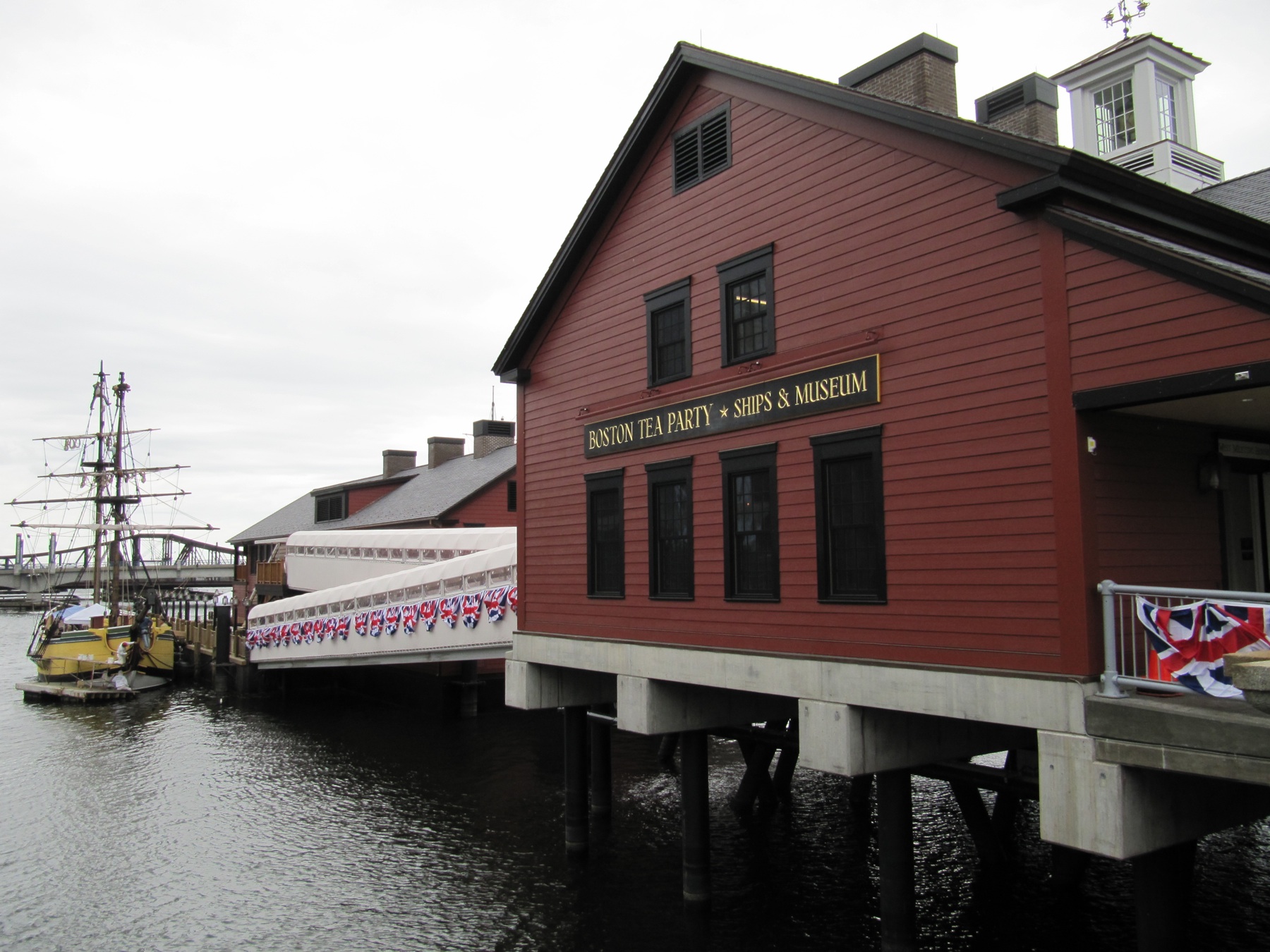
While sauntering up and down the Fort Bay Channel in Boston, while searching for a huge cup of glorious coffee, I came across a bit of commercial public history, the Boston Tea Party, Ships and Museum. It seemed worthwhile to share some photos and provide a bit of analysis and description, at least of the aesthetics. You’ll notice the superstructure of this twenty-first century Tea Party is built on a foundation of modern concrete and modern steel pilings, and this supports a Disney-like façade that shoves visitors through one particular interpretation of the past. The Tea Party seems to be floating just above the Fort Bay Channel, this perhaps a metaphor — visitors can pay some money to float in a romanticized delusion of the past?
The Boston Tea Party Museum, situated at the intersection of Congress Street and Fort Point Channel in Boston, MA.
It is unfortunate that my flight takes me back to the gravitational pull of the northern Great Plains tomorrow. It’s unfortunate because the Tea Party museum opens on June 26, 2012, and this is cutting it too close to when we on the northern plains purchase massive quantities of Chinese-made fireworks to celebrate explosions and things that blow up. It’s important to know your priorities.
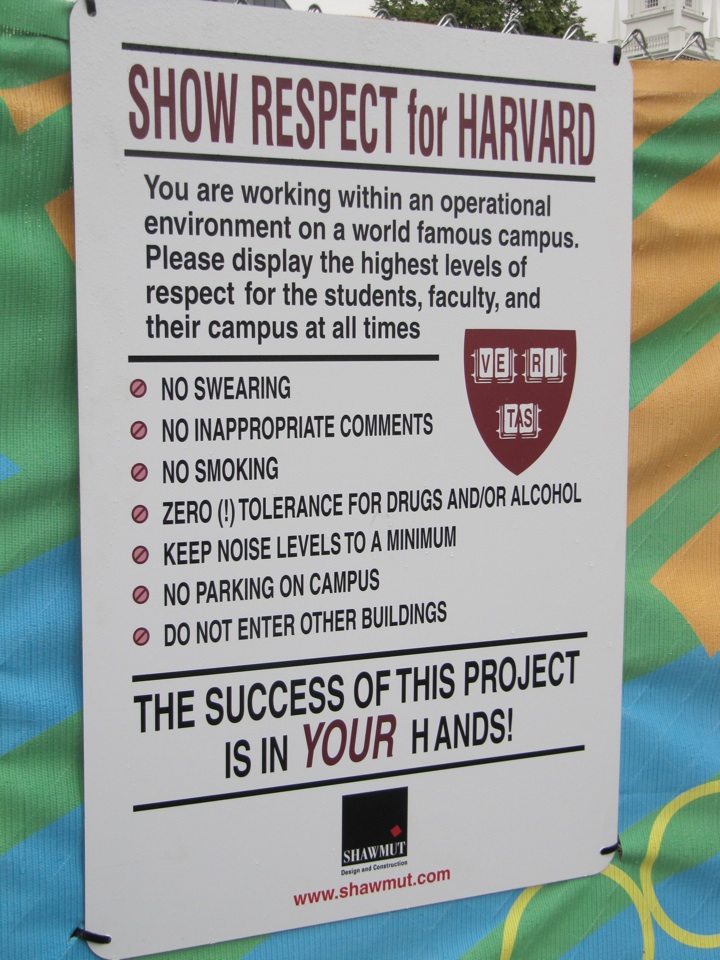
The Tea Party is situated, of course, in Boston, and Boston is home to the famous minister John Harvard, whom I’m told created some kind of magnificent beet sauce (or at least he was the catalyst for its inception), this along with pushing the brain to pontificate on matters of theology and metaphysics. Eventually he became the first benefactor of the oldest friggin’ university (est. 1638) in the U.S. of A. Today you can pound around Harvard yard (and attempt to park your car) and come within range of all sorts of asserted universals. One of these universals takes the form of the following signage put up in or near a construction zone. Is this for the construction workers or the Harvard students? If it’s for the former, it seems fairly anti-labor and anti-blue collar. If it’s for the latter, well, that makes sense:
World Famous Rules at the World Famous Harvard. Photo taken on June 13, 2012 while sauntering around Harvard’s campus.
It’s good they put this signage up, because it’s important to know the rules up front. They list them chronologically, although I don’t know if this is a hierarchy as to which is more bad [sic] than the other. Here they are: “No swearing, no inappropriate comments, no smoking, zero (!) tolerance for drugs and/or alcohol” — Harvard, isn’t alcohol a drug? — “keep noise levels to a minimum” — okay, I can do that — “no parking on campus” and “do not enter other buildings[?]”.
More signage in and around Harvard. Again, these signs are good so that people know the rules. No standing around like everyone tried doing in east-Germany during the Cold War. Photo taken on June 13, 2012.
It seems there is some kind of dialectic at play between the Tea Party museum and Harvard’s administrative rule makers.
Anyhow, I’m off to find the Union Oyster House just down the Congress Street way. The UOH was recommended to me via phone by Justin Vinje, and it is the oldest functioning oyster house in all of North America, or America, or the oldest restaurant at least, so goes the argument. Daniel Webster used to frequent it regularly, guzzling who-knows-how-many raw oysters and tumblers of brandy and water. I’ll do the same, spending a fine Boston afternoon while pontificating the meaning of Harvard gentrification, this along with Tea Party History gentrification. Again, a dialectic is at work here, folks. Something is indeed happening. More on that later. Perhaps I just gotta get back to the northern Great Plains…
There is an understandable concern that in our increasingly digital world we are bombarded with spurious and disparate bits of information from any number of electronic devices, and this is suspect of causing a variety of collective cognitive shifts (for example, as I type this blog entry I’m listening to Joe Strummer and my cell phone is sitting to my immediate right ready to receive and announce any number of texts and phone calls). Sometimes this cognitive shift is reflected (or presumed to be reflected) in the seeming inability of young adults to carry on a real-time conversation complete with the niceties intrinsic to social discourse in the twentieth-century. Ever ask a young adult a question, and then have them simply stare at you at length without any kind of response? Perhaps I’m misreading this as well. Perhaps I’m the one that needs to have a serious adjustment? Well, not yet. Hear me out.
For example, I remember my late grandma Christy going on at length about what constituted “success” in any vacation. She would say, “I had several days of long visits with [insert name of relative or close friend here]…” Rarely was her vacation success a matter of conquering monumental architecture, or pounding around some metropolis looking for real or superficial authenticity. Sure, she wouldn’t mind doing that. But she was more interested in long conversations with people she cared about. But enough of all that for now (a conversation worth revisiting, indeed; love you grandma Christy).
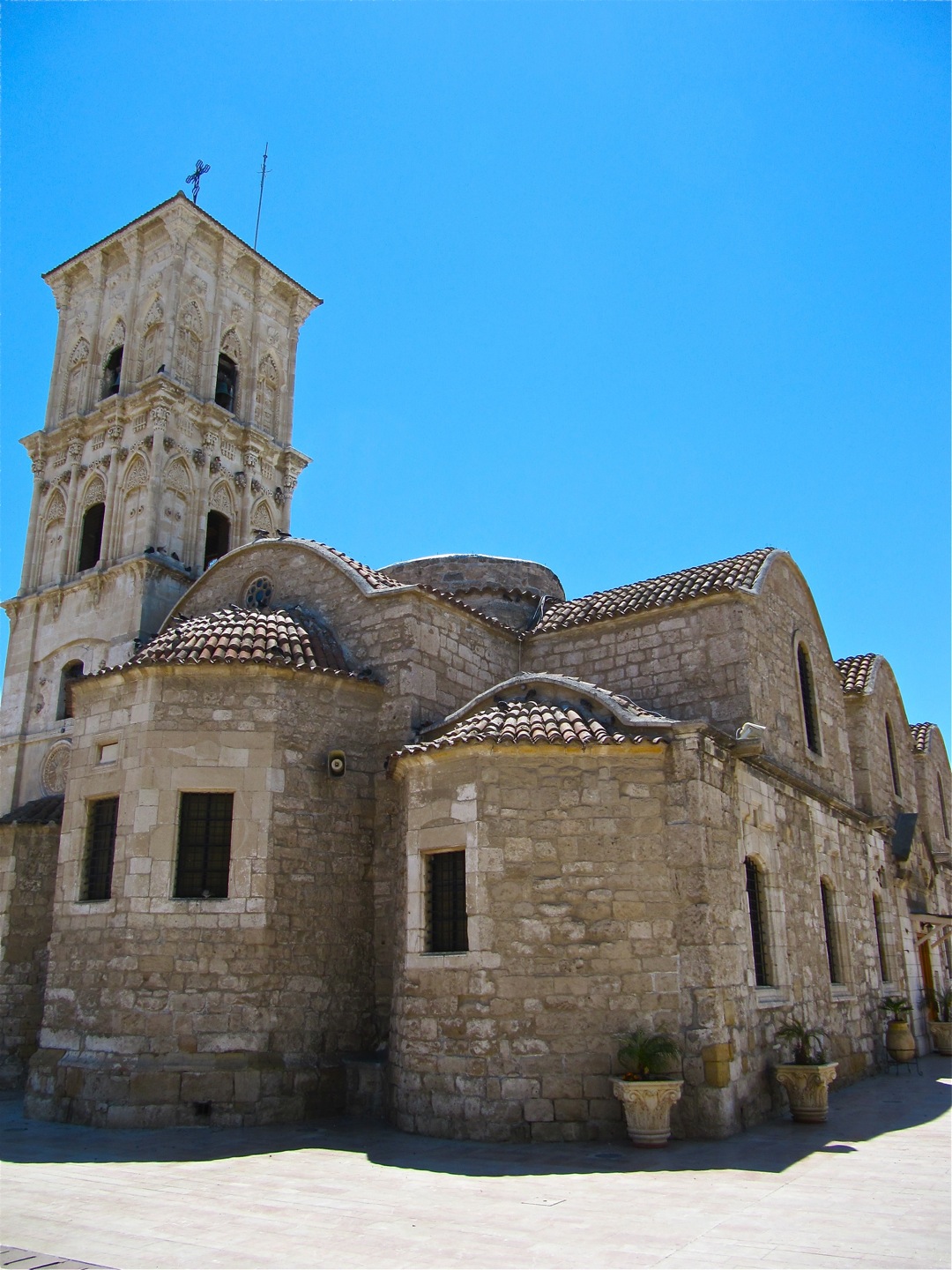
Here are some real and digital images of monumental architecture from Larnaka, Cyprus, at least the St. Lazaros Church as taken in mid-June 2012, and as presented in Google Earth’s 3D image modeling.
Google Earth snap shot of St. Lazaros Church in Larnaka, Cyprus.
Photograph of St. Lazaros Church in downtown Larnaka, Cyprus, taken on the afternoon of June 10, 2012.
Surviving and thriving in our 21st century digital world requires a degree of self-discipline and control, but you could say this discipline was required by any age. For example, when setting out on the Internet on some type of research trajectory, it is all to easy to get lost in hyperlink rabbit holes. We often have a vague recollection of why we opened the browser, but pretty soon we’re lost in the digital ether, one link click after another. We snap out of this link clicking, often wondering whether we just spent 15 minutes or three hours on said link clicking, and all without really knowing what we looked at. It’s much like getting sucked into television for a period of a couple hours and then saying, “What the hell did I just watch?! Where am I?” Yup, we’ll never get that time back.
We shouldn’t dwell on it, though. Seems worthwhile to either turn off the television (or just cancel cable), and call or visit a relative or friend to listen to their happenings, and also share life stories. We might also upload some photos to Google Earth, and thereby use Web 2.0 as a catalyst to induce real-time conversations rather than inadvertently avoid or smother them. Real time conversation takes time, patience and practice. Turn off the damn cell phone, too. Or silence it. At least for two hours. Humanity made it up to the 1990s without cellphones. So we’ll likely survive if we abandon them from time to time. And texting. It’s just an idea. I’m now going to publish this post, and log on to facebook to disseminate it. Then I’m going to log right off. Seriously. No, really. Seriously. I mean this. I gotta go check my text messages…








 The Edge of the Village