On August 22, 2012, Naomi Shihab Nye took a walking tour of downtown Fargo, North Dakota. Inspired by an article in the Fargo Forum on Louise Erdrich, Naomi set out to locate two buildings connected with Erdrich’s time in Fargo during the 1970s. The first was the building where Erdrich lived, and the second is where Erdrich worked. Below are two short video clips of Naomi’s impressions, first of the location of Erdrich’s Fargo flat, this above Arctic Audio at 14 8th Street South…
…and the second on the north sidewalk of deLendrecies at 620 Main Avenue, what used to be the location of Erdrich’s office…
Buildings are stories on so many levels.
Thanks, Naomi, for advancing historic preservation…
As we lean closer and closer to November, and since the political rhetoric is going to get even more insane than this, it seemed necessary to revisit Aristotle’s Nicomachean Ethics (the David Ross translations from Oxford World Classics) a couple days ago. As is the case when wandering around in the history of ideas, any number of said ideas will barrage the brain and apply themselves to contemporary conundrums, situations, and topics. Instead of focusing on or responding any further to said insane political rhetoric, a more constructive use of time came by way of coming across Aristotle’s remarks on academic or professional training. In Book VII, Part 3 of his Nicomachean Ethics, Aristotle said,
“…those who have just begun to learn a science can string together its phrases, but do not yet know it; for it has to become part of themselves, and that takes time…”
Today, 20 August 2012, at 4:00PM, the North Dakota University System mobilized and started the autumn semester, North Dakota State University included. I was thinking how tens of thousands of incoming and returning students will begin or continue professional training within the state, and sometimes it is worth remembering that this professional training takes time. No one wakes up one day, picks up a skate board for the first time, and flawlessly executes an ollie impossible — I stick to walking for these reasons, as I found it is safer for society and myself. Ollie impossibles and any kind of technical and theoretical training requires repetition and practice, similar to what Aristotle mentioned above, or what Zeno of Kitium knew — rail slides and all. Professional training takes time. I think it’s important to remind students of that.
Glad to start the semester, get my head back in the books, the studies, the reports, and in conversation and seminar. Off to it…
This last weekend Dr. Bill Caraher and Dr. Bret Weber invited me to join a research crew that
The petroleum industry (a total of four wells in this photo) dropped in amongst an ocean of industrial agriculture, or wheat fields, in northwestern North Dakota.
Anyhow, the first video captures a green horizontal cylinder with a vertical pipe attached — even if you’re familiar with the oil fields, this first video might capture a slice of what it will sound like when Homo Sapiens attempt to colonize Mars (and sans golden wheat fields as a backdrop). The camera pans to the southwest and then to the southeast, and captures the grasshopper-like derrick smoothly rising and lowering the counterweights.
While standing there the project’s architect and art historian, Dr. Kostis Kourelis (during the tour, he was often known as “Kostis the Greek”), noted to me that in a 21st-century world, this type of industry provides serious relief to assertions that this country only produces digital and virtual instead of tangible and material. I don’t mean this in a celebratory or conspiratorial way, but it’s important to remember that plastics and automobiles and drinking straws and pace makers and Curiosity rovers and good beer and running shoes and punk rock necessitates petroleum.
The second video almost doesn’t even seem like our fault. While heading back from Alexander to our lodging in Watford City, we (John Holmgren, Kostis Kourelis, Richard Rothaus and I) looked to the south of the east-west running road. And we didn’t really look ourselves so much as have the vertical 30′ (or more) natural gas flare streaming up out of the prairie pull our eyes in that direction. How would a full size pick up full of four adult males not be drawn to a 30′ flame shooting up and out of the prairie?
I was going to say the stack was belching, but the flare wasn’t quite reflecting the irregularities associated with a belch. A belch, for example, is quite sharp and abrupt, and it has a definitive beginning and end (the Oxford American Dictionary defines the verb as “emit gas noisily from the stomach through the mouth.”). The natural gas flare, on the other hand, was more of a steady stream of orange and yellow that illuminated the surrounding wheat fields in a pulsing glow. More of that glow is captured below, and again the video is required because a single still photograph is incapable of showing change through time like successive photographs (which is what video is).
We took these photos from a section line road which, in turn, is public. One of the oil worker supervisors came over to interrogate us, but he and we were quick to acknowledge that we were indeed on public land.
It was a bit curious that during our entire 4 day tour of the oil fields in western North Dakota, the most intense security and interrogation came at an oil well rather than any of the labor, crew, or man camps. Nonetheless, before the supervisor left, he made sure to reassure us that our way of life relied on the stuff coming out of the ground. Of course, platitudes are impossible to dispute. When I conveyed this story to Dr. Caraher the next morning, he reminded the table that the vehicles and technologies and ever-changing philosophies that the planet uses result from the intense debates that carry forth within the arts, sciences and humanities. At its best, the mission of universities and colleges is, broadly, to un-dumb the planet (and we are constantly having to un-dumb one another).
On August 4 (a Saturday evening), the Suchy family played the Bohemian Hall, this just south of Mandan, North Dakota on Highway 6. According to Chuck Suchy (a Bohemian Hall specialist) music has been played at this venue since the building was put up. For a deep history on this theme, check out Willa Cather’s My Ántonia. At least I couldn’t stop thinking about how these sorts of novels strike at the heart of cultural truths.
Chuck Suchy ripping it up with accordion on the north elevation of Bohemian Hall.
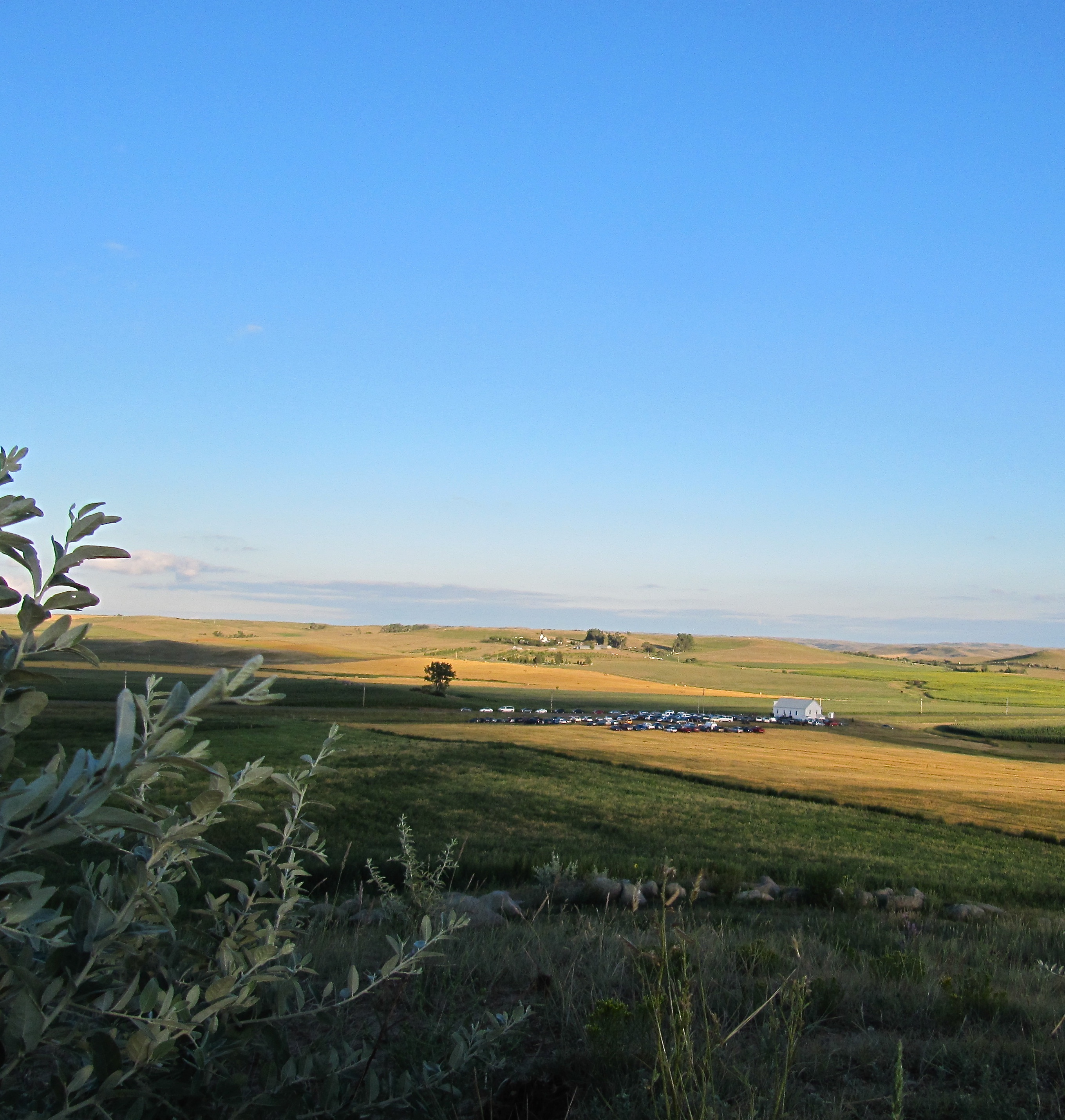
When sitting there listening to Chuck belt out according licks in front of the north elevation of a historic prairie building called Bohemian Hall, the mind wanders through time. Pretty soon you have what in the business we call that “sense of place.” Tall corn fields to the southwest and cut wheat fields immediately north of that. Just to the east is a small village and a rehabilitated church. The shadows get taller as the music plays on and the sun sets in the west. There were two just-off-the-boat Czechs in the audience. The remaining Bohemians (at least the performing musicians) were just a generation or two removed. This hall means something to the Suchy family, and pretty much to anyone that has come within its range. It means something because we’ve decided to make it mean something. We didn’t wait for a financial analyst to come in and tell us whether it would be viable or not (but I suppose one might be handy when it came to crunching numbers about how many pulled pork sandwiches to supply). We gather around because we want to do this.
Bohemian Hall is the white building center-right in the photo. This view looks to the east-southeast.
The Suchy family not only captures the exact identity of what it means to be Bohemian artists, but they are in fact reflections of it to the core. We associate art and music with ethnic Bohemians because of families like this.
During the final couple songs, the late evening gave way to night, and a burning moon rose up out of the prairie.
The weather was remarkable on this evening. No wind (which is unusual for the Plains) and temps that required a light jacket. A horse whinnied during one of Chuck’s tunes, and toward the end of the entire set a burning moon rose up out of the prairie.
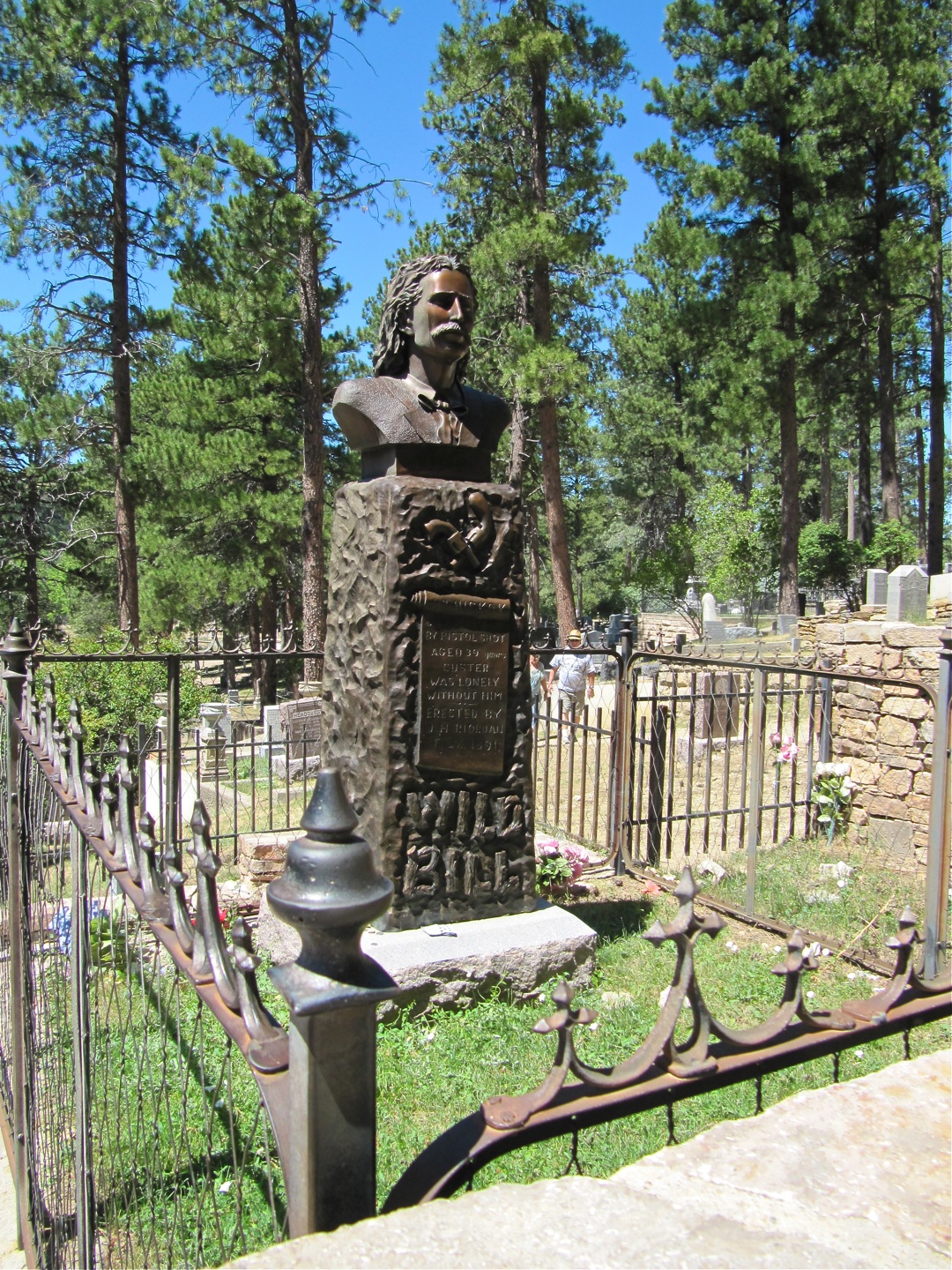
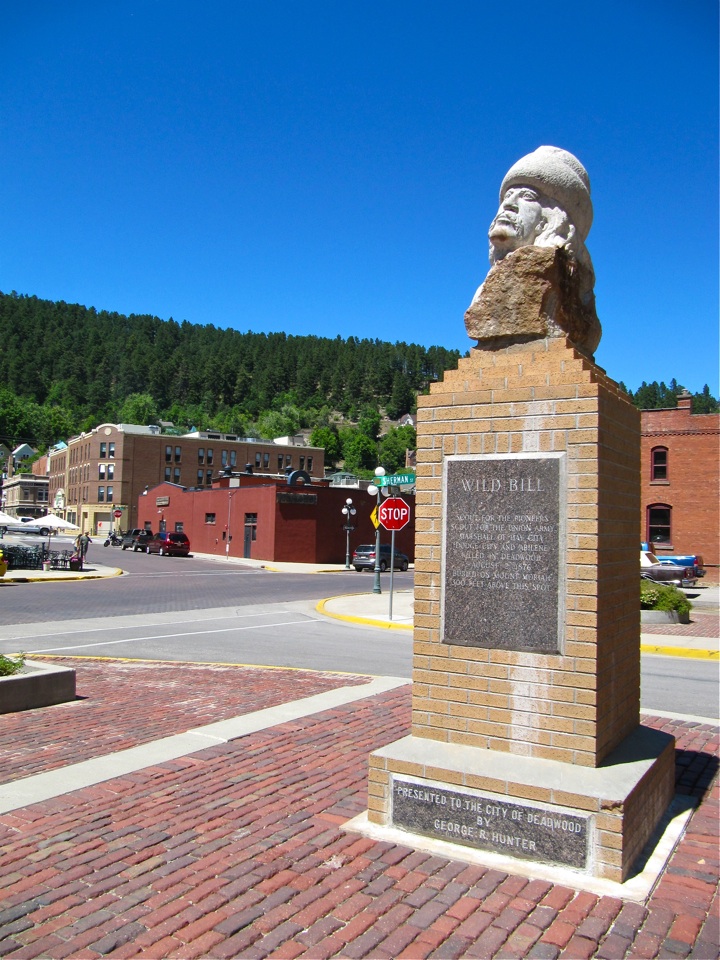
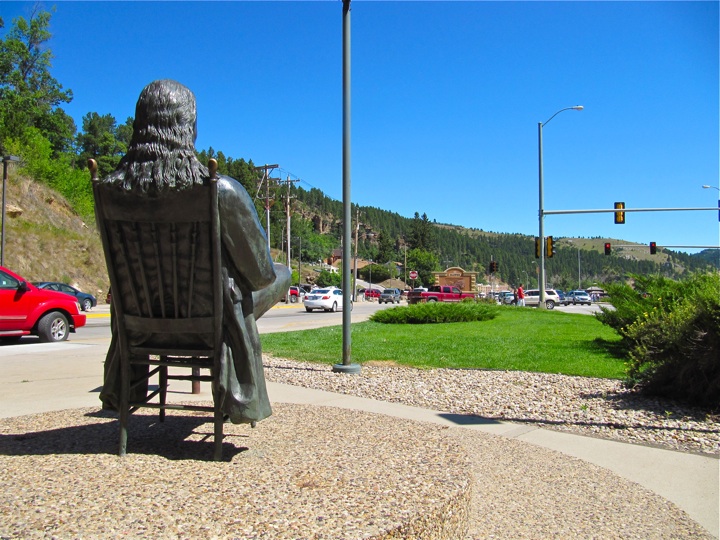
On August 2, 1876, Jack McCall forever immortalized himself and Wild Bill Hickok when said McCall shot and killed Wild Bill in Deadwood, southwestern Dakota Territory. Since then, any number of statues have been created to memorialize and deify Hickok. In Deadwood today, at least as of July 2012, there are numerous signs and busts of Hickok. His heroic and tragic story was popularized even further by the HBO series Deadwood (this is similar to the how Shakespeare popularized the story of Julius Caesar, too). Below is some of the Hickok iconography throughout Deadwood, South Dakota:
Wild Bill Hickok’s grave site at Mt. Moriah Cemetery in Deadwood, South Dakota.
Offerings at Wild Bill Hickok’s grave in Deadwood, South Dakota.
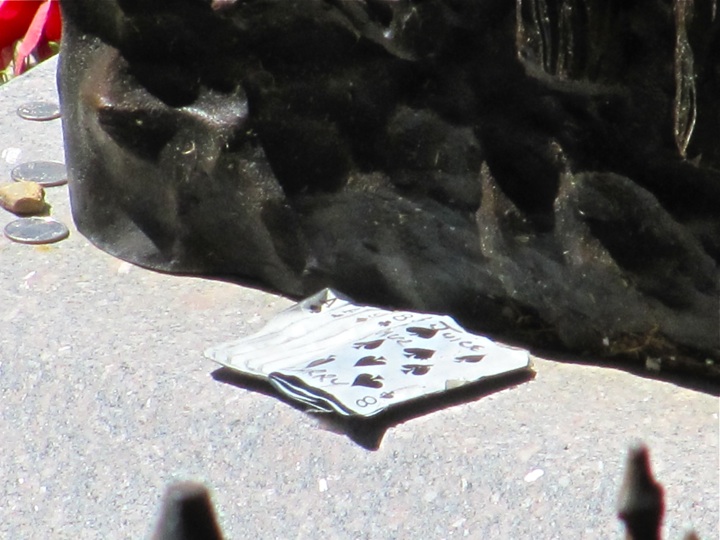
The “Dead Man’s Hand” at the base of Wild Bill Hickok’s grave in Deadwood, South Dakota.
Saloon #10 signage in downtown Deadwood.
Bust of Hickok in downtown Deadwood.
A 19th century bronze Hickok greets 21st century motorists entering Deadwood, South Dakota.
Brothers from Braddock, North Dakota: David Barth and Charles Barth. Photo taken in 1943.
I have since loaded up the digitized oral history from Charles “Bud” Barth, this curated for public dissemination (amongst hundreds of thousands of other oral histories) with the State Historical Society of North Dakota. In the previous post I noted how Charles was a medic in the 103rd Infantry Division, European Theater, Second World War. Here are a couple lines I transcribed from the audio, at least what Charles recounted from his time on the front lines. Charles said:
“…I was not on the front line all the time. I was what they call a medic recorder. I took care of all the guys who were hit, who were killed, who were prisoners of war, and stuff like that…”
And then he recounted one of the particulars in the broader, global war that resulted in millions of deaths. While in the Western European Theater, Charles said this:
“…I remember one incident, this guy was shot, two shells in his upper chest. And he knew he was going to die. I grabbed him, held him in my arms, gave him a [morphine] shot, and he said, ‘Would you… tell mom… and dad…’ and that was the last he said. Now I don’t know what he was going to say… I looked at his dog tags and they were so shot up I didn’t know where he was from.”
Charles transcribed these final words, “Would you… tell mom… and dad…” in the context in which he heard them, and then he attached them to the killed soldier. Days and weeks went by, and one of Charles’s commanding officers eventually tracked him down. His officer asked if he was the medic who wrote the note about the soldier who was hit and killed. Charles said that was the only identification he could make out since the dog tags were so shot up. The officer said they had the killed soldier’s home address, and they gave it to Charles.
Eventually Charles drafted a letter to the soldier’s parents who lived in Wisconsin. He told them he cared for their son just before he was killed in action, and he wanted to pass along his final words. This induced a correspondence between this soldier’s parents and Charles, and they sent letters and Christmas cards back and forth until they just stopped one day. Charles suspected that the soldier’s parents had passed away, and he never was able to track them down.
Nonetheless, these North Dakotan oral histories are a part of the larger picture that is the national Veteran’s History Project. It seemed more than worthwhile to share this bit of digitized history. War is ugly. It is horrible; in fact the most horrific. Yet embedded within this horror are singular stories of selflessness, empathy, appreciation and compassion. These individual stories humanize those larger historical narratives that can seem so rote and distant. The individual stories are all around, just so long as we are ready to sit down and listen.
Within the archives of the State Historical Society of North Dakota’s Veteran’s History Project you can track down any one of the veteran oral histories. So upon hearing this morning that Charles Eugene (“Bud”) Barth passed away sometime last night at 92 years of age, I thought it would be good to track down the oral history he and I put together some years ago. I’m in the process of obtaining the entire file of his history, and it seemed reasonable to reflect a bit on exactly what he did in the Second World War.
Charles was known as “Bud” by any number of people. He hailed from a farmstead just outside of Braddock, North Dakota, and was called to serve not too long after the U.S. entered the Second World War. Charles was rolled into the 409th Infantry Medical Detachment, 103rd Infantry Division, and he served as a front line medic in the Battle of the Bulge. I did a bit of checking around to see about this division’s feats during the Second World War, and it also turns out that Charles along with the rest of the 103rd Infantry Division liberated one of Nazi Germany’s concentration camps, the details of which can be found in the link here.
I think it has been approximately 10 years since Charles and I recorded this conversation about his time in WWII. I remember that he gave me the stories primarily because he was getting up there in age and he thought it might be important to set this information down. I agreed with him. After the interview, at least after the tape recorder was shut off, I also remember Charles saying that he wanted to tell me a bit more about the war, but sans recording device. Vets carry the raw elements of war with them throughout life, and as Charles mentioned to me, every vet deals with it differently. I remember Charles telling me how guilty he felt for making it out of the Second World War while so many others perished. This feeling of “Why not me?” is not at all uncommon, and even quite normal as well.
Later this afternoon I will listen to the interview with Charles that was recorded some 10 years ago. I remember that for a short time he was captured but then escaped from the German Army. When he found his way back to the Allied front lines, his commanding officer told him to get back to work: no time to sit around and celebrate one’s escape after being captured. After all there was a war going on out there.
On the morning of July 19, 2012, at the Fort Clark State Historic Site on the western side of the upper Missouri
W. Raymond Wood and others at the Fort Clark historic archaeological dig on July 19, 2012.
River in North Dakota, Mark Mitchell took time to describe the archaeology and systematic excavations that had taken place up to that point in time. Due to advances in technology — geophysics, and more specifically remote sensing, geomagnetic, electrical resistivity, electromagnetic induction, ground penetrating radar, among others — contemporary archaeology, or “techno-archaeology,” allows for archaeologists to garner a glimpse of what had gone on underneath the ground surface before they punch holes in the said ground. It takes an art and artist, though, to manipulate the controls of these devices and read and interpret the results. The results, in turn, allow archaeologists to drop excavation units down on focused areas, and some of the interpretive results of that are below.
The goal of this project is to discern whether or not the anomalies reflected by the geophysics are part of the broader North American fur trade that characterized much of the first half of the nineteenth-century. Mark explains how this archaeology may be the Fort Clark fur trading post built by James Kipp (note: temps on July 19, 2012 reached 101° F, or 38.3° C — nonetheless, the archaeology pushed on-ward):
During the first week of July 2012, I sat down with my grandmother, Vivian Marie (“Larson”) Barth, and we started chatting about genealogy. We, as in the Royal Humanity We, are interested in genealogy for several
Vivian points to a Google Earth map focused in on the near historic archaeological townsite of Bremen, North Dakota. Her father, H.T. Larson, and his brothers and relations settled in and around Bremen and throughout Valhalla Township.
reasons. One of the reasons has to do with identity, or explaining who we can identify with, and how we identify who we are when asked by others. Large genealogical thinkers are often reflected in the form of theologians and naturalists (such as Charles Darwin): they have thought long and hard about where humanity came from, or might have come from.
Another reason we are obsessed with genealogy has to do with trying to explain to ourselves and others with better detail where we came from (when we know our origins, it gives us a feeling — delusional or not — that we know exactly where we are going, a way in which to push into the future). It’s a fallacy to think that those in the past had such clarity of vision and that they new exactly where they were going. It is only the present, or present mindedness, that imposes this view on the past.
Anyhow, while chatting with this 96 year old Swede, I was able to capture some more focused familial history that invariably reflected a broader historical pattern (migration patterns and that thing we call diaspora). Vivian’s father (or my Swedish great grandfather, Hans Theodore Larson, or “H.T.” as he
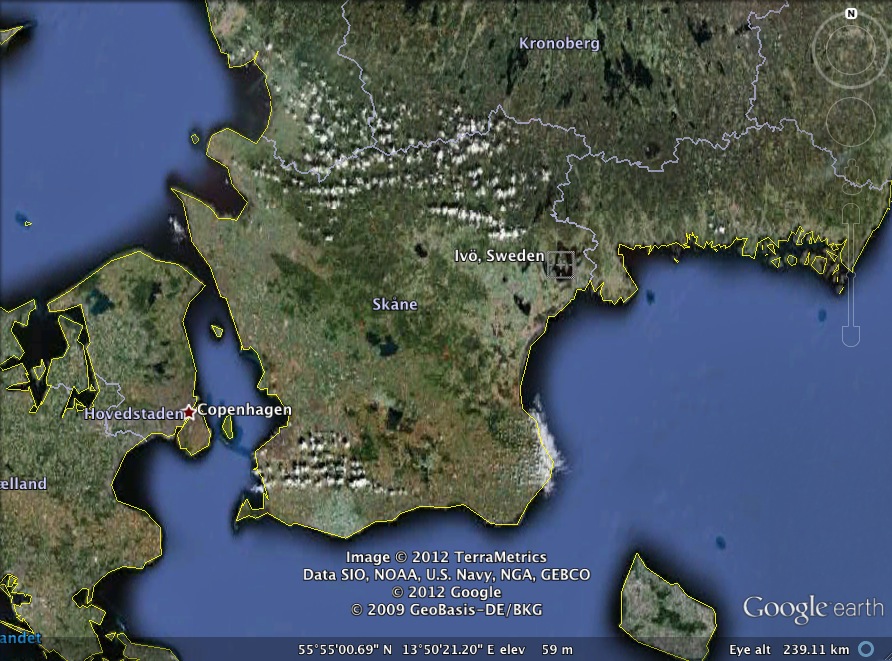
Ivö, Sweden on a Google Earth map.
preferred to be called), came to the United States with his Uncle Pehr in 1889. H.T was 13 years old at the time, and he eventually found himself in Willmar, Minnesota (amongst other folks who talked his talk as well). I knew H.T. came from Skåne, but I did not know he came from the eastern portion of Skåne called Ivö. While sitting with Vivian, I pulled Google Earth up on the laptop and typed in “Ivö, Sweden” and hit “return.” The Google Earth map went from the now nearly historic archaeological townsite of Bremen, North Dakota (in northeastern Wells County), zoomed out, and then back in to the rural Ivö setting in southern Sweden. Below is a short clip of Vivian recalling where her father came from. One more ancillary note: does anyone else see a likeness in facial features between my grandma and the sitting Swedish King? Yeah, you’re right, I’m probably just projecting.
On July 7, 2012, I departed Bismarck for western North Dakota to take in another sample and slice of the industrial labor boom that comes with being the #2 oil producer in the United States. I left Bismarck, traveled down I-94 to Dickinson, turned north onto Highway 22, looped around through Watford City, up through Alexander and then into Williston. A sample of that is in the video below, the intersection of Highway 22 and the Green River just north of Dickinson, North Dakota.
This was taken on a Saturday (presumably a more toned down day of labor than a weekday?). From the cab of a ’93 S-10, semis whipping by give the impression of this. And that is tempered by the realities of real life stories, this one by Scott Grote when he confronted a truck dumping salt water on a road (presumably around Tioga, yes?):
“I found a truck dumping salt water on the road. Just open the valve and they drive down the road. I followed him into location to have a little talk with him. He was going to have a talk with me with his hammer. And I had my .45. That’s how I got away from that one. It’s not much fun. Wherever you go, you got one eye open looking for what’s coming.” [The full story is linked here, and I came across this through Mike Frohlich.]
North Dakota has hit the big time whether we like it or not. While some of us enjoy Mad Max movies and labor industrial environs, there are many who understandably want a slice of the way things used to be (and this phrase, “the way things used to be,” is forever changing, since what’s different today will tomorrow be the way things used to be — once again, historians love tracking change throughout time).
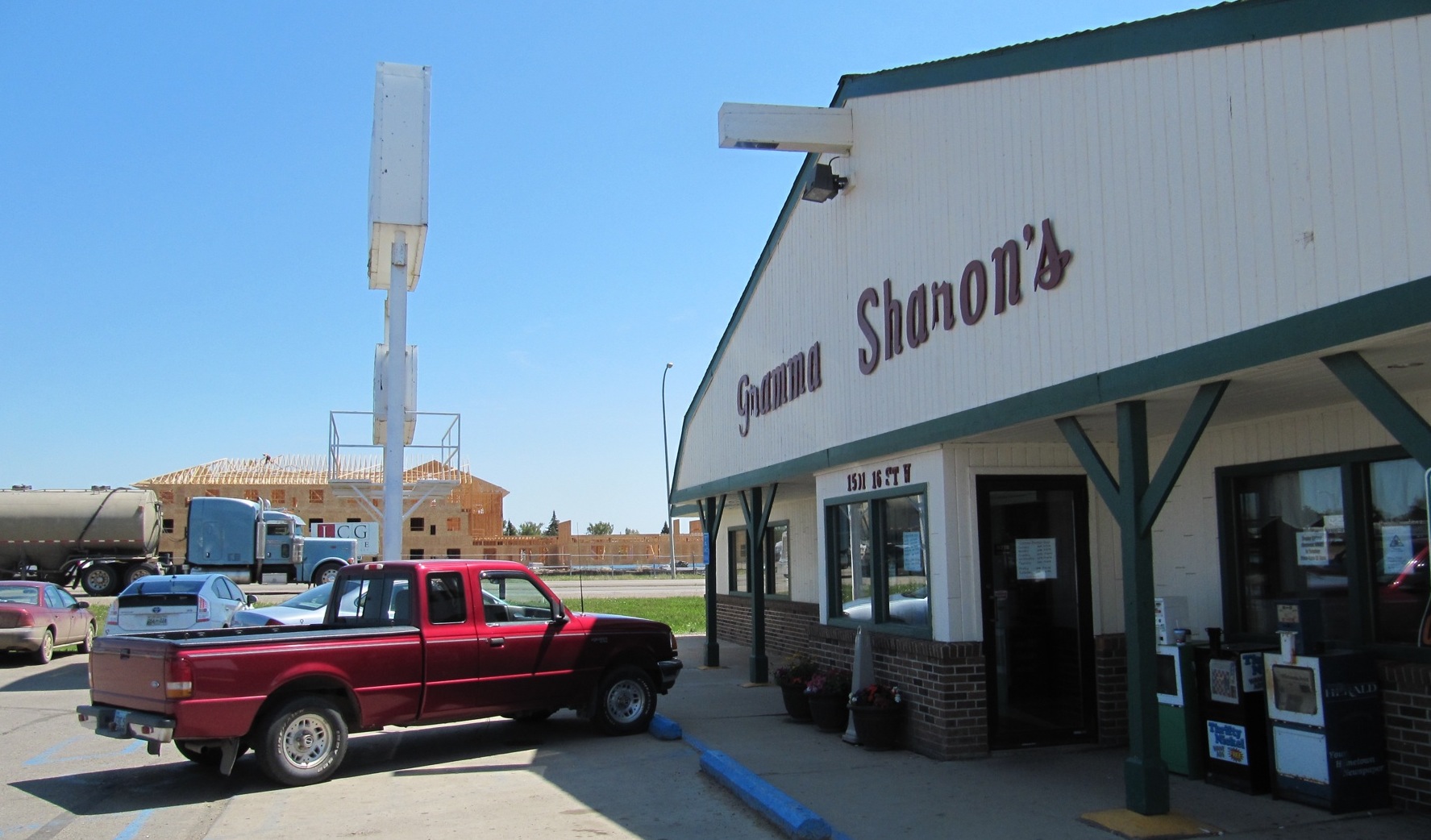
A July 7, 2012 photo of Gramma Sharon’s in Williston, North Dakota. Note the oil truck at left, and the wood frame construction in the back-drop. As for the BLT when you get here.
When I arrived in Williston, I arguably had a bit of normalcy, at least in the form of one of the best BLTs I’ve had in the last 5 years, this at Gramma Sharon’s — even in the Mad Max series there are segments of normalcy. For a BLT, some potato chips, a couple pickles and about a gallon of icy cold ice tea, I was charged $6.97 (If you prefer unsweetened tea, it might be worthwhile to say, “Do you have unsweetened tea?” I do this since the southern migration into the northern Plains will invariably bring sweet tea
This is how they log complaints at Gramma Sharon’s in Williston, North Dakota.
along with it). They are also into self-empowerment at Gramma Sharon’s, and they communicate this in a way typical to North Dakota. If you have a complaint for management, you’re free to fill out an application to become a solution instead of contributing to the problem.
Of course, the pendulum swings back the other way, since everything is not a sustained normalcy. (Note: “sustained normalcy” is a fallacy in any time and age of human history; it’s probably a good idea to think what we mean by “sustainability” when we say it.) After lunch, I had a conversation with a white collar worker, and she said her lodging had to be subsidized since there was no way her salary could accommodate how the oil boom has inflated monthly apartment rates. This even came on the heels of some kind of 10% raise to her said salary. Ouch.
How to manage all of this change is a huge topic of conversation. And it’s nothing to be addressed in full in any singular blog posting. But this is just another contribution.