Monthly Archives: December 2025

Thoughts on Condescension and Pretentiousness

I had a chance in the last couple days to visit an art center in a metropole in the Great Lakes region. While visiting, I got to thinking a bit about these spaces that are curated art spaces. And the resources that go towards, and have gone towards, their creation, maintenance and activation. And how this is a structural space for artists to show their art, thereby allowing the artist to have greater exposure, and even instilling in the artist a sense of making it. Within the art space (and this can be said for other art spaces) squads of staff help, instruct, or politely command visitors to behave in certain ways. This makes sense as the works of art cannot be (or often should not be) touched. Visitors also appreciate being instructed in the ways in which to behave in these spaces.

While at the art center, my mind also wandered toward thinking about the humanistic feelings of snobbery, condescension and pretentiousness, and how these feelings rise up out of human ether and into a kind of social structure. Like a group of people (potentially well financed) agreeing that one collection of art is worthy. And other bits of art are not worthy. The worthiness can in turn be a reflection of the actual material cultural product that is the art (whether fixed or ephemeral, or 2 dimensional art, such as on canvas or paper; or 3 dimensional art, such as mixed media or multi-material and so on). The worthiness can also be a reflection of perception. If an institution and the activators of the institution (such as a committee of individuals) decide, or are directed to decide by a director or museum conductor, that this or that person’s art is now needing to be worthified, then that work of art will be worthified. Then this worthification will be broadcast to art center membership, to past artists who have been worthified, to current artists being worthied, and to future artists who want worthification. It’s like a Gutenberg press to announce a cohesive media message that all readers are on board with. Or are told to be on board with. Like a ship requiring all hands on deck. So all this real feeling and structure then creates the idea that one is either in the artistic center, or they are not, or yet have to be. That is the creation of an other, or “an other.” It’s the feeling of there are us. And there are them.

Snobbery, pretentiousness, and condescension have an intellectual tradition. I cannot recall all titles. But some that come to mind are the following. The 19th century Ambrose Bierce’s Devil’s Dictionary, at least a piercing commentary on words and definitions from the time. Many seem to last. And there was Samuel Johnson, a person who manufactured and thought about snobbery, pretensions, and condescension from the London (not the Parisian) side of the channel circa 18th century. The Ancients have a real warehouse of this stuff. It’s the sort of stuff that inspired individual humans to develop philosophy. A sort of “wait a minute… what the eff did I just experience with that snob Alexander the Great? Why is he such a jerk? Let’s think about this for a bit…” Then boom, the rise of philosophical schools begins. Which creates even another “other,” as in the school of philosophy. It’s never ending. It’s just how it is.

So based on all these thoughts, I texted some friends. In some ways to insulate myself from potential feelings of inferiority within the metropole art center (it’s a punk rock sort of thing to do, or so I tell myself). But again, the substance of the texts had merit. How does one art. And when one arts, are we arting for the love of art? This is the central punk rock DNA we all have within ourselves. Or are we trying to art to become noticed by metropole art centers? It doesn’t have to be straight away one or the other, too. Like it could be percentage mixes. Without fixed percentages. Like percentages that were fluid throughout the day. I think the best texting arrived in a back and forth texting with a friend. We arrived at renaming the metropole art centers the following (it’s only proposed): The Center for Studies in the Acceleration of Pretentiousness and Condescension. It’s not meant to be a mean name. And not all artists or art consumers are pretentious. Or condescending. Very few are. Or very few want to create an other, where folks on one side of the fence attempt to project un-worthiness toward the other side of the fence. At the end of the day, condescension and pretentiousness only has power if a person allows it to have power. Like anything in life. Okay that’s all for this blog spot. Off to other things in the day.
More Landscape Memory of Driscoll, Burleigh County, North Dakota

The last couple days I have been on a text message thread with a descendant of settlers who activated and ran Driscoll, Burleigh County, North Dakota, in the first couple decades of the twentieth century (let’s say from 1900 to 1920s or so). The text message thread came about as many months earlier I had been reading and blogging Era Bell Thompson’s memoir (some more here), one of two she wrote and published, American Daughter (University of Chicago Press, 1946).

In 1946, Era Bell, on page 21, provides a description of how she remembered Driscoll in the 1910s:

“Driscoll was a typical small North Dakota town, population about one hundred. Main Street, a broad, snow-packed road, was lined on both sides with frame store buildings, and its few homes were scattered out to the west of Main and south toward the Lutheran and Protestant cemeteries. A four-room consolidated school sat upon a hill, midway between the cemeteries and town.”

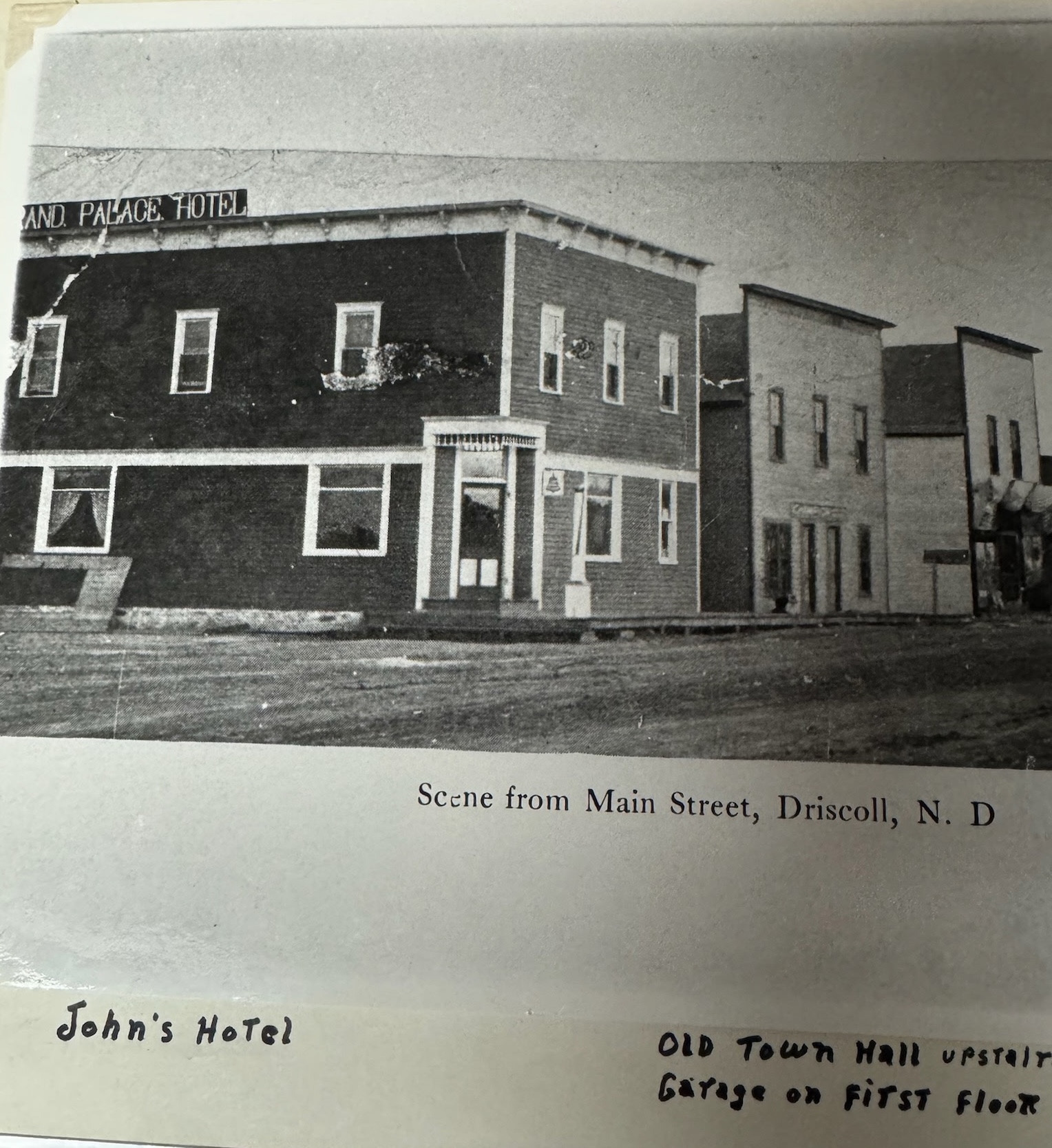
On August 3, 2025, I had a chance to stop along where the north-south automotive road crossed the east-west railroad tracks at Driscoll in an attempts to better acquaint myself with the landscape, and imagine what had been 110 years prior. Fast forward to this week of December 14, 2025, and the text message thread: Kate Herzog (also a commissioner for Bismarck Parks & Recreation District) mentioned some of her great grandparents owned the Grand Palace Hotel, she thinks in the 1910s. Perhaps a bit later. Now cut back to Era Bell Thompson’s 1946 memory of her family relocating from a house “to the empty hotel on the edge of town” (page 26 of American Daughter). Was this the same hotel? I mean, how many hotels could have a town of approximately 100 people supported in the 1910s?

Of the hotel, Era Bell said,

“The hotel was an old, eighteen-room barn of a building, bare and cold, but we set up living quarters in the spacious kitchen, and that night Pop made southern hoecake on top of hte gigantic range and fried thick steaks in butter. The tightness was gone from the corners of his eyes as he threw his head back and sang, ‘I’m so glad, trouble don’t last alway, Oh, I’m so glad, trouble don’t last alway.'”

Kate Herzog texted me this digital image of this hotel week of December 14, 2025.

Also within Era Bell Thompson’s memoir is a Norwegian store owner and clerk identified as “Old Lady Anderson.” Herzog mentioned she had Norwegian kin in Driscoll with the surname Hanson. Are these interconnected somehow? Era Bell also mentioned an Oscar Olson, and a Hank Hansmeyer, the local blacksmith who offered the Thompson family land to share crop on a quarter section that had yet to be picked clear of glacial rock deposits. Era Bell recounted the agreement (page 29): “Hank… would furnish the land, the buildings, and the horses if we… would furnish the seed, do the work, and give him half the profits.”

There’s nothing definitive from this blog entry of mine. Only a continued fascination of the layers of meaning on a particular landscape. A landscape that could otherwise feel “like nothing is HERE!!!” We’ve heard this all too many times from visitors of our rural, or “rural.” Without this meaning, without the intentional and sustained want of us in the present to incrementally scratch the layers away to find out what has happened here in the written, published, and oral historical record, it may well remain a superficial place of “nothingness.” But there’s a lot going on here. A lot today. A lot from yesterday. It’s a model used by the fancier Simon Schama in his Landscape and Memory (Vintage, 1996). I’ll keep chugging on this. But for now, at least I’ve been able to locate in the present the person (Kate Herzog) who will help lead any real or imagined future landscape memory bus tours to Driscoll in eastern Burleigh County, North Dakota.


Reading Joseph M. Marshall III’s Hundred in the Hand

Some weeks or months ago, while in conversation, Dakota Goodhouse mentioned the name of the late Joseph M. Marshall III. I scribbled it down and got to searching on the webs. Turns out he went to the other side in April 2025, but before that he set down a magnificent body of history, cultural history, and novels in the original sense of the word: new ideas.

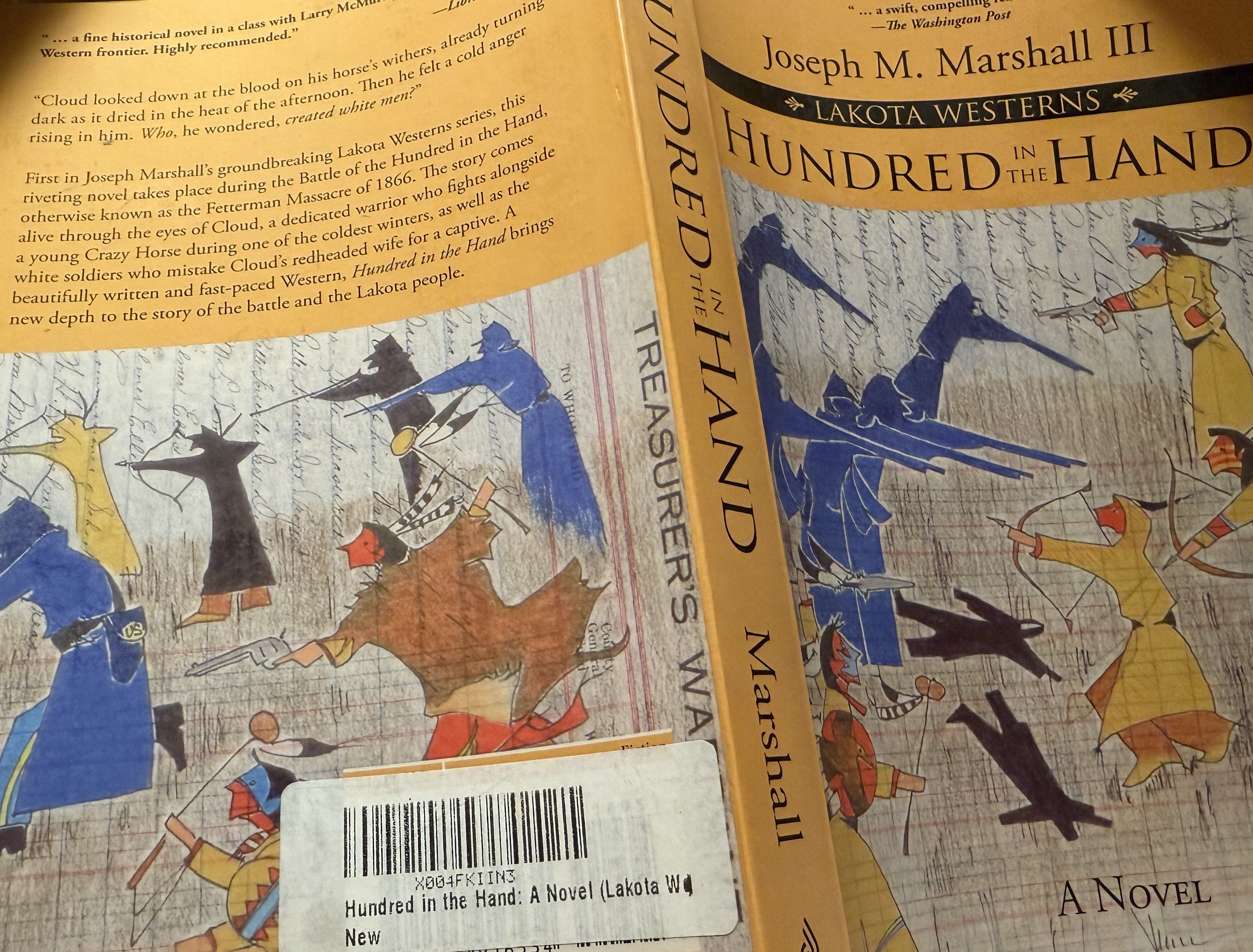
Last night, and in between first and second sleeps, I continued cruising through Marshall’s Hundred in the Hand (Golden, Colorado: Fulcrum Publishing, 2007), described on the coverpage, appropriately, as Lakota Westerns (it’s good to read the plural, as it suggests there is, or will be, more than one).

Reading Marshall III got me thinking about analogies: finding out about Marshall III was similar to finding out about the late Peter La Farge’s work of folk songs, and how Johnny Cash took up numerous songs of La Farge and popularized them. The analogy my brain was running is like this: it seems I’m only now finding out about this amazing historian, artist, folk singer, novelist. It is good stuff.

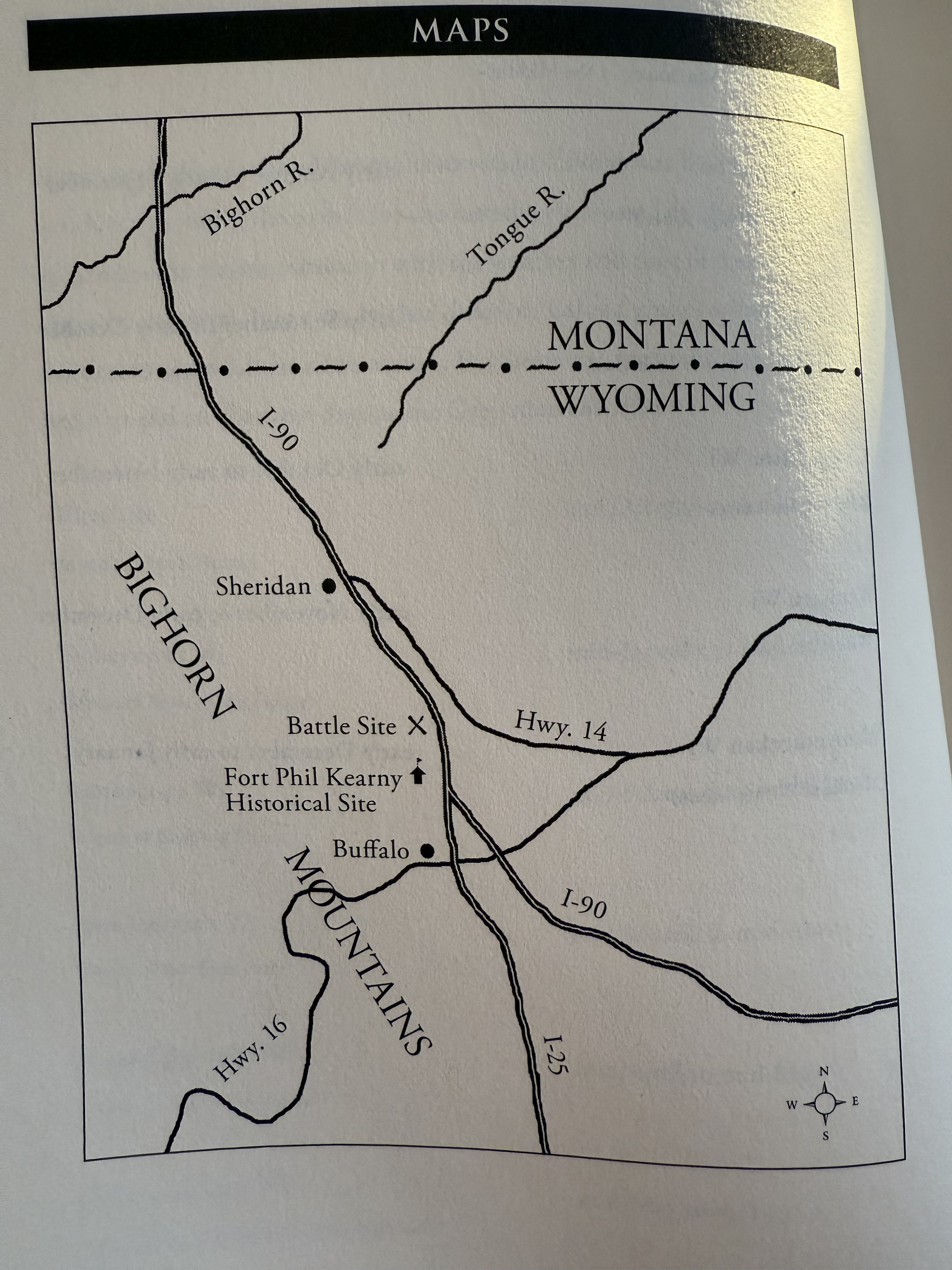
As to Marshall III’s Hundred in the Hand: this morning I texted Goodhouse, “It paints Lakota culture across the 1860s northern plains landscape. Daily lives. It’s good.” The novel takes a reader into a post-American Civil War landscape where the Great Plains mingles with the eastern elevation of Rocky Mountains in today’s Dakotas, Wyoming, Montana, and Nebraska with the characters involved with the specifics of the Bozeman Trail, or what Marshall III notes was called the Powder River Road or, as described in the introductory Lakota to Euro-American glossary, Makablu Wakpa Canku. Marshall III also dictionaries (now a verb) several other landscape names: He Wiyakpa or He Ska (Shining Mountains or White Mountains) = Bighorn Mountains; Canku Wakan Ske Kin (The Road Said to be Holy or Holy Road) = Oregon Trail; Hehaka Wakpa (Elk River) = Yellowstone River; and several others.

The geological river and creek valleys and buttes filled in with the small islands of cottonwoods, amidst a sea of scrub grasses, sage, and cacti. Layered into and upon this is the day to day lives of Lakota, circa 1866, who are understandably frustrated with watching increasing waves of Euro-American gold-seekers migrate through and post up in their country. Without going too much further into it all (save that for reading it yourself), I’d recommend reading Marshall III’s Hundred in the Hand. It adds a greater layer of texture to the region it describes. Needed layers. Historical works often narrate the historical events informed by historical documents (those primary sources) that are created by and for historic bureaucracies: the structures of nation states. Marshall III’s novel allows a reader into the cultural window of a regional northern plains landscape. The smells. The feel of summer heat. The cool of summer night. The tastes of elk stew in the surround of a hide tipi.

The takeaways from this novel thus far? I’ll work in groups of three. The first is that 1866, and Red Cloud’s defense of his people’s country that culminated in the Fetterman Fight, was one of several prologues to the Battle of Greasy Grass/Little Bighorn a decade later. Lakota who fought in 1866 would remember this as one of many as the spring of 1876 approached. Why is this important? As we approach America 250, it will forever coincide with the centennial observance of the June 25, 1876 Battle of Greasy Grass/Little Bighorn, and the various conversations had in the Anglo-American Sphere when news hit the newspapers just after the Bismarck Tribune wired narratives to the New York Herald on July 5, 1876, and the subsequent days after. A second reason take away is the perceptive shift the novel takes the reader on: it reminded me a bit of what Patrick Byrne would like, or would have liked to read, the author of Soldiers of the Plains, a 1926 publication that brought a native perspective to an Anglo-American readership fifty years after the Battle of Little Bighorn. Byrne, who emigrated from Ireland as an orphan, and eventually arrived to Bismarck, Dakota Territory, would understand what Anglosphere Colonization looked like, having seen and heard the recent memories of the potato famines in Ireland, and the Anglosphere’s complete inability to respond in a humanitarian way.

Where are we at with the 3rd takeaway? Regionalism. Unique things have happened, and continue to happen, in the various regions of the world. It’s not that one region is better than another. It’s that things happen in regions. People live out lives in these regions. They are worth considering and thinking about. This, as it goes, leads to an appreciation of regions, and it gives those regions infinite cultural depth in the face of standardized horizontal and vertical strip mall culture (which has its own value of standardized consistency, don’t get me wrong).