Monthly Archives: November 2013

Some Rough Notes on Armistice Day

A section of Joe Sacco's 24-foot-long illustrated panorama of the Battle of the Somme, First World War.

A section of Joe Sacco’s 24-foot-long illustrated panorama of the Battle of the Somme, First World War.

It is Armistice Day today, or what in the U.S. we often refer to as Veterans Day. In the last couple days, I’ve noticed a couple news outlets (here and here, and friends, including Richard Rothaus) commenting or  reporting on Joe Sacco’s latest illustrative work on the Great War entitled, The Great War: July 1, 1916, The First Day of the Battle of the Somme, An Illustrated Panorama (W.W. Norton, 2013).  In America, there is a tendency to remember the Second World War more than the First World War. The former was a kind of mopping up of the latter.

Within that former, or WWI, The Battle of the Somme (or Bataille de la Somme; or Schlacht an der Somme) took place between July 1 and November 18, 1916, and it proved to be one of the most horrific military engagements in industrial human history, where something like 60,000 soldiers died, and a total of 1,000,000 men were wounded or killed. Sacco portrays this in his 24-foot-long panorama, complete with howitzers, machine guns, entrenched soldiers in tin hats… The details are superb, and so is the idea of illustrating war with the medium of cartoon. Another recent portrayal of the serious topic of war by way of cartoon comes from Waltz with Bashir, some remarks on that here.

The Battle of the Somme map from Wikipedia commons.

The Battle of the Somme map from Wikipedia commons.

I think the medium of cartoon is attention-getting, especially for these serious topics, for a couple reasons. When it comes to the First World War, it sometimes seems that we’re reading about a topic that certainly happened, but it is in such a far away temporal place. By capturing or re-imagining it with cartoon, a viewer is impressionistically given the choice to mentally go back and forth between the idea of a cartoon and that of reality. One is supposed to be nonrealistic while the topic is very, very real. This in turn is of interest because wars have induced re-education, at least where nations try to get their soldiers to think of the enemy as just that: non- or sub-human, something we might call the “other,” often captured by the phrase, “They aren’t like us.” This psychology, at least as laid out by Ari Folman’s Waltz with Bashir, allows a soldier to not think too hard about pulling the trigger or getting up out of one’s trench and marching head-long into mortar and machine gun fire: one doesn’t think about marching into mortar and machine gun fire before or while marching into mortar and machine gun fire.

This is a point of discussion — conceptualizations of “the other” — that comes up from time to time in the history of conflict on the northern Great Plains. Just last week, while talking about Paul Beck’s, Columns of Vengeance (U of Oklahoma Press, 2013), I was thinking about how much these otherwise ordinary farmers were mustered into being Union soldiers, and how they  conditioned themselves (or were conditioned) to think of Native America as something other than human. When someone thinks of another human as sub-human, the human with those thoughts is becoming less than human. We might also say that humans are capable of great compassion, but they are also capable of atrocious avarice and hate. By being conscious of this, perhaps we can lean more toward the compassion and empathy instead of the avarice, malice and hate.
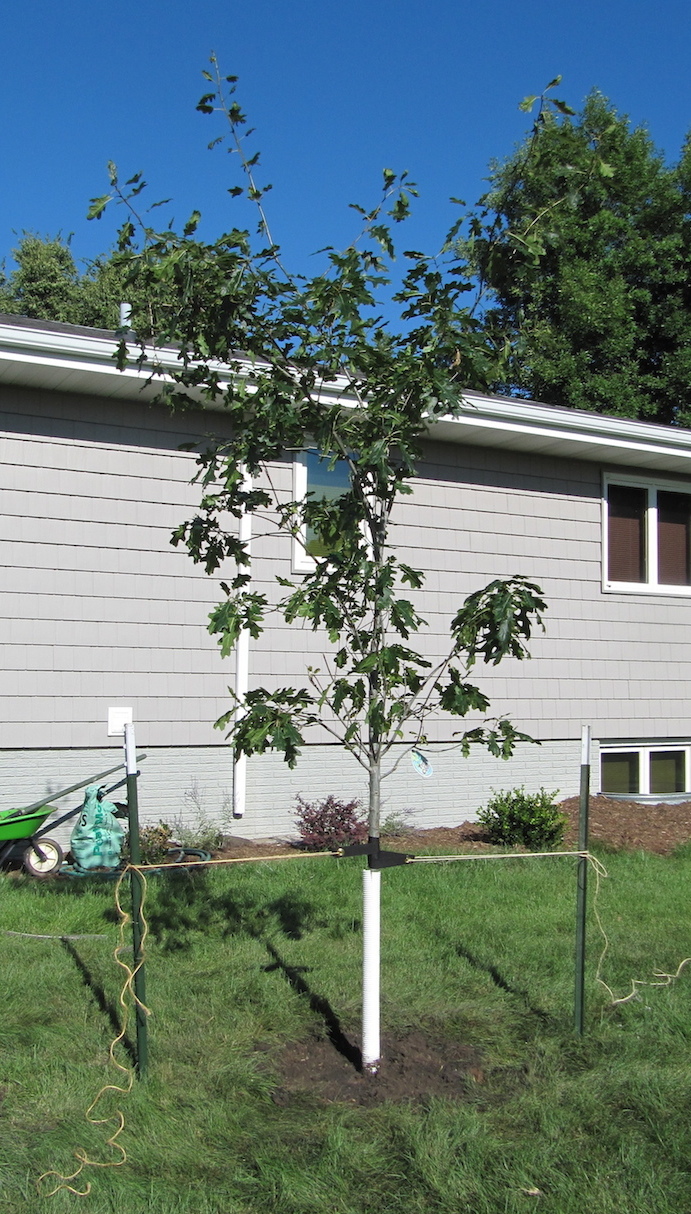
Barth Memorial Tree

An August 5, 2012 photo of the Charles Barth memorial oak tree.

War is terrible, and terrible things will always happen in war. It’s important to reflect on this. I was privileged to be able to chat at length about the Second World War with my late great uncle Charles “Bud” Barth. He was a front-line medic in the European Theatre of the Second World War. I have blogged about these chats here and here and here. Anyhow, that’s what I’ve thought about a bit this morning.

At left, here is a August 5, 2012 photo of the silver oak tree I planted in my family’s yard in Bismarck, North Dakota, right around the time that Charles passed away. I call it the Charles Barth memorial oak tree. The tree itself was purchased from Cashman’s Nursery, a great local greenhouse in southeast Bismarck. I’m reminded of Charles when I look at that tree.
Dakota Goodhouse’s Winter Counts

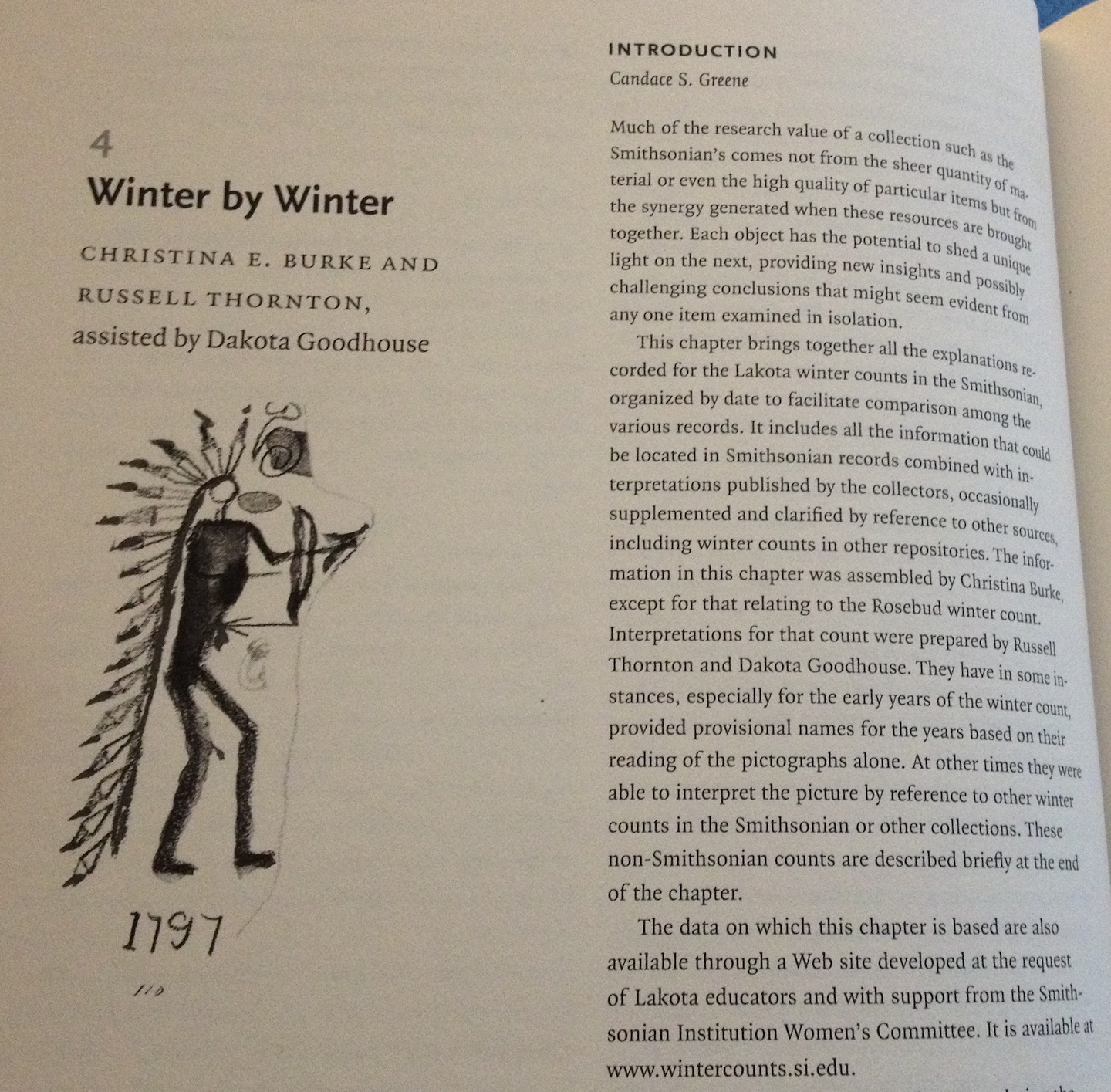
Chapter 4 of "The Year the Stars Fell: Lakota Winter Counts at the Smithsonian" (2007).

Chapter 4 of “The Year the Stars Fell: Lakota Winter Counts at the Smithsonian” (2007).

In the last couple days, Dakota Goodhouse (his blog, which you’ll want to visit, linked here) and I have been hanging out in downtown Fargo, as he’s in town to expand on the Native tradition of winter counts. He crashed at my place for a couple nights, and last night we had dinner over here after his short talk at the Spirit Room (this was organized and funded through a collaboration between the Fargo-West Fargo Public Schools Indian Education program and the North Dakota Humanities Council). Dakota and I chatted more about winter counts, and about future prospects of scholarly interest and inquiry.

I’m thinking that winter counts, and the history of them, have become popular enough that I don’t really need to explain them. But just in case, a winter count is an annual pictograph painted onto the larger medium of buffalo or elk hides. In the latter part of the 19th century, they were painted onto canvas. These counts provided the owner or memory group with a traceable past, the pictograph often representative of a successful high-point of that year.

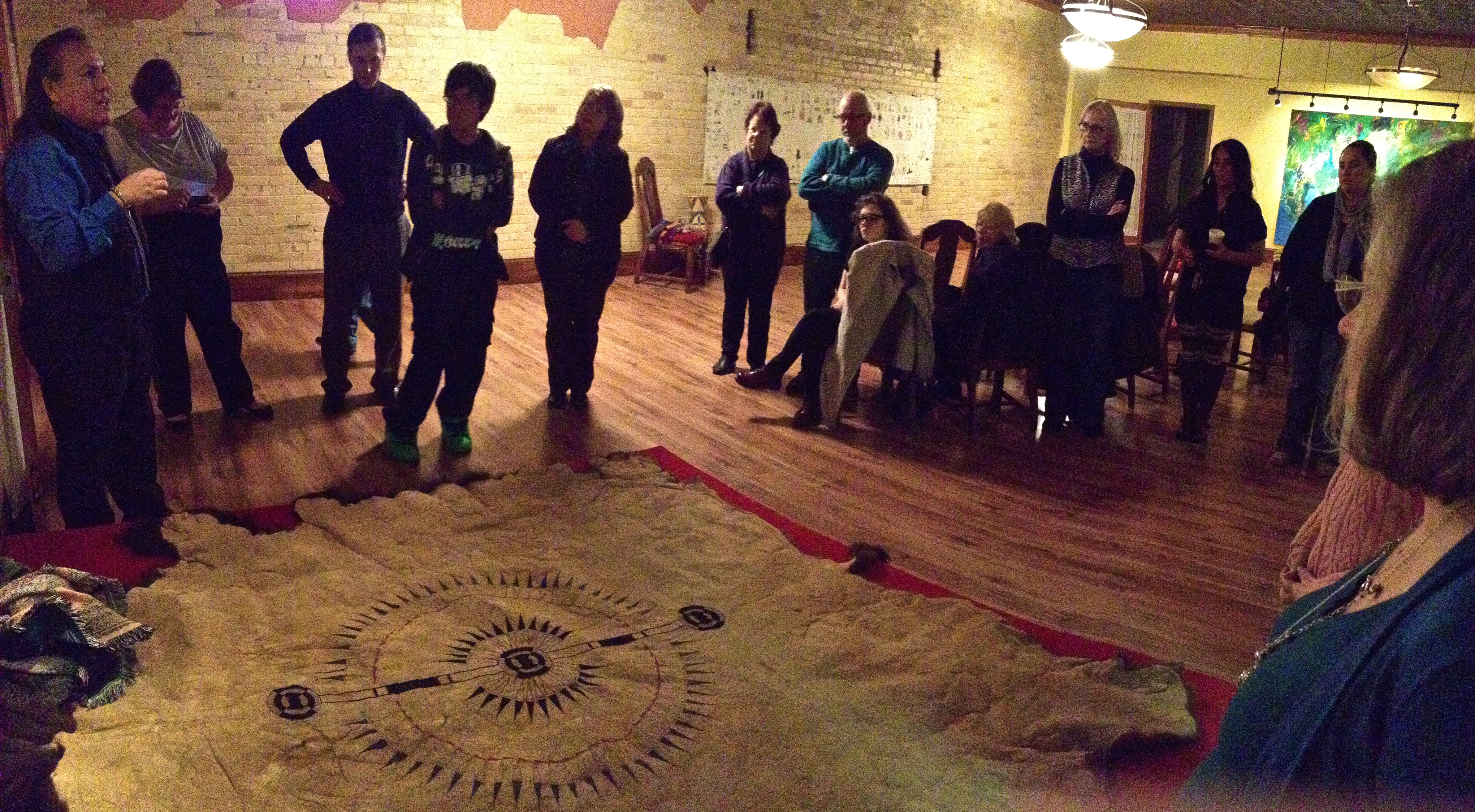
Dakota Goodhouse explains the stories reflected by and attached to the pictographs on the bison hide.

Dakota explains the stories reflected by and attached to the pictographs on the bison hide.

While Dakota explained the winter counts to the group at the Spirit Room last night, he pointed to one of his buffalo hides while expanding on how he saw something different in that particular account. This particular account is a symmetrical series of triangles running around the circumference of a circle. Some years ago, Dakota said he used to think of this as a war bonnet laid out on the floor. Today, though, he said it also looks like the plains indigene narrative attached to what we call “sun dogs.” One of the stories that he knows is that the sun dogs are thought more of as camp fires next to the sun.

These various stories got me thinking at least two related things that are slightly polemical. The first is something we deal with every now and then, and that’s one-dimensional thinkers who sometimes say, “Well, cultures with oral traditions don’t have a history, or if they do it’s impossible to trace.” This is always a fun question to respond to, but last night I was thinking more-so of how a person who reads a novel, or a good piece of history, are likely to walk away with a different perception about the same piece of scholarship within the span of two or more readings.

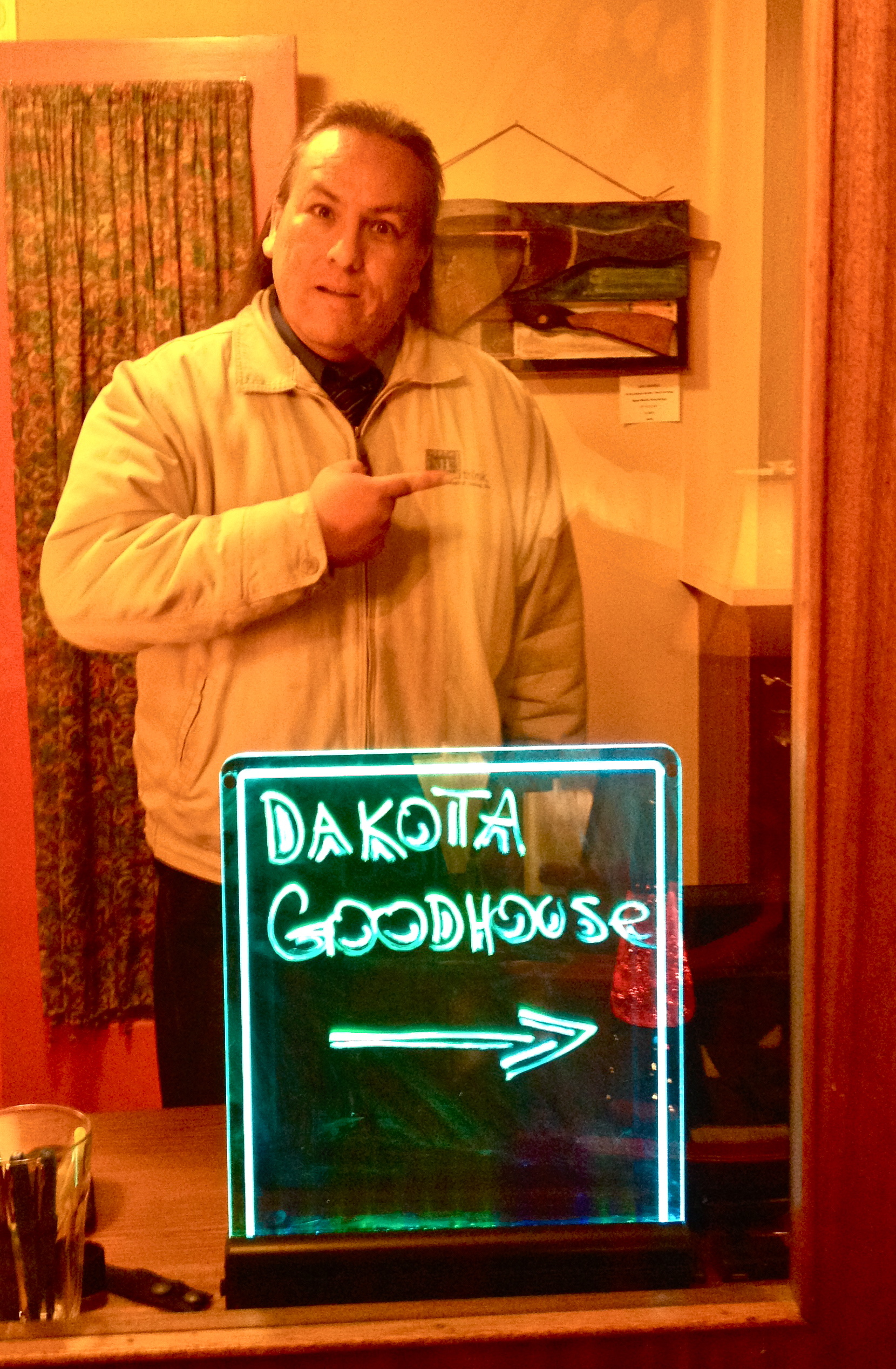
A picture of Dakota being hilarious.

A picture of Dakota being hilarious.

This is similar to the winter count. Dakota explained the difference in how one individual, when looking at the bison robe laid out, might see a native headdress while another might see sun dogs, parhelia, or what the Dakota call wi’aceti, this roughly translated and defined as “when the sun makes fires.” Dakota added that the winters on the northern Great Plains are so cold that the sun requires camp fires to keep it warm.

From here on out I decided to abandon the sun dog phrase and replace it with wi’aceti (pronounced, roughly, “we-ah-che-tee”). If anyone wants to join me on the northern Great Plains in this effort, by all means. If we hear someone say “sun dog,” please feel free to add wi’aceti to that, and with explanation.

Also, Dakota contributed heavily to a piece of winter count scholarship that yo might be interested, chapter 4 of Candace Greene and Russell Thornton, The Year the Stars Fell: Lakota Winter Counts at the Smithsonian (Lincoln: U of Nebraska Press, 2007).


Punk Archaeology Updates

Before getting after some technical writing this morning (only to be later usurped by some Dakota language studies), I thought I’d link to some forthcoming scholarly analyses on the cultural movement of Punk in all of its unadulterated filth and fury. You can read about the soon-to-be-realeased Punk Archaeology anthology here, and about a work of Punk Sociology here. It was great this morning to come across a local story of a proto-punk Jonathan Richman, who is getting ready to play the Aquarium in downtown Fargo, North Dakota this next week too.

On this single-chord punk note, it’s appropriate to mention the passing of one of the first proto-punks, as memorials and obituaries on Lou Reed have been popping up all over the place (here, here, here and here). This shouldn’t eclipse the passing of folk punk hero Phil Chevron (aka, Philip Ryan of The Pogues or The Popes, depending on the year) in early October 2013. A sad reality for sure, and a time for reflection and contemplation.

An October 19, 2013 photo of Modern Times Cafe.

An October 19, 2013 photo of Modern Times Cafe.

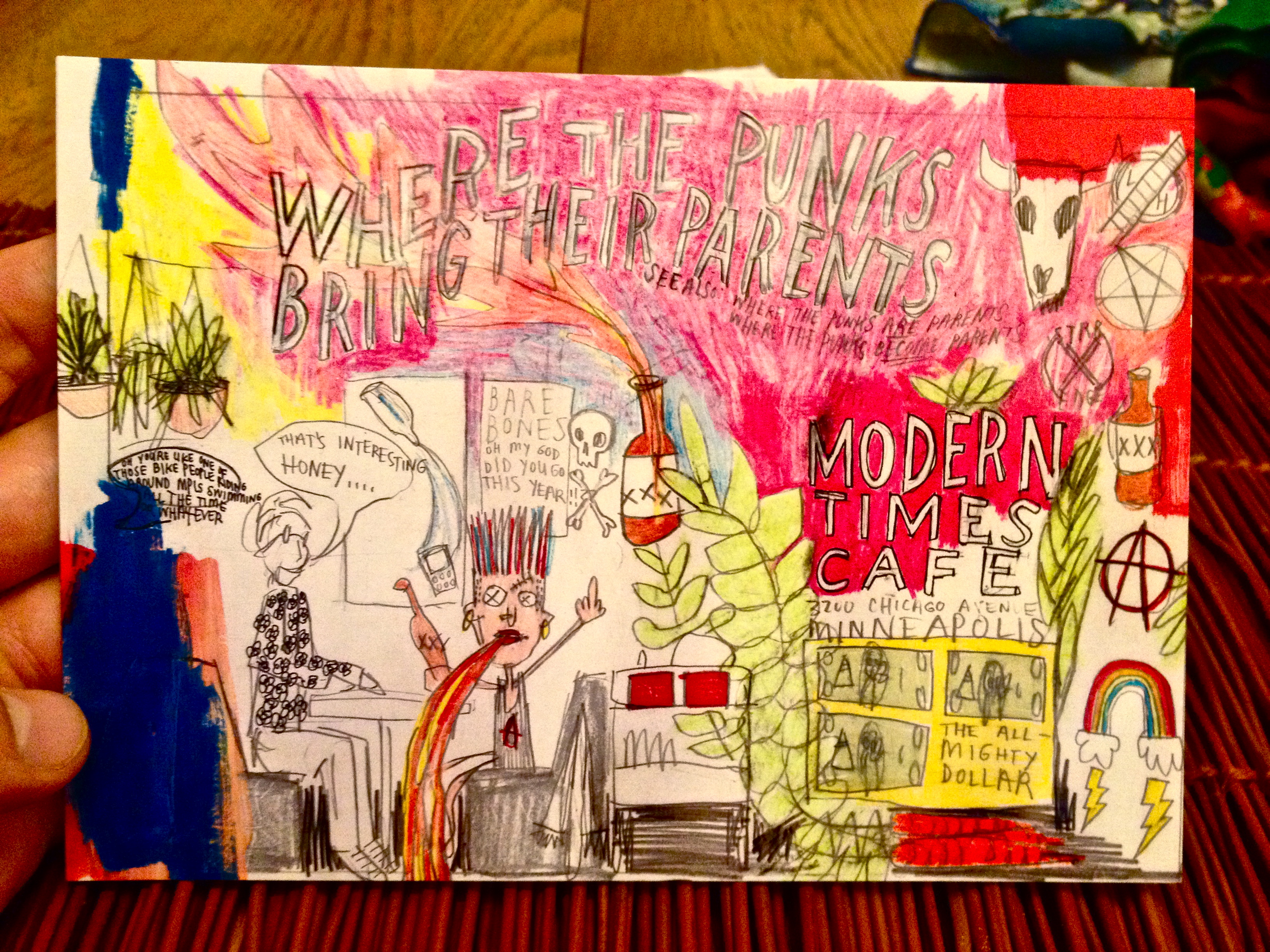
And although we are losing our original punk heroes, punk culture continues pushing in a variety of directions today. Here is a photo from some boots-on-the-ground punk (lower case “p”), this coming from the delicious Modern Times cafe in Minneapolis, Minnesota. A couple weeks ago Molly and I had a chance to make a quick jaunt down the I-94 block from Fargo to MSP to visit a couple friends, and the next morning we hit up this cafe. It’s at the intersection of Chicago Avenue and E. 32nd St. in Minneapolis, and everyone should go here. It’s a place where punks either are parents or a place where punks bring their parents to engage in politely brash conversation and society. A couple more photos below, one of the delicious breakfast meal, and below that a photo of a post card from the fine by-and-for establishment. The only thought left was this: “When will Modern Times open up in downtown Fargo and Grand Forks?”

Delicious, sensibly priced breakfast from Modern Times Cafe.

Delicious, sensibly priced breakfast from Modern Times Cafe.

A Modern Times Cafe postcard indicating that this is a place where punks bring their parents.

A Modern Times Cafe postcard indicating that this is a place where punks bring their parents.

At the right, the viewer is informed with the icons that Modern Times is anti-establishment. This includes an anarchist logo, a rainbow with lightning bolts, a pentagram (suggestive of neo-pagan revivalism or acceptance), a phrase that mocks “The All-Mighty Dollar” (strongly suggestive of a counter-capitalist culture), and so on. At the top is a descriptive banner that says, “Where the punks bring their parents; see also: where the punks are parents, where the punks become parents.” Seated in the lower left are two individuals, presumably a mother and her son. Impressionistically, the son is advertising to one and all that he doesn’t care (this indicative of his hoisted left-handed single digit and a “xxx” booze bottle in his right). His mother, like all loving mothers, is just happy to see that her son is engaged in activities of all sorts. She is responding to her son, saying, “That’s interesting honey…”


Post Un-Conference in North Dakota

We — the royal North Dakota humanities scholars We — just concluded an informal state-wide humanities get-together in downtown Fargo, North Dakota. It provided a venue to bring a large cross-section of North Dakotans together, pack them into one room, and get them talking about various projects they work on, this to generate unforeseen collaborations for future projects and programming.

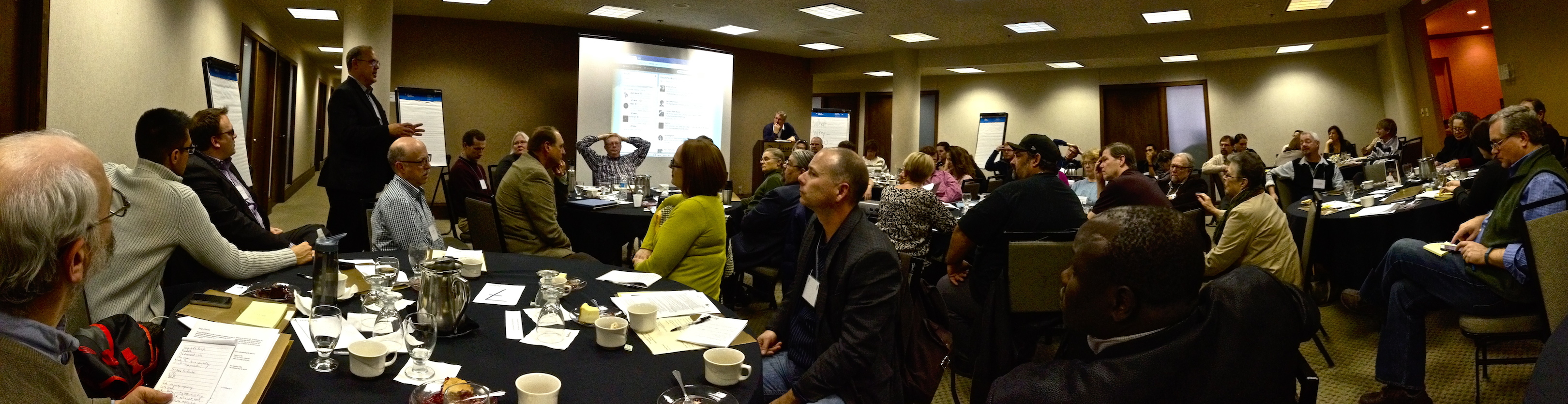
Individual attendees came from a variety of institutions, and I’m not going to group them because the conversations cut across all sorts of arts, humanities, and social scientific lines. Scholars came from Williston State College, Minot State University, Sitting Bull College, Holden Village, Turtle Mountain Band of Chippewa, The Arts Partnership, Cardno ENTRIX, the North Dakota Council on the Arts, UND’s Scrap Iron Press, the Plains Art Museum, the First Sudanese Lutheran Church, Concordia College, the Bush Foundation, Bismarck State College, Candeska Cikana Community College, the German-Russian Country Tri-County Tourism Alliance, Prairie Talks, the North Dakota House of Representatives, Trefoil Cultural and Environmental, the ND American Civil Liberties Union, the Red Door Art Gallery & Museum, Cinema 100, the North Dakota Women’s Network, New Rivers Press, Preservation North Dakota, the Dakota Resource Council, the University of North Dakota, the Greater Grand Forks Community Theatre, Meadowlark Arts Council, North Dakota State University, the Northern Plains Ethics Institute, crack scholar Ken Smith from Ellendale, North Dakota, Prairie Public Radio, the State Historical Society of North Dakota, and the North Dakota Humanities Council. Here is a panoramic of it at one point.

Unconference

So that happened. And at the outset I didn’t really know what to expect. But it turns out that there are a lot of arts, humanities, and social scientific scholars on the northern Great Plains primed for this kind of discussion, and it was excellent to hear and see state-wide relationships being formed with individuals who had no idea that such potential collaborative relationships could even exist. Who knows what will come from a conversation? I say this to myself from time to time. The previously unforeseen has been realized, though, and a true genesis happened in numerous ways over the last couple days. More on all this down the line for sure.