
I’m on site at the University of North Dakota this week for professional work and research. While on site, walking across the campus mall, it was a pleasure to see the memorial tree of the late Joel Jonientz, professor of art and design who, in the inscription of his eternal self descriptor, always “loved a bad plan.” Other phrases that come to mind when recalling Joel (he and I interacted directly like 2-5 times in the course of us walking the earth at the same time): “You wanna know how you accomplish something?” This was a rhetorical line of questioning from Joel. He said this to me in like February of 2013 while we were at a high top table at the used-to-be HoDo, now the remodeled BlarneyStone in downtown Fargo. This as we were ramping up with collaborators to carry forward the first global Punk Archaeology Un-Conference at the historic and since bulldozed Sidestreet Tavern (one finds as the decades proceed, one is saying “the old one, not the new one” a lot more and more). He’d follow this by saying something to the effect of, “Ninety-eight percent of it is will power. That’s it.” Not all in one big shot will power. Like sustained will power. Willing power, making incremental gains, sometimes of the magnitude that could be similarly gauged by clipping a hang nail.
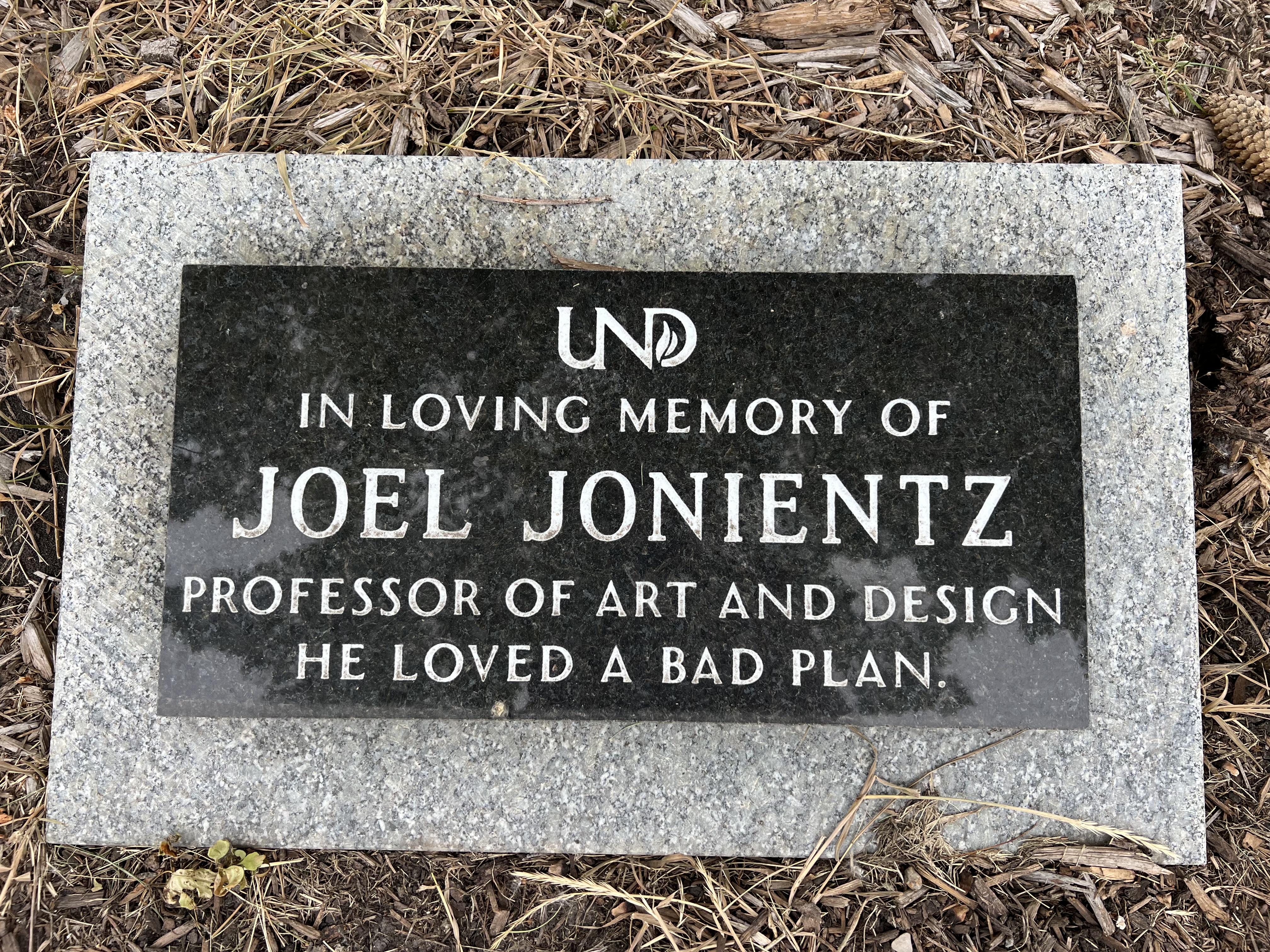
Anyhow, some description of the landscape architecture and my own mental point of entry where Joel’s memorial tree resides. The tree itself is a silver maple. I rant the tree image through the PictureThis app on the iPhone. Joel (and the ripple effect of his collaborators) liked detail. So here is some detail. The silver maple is also known as soft maple, water maple, river maple, white maple, creek maple. The latter name, the creek maple, is fitting, as his memorial and this tree is planted near English Coulee (aka creek; and aka “English” as in a departmental discipline) on UND’s campus. The Latin (“It’s a dead language!”) name is Acer saccharinum. It is one of the most common deciduous tress in the United States and southeast Canada. So hardiness zones of 5-9, sustaining Fahrenheit temps from -4 to 100 degrees. It can get vertical from 5-9 stories high. I looked up and snapped this photo of the canopy that arches out over the sweet granite memorial to Joel. It’s okay to lay in the grass and look up at tree canopies.

Also, there are several families of geese with their teenage geese offspring hanging out around the English creek. This just east of the Hughes Fine Arts Center (same Hughes namesake fellow of the Hughes Junior High I attended in the early 1990s in Bismarck — he invented or popularized some kind of electric stove for the world).


 The Edge of the Village