Leaning the Hutmacher Complex Into a Global Context

By no means am I the first to recognize that the world, planet, or globe has lately been so intensely populated by humanity. Things really took off about the 18th century, and a variety of Industrial Revolutionary pulses provided the catalyst that intensified those population explosions. Think about it: assembly lines provide us with the economic access to all sorts of stuff. It is built so quickly and efficiently that more and more folks can afford it. Before assembly lines, though, artisans poured time and energy into works of art that were only accessible by a few (perhaps the Pre-Industrial 1%’ers).

Prior to the variety of Industrial Revolutionary pulses (so my thinking goes), I have experienced or have been fortunate enough to locate what we might call the archaeology of the home. In this

Robert Kurtz explains the Hutmacher homesite in western North Dakota to a group of scholars assembled in Houston, Texas.

realm, Robert Kurtz is making large amounts of scholarly head-way at the Hutmacher homesite in western North Dakota, and beyond. In my own experience, I have unintentionally come across (I’ve never been a big fan of the word “discover”) stone circles (or what in lay terms are “tipi rings”), earth-lodge remnants, and basement foundations, to name a few. Prior to the global population explosion, a large swath time was spent in villages, and these villages were built piece by piece using local materials.

Placing the Hutmacher site (and humanity) within the context of the globe is why descriptions of 1898-1902 Russian peasant vernacular architecture are of interest. Literary passages from, for example, Olga Semyonova Tian-Shanskaia, Village Life in Late Tsarist Russia (Indiana University Press, 1993) help to understand these villages. Dr. John Cox first introduced me to this work in the spring of 2011.

If you look at the Hutmacher (and if you have worked there as well), you’ll notice that vernacular architecture reflects the spirit of the times (sometimes the spirit and times are very local). This means that the length and width of the building came about through human ingenuity using available technology at that particular place and time. So if you wanted to build an abode or outbuildings, you did so with the consideration that you had to, in the case of the Hutmacher, pitch straw and mud up on the roof with a pitchfork from the back of a wagon. This limited how wide any room of a home would be — practicality figures into this. Large homesteads and villages also required laborers (to maintain all the structures), and this in turn was something that the moms and dads would think about when enlarging families. If you have more children, you need more rooms or space, but you invariably have more laborers.
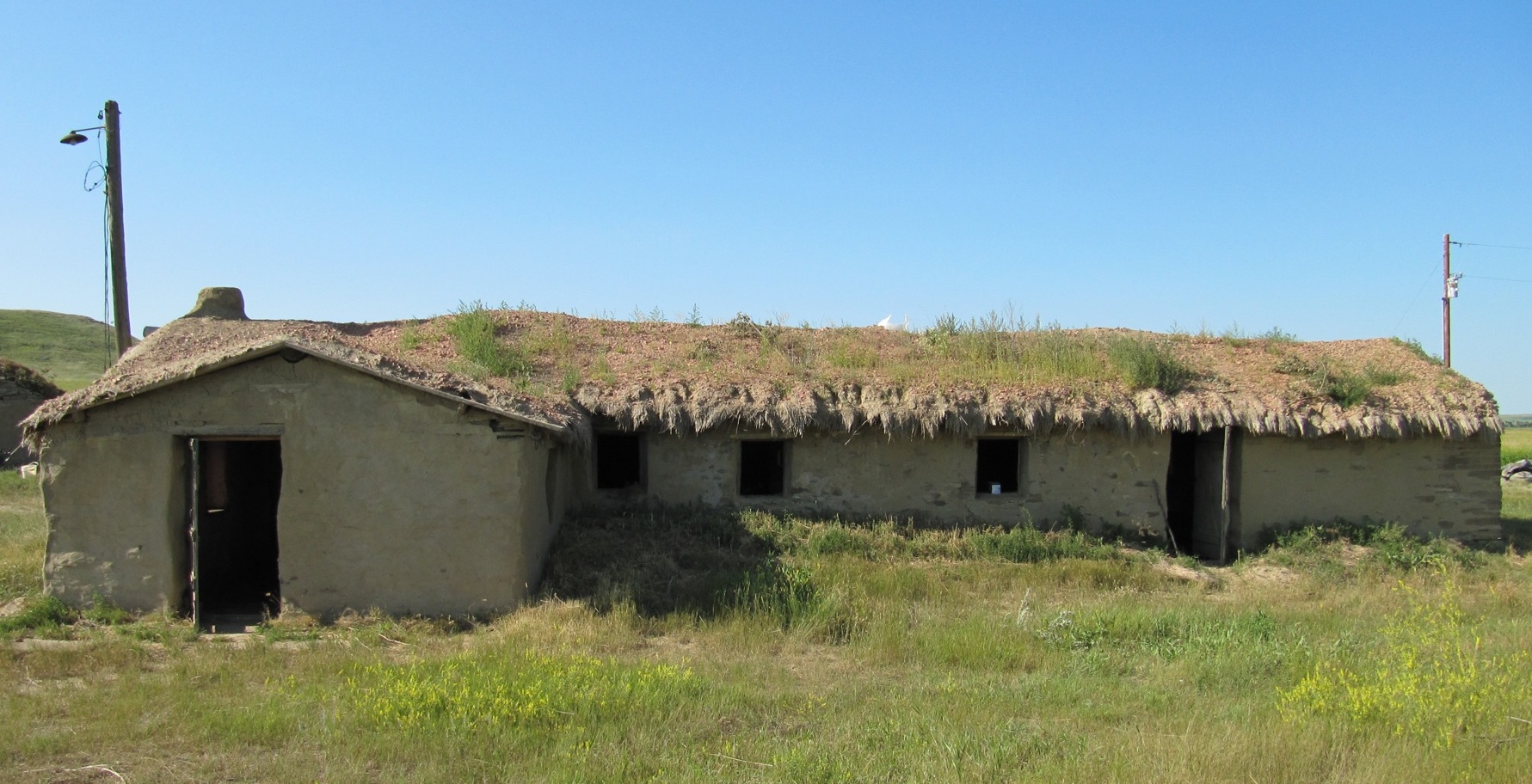
Hutmacher abode at the homesite in western North Dakota. On-going restoration organized in large part by Preservation North Dakota.

Back to Olga, and even Vasily Grossman’s opening remarks on peasant architecture in Life and Fate. Think about the German-Russian Hutmacher in western North Dakota, and then read the following passages. The first is from Olga, reporting from the countryside about Moscow, circa 1898-1902:

…Back to the house. The stretch of the wall from the stove to the wall with the entrance door is also lined with a bench (zadnik), which in the corner joins another bench (pridelok) that runs up to the entrance door. Next to the protruding corner of the stove there is a post (the same height as the entrance door) that supports a beam, the other end of which rests on the log forming a lintel just above the door. The space between this beam and the wall running parallel to it is covered with planks to form a kind of raised platform or loft, on which older members of the family and small children sleep. The rest of the family is accommodated on the sleeping shelf atop the stove and on the benches lining the walls of the house…

…Stay with me here. This is going somewhere…

…In the left-hand corner opposite the entryway stands a table. Normally a peasant’s house has one or two short portable benches that are brought to the table for dinner and supper. The floor is made of either hard-packed earth

A photo of a Russian peasant home taken by Olga Semyonova, likely from the village of Muraevnia. See Olga Semyonova Tian-Shanskaia, “Village Life in Late Tsarist Russia” (Indiana University Press, 1993), p. 122.

or wooden planks (rough or finished). If of planks, these are supported by joists and run across the house parallel to the entrance-door wall. In a floor made of boards, there is usually an opening through which a ladder leads into a pit dug out under the house where potatoes are stored. Above the bench opposite the entrance door, shelves are mounted on the wall to store dishes. Ceiling boards run parallel to the wall with the windows and are supported by a beam that rests on the walls. On the attic side these boards are coated with clay and a layer of dry leaves, and topped off with earth. The roof is supported by rafters and angle brackets. Wattles across the rafters form a base for brushwood, which is then thatched. The lintel is hewn as the walls are being ererected, but the door frame and window frames are purchased separately…

…Seriously, this is going somewhere…

…In the past, wooden houses were made chiefly of oak, but nowadays willow wood is more often used. Numerous masonry houses are also found, accounting for more than half the homes in a few villages. The clay-walled type of house is becoming increasingly common as we see more and more family divisions and splitting up of property [so that people live in smaller families but with fewer resources]. Many peasants now have neither a threshing barn, a shed, nor even a yard of their own…

This 1898-1902 sample is transposed against some of the opening lines to Vasily Grossman, Life and Fate, (essentially the War and Peace of the 20th century) at least his opening descriptions of how Nazis imposed standardization onto the village countryside of eastern Europe and Russia:

…It hadn’t rained, but the ground was still wet with dew; the traffic-lights cast blurred red spots on the asphalt. You could sense the breath of the camp from miles away. Roads, railway tracks and cables all gradually converged on it. This was a world of straight lines: a grid of rectangles and parallelograms imposed on the autumn sky, on the mist and on the earth itself. Distant sirens gaive faint, long-drawn-out wails… The fence of the camp appeared out of the mist: endless lines of wire strung between reinforeced-concrete posts. The wooden barrack-huts stretched out in long broad streets…

This next part is important.

…Their very uniformity was an expression of the inhuman character of this vast camp. Among a million Russian huts you will never find even two that are exactly the same. Everything that lives is unique. It is unimaginable that two people, or two briar-roses, should be identical… If you attempt to erase the peculiarities and individuality of life by violence, then life itself must suffocate.

Okay, that’s enough for now. But anyhow, this is some of the stuff to think about when slinging mud at the Hutmacher in western North Dakota; or some of the stuff I think about when I think about having slung mud at the Hutmacher site in western North Dakota. There is individuality within historic archaeological walls, or at least individual labor reflected by the walls. I don’t mean this in some kind of delusionally nostalgic or romantic vein. But hard work went into putting these homes up and together. It’s worth our while to think on this, to restore it, to preserve it. Not necessarily to stop humanity from living today, or pushing onwards into tomorrow. But at the very least to think on where we came from, and give a type of nod to our predecessors.
Reading for Archaeology in Cyprus: the Prologue

With a good chunk of semester-end grading behind me, it’s about time to look toward the Cyprus Bibliography and set down with a couple of works. I’ve gladly been charged with the task of archaeological trench advisor (or adviser, depending on your preference; I suppose archaeological monitor would also work). There is Dr. Bill Caraher’s blog that I check in with about every 1 to 3 days. Bill is Ohio State University-trained, and U of North Dakota’s historian of the Ancient World, North Dakota Man-Camps, and Punk Archaeology, among other topics.

But now I’m reading Yiannis Papadakis, Echoes From the Dead Zone: Across the Cyprus Divide (I.B. Tauris, 2005, ’06, ’08, ’10). When I first started reading it I thought to myself, “Is this guy serious?” but then realized he was parodying (or a parody as a youth) what Ed Said, well, said back in Orientalism circa 1978. Papadakis’s work is that way up through at

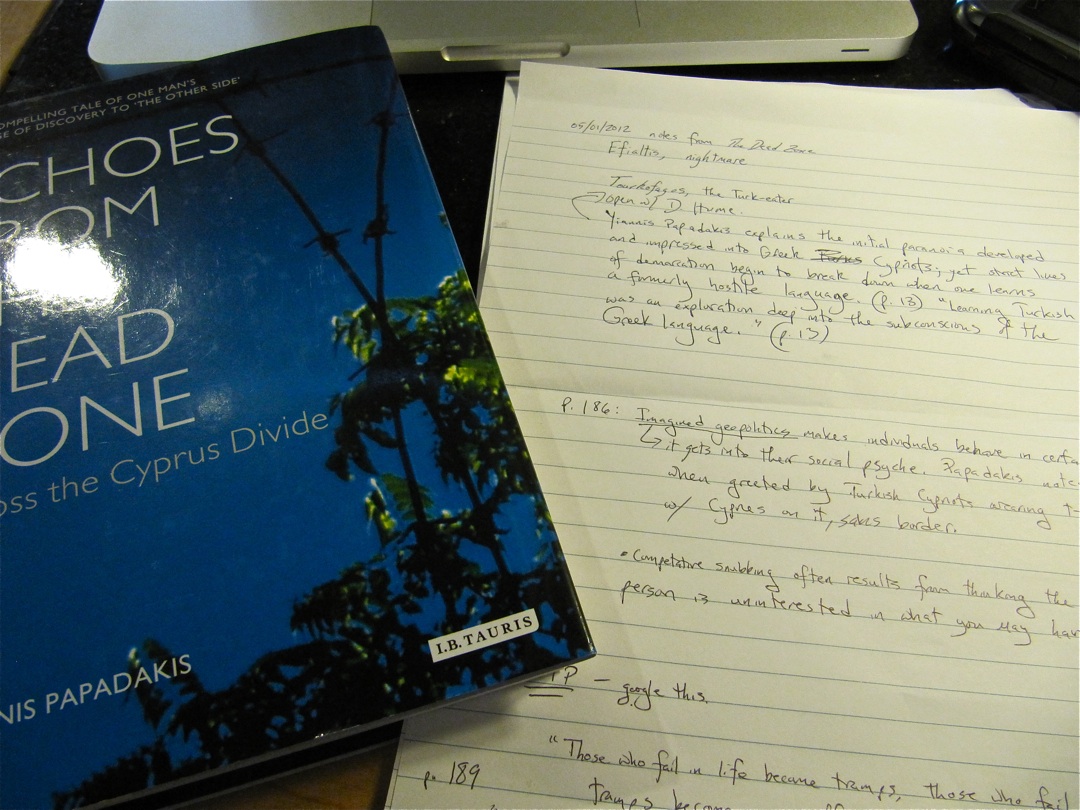
Actual hand-written notes from a book, this in 2012.

least the first 10 or so pages (easily more, but I got the point), articulating one Western view of the Middle East where coke-addled debauched sultans (this is one Western Parody of the Mid-East) since 635AD charged Janissaries with spreading Islam throughout the world “by the force of fire and the sword.” (Papadakis, 2005:6) Mehmet II was a bit overzealous, but oh c’mon. A person can’t go around razing villages and metropolises just because there are a few bad apples in the mix. If that were the case, then there would be no New York City.

Anyhow, and moving along, toward the end of the book Papadakis eventually finds himself having made friends with individuals he formerly had stereotyped, and a new level of objectivity is achieved. That is perhaps a universal in the history of humanity: generalized ideas about the world, or The Other, and all of this undermined once friendships are established with individuals in that Other. In lay terms, this is called getting to know someone, or what in kindergarten was called, “Making friends.” It’s okay to approach a stranger and ask them about the weather, and then move on to other standard topics like, “So you from around here?” It doesn’t always pan out, but life is a game of odds, and if you ask enough the odds are stacked in your favor. Eventually this leads to more substantive conversation, and perhaps even friendships. I think the point, though, is to listen more than you talk. And when you do talk, speak to what has been said to you. This is the epitome of conversation. And apparently you need to do this throughout life, not just in kindergarten. Back to Papadakis…


Some Thoughts on Plagiarism

In the last week or so a fellow graduate student, Robert Kurtz, uncovered a couple cases of plagiarism. He called me and we chatted about the different courses of action we were going to take and the implications of plagiarism in general. I have to remind myself often that just because I know through and through that plagiarism is stealing, and stealing is wrong, others may not understand this (or they may plead a case that they don’t understand this when they clearly do — this is what I call Cold Blooded Plagiarism).

The cases Kurtz uncovered had to do with a couple undergraduate student plagiarists cutting entire sentences from the old Internet or textbook and passing them off as their own. This, we told the classes — Wait. For. It. — was wrong. By and large the majority of students understood this. But with any organization or institution (I’m increasingly learning), there are always a few who disappoint and depress the rest.

Large scale cases of plagiarism (what I like to call Competitive Plagiarism) included the shenanigans intrinsic to Enron (circa 2001) and Madoff. It was plagiarism in the sense that short-term accountant fudging invariably turned into huge and delusional bubbles of profit, and this in turn generated an inertia of expectations. By this point, there was no way for the lies to stop because expectations had been developed, and investors believed what the plagiarists — who carried badges of Authority — delivered. The only thing that made it stop was for it all to come crashing down around them. It played out then as it played out this last week: the plagiarists are brought into some kind of court, and publicly shamed outside of court. In the case of large scale plagiarism, the thief gets sent to White Collar Prison (that’s just kind of how it is). Small-time plagiarists get locked up in the Criminal Justice System (that’s also just kind of how it is).

One of the goals I want to communicate to students, though, is not only why plagiarism is wrong, but how civilization and societies cannot rest or prosper on foundations of lies and deceit (well, not any more than this planet already has — we always seem to be at a threshold). There is a Plagiarism.org website (be sure to cite your sources so you don’t end up plagiarizing content in an effort to combat plagiarism), and following is the definition I produced some months ago for a mock syllabus in a graduate seminar, the Teaching of College History. The definition is a hybrid of NDSU’s code of academic conduct, some of what Dr. Tracy Barrett uses in her syllabi, and some of my own thoughts as well:

The American Oxford Dictionary defines plagiarism as the practice of taking someone else’s work or ideas and passing them off as one’s own. Plagiarism is, to be blunt, theft. Plagiarism is intolerable because it undermines the time, energy, critical thinking and writing used to produce a product, term papers or otherwise. Thus, plagiarism cheats not only the individual who is a plagiarist, but it also swindles fellow students and scholars who do put the time into playing within the defined rules. In short, this is why plagiarists will be disciplined in accordance with University policy.

Students have my official and unofficial blessing to openly shame and mock on social media sites and in public anyone who plagiarizes. This is regardless of political or religious affiliation, ideology, ethnicity, creed, nation, cultural relativism, and so on and so forth. I told them to especially mock plagiarists who are co-workers, fellow students, colleagues and comrades within their own organization, since the brand and integrity of the institution — something they are a part of — requires a solid foundation. Plagiarists undermine that foundation, this whether they know it or not.

One more point: if you call a plagiarist out, be sure to have data that supports it. Empiricism, evidence and data sets us free, so be sure to always get it from the source, and don’t be shy about citations, bibliographies and references. We’re all in this together.


An Evening Stroll in Downtown Fargo

Often times a Wednesday evening walk is in order to counter or shake off the protracted sitting incurred throughout the day (Homo sapien is at a peculiar time in history, the most sedentary we’ve been since emerging out of east Africa some 150,000 to 200,000 years ago). To recap my

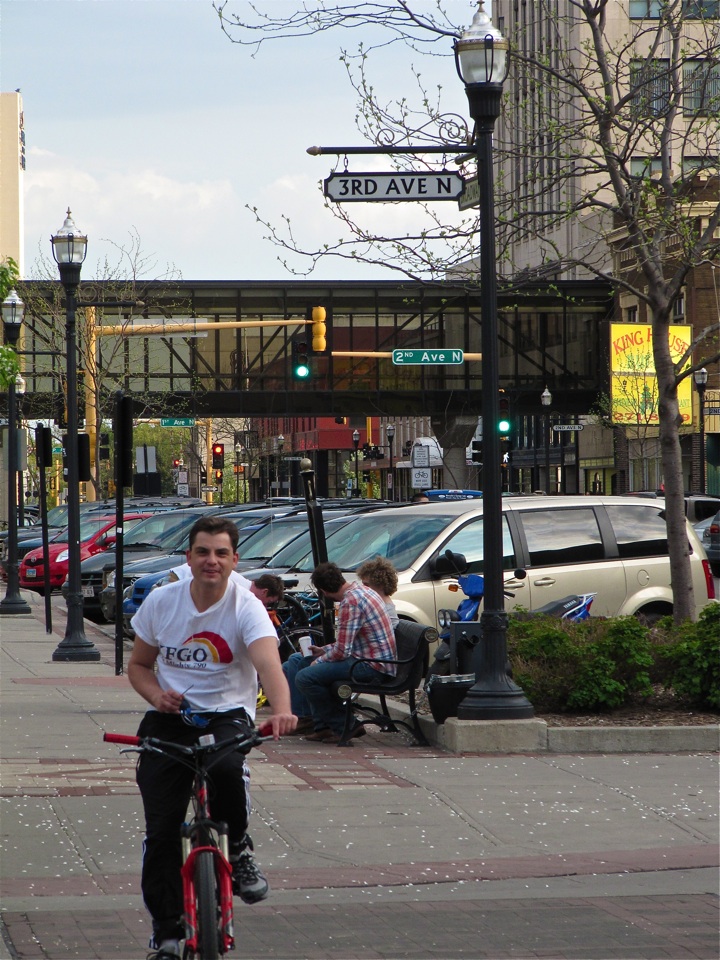
A May 2, 2012 photo of Rick Gion in one of his natural habitats.

walk from May 2, 2012, about the 7:30PM hour, I set out from 4th Avenue and Broadway in downtown Fargo and headed south toward Island Park. Along the way I noticed that groups of two-to-five or more gathered here and there, folks wanting to be outside with the short-sleeve temps and all. They tended to station themselves on the sidewalk benches installed at the ends of each block. About a block south of where I started my walk I ran into Rick Gion (or Rick Gion ran into me) to, as we often say, shoot the breeze. After busting each-other’s chops a bit (which is a North Dakota thing to do), Rick rode off to the north and I continued south. After that I called my father on my cell phone, and also thought of the mobility cell phones allow us. Not that many years ago a chat on the telephone required that we seek out a telephone which in turn was attached to a telephone line: this arguably required more social commitment, since you had to call someone, plan on being at a set location, and then do everything possible to make it to that location at the designated time. Today the convenience of cell phones and text-messaging ensures that you will receive something like 3 to 17 texts from the party you intend to meet, first canceling the meeting, then rescheduling the time and location, and then informing one another that you are within 2 minutes of arriving via text. Cell phone technology influences our behavior, but technology does that often. It shifts how we behave throughout time, and tracking this otherwise gradual change is one of the businesses of historians. Phone booths are nearly if not entirely obsolete, now, and I often wonder if in two or three decades (or even sooner) we will look at the 20th century as the Age of the Telephone Land Line. Anyhow, I phoned my dad because before setting out on my walk a couple

About Main and Broadway in Fargo on May 2, 2012. Photo looks west toward the storm dumping rain on central North Dakota.

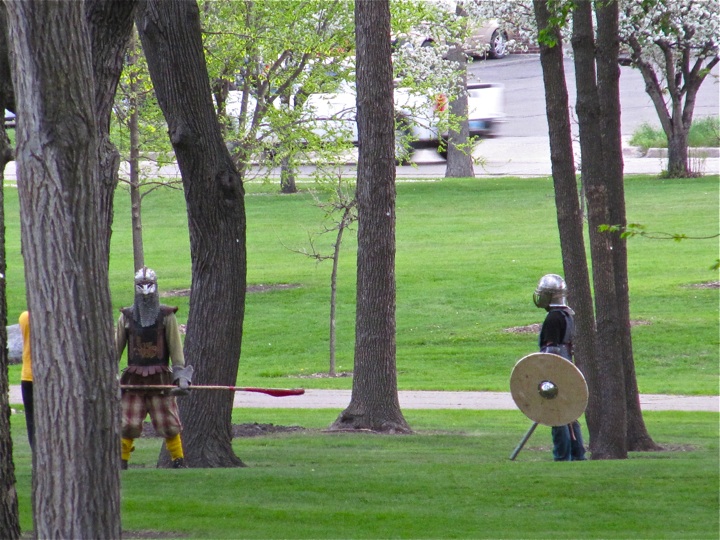
friends from Bismarck updated their social media web site with information about rain and possible hail. I wanted to check up on that, chat with kin, and since the weather is a very neutral topic, it is a great way to have a conversation with basically anyone in or outside of North Dakota. I stopped just north of the intersection of Main Avenue and Broadway, looked west, and snapped a photo of the eastern tops of the cloud system that was saturating Bismarck. I communicated this to my dad, and then moved on to other neutral topics such as the price of gas, how the Twins are doing, and so on. Eventually I got into Island Park, and visited the Henrik Wergeland statue, which has been a monument for quite some time, a video-history of which can be seen here. I circled the monument, and then to the west noticed a chivalrous scene playing out. I snapped a photo of that as well. “So this is what some people do on Wednesday evenings…” I thought. “Interesting…” By the time I rounded the park, the cell

Knights at Island Park in downtown Fargo, North Dakota.

phone conversation had ended and another couple folks spotted me. So more light banter ensued, and I remember asking the two if they had yet seen the Cold War Comedy, “Spies Like Us.” This was the third time in 24 hours that I’ve asked groups of two or more if they had viewed this movie. Each time the groups have responded with no. For some reason I think it’s important for people to watch it. After that, the final stretch of my walk took me back up Broadway, and I inadvertently ran into Den Bolda, perhaps one of the most accomplished Civil War reenactors in the tri-state area. I say this only after learning that Mr. Bolda had just finished attending another knitting class, this so he could reproduce vintage (aka, knit) Civil War wool socks to wear at all the 150th anniversary mock-battles back east. Nice work, Den. Nice work indeed.


Shadd Piehl on Pigskins

On April 26, 2012, Shadd Piehl drove over from Menoken to Fargo, picked me up from my place, and from there we headed over to Minnesota State University Moorhead (MSUM) for a bout of poetry readings hosted by Red Weather press. Between my place and MSUM, though, we stopped by Mick’s Office, a tavern in Moorhead. Below Shadd recounts the time he spent shaving hog skins in Minot, North Dakota. Since hog skin is similar to human skin, these come in handy for burn victims who are on the mend.

Shadd is what in the business we refer to as a cowboy poet from the northern Great Plains. After the poetry reading, we caught a burger at JL Beers, and then went across the street to the HoDo (not to become legends, though). As I charge through my own graduate training, Shadd inadvertently made me think about how in the future I would think about the past (or what is now the present). He remembered and told particular stories now absorbed by the urban Fargo-Moorhead landscape, these from the time he spent getting undergraduate and graduate degrees some years back from NDSU and MSUM.

One of the only known April 26, 2012 photos of Shadd Piehl in the Red River Valley.

In addition to writing and reading poetry, Shadd fixes fence, sings in a band, and teaches English classes in Bismarck, North Dakota. Actually, I don’t know how regularly Shadd fixes fence. But that’s something it seems a cowboy poet ought to be doing on the northern Plains from time to time.


Houston Syndrome

Houston Syndrome is not like Paris Syndrome, the latter defined by one author as “a collection of physical and psychological symptoms experienced by first-time visitors realizing that Paris isn’t, in

fact, what they thought it would be.” Or, more to the point, Houston Syndrome (or this “syndrome” in general — I guess it’s legitimate since it has a Wikipedia entry) is not specific to Paris, but has more to do with the feelings produced when expectations come into discord with reality. 

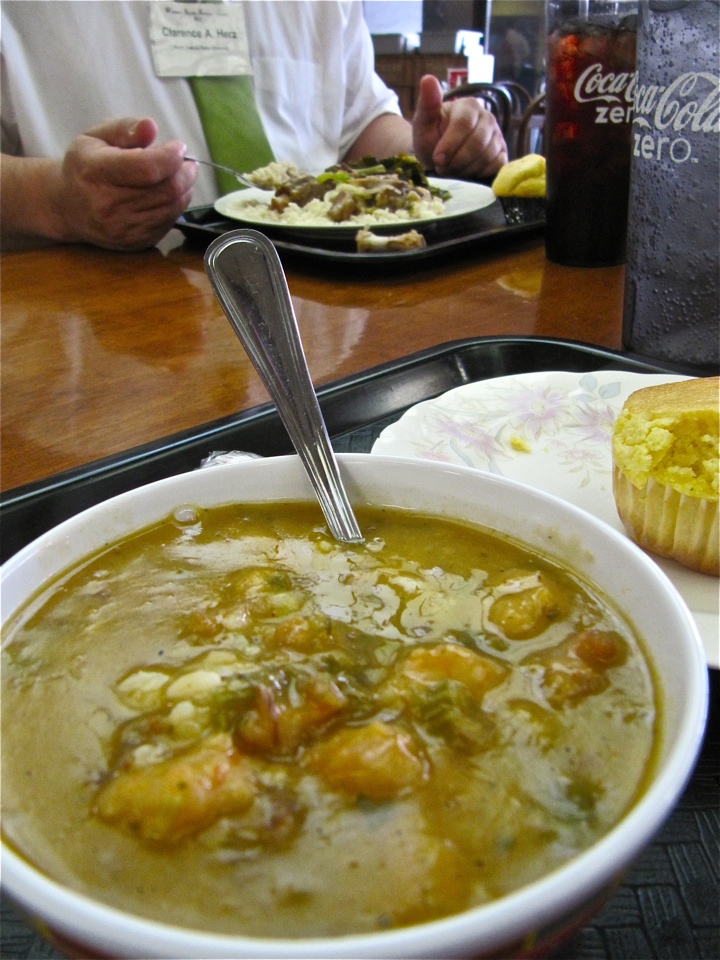
This last weekend I experienced what I have come to diagnose and call Houston Syndrome. Please note: Houston Syndrome is different than Paris Syndrome. Houston Syndrome has less to do with expectations of Houston coming into discord with reality, and more to do with an indifference or ambivalence to Houston in the first place. Therefore, there isn’t any expectation that can come into contact with reality. In Houston, for example, there are many skyscrapers, and these are sprinkled with ground-level shops, migratory residual from the massive relocation that took place due to Hurricane Katrina (2005). Anyhow, the realization of Houston Syndrome came to the fore when I visited a creole and cajun lunch eatery, and had some of the greatest shrimp étouffée known to humanity. I assert this for several reasons, and perhaps this is why Houston Syndrome is a good thing to experience: in the back of my subconscious I know I had read plenty of stories about Hurricane Kate dislocating New Orleans’ers (among others) to Houston. Until sauntering into the creole and cajun eatery, though, I had no expectations. Perhaps since I had no expectations was in fact my expectation. There, that’s the take-away: don’t have expectations, but be sure to pack sensibly for any trip.

Also, Houston has many new (aka, less-than 60 or so years old) skyscrapers with a lot of mirror-type

Note how the sky reflects off the mirrored windows on the skyscraper, creating the illusion that the Art Deco-like cap on the top is floating in the sky.

windows (technical definitions pending). One of the many skyscrapers visually gives the ground-viewer a sense that it is floating. When looked at from above, though, the reflective glass, well, reflects the city below, arguably giving a sense that it is deeper than reality — again to return to Houston Syndrome unfolding before my eyes. The visual is in discord with reality, and so on and so forth.

Paris Syndrome and Houston Syndrome have been happening for a long time, so don’t sweat it. If you feel you’ve become afflicted with this, I wouldn’t recommend scheduling an appointment with or shelling out cash for a psychiatrist or psychologist, even though buying those friends can indeed be important for certain folks having certain crises from time to time. Instead, purchase and read Paul Zanker, The Power of Images in the Age of Augustus (U of Michigan Press, 1990). I came across and discussed this title while chatting with U of North Dakota’s Ancient Historiansome years ago. Within you’ll notice that Ancient Romans experienced this kind of timeless syndrome as well: what they thought Rome was, and what Rome actually was. Aesthetics and life is fantastic that way.

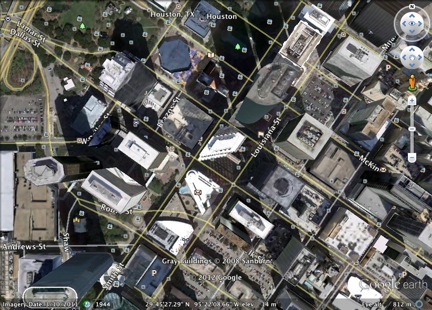
Houston, TX downtown, the skyscraper images from Google Earth.


Fargo’s Airport: Some Notes on Documenting the Documenters

There’s a bit of psychological preparation necessary and intrinsic to flying, at least since the G.W. Bush years of 9/11/2001. This is how my experience played out on April 11, 2012 with the friendly Airport Security citizens in Fargo’s Hector Airport. Typically a passenger approaches the nylon cattle gates and begins to mentally cycle through exactly which order they ought to temporarily remove the necessary items and elements from their persons. Keep smiling, folks, keep smiling.

Your friendly Airport Security People at work. They are doing their job.

Now remove your bracelets and rings and necklaces and cell phones, rip that belt off your pants, then shoes (Thoughts of “Hurry! Untie those damn shoes because a line is building behind you and you’re holding the whole damn show up!!!” rattle through the brain and smiles remain on the surface), wallet (there goes my identity), pens in your pocket, keys (whoops — security just inherited another small Swiss Army tool of mine, once again), change, watch (if for some reason you’re still wearing one), and then take the laptop computer out of your briefcase and, if you prepped ahead of time, remove the ziplock baggie full of gels and liquids (toothpaste, contact solution, deodorant) that you remembered to purchase the night prior at a Target or an Über-Walmart. Then you get (you don’t “have to” if you want to fly) to be instructed through the latest in technology, the ProVision ATD. It’s basically pretty sweet. My only critique would be to design a monitor for the person being scanned to watch as well. The same monitor that the Airport People get (or have to) look at. Step into the cylinder and throw your hands in the air so the two vertical batons can swoop around your front and back and sides. Whoosh, whoosh. “You’re free to step this way, sir.” Nice, they called me “sir” — automatic knighthood (Quixotic Romanticism still in our 21st-century lexicon).


Tony Bourdain and Marilyn Hagerty

As of late, Anthony Bourdain’s outlook on the world has evolved. For a long time we looked toward Bourdain to provide us with a kind of debauched interpretation of the culinary world, channeling H.S.

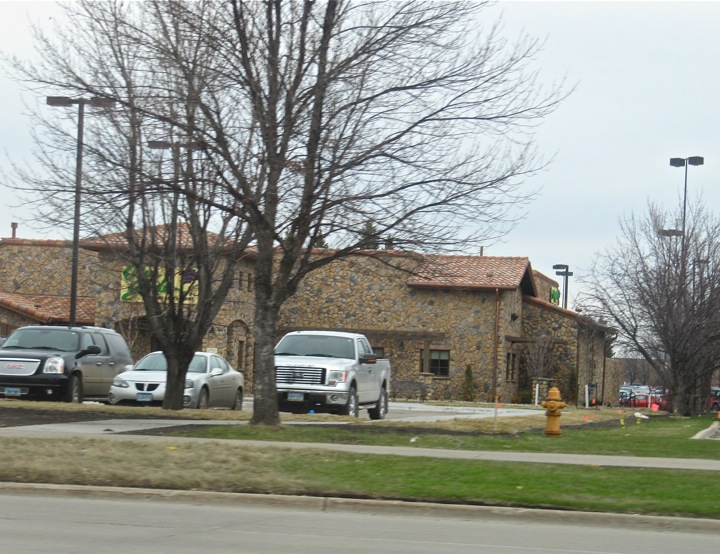
I captured this photo of the Olive Garden in Grand Forks, North Dakota on March 31, 2012. This is the south elevation, the photo taken from a moving car.

Thompson and Graham Greene and Joseph Conrad among others. Tony started it, but the audience (us) came within its gravitational pull and continued to grow. Pretty soon large amounts of people depended on him to say what we wanted him to say.

At least since 2008, various episodes of “No Reservations” have come across as contrived — there’s only so many times a beating cobra heart can be eaten before one runs out of original ways to describe it. Now he’s saying something different. And it irks many, since it deviates from expectations.

There’s an expression that people either stick to their guns, or they fall into a rut. Perhaps Bourdain felt he was in a rut. For some time. And now he wants to shake it up, in this case with Marilyn (who has a Wikipedia entry here), and she is coming into a similar orbit that Bourdain did: thrust into a situation that she had little control over. She just wants to play bridge, take notes on what she’s eating in Grand Forks, and sip a little Crown from time to time.


History and Social Science in Houston, Texas: Western Social Science Association Conference 2012

In a couple days a small cohort (or more like a squad) of NDSU historians will descend on Houston, Texas to take part in the 2012 Western Social Science Association conference (the program here). This year Tom Isern is the official conference Program Coordinator, so he went down early (“down” is the direction you need to go to get to Tejas when you live on the northern Great Plains). There are a couple discussions or panels I’ll be sitting in on, and since I was getting my thoughts in order with pen and paper I thought I would just as well blog them.

  • On Thursday, April 12, 2012, about 1630 hours, I’ll be partaking in a book discussion with Tom Isern, James Beattie, and William C. Schaniel. We’ll be discussing James Beattie, Empire and Environmental Anxiety: Health, Science, Art and Conservation in South Asia and Australasia, 1800-1920 (Palgrave Macmillan, 2011). The key phrase is environmental anxiety, and it considers how nineteenth-century Christianity (which at the time was loaded with romanticism, among other things; perhaps it still is?) and positivistic science (similar kind of situation) anticipated certain environmental results after arriving on the scene (aka, colonizing) throughout the globe. When these theoretical anticipations fell into discord, it resulted in a type of psychological torment, or environmental anxiety. In many ways this work holds thematic continuity with Leo Marx’s Machine in the Garden, or Publius Vergilius Maro’s Eclogues, at least an exploration into how humanity has understood nature, and how humans have or have not altered said nature. We’ll likely talk about the word nature itself, and what it means to be natural or unnatural — I often feel unnatural even though Homo sapiens in the evolutionary scheme of things are natural. Once again, though, the word nature can be a slippery one, and its abstraction is one of the reasons why it has persisted (speak in metaphor if you want your statements to have staying power throughout the ages). Isern and I, among others, are anticipating that today’s politicians will appropriate the phrase “environmental anxiety” if they haven’t already. The latest phrase I cobbled together was Industrial Christianity 2.0, a sort of hyper-Max Weberian model for the 21st century.
  • On Friday (04/13/2012) at 800 hours (CST) I’ll be showcasing a poster in, well, the Poster Session. It deals with issues as to how the public has remembered the various sites of memory and mourning that are connected with the Dakota Conflict in the Minnesota River Valley in 1862, and the subsequent Sibley and Sully punitive campaigns in Dakota Territory in 1863 and 1864. I’m working on a research seminar paper for Dr. David Silkenat that deals with this, along with understanding how contemporaneous massacre sites and sites of memory, conflict, skirmish and mourning have been interpreted too. This includes the massacre sites of Sand Creek in southeastern Colorado, and the Bear River Massacre in southern Idaho. I’m in the midst of considering the global implications during this period, when empires (see Russia, Ottoman, Austro-Hungarian, French, British, Chinese, and so on) sought to assimilate at best and annihilate at worst the indigenes whom were labeled as not fitting the imperial or national mold. For example, the Maori of New Zealand really gave the Brits a go in the 1860s, and so on and so forth.
  • I’m still rounding out thoughts on the panel that explores the Aussie flick, “Red Dog,” and that will take place on Friday (04/13/2012) about 1300 hours (CST). The trailer is just below:

And some out takes here…

  • Notions of Human’s Best Friend surface with dog movies, so last week Isern and I tossed around some ideas. I was thinking about grounding this in prehistory, or those stories anthropologists often tell that explain how otherwise non-domesticated dogs became dogs. Hunter-gatherers invariably create trash, and this trash contains scraps of food, or bones to chew on. Eventually four-legged creatures work their way close enough to the human trash piles for a free nibble, and then they start nibbling away more regularly, and eventually relationships between human and dog form. Pretty soon we’re wondering why dogs circle two or three times before they lay down in the corner of a house, or something along those lines. It probably has to do with being hard-wired to push down foliage and tall grasses before taking dog naps. Homo sapiens have been around anywhere from 200,000 to 150,000 years (we pushed our way out of east Africa) and only sedentary for the last 6,000 years or so. There’s the wolf-dog Two-Socks in “Dances With Wolves,” and there’s the usual suspects of Lassie, Rin-tin-tin, Turner and Hooch, Beethoven, Lewis and Clark’s newfoundland retriever Seaman, and some areas of east Asia that still consider it a delicacy. The floor remains wide open, anyhow. This “Red Dog” flick also has similarities with the work camps and crew culture springing up in western North Dakota’s Bakken oil field these days, too.
  • Also on Friday (04/13/2012) at 0945 hours I’ll moderate a panel with Erika Wright and Anthony Amato entitled, “Unpredictable Developments” — so far I haven’t thought about where this panel will go.

Pulp Historic Preservationists

In the pulp cinema-ist’s 2009 DVD edition of Inglourious Basterds, I recently came across some of the bonus features and decided finally to click “Play” on them. The video short Nation’s Pride is effectively — or affectively for NAZIs — propagandistic pulp on propagandistic pulp, a parody on Leni Riefenstahl’s Triumph of the Will (1935), this latter a serious film forwarded by Leni who in the 1930s subscribed to NAZI-lightism (if it’s possible to be kind of a NAZI).

Within Tarantino’s pulp short that is Nation’s Pride, though, it’s important to not take a sip of your beverage just before the below seen, where a fictional American Army commander does not allow for the bombing of a NAZI sniper because the jerk is sniping from the top of a 1,000 year old historic Italian tower. See below for context.

To be blunt, screw the tower and bomb the sociopathic sniper hopped up on social darwinian national socialism. FDR, Einstein and Churchill would have nodded in approval.