Houston Syndrome

Houston Syndrome is not like Paris Syndrome, the latter defined by one author as “a collection of physical and psychological symptoms experienced by first-time visitors realizing that Paris isn’t, in

fact, what they thought it would be.” Or, more to the point, Houston Syndrome (or this “syndrome” in general — I guess it’s legitimate since it has a Wikipedia entry) is not specific to Paris, but has more to do with the feelings produced when expectations come into discord with reality. 

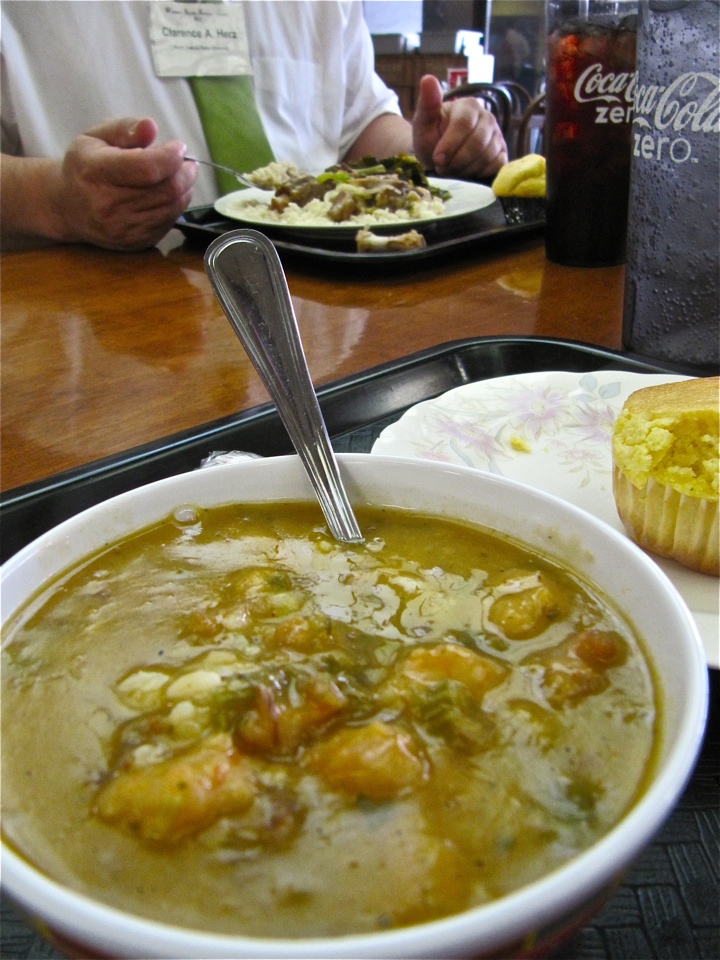
This last weekend I experienced what I have come to diagnose and call Houston Syndrome. Please note: Houston Syndrome is different than Paris Syndrome. Houston Syndrome has less to do with expectations of Houston coming into discord with reality, and more to do with an indifference or ambivalence to Houston in the first place. Therefore, there isn’t any expectation that can come into contact with reality. In Houston, for example, there are many skyscrapers, and these are sprinkled with ground-level shops, migratory residual from the massive relocation that took place due to Hurricane Katrina (2005). Anyhow, the realization of Houston Syndrome came to the fore when I visited a creole and cajun lunch eatery, and had some of the greatest shrimp étouffée known to humanity. I assert this for several reasons, and perhaps this is why Houston Syndrome is a good thing to experience: in the back of my subconscious I know I had read plenty of stories about Hurricane Kate dislocating New Orleans’ers (among others) to Houston. Until sauntering into the creole and cajun eatery, though, I had no expectations. Perhaps since I had no expectations was in fact my expectation. There, that’s the take-away: don’t have expectations, but be sure to pack sensibly for any trip.

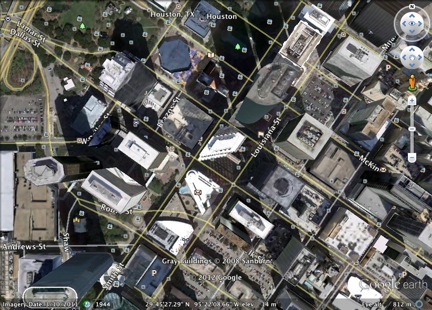
Also, Houston has many new (aka, less-than 60 or so years old) skyscrapers with a lot of mirror-type

Note how the sky reflects off the mirrored windows on the skyscraper, creating the illusion that the Art Deco-like cap on the top is floating in the sky.

windows (technical definitions pending). One of the many skyscrapers visually gives the ground-viewer a sense that it is floating. When looked at from above, though, the reflective glass, well, reflects the city below, arguably giving a sense that it is deeper than reality — again to return to Houston Syndrome unfolding before my eyes. The visual is in discord with reality, and so on and so forth.

Paris Syndrome and Houston Syndrome have been happening for a long time, so don’t sweat it. If you feel you’ve become afflicted with this, I wouldn’t recommend scheduling an appointment with or shelling out cash for a psychiatrist or psychologist, even though buying those friends can indeed be important for certain folks having certain crises from time to time. Instead, purchase and read Paul Zanker, The Power of Images in the Age of Augustus (U of Michigan Press, 1990). I came across and discussed this title while chatting with U of North Dakota’s Ancient Historiansome years ago. Within you’ll notice that Ancient Romans experienced this kind of timeless syndrome as well: what they thought Rome was, and what Rome actually was. Aesthetics and life is fantastic that way.

Houston, TX downtown, the skyscraper images from Google Earth.


Fargo’s Airport: Some Notes on Documenting the Documenters

There’s a bit of psychological preparation necessary and intrinsic to flying, at least since the G.W. Bush years of 9/11/2001. This is how my experience played out on April 11, 2012 with the friendly Airport Security citizens in Fargo’s Hector Airport. Typically a passenger approaches the nylon cattle gates and begins to mentally cycle through exactly which order they ought to temporarily remove the necessary items and elements from their persons. Keep smiling, folks, keep smiling.

Your friendly Airport Security People at work. They are doing their job.

Now remove your bracelets and rings and necklaces and cell phones, rip that belt off your pants, then shoes (Thoughts of “Hurry! Untie those damn shoes because a line is building behind you and you’re holding the whole damn show up!!!” rattle through the brain and smiles remain on the surface), wallet (there goes my identity), pens in your pocket, keys (whoops — security just inherited another small Swiss Army tool of mine, once again), change, watch (if for some reason you’re still wearing one), and then take the laptop computer out of your briefcase and, if you prepped ahead of time, remove the ziplock baggie full of gels and liquids (toothpaste, contact solution, deodorant) that you remembered to purchase the night prior at a Target or an Über-Walmart. Then you get (you don’t “have to” if you want to fly) to be instructed through the latest in technology, the ProVision ATD. It’s basically pretty sweet. My only critique would be to design a monitor for the person being scanned to watch as well. The same monitor that the Airport People get (or have to) look at. Step into the cylinder and throw your hands in the air so the two vertical batons can swoop around your front and back and sides. Whoosh, whoosh. “You’re free to step this way, sir.” Nice, they called me “sir” — automatic knighthood (Quixotic Romanticism still in our 21st-century lexicon).


Tony Bourdain and Marilyn Hagerty

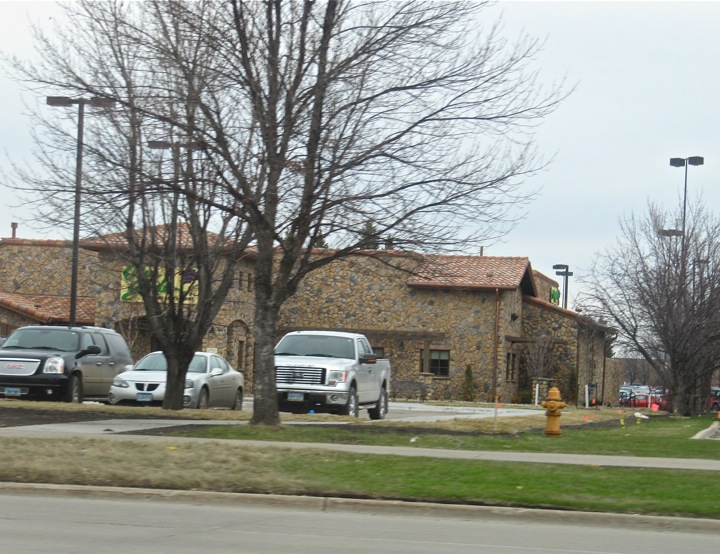
As of late, Anthony Bourdain’s outlook on the world has evolved. For a long time we looked toward Bourdain to provide us with a kind of debauched interpretation of the culinary world, channeling H.S.

I captured this photo of the Olive Garden in Grand Forks, North Dakota on March 31, 2012. This is the south elevation, the photo taken from a moving car.

Thompson and Graham Greene and Joseph Conrad among others. Tony started it, but the audience (us) came within its gravitational pull and continued to grow. Pretty soon large amounts of people depended on him to say what we wanted him to say.

At least since 2008, various episodes of “No Reservations” have come across as contrived — there’s only so many times a beating cobra heart can be eaten before one runs out of original ways to describe it. Now he’s saying something different. And it irks many, since it deviates from expectations.

There’s an expression that people either stick to their guns, or they fall into a rut. Perhaps Bourdain felt he was in a rut. For some time. And now he wants to shake it up, in this case with Marilyn (who has a Wikipedia entry here), and she is coming into a similar orbit that Bourdain did: thrust into a situation that she had little control over. She just wants to play bridge, take notes on what she’s eating in Grand Forks, and sip a little Crown from time to time.


History and Social Science in Houston, Texas: Western Social Science Association Conference 2012

In a couple days a small cohort (or more like a squad) of NDSU historians will descend on Houston, Texas to take part in the 2012 Western Social Science Association conference (the program here). This year Tom Isern is the official conference Program Coordinator, so he went down early (“down” is the direction you need to go to get to Tejas when you live on the northern Great Plains). There are a couple discussions or panels I’ll be sitting in on, and since I was getting my thoughts in order with pen and paper I thought I would just as well blog them.

  • On Thursday, April 12, 2012, about 1630 hours, I’ll be partaking in a book discussion with Tom Isern, James Beattie, and William C. Schaniel. We’ll be discussing James Beattie, Empire and Environmental Anxiety: Health, Science, Art and Conservation in South Asia and Australasia, 1800-1920 (Palgrave Macmillan, 2011). The key phrase is environmental anxiety, and it considers how nineteenth-century Christianity (which at the time was loaded with romanticism, among other things; perhaps it still is?) and positivistic science (similar kind of situation) anticipated certain environmental results after arriving on the scene (aka, colonizing) throughout the globe. When these theoretical anticipations fell into discord, it resulted in a type of psychological torment, or environmental anxiety. In many ways this work holds thematic continuity with Leo Marx’s Machine in the Garden, or Publius Vergilius Maro’s Eclogues, at least an exploration into how humanity has understood nature, and how humans have or have not altered said nature. We’ll likely talk about the word nature itself, and what it means to be natural or unnatural — I often feel unnatural even though Homo sapiens in the evolutionary scheme of things are natural. Once again, though, the word nature can be a slippery one, and its abstraction is one of the reasons why it has persisted (speak in metaphor if you want your statements to have staying power throughout the ages). Isern and I, among others, are anticipating that today’s politicians will appropriate the phrase “environmental anxiety” if they haven’t already. The latest phrase I cobbled together was Industrial Christianity 2.0, a sort of hyper-Max Weberian model for the 21st century.
  • On Friday (04/13/2012) at 800 hours (CST) I’ll be showcasing a poster in, well, the Poster Session. It deals with issues as to how the public has remembered the various sites of memory and mourning that are connected with the Dakota Conflict in the Minnesota River Valley in 1862, and the subsequent Sibley and Sully punitive campaigns in Dakota Territory in 1863 and 1864. I’m working on a research seminar paper for Dr. David Silkenat that deals with this, along with understanding how contemporaneous massacre sites and sites of memory, conflict, skirmish and mourning have been interpreted too. This includes the massacre sites of Sand Creek in southeastern Colorado, and the Bear River Massacre in southern Idaho. I’m in the midst of considering the global implications during this period, when empires (see Russia, Ottoman, Austro-Hungarian, French, British, Chinese, and so on) sought to assimilate at best and annihilate at worst the indigenes whom were labeled as not fitting the imperial or national mold. For example, the Maori of New Zealand really gave the Brits a go in the 1860s, and so on and so forth.
  • I’m still rounding out thoughts on the panel that explores the Aussie flick, “Red Dog,” and that will take place on Friday (04/13/2012) about 1300 hours (CST). The trailer is just below:

And some out takes here…

  • Notions of Human’s Best Friend surface with dog movies, so last week Isern and I tossed around some ideas. I was thinking about grounding this in prehistory, or those stories anthropologists often tell that explain how otherwise non-domesticated dogs became dogs. Hunter-gatherers invariably create trash, and this trash contains scraps of food, or bones to chew on. Eventually four-legged creatures work their way close enough to the human trash piles for a free nibble, and then they start nibbling away more regularly, and eventually relationships between human and dog form. Pretty soon we’re wondering why dogs circle two or three times before they lay down in the corner of a house, or something along those lines. It probably has to do with being hard-wired to push down foliage and tall grasses before taking dog naps. Homo sapiens have been around anywhere from 200,000 to 150,000 years (we pushed our way out of east Africa) and only sedentary for the last 6,000 years or so. There’s the wolf-dog Two-Socks in “Dances With Wolves,” and there’s the usual suspects of Lassie, Rin-tin-tin, Turner and Hooch, Beethoven, Lewis and Clark’s newfoundland retriever Seaman, and some areas of east Asia that still consider it a delicacy. The floor remains wide open, anyhow. This “Red Dog” flick also has similarities with the work camps and crew culture springing up in western North Dakota’s Bakken oil field these days, too.
  • Also on Friday (04/13/2012) at 0945 hours I’ll moderate a panel with Erika Wright and Anthony Amato entitled, “Unpredictable Developments” — so far I haven’t thought about where this panel will go.

Pulp Historic Preservationists

In the pulp cinema-ist’s 2009 DVD edition of Inglourious Basterds, I recently came across some of the bonus features and decided finally to click “Play” on them. The video short Nation’s Pride is effectively — or affectively for NAZIs — propagandistic pulp on propagandistic pulp, a parody on Leni Riefenstahl’s Triumph of the Will (1935), this latter a serious film forwarded by Leni who in the 1930s subscribed to NAZI-lightism (if it’s possible to be kind of a NAZI).

Within Tarantino’s pulp short that is Nation’s Pride, though, it’s important to not take a sip of your beverage just before the below seen, where a fictional American Army commander does not allow for the bombing of a NAZI sniper because the jerk is sniping from the top of a 1,000 year old historic Italian tower. See below for context.

To be blunt, screw the tower and bomb the sociopathic sniper hopped up on social darwinian national socialism. FDR, Einstein and Churchill would have nodded in approval.


Fargo Punk and Historic Preservation

While the following insubordinate clause may read like a platitude, we might still remind ourselves that buildings are built by individuals, and those individuals have stories. And once built, those buildings take on owner after owner, tenant after tenant, and this brings additional stories into the fold.

824 Main Avenue in Fargo, North Dakota

In the case of 824 Main Avenue in Fargo, North Dakota, the Fargo-based punk band Les Dirty Frenchmen has for some years rented a space in the basement. They use it for practice, that perpetual process that can easily go unnoticed by anyone not in a band.

To provide a bit of historical context to the origins of punk, it’s necessary to acknowledge it as both a cultural and political movement. In Samuel Johnson’s 18th century distilled book of Insults, a punk is defined as “A whore; a common prostitute; a strumpet.” The Tory Johnson did not

Les Dirty Frenchmen emerge from 824 Main Avenue on March 1, 2012.

mince words. He was pretty much a jerk. Hilarious? In a cynical vein, yes, and even more so at a distance. And a jerk to be sure.

By the 1970s, much of punk rock (whether conscious or not that it was in a labor or labor light vein) would easily interpret humanity as getting ground down by advanced industrialization and ineffective political leaders to the point where it was only appropriate to, well, appropriate the term punk. Every one is grist for the mill, so you might as well pick up an instrument and give it a go. From that chaos emerged a pattern intrinsic to punk (no more than three chords, please), and rockers that are regularly played on the iRadio, such as the Ramones, Green Day, Rancid, and so on.

The architectural style (arguably a brick commercial style) of this Fargo building strongly suggests it was originally built as a creamery, or a creamery co-op (this style is associated with the creameries throughout the upper Mid-West): once again, potential rural and agrarian labor unifying to optimize output in order to compete with larger industrial urban giants. Further research will draw this out (there are only so many hours in a day, folks).

In the meantime, though, here is some on-the-ground YouTube video of a Les Dirty Frenchmen practice from the evening of March 1, 2012. They are practicing the original tune, “All Blowed Up,” another video of that here. In addition to that, guitarist Troy Reisenauer explains the dynamic of the practice space.

Long live punk, intellectual history, early twentieth-century creamery co-ops, and historic preservation.


Moon History from the Backyard: Public, Digital, DIY

Google Earth has a Moon feature within its main program, and the below video demonstrates how a person might take their laptop to the backyard some evening during a full moon, and compare the Google Earth Moon model and the uploaded human features on it with the moon that is right in front of them, real time.

This video below begins by showing the location where I snapped a photo of the moon one evening, in the autumn of 2010, in Grand Forks, North Dakota. I did minimal prep work before starting my camera, taking the viewer through what turned into almost a six minute Edupunk tutorial. Because of this, I mistakenly referred to a lunar landing craft as a rover. But that is the nature of real-time lecture. Mistakes are made. It happens. Acknowledge them, correct them, and move on. Or preserve them and use it as a point of teaching.

Anyhow, the location where the still moon photo was shot happens to be just down the road from the University of North Dakota’s Department of Space Studies.


Mike Frohlich’s Thoughts on the Political Economy of Craft Brewing in North Dakota

On March 17, 2012, Mike Frohlich sat down at our United Tavern table at the Alerus Center-CanadaInn in Grand Forks, North Dakota. I was in town to chronicle the 2012 North Dakota Democratic-NPL convention, chat with Ryan Taylor, and document a democratic-republican process in action.

Mike Frohlich hauls around his craft brewing luggage at the CanadaInn on March 17, 2012 in Grand Forks, North Dakota.

Below Frohlich demonstrates how beneficial it is to be plugged into these processes, and how understanding current legislation allows an individual to figure out if it is the best political-economic model to enable, in this case, local craft brewing business throughout North Dakota. Frohlich has some constructive ideas about how to reform the current legislation and thereby create more small businesses and jobs.

In his words…


Augustine on Memory

For an end-of-the-week dose of historiography and some remarks on Augustine of Hippo‘s (354-430AD) thoughts on memory, here is what I came across the other day while browsing some chapters in The Confessions of St. Augustine (I must confess I did this while guzzling pints of coffee at the Red Raven coffee shop in downtown Fargo):

Great is this force of memory, excessive great, O my God; a large and boundless chamber! who ever sounded the bottom thereof?… The memory then is, as it were, the belly of the mind, and joy and sadness, like sweet and bitter food, which, when committed to the memory, are as it were, passed into the belly, where they may be stowed, but cannot taste.

Memory, and the various perceptions of memory, has forever been the business of historians. It is unlikely to let up. Also, if you ever begin to browse Augustine, at least this work, you’ll note that he is very repetitive in pledging monotheistic allegiance — but this isn’t unusual, especially for a saint.

Augustine of Hippo painting in Richardton Abbey, western North Dakota.

The last time I sat down and read some Augustine was during a graduate historiography seminar with Dr. Jim Mochoruk at the University of North Dakota, Grand Forks. We did not read The Confessions, but instead read The City of God (or large chunks of it), the title of the work that is painted into the photo of the Augustinian fresco in Richardton Abbey, western North Dakota. When you enter the sanctuary, look up and just to the left. You’ll see Augustine.

Memories from that class with Mochoruk: he required that we put together two term papers. I wrote one on David Hume and another on R.G. Collingwood, two more philosopher-historians who couldn’t stop thinking about memory, and thinking. I haven’t been able to stop thinking about Hume and Collingwood, and thinking about their thoughts as well.


The National Park Service on Charles Lindbergh

This is — to use the tactful word — interesting: while scanning this link, it is obvious during the Charles Lindbergh portions of this historical write up that the National Park Service decided not make any references to Chuck rubbing elbows with Hermann Goering, this latter jerk being the one in charge of the NAZI Luftwaffe. Nor does the NPS let us know of Lindbergh’s publicly shady side here. Wikipedia (an increasing source of collective intelligence), however, had no trouble with showing how Lindbergh himself adhered to racism, and also referencing and providing a digital photo of it.

If an American rubbed elbows with NAZIs, the NPS today ought to let us know. This is also on par with asking the NPS to let the public know whether or not an American rubbed elbows with Stalinism, at the very least during his liquidation years. The past is complex that way. But Americans are capable of dealing with this sort of information. We can say things like, “While Lindbergh was good at making the first trans-Atlantic flight, his raging shortcoming was that he accepted Nazism…”

These truths will not somehow undermine the objective (though perpetually elusive) of pushing toward the democratic-republican ideal of an engaged citizenry. This ideal can only come about by incessantly challenging us to actively grapple with the realities of history rather than having us passively accept nostalgic national interpretations which are on par with the chicken soup for your soul sections at your local bookstore (rant alert!). I digress. NPS: please feel free to add a sentence or two in the national web site write up on Charles. We are adults. We can handle it.

In late December 2011, I visited the Charles Lindbergh home in Little Falls, Minnesota, snapped a photo of it, and of the public history signage as well. See below photos.

A photo of the Charles Lindbergh home in Little Falls, Minnesota, taken in late December 2011.

The public history signage at the Lindbergh Home in Little Falls, Minnesota. Note how there is no reference to Herb Goering in this signage.