Category Archives: Uncategorized

Power to HBO’s “The Wire”

Currently I’m revisiting the HBO “The Wire” series.  I watched it a couple years ago, read a couple articles on it from The Atlantic Monthly (here) and I thought it was time to once again re-watch organized gang-bangers in Baltimore.  What I enjoy about this series is how once a person scrapes below the surface of (or cultural constructs as we sometimes say in the business — and yes, the phrase cultural construct is even a cultural construct) Police and Drug Dealer and Politician and Judge and Journalist and Realtor and Commerce and Union and Lawyer, the viewer is shown exactly how interconnected they all are by the quest for money (which is analogous to power) that flows in and out of the cops, courts, politicos and, effectively, that huge thing we call the free market.

Season 1 and Season 3 of HBO's "The Wire"

To another degree David Simon, the main author of the wire, is attempting to shock his viewers. Yet we, the viewers, are just as ridiculous to think that somehow 1) money is — ahem — clean; and 2) that it ever was or could be, ahem, “clean” — whatever that word may mean.  To a large degree we ascribe the negative value judgement of “dirt” to money, but it, money, is just sitting there, empowered by the viewer and backed by the Federal Reserve and the most powerful and technologically equipped military in the history of the world (if the United States was unable to defend itself and its interests, there would be a serious under-mining of that currency — there would be, as they say, no street cred because there would be an absence of power backing it all up). So is there such a thing as virgin purity?  Only illusions of it, smoke and mirrors as we say.  But perhaps there’s more to it.

To conceive of virgin purity feeds into the reality of being able to start things anew, and perhaps this is why it’s a concept inherent to our existence.  If an individual is experiencing something new for the first time, then by all means that individual has yet to be touched by the experience.  This is why the older a person is, the less likely they are to be outrageously excited by what they come into contact with (old hat, aka, they have been there and done that).  Anyhow, the above is a slightly remixed and expanded conversation I had the other day with Nick Steffens about The Wire.


Mash Up, Remix and Originality on the Northern Plains

In the analog and digitized age, every generation has reached (or will reach) a point where they listen to what is touted as The New and Original yet internally say to themselves, “That sounds a heckuvalot like [insert name of artist from previous generation here]…”  To the naive (or the really naive since naivete is a matter of degrees — this means, deep down, we all have a little naivete in us no matter the age), this can be particularly disturbing since it seemingly undermines the illusion or construction of the word known as originality.  Yet mimicry — supposedly an abandonment of originality — is easily one of the greatest forms of flattery (and it can also be one of the greatest forms of mockery — it’s a matter of presentation, perception and reception).

In our digital Web-based world (currently at Web 2.0 and poised to push into Web 3.0), this idea of the new and original is not, in fact, new or original.  Take any profession — the Rock Star profession notwithstanding — and trace the history of its intellectual or artistic trajectory. Without too much researching effort, this rather quickly demonstrates how forerunners and pathfinders benefitted from the ideas of their predecessors.  This, for example, is why Lewis and Clark and the Corps of Discovery just didn’t come on the scene and heroically discover the Pacific Ocean (trust me, it’s pretty large and hard to miss if you just keep heading west; and W. Raymond Wood speaks at length as to how L&C benefitted from several mapping and exploring predecessors); or why Nirvana didn’t create “Where Did You Sleep Last Night” one day on MTV Unplugged — that was Lead Belly, and as Wikipedia informs me Lead Belly was merely reflecting an 1870s American folk song of Southern Appalachian origin.

A Mashup of potatoes, sweet corn, garlic, butter, salt and pepper.

So this leaves us with the ways in which humanity rebrands and repackages seemingly old ideas, or combines several old ideas to form something anew.  In Web-2.0 Speak, this comes by way of the words Mashups and Remix.  In Web 2.0 for Librarians and Informational Professionals (New York: Neal-Schuman Publishers, Inc., 2008), Ellyssa Kroski defines Mashups as follows: “Hybrid Web applications created by combining two or more distinct sets of data or functionality to form something new.”  Brian Lamb defines the remix as “the reworking or adaptation of an existing work,” noting varying degrees of subtlety, but how “efforts are focused on creating an alternate version of the original.”  So you just take old stuff, or stuff that’s lying around, and slap this or that together to make something new and — with any bit of artistic ingenuity or luck — quite beautiful or useful, philosophically or technically.

On the northern Plains, several in-your-face Mashups and remixes come in the form of 1) University of North Dakota’s Chester Fritz-at-50 site; 2) the Digital Horizon site; 3) the Theodore Roosevelt Center at Dickinson State University; and 4) the horizontal fracking technology honed in Canada and deployed in western North Dakota and eastern Montana (as of November 9, 2011, we’re still very curious as to what is in the fracking slurry that is pumped underneath us on the northern Plains).

And this raises other points, especially when it comes to copy and property rights.  With digitized songs and artifacts, the way in which the digital resources can be re-used, recycled and re-analyzed again and again is infinite.  When it comes to fracking and acquiring petroleum, however, the resource is finite — in effect, oil cannot be digitized and reused, and the companies pay the mineral right owners to de-value their land through the extraction and exploitation of those finite resources (until theoretical chemists and physicists can give us clean endless power and energy, there will always be a market for energy resources).

The only overarching and concluding remarks on how all of this will play out in the future comes in the form of musings on how it is quite all right to digitally mashup and remix.  How the mashup and remix are deployed to better — or seemingly better — our lives is the point of contention.  It is another matter for the technological mashup and remixing that allows for the exploitation of the finite resources that are, in the case of this posting, petroleum reserves in the middle of North America.  A bigger question in that realm is how the public, laborers, professionals, academics, artists, writers, bloggers, politicians and state legislators are or are not getting together to mashup and remix old ideas to develop ideas that maximize the long-term impact of the permanent degredation that is part and parcel to extracting finite resources in any realm of the world [insert “Treat North Dakota’s Resources Well for Future Generations” motto here].  I can only assert how useful it would be for a large chunk of these finite resources to be put — through state taxes and/or later philanthropy — into educational institutions throughout the northern Plains, including N.D. K-12 and the North Dakota University System as well…


Thoughts on Digital History

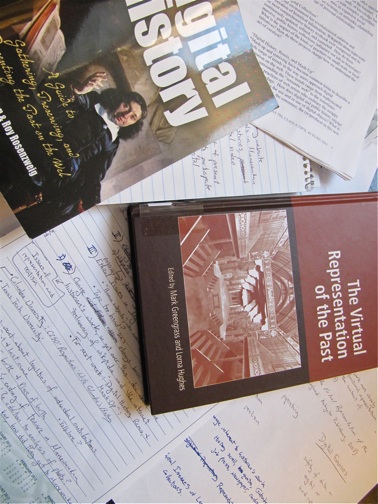
Digital History is a phrase that needs to be un-packed, but it also needs to be placed into the context of how change is inevitable in any private and professional aspect of our lives — the historical discipline notwithstanding. Some notes scribbled down in thinking about this are 1) the change that has always been central to a historian’s work, whether from Ancient Chinese historians to Herodotus and Thucydides using scrolls to the advent of the book (revolutionary since a person didn’t have to unroll meter after meter of scroll to locate a piece of information — they could just flip to the assigned page number), then the famous Gutenberg press, the individual job press (a sort of personal “blog”), the newspaper, then radio, television and then the Internet in all of its endlessly random glory. Thus, an acceptance of this change and realization that this digital web-based world is not going to go away — whether we like it, or sit in denial and cry about it in a closet — is crucial to the 2) point, which is our real and our imagined problems associated with digitally representing two and three dimensional artifacts. Are tangible, paper artifacts somehow superior to digitized artifacts, and if so why or why not? Tangible artifacts are susceptible to burning up in a fire; this as opposed to a digitized artifact that cannot be touched, but can be disseminated and copied onto an infinite number of individual hard-drives, arguably ensuring that it is preserved somewhere at all times. In our increasingly paperless society, the digitized is regarded as ephemeral and the in-your-hand paper as constant. Yet this feeds into the presumption that paper, even archival quality, is some how not ephemeral. So is it better to digitize the tangible artifacts and disseminate them across the web, thereby democratizing the access? Or is it better to not digitize the artifact and keep them safely stored in a fire-proof archive, access to them only allowed during normal business hours? (Which, by the way, coincides with your own normal business hours, making it all the more difficult to access those documents.) And finally the 3) point concerns the ethical nature and legal/copyright issues inherent to the digitization of private and seemingly public collections.

In no way is this (or any) simple blog-posting meant to be exhaustive or equally representative of all the issues at stake here. It does, however, address the broad question in our digital age of access to and the sorting of information, and the ever-present human and professional need to analyze and put that information into some type of deliverable and intelligible context — whatever your job, your comrades, colleagues or co-workers will not be impressed if you just dump information onto their desk or workspace. All professions require (ideally) information to be sorted and processed in some kind of way. It continues to be up to historians (and all professionals, from automotive mechanics to physicians to lawyers) to figure out ways to remain salient as more and more information becomes increasingly accessible to larger and larger sections of the planet’s population.


Caesar and Mongolia

Mongolian Vodka

Mongolian vodka from the Central Asian steppe and fresh tomatoes from the northern Great Plains.  If it’s a Sunday afternoon and autumn feels like it is giving way to winter, go ahead and juice those tomatoes into a chilled schooner. To that add Khan’s vodka along with some British Worcestershire, Tapatio’s hot sauce, Spanish green olives, and sliced kosher dills.  Ingredients the planet over are necessary to make a Caesar.


The First Blog: Setting a Foundation

The Edge of the Village content is largely composed of anything and everything that deals with Great Plains History, Public History, and World History, three themes and topics that happen to be the graduate and professional focus of this blogger.

The intent of this blog is to bring information from academia (whatever that word means in all of its glory and horror) and the professional world closer to the non-professional.  Another intent is to listen to, report on, and analyze what others are saying, professional and non-professional, political and non-political alike.  Professions are loosely defined as the codification and standardization of subjects and disciplines, but by no means does this mean professionals are somehow smarter or more informed (one can defer to the story of Socrates and the oracle, or the chorus line in Operation Ivy’s “Knowledge”: All I know is that I don’t know nothing — this helps this blogger feel somehow connected to the EduPunk movement).

As well, politics are polemics are one-sided arguments that are effective at getting a dialog going.  The important component, though, is to remember that rhetorical polemics are intrinsic to chopping it up a bit to learn something new, or anew.  Nothing is ever settled.  It is only transitory, or another phase of modernity, a word Leszek Kolakowski defined as a sort of tension between existing structures and the evolution necessary for culture and society and individuals to breath in the grand present day push into the future.  Kolakowski said this in a collection of writings published under the title, Modernity on Endless Trial (University of Chicago Press, 1997).

Note: The Edge of the Village is a namesake built off a modified or remixed version of The Village Voice namesake.