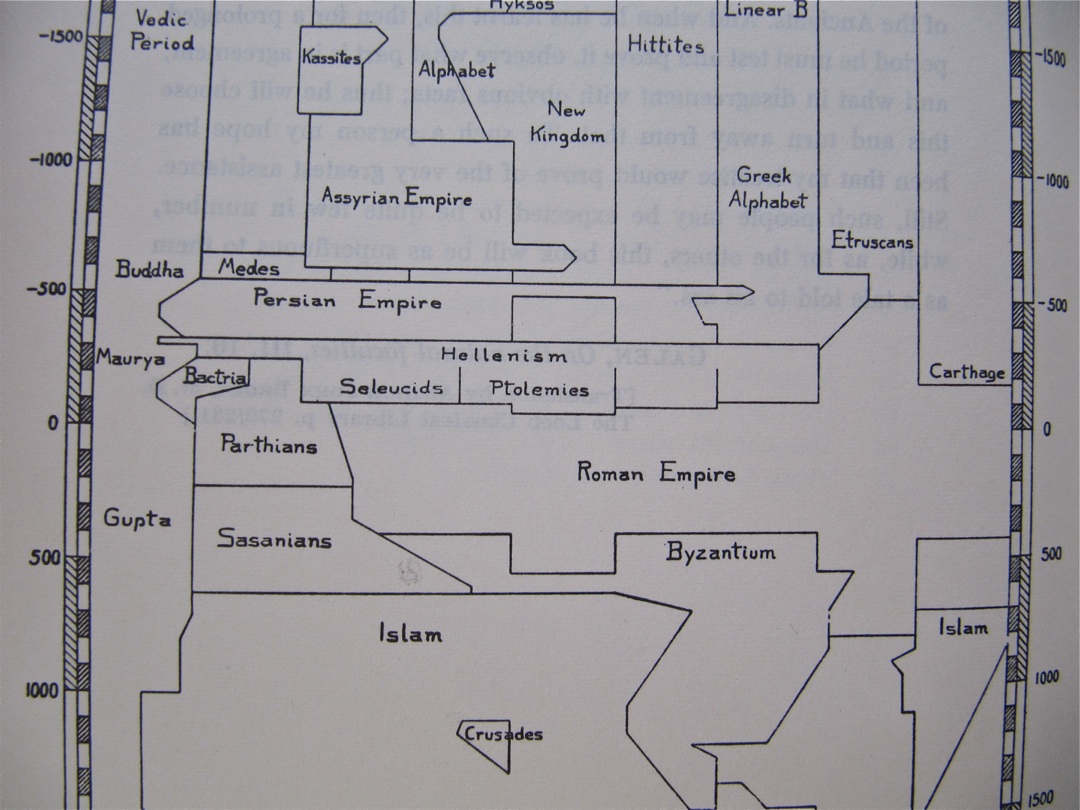
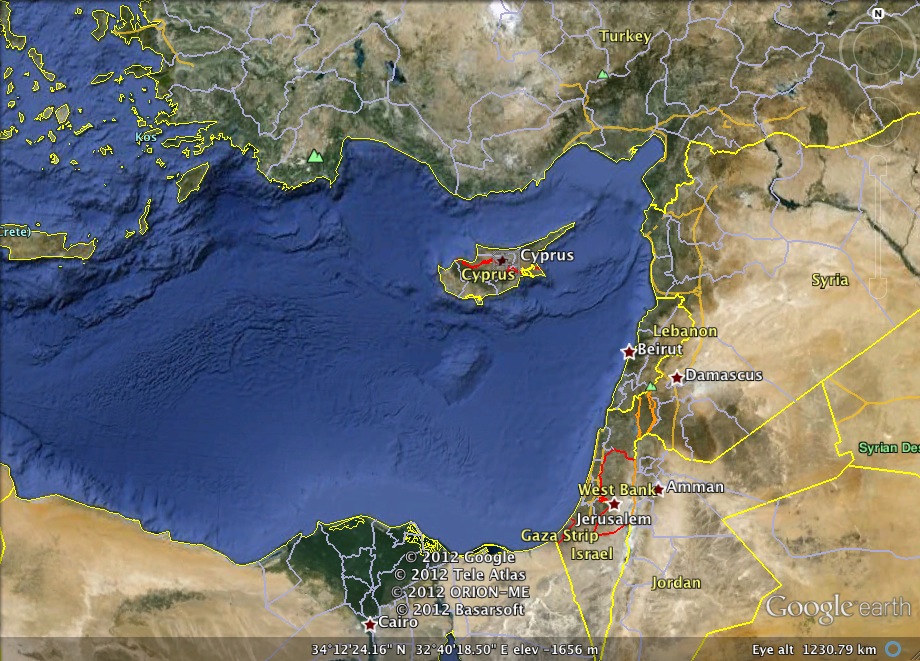
O. Neugebauer has a great geometric map of the Ancient Mediterranean world in The Exact Sciences in Antiquity (Brown University Press, 1957). Neugebauer’s map helps orient someone in 2012 with where the Hellenistic world fit into Antiquity. Scholars and field archaeologists today are still piecing together bits of reality from those ancient worlds. It seemed worthwhile to upload and post Neugebauer’s geometric-ography (yeah, I just typed that) to help orient myself and anyone else with the Hellenistic world. In lay-terms, Neugebauer was the type of thinker that one would call a “Big Dog.” With the illustrations below, the contemporary nation-states are at the top, and the boundaries of the Ancient worlds (and how they spilled in and out of today’s nation-states) are beneath that.
Overview of the sciences in the Ancient world. From Neugebauer, “The Exact Sciences in Antiquity” (Brown University Press, 1957), xvi.
If you’re a byproduct of the late-’80s and early-’90s North Dakota K-12 educational system, when you weren’t thinking about pop culture in a rural setting, there were certain hours of the day when you were subjected to 4th and 8th grade North Dakota Studies. The North Dakota Studies training was a bit like chest-thumping boosterism (take that, South Dakota, Manitoba, Montana and Minnesota — Saskatchewan wasn’t yet on our young radars), yet there were other segments that appeared as cold hard facts (something Carl Becker perpetually wants us to consider and reconsider).
I’ve lost touch with the curriculum changes since the late-’80s and early-90s, but I do recall my 4th and 8th grade teachers teaching us (as they were taught to teach us) just how fertile the soils in the Red River Valley were. At that young age, much of this information is either lost on 4th graders in the late ’80s, when the Red River Valley seemed like a place so distant — “…it takes a little over 3 hours by car to get there!” goes the fourth grade line of reasoning, “…and that is without stops!” Or it works its way into one’s developing subconscious (the theory out there now is that we never forget anything; it’s more of a matter of how to access that information in the enigmatic file drawers within the brain — “Where did I put that piece of information?!”).
Below are two photos from 2012 archaeological fieldwork that make the North Dakota Studies Soils Boosterism all the more transparent, at least in the comparative context of the Levant and the Red River Valley. If you tell a North Dakota 4th grader, “The Red River Valley has some of the most fertile soils in the world!!!” they will believe you (or pretend to care) but without knowledge of just what that means. When our great grandparents and great-great grandparents swooped onto the northern Plains, they came from any number of places. The point of entry with the railroads and all was Fargo, and no doubt they could take an assessment of what the glaciers left behind.
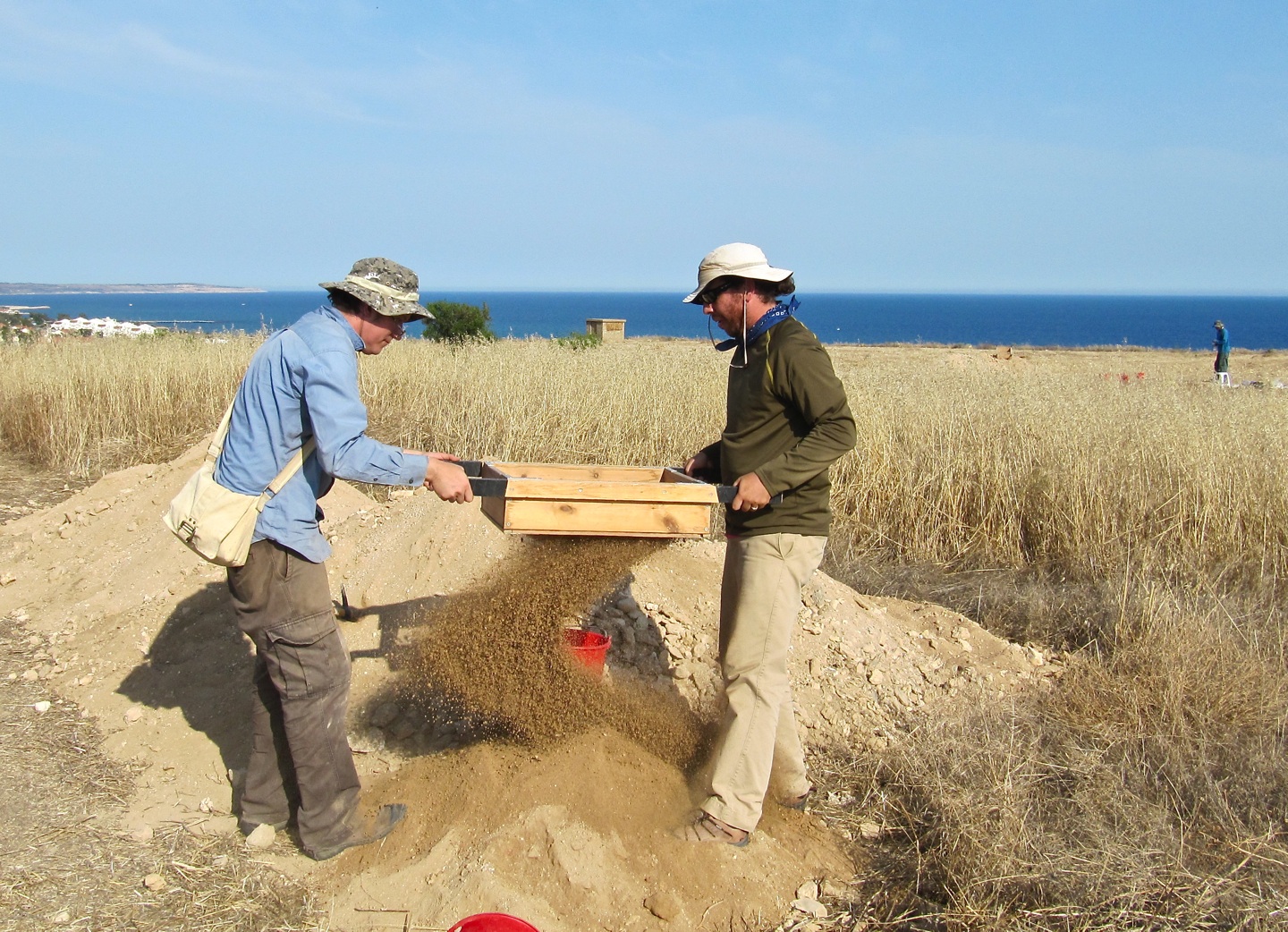
The first photo below is what soils from the southeast coast of Cyprus looked like as they were sifted through an archaeological dry screen in 2012…
Dr. David Pettegrew and Dr. William Caraher sift Cypriot soils through an archaeological dry screen in June 2012.
Red River Valley soils after sifted through a 1/4″ dry screen at Fort Abercrombie, North Dakota. Photo by Richard Rothaus, PhD.
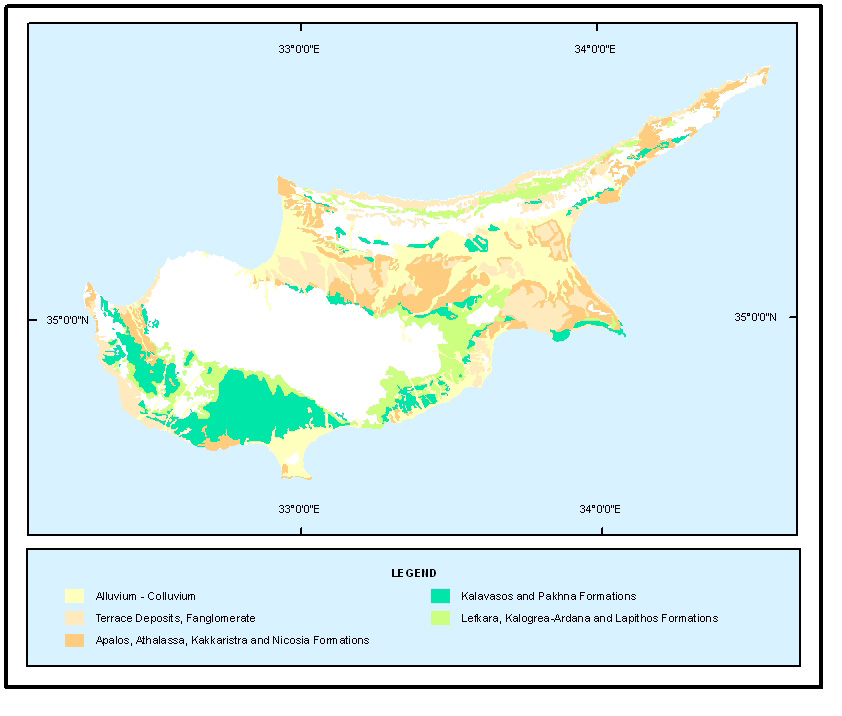
The second photo (courtesy of Richard Rothaus) is what Red River Valley of the north soils look like, specifically around Fort Abercrombie, at least just after sifting them through an archaeological dry screen. Finally, here are a couple photos of both the Red River Valley and Cyprus produced by the SCIENCES and SCIENTISTS! The first is from the Republic of Cyprus Geological Survey, and the second is from Dr. Donald P. Schwert, North Dakota State University professor of geology. Yes, science is worth the funding folks.
Map from Donald P. Schwert, “A Geologist’s Perspective on the Red River of the North: History, Geography, and Planning/Management Issues,” (Fargo: North Dakota State University, 2003), page 3.
Crops can be grown in either of these soils (the lemon trees on Cyprus make the mouth pucker and water just looking at them), and you’ll also notice which dirt will raise the eyebrows of serious farmers. The Cypriot soils do not benefit from glacial activity (too close to the equator and Levantine climates), but the geology that the soils reside on do benefit from precious metals, specifically copper. This is where we get the island’s name, the Latin scientific word for copper as Cuprum = Cyprus (the Troodos Mountains are full up with it).
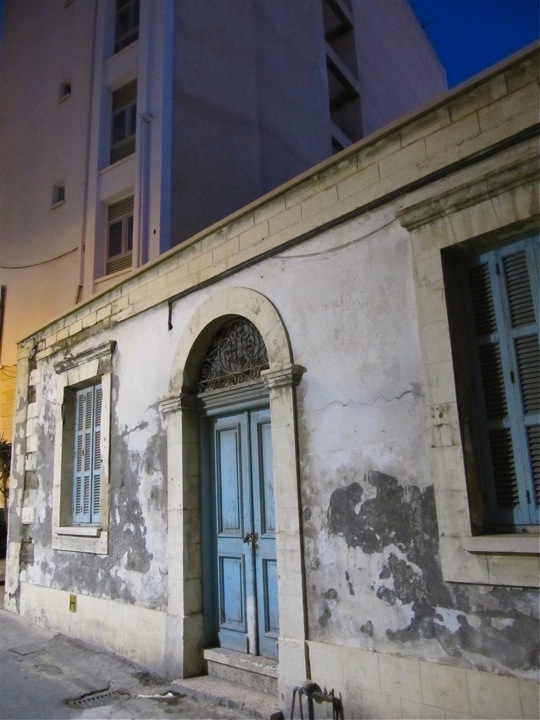
On the evening of June 9, 2012, William Caraher, R. Scott Moore and I walked down to Larnaka’s beachfront on Cyprus. The late-Ottoman beachfront mansions on this walkway are giving way to modern high-rise hotels and apartments, the latter approximately 3 decades old. Caraher and Moore noted one of the older buildings
A June 9, 2012 evening photo of downtown Larnaka, Cyprus. Note R. Scott Moore and William Caraher in photo.
on this walk. With each year that they return, they said another window is boarded up. The place houses a Mexican restaurant (or the signage indicates that), but it appears to be incapable of pulling whatever needs to be pulled together to maintain it. Amidst all the rising tourist properties, this historic mansion reflects the broader contextual theme of this flick, at least to one degree, and in a Mediterranean-Levantine setting (instead of a Caribbean one).
It is not unusual for a city to breath (in fact cities need to breath otherwise they are on the decline), and in order for it to grow certain things need to be managed — to a cynic, that’s a handy MBA word for excising and tearing down in the name of, ahem, progress. In a realistic vein, managing historic preservation with the needs of a community (rather than the needs of a politician who wants to get elected by a community — whoops, back into cynic land) is a careful act of balance. Everyone needs to be brought together at the outset: concerned, attentive, intelligent, non-egotistical, informed and thoughtful citizens (which are core ingredients for a healthy, democratic-republic), engineers, historic preservationists, trash collectors, spiritual leaders, fat cat lawyers, artists, bakers, the corporate employee grinding it out in the cubicle, little league coaches, physicians — essentially every contributor to what we call Civilization.
A cross-section slice of old and new Larnaka, Cyprus.
And progress is important. It’s important to keep in mind that we build meaning for ourselves, and that meaningfulness is created by reaching back and pulling from the infinite repository of information that is the past. If you reach back into and wander around in the past long enough, you’ll begin noticing patterns, and those patterns reflect the organic nature of culture. We see someone or a group of someones doing something in a certain way, and we mimic that accordingly. “Okay, that’s what they are doing? Seems all right. I’ll do that too.” We become jaded when we begin perceiving that aspects of the organic cultural processes have been hijacked by marketing geniuses. I think this strikes at the foundation of our desire to experience what is authentic, this word connected with authority and authorship.
Authenticity competitions can be of value to a culture and civilization. For example, think about two chefs who each claim that their own lamb fricassee recipe is the best, and they are going to have a competition to prove it. Yes, I too want to participate as a taster in that event. Authenticity competitions can be a detriment to civilization as well, especially when the authors are nihilistic and kill in the name of their assertions. But healthy cultures find ways of dealing with those types. Healthy cultures also find ways of creating outlets for chest-puffing and -thumping.
This locally and in the present is most noticeable when you’re sitting in a tavern in Cyprus, and the UEFA Euro Soccer championship is on every television in the joint. Before coming to Cyprus, I knew that non-America considered soccer an extremely important regional, national and international event. The energy locals invest throughout the planet in watching and following this sport becomes transparently real when experienced firsthand, at the on-the-ground level. A friend in Prague (or somewhere north of here) communicated that too, noting in an E-mail how fanatical nations become when throwing their soccer teams against one another. Note: when you come across a graduate student of history who tells you he is studying the history of nationalism through the sport of soccer — like Trevor Saylor at North Dakota State University — know that this subject of study is very real for a lot of people. It’s probably a lot better that Russia and the Czech Republic in the 21st century can slug it out on the soccer field rather than the traditional 20th century way.
If you stumble across the correct place, you can watch these soccer matches play out in a rehabilitated and preserved building owned by a Cypriot-Australian husband-wife team, at least if you find Art Café 1900in Larnaka, about a block or two northwest of the Zeno of Kitium statue. As one of the co-owners told me, “If
A June 9, 2012 evening photo of Art Café 1900, Larnaka, Cyprus. Note the European football banner at right.
you’re heart is not in it, it’s not going to work.” And these are words that need to be remembered, especially when humanity increasingly makes economic justifications that override the spirit of the soul (yes, I just dropped the “soul” bomb). Money is important, yes. But at the end of the day (either the literal day or perhaps a couple years or days before mortality kicks in, when we’re in that contemplative state), we’ll have wanted to have lived for authenticity rather than strictly for the monetary Bottom Line. Constructive, sweat-inducing, knuckle-nicking, protracted-thinking and physical labor should be our Bottom Line, this rather than the illusion or delusion that successful statesmanship or business savvy is how much money you saved by excising the old for the new. And authenticity isn’t something that can be rushed. It requires protracted amounts of energy, self-discipline, encouragement, discouragement that gives way to re-encouragement, and so on. I suppose a Robert Musil quote would be a decent way to end this rambling. “We do not have too much intellect and too little soul, but too little precision in matters of the soul…” Or if that doesn’t work, here’s a little different slice of soul, some R.L. Burnside…
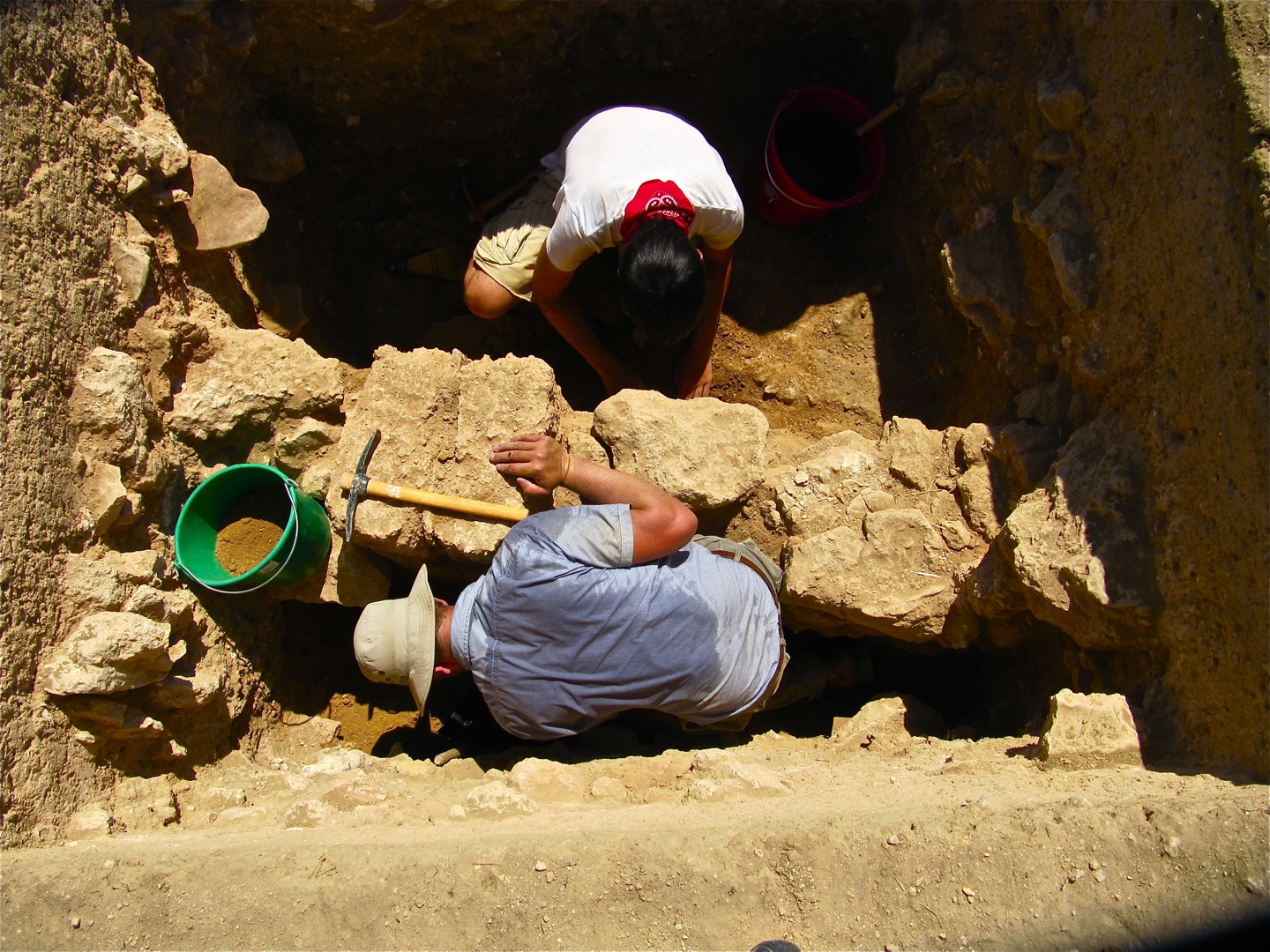
On June 5, 2012, my Pyla-Koutsopetria Archaeological Project excavation team hit glorious bedrock (something just over or around 1.8 meters below ground surface). Here is what happens when you sink a hand pick into clay and hit said bedrock. Reverberations shoot up and in through the handle, up to the hand, all while simultaneously returning audible reverberations produced by said metal pick striking bedrock (also known as “that sturdy clink”). The ear drum will pick this up and trigger cognition in a certain direction. It will induce a New World northern Great Plains’ers’ eyes to widen. Note: if you are privy to Native America and its history (and you always should be), you will arguably not regard yourself as from the New World (in academia, we sometimes refer to this as post-colonialism). However, when you are in the Mediterranean, you will need to somehow communicate differences from one side of the Atlantic to another. “Damn that Columbus.” Say this while smiling. If you carry Scandinavian historical identity with you, remind Columbus fanatics about this Smithsonian web-link. We all need balance.
The wall emerges. It’s okay to vacillate between the late Lewis Binford’s processualism and Ian Hodder’s post-processualism while uncovering subsurface Hellenistic architecture at this stage in the game. Say to yourself, “What does this all mean!?”
Anyhow, and upon hearing this bedrock clink, thank the archaeological comrade to your immediate east. “Thank you for also hitting bedrock.” Then pull the pick up out of the earth, swivel the handle 180 degrees, grip it again, and bring back the right arm to its physiological apex. When at its entire apex swing downward, coordinating the arm with gravity to aim the scraper end where the pick left off. Note: you will hear a similar clink and feel the handle vibrate again. With the pick lodged in the dirt and resting on the bedrock below, extend the free left arm toward the upended pick, enclose the left hand around the topside of it, and then drag the handle toward yourself with your right while pushing down on the backside with your left. Essentially, pull the scraper in to the body. Do this repeatedly, moving across the horizontal stratigraphy, only stopping to wipe the sweat from the brow (it otherwise will get into your eyes and produce a slight sting in the corners). This, in turn, will ultimately induce northern Great Plains and Old World historic and archaeological comparative thoughts.
No matter the location on the planet, archaeological excavation units are essentially closed quarter laboratories, where theory and data are in constant exchange with one-another. There is the material culture that continuously emerges from below, inanimate objects from a bygone age (note: do not ever, ever, refer to skeletal remains as “inanimate objects.” You will deservedly be destroyed by the present). These objects carry and reflect the imprint of humanity. Know them. Respect them. They are from civilizations and cultures that pushed in certain directions for an infinite amount of reasons. While in the excavation unit, thoughts will continue, at least when bounced off the word culture (this word and idea re-popularized by Fernand Braudelin the 20th century). This latter word, culture, is analogous with the word cult (and even agriculture, and monoculture), or the process of doing things together and in a particular direction. These are some thoughts that will rip through your brain.
In addition to this, your archaeological physiology will be in constant exchange with meteorology and the weather. This may be reflected in the saying, “If you can’t stand the heat, then get out of the excavation unit.” You will be uncertain how warm it has been getting at the Vigla site on Cyprus — “What does this Centigrade mean? And why can’t the world just get on board with Fahrenheit? What does it all mean?!” Never mind all of these thoughts. Keep them to yourself. If you know the sun is going to be up and about, definitely wear a brimmed hat (sombreros have been suggested), collars if you can, sunscreen for certain. If your shirt is in its second day of rotation, you may take offense at your own odor about mid-afternoon of that second day. It’s okay to announce this to your crew. Be calm in your tone, though. “I am taking offense at my own body odor. I just wanted to announce that.” In the correct context, all of this will lighten things up a bit.
But back to this exchange in the excavation unit, the one that is set down on top of a 3rd century BC Hellenistic site. As the fortification wall grows up out of the ground (you’re excavating around it), you will begin admiring the mason who some 2,300 years prior chiseled these ashlar blocks and roughed out stones here and there to assemble this wall. “Is it a partition wall? Is it one phase of an exterior wall? What’s with all the military-like artifacts we keep coming down on within these walls? MAKE SENSE OF ALL THIS, DAMMIT!!!” You’re brain will think these things, a kind of psychological inversion into itself. After climbing out of the test unit, scribble a distilled and filtered variation of these thoughts down in the subjective note section of your excavation unit forms. Use big words here and there. They tend to be more timeless than relativistic lay-terms. Also: a slight breeze may push up over the plateau and evaporate the sweat out of your drenched shirt. Be sure to say to the crew, “Don’t come out of the excavation unit: it’s cold up here, something like 90 degrees Fahrenheit, or whatever, and you’ll catch a chill and perhaps your death. Stay down and warm in the breeze-less 90+ degree excavation unit.”
As mentioned above, excavation units can become cramped. But this doesn’t matter because you’ll have kept the bigger idea and picture in mind. The mind convinces the body that an inevitability is at stake: we will finish this excavation unit, record it properly, and be satisfied with questions we answered, and the new questions generated by the unanticipated finds — happens every time.
While in the western portion of the excavation unit and while facing north, you will have to bring the pick down close to the emerging foundation wall. This will invariably bring your knuckles into direct contact with the said foundation wall. With one repeated swing after another, your knuckles hitting the wall is ultimately a game of chance and odds. At some point they will scrape the wall. When this happens, you’ll immediately think of the epilogue Tom Isern set down in Prairie Churches. Tom was re-roofing a prairie church, and he maneuvered in a way on the ladder that was in discord with gravity, and amazingly he captured himself, but only after dragging his forearm across the said church roof. One imagines that a bit of Tom, at least the DNA from his scrape, was set into this church roof. Similar situation when your knuckles whack and scrape the side of subsurface Hellenistic architecture in the Levant. You’ll see a dash of blood and think, “Well, there it is. Better take a picture and Web 2.0/Digital Humanities this thing on the Internets…”
Any archaeological field school invariably draws in a cross section of students who are not directly working toward receiving a degree in archaeology. For a truly rounded education in the arts and sciences, students end up taking a cross-section of classes for a variety of reasons. A couple days ago when the slight 35 kilometer/hour breeze came to a lull at the Vigla Site in Cyprus (allowing the microphone to pick up the audio), I asked my team of undergraduate students brought in from Messiah College to think how undergraduate disciplinary training in non-archaeological fields might be applied to the archaeological process that they were doing right then and there.
I posed the question, and they had 15 minutes to think of a response. This is how it played out. I was very satisfied with the results, as the students worked with the data emerging from the field and excavation unit, and also explored how this influenced them personally (back in the day, we used to refer to this as building character).
The first is Danielle King, an education major…
The second is Carrie Bisciotti, a philosophy major, who discusses theories laid out by Dr. Robin Collins, and how these theories might be applied to thinking of evil as inherent to virtue-building processes (is Carrie suggesting that my trench supervisory skills were at first perceived as evil to her, but then looked at another way, perhaps as the anvil and hammer upon which virtue is built?)…
The third is David Crout, a history major who discusses epistemology, real-time…
A couple points about this short video clip below, taken on June 1, 2012 at the Vigla site (dated to roughly 3rd century BC) on Cyprus. The first point is that it, the video, captures the A/V of an archaeological trowel at work. The video doesn’t capture the essence of the meteorology and atmosphere, though, which on the hottest and most humid days induces 21st century archaeologists to ponder what a 12th-century crusader thought when arriving on the scene in full battle regalia (“Chain mail in this heat? Yeah, I think I’ll crusade up to the North Pole instead…”). Then the thoughts drift to how some of those knights returned home to contemplate existence and play chess with death (or life, depending on one’s interpretation).
The up-close trowel shot also demonstrates what the majority of archaeological fieldwork is like: one scrape after another, and how this requires archaeology attentiveness to the changes in the soil. In the video, the soil color change is what the ubiquitous mud brick looks like upon digging into, the mud brick a staple of any rural and urban settlement. To identify this, look for the color change that is darker rust-colors, a type of clumpiness in the soil, and white fibers that helped bond the bricks (today fiberglass strands provide that binding agent, at least with concrete). Mud bricks also required a foundation that raised them above the ground surface so they didn’t melt away when it rained (saturate the mud bricks, and they will slump and fail).
Chieh-fu Jeff Cheng leaves from Cyprus for Taiwan, today, and this got me thinking about the dynamics of any and every archaeological crew. Like any job, trade or profession, what people bring to the profession provides additional bonus
Chieh-fu Jeff Cheng hanging from a cliff, inadvertently preparing for his Aeroflat flight.
(I almost said “incentive”) to the already-interesting work. In the case of Chieh-fu (or Jeff), he has an amazing ability to hang off the edge of cliffs in need of excavation (more on that eventually). This has proven good training for Jeff since one of his outgoing flights has him on board the famous Aeroflat, this to eventually take him back to Taiwan for a summer visit with his folks. In the autumn, Jeff will continue his studies at Boston University, and he’s doing some fairly ground-breaking work in looking at the archaeology, history and material culture of the Japanese occupation of Taiwan in the first half of the twentieth-century. We will be sure to see Jeff on down the line.
Spend time at an archaeological dig sometime (they often take able volunteers). Then spend some more time with the crew in the evenings. That’s when the relationships and ideas begin to really take shape. See you down the way and on the other side, Jeff. Great getting to know you.
Archaeological fieldwork is rarely if ever this (although we will shoot Nazis if provoked), and never this. In reality, the fieldwork is so deliberate that it is often described by newcomers as “boring.” Of course, it is anything but boring, and professors of literature might understandably remind students that if they find a text boring, the students themselves are boring. Stratigraphic profiles (the layers of culture that build up over time) are also non-boring texts, as are historic photographs. Keeping all of this in mind, I was reading through and looking
Note the stone wall behind the “Man at Geroskepou,” Paphos District circa 1940. Photo from “Faces and Places of Cyprus (1933-1956): Porphyrios Dikaios’ Photographs at the Department of Antiquities” (Nicosia, Cyprus 2012), 132.
over reproduced photographs in Faces and Places of Cyprus (1933-1956): Porphyrios Dikaios’ Photographs at the Department of Antiquities (Nicosia, Cyprus 2012). The stone wall within the 1940 photograph struck me, especially considering what my May 2012 team has been uncovering at our excavation unit on the Vigla site in Cyprus. After scraping away one centimeter of soil after another (along the way discovering a Scythian metal arrowhead, an inscribed lead sling bullet, and kilo after kilo of pottery), our group came to what appears to be a foundation wall. This is what the geophysics also suggested a year or two ago, which is one of the reasons our test unit was placed in the position it is in. Bring in the geophysics, and ground-truth with test units. Anyhow, without jumping to one definitive conclusion or another, while digging it is still important to imagine what buried piles of stones may have once been. A stone wall? A floor? It is equally important to swoop up local and regional publications while on an archaeological dig, no matter where the dig is situated on the planet. At the very least this keeps the imagined and creative juices flowing in the evenings, and these ideas can be brought to the field during troweling and sifting throughout the daytime heat (You can talk about this and follow it up by handing a crewmember a bottle of water that has been sitting in the afternoon sun and say, “Here is some warm water to cool off with…”). No doubt, the wall in the 1940 photograph is not the same as the possible wall from thousands of years ago. But there is such a thing as pre-Industrial continuity, at least in how folks back in the day constructed stuff using local materials and raw, human labor (one stone after another). Your crew just may appreciate these kinds of speculations. And if they can see a comparative example to imagine what the wall they may be digging may have looked like (yes, a perhaps and maybe), that is all the better.
Dr. David Pettegrew photographs the stones emerging from the bottom of an excavation unit on the Vigla site in Cyprus, late-May, 2012.
We are increasingly hearing the phrase Digital Humanities bandied about these days. The following YouTube videos are localized reflections of this broader theme from the eastern Mediterranean. Reporting from an ancient historical
Cyprus and the Eastern Med
site on Cyprus on May 26, 2012, Dr. William Caraher (University of North Dakota) and Dr. David Pettegrew (Messiah College, Pennsylvania) provided 3-4 minute site overviews for their incoming colleague Dr. Scott Moore (Indiana University of Pennsylvania). The on-site video descriptions were taken in the morning when the wind was calm enough to allow for the audio to be heard (mics on these handy DIY digital cameras have a hard time in the wind).
Tomorrow (05/25/2012) we re-enter the archaeological test units we started some days prior at the Vigla site on the southern coast of Cyprus, heading back into the field after an intermittent lull in the excavation action. Without sensationalizing any of this, the reason for lulls has to do with the reason there is a preserved site for us to dig at Vigla in the first place: British artillery. More specifically, the British military has a base on Cyprus, and they use and have used this area for a test-firing range. Now this doesn’t mean shells are directed toward the PKAP Vigla site (well, never intentionally), but there always is a chance for some kind of misfire or ballistic trajectory to go all wrong. That is why the Brits won’t (or cannot) allow anyone up on the Vigla mesa during certain times of the week. The PKAP team organizes the weekly schedule this way in order to make up for lost digging time due to the Brits understandably having to sharpen their artillery skills — for Queen, country, and Hellenistic archaeology (inaccurate and imprecise artillery is the dangerous kind).
I have a 3-person crew, and we are all scheduled to leave for work tomorrow at the site at 6:15AM, and not stop excavating until 7:00PM. Then we will repeat this process on 05/26/2012, a Saturday, and have a little bit lighter schedule on Sunday and Monday, excavating some and getting into the lab in Larnaka to process the recently pulled artifacts.
Looking south from the top of the Vigla site. This photo taken sometime around 05/20/2012.
I have been in the archaeological field since 2002, at least in North American contexts. For the first time in the eastern Mediterranean on a dig, I am quite looking forward to re-entering the test units we started some days ago, pulling out material and plotting artifacts, taking notes and dry screening. I am also looking forward to taking down field-notes on an iPad ap that the PKAP crew put together (Digital Archaeology goes on-line: more on this later). I am equally looking forward to guiding my three-person crew on what is the first dig of their lives. Remember to put your water bottles in the freezer the night before, at least so it is icy cold up through the noon hour. Keep your broad-brim hat on, and suck down the water whenever you think of it. See you in the trenches.










 The Edge of the Village