Category Archives: Uncategorized

McGovern Archaeology

Today (10/21/2012), Sunday, George McGovern died in Sioux Falls, South Dakota at 90 years of age. He had been hospitalized for a time, slipping into a coma within the last couple days. During that time I started thinking about McGovern at the local level, at least in South and North Dakota. McGovern hailed from the small town farming

George McGovern buttons from a private collection. Photo taken on October 21, 2012.

community of Avon in southeastern South Dakota. He joined up with the Airforce at 19, and flew B-24 bomber missions against Nazi Europe. After the war McGovern returned to South Dakota, and with his GI Bill he worked toward a graduate degree in history and lectured at Dakota Wesleyan University in Mitchell, South Dakota. He eventually got into politics, and the state of South Dakota elected him for 3 terms to the United States Senate. In thinking about all of this, it seemed like a good idea to upload some George McGovern archaeology, at least a photo of his presidential buttons from his 1972 campaign against Richard Nixon. McGovern lost. Big time. He carried no more than one state in the election — apparently it’s a really good idea to find out a lot about your vice presidential running mate before you ask them to be your vice presidential running mate. But that was how things played out external to the Democratic Party. Internally, McGovern ushered in numerous progressive reforms. Ross K. Baker, a political science professor at Rutgers University, has pointed out that McGovern helped revolutionize the internal workings of the Democratic Party, driving out the old guard and absorbing the times that were a changing — thank you Bob. The buttons reflect those changing times and reforms. The buttons have a variety of iconography, including a rainbow, the sign for women with parallel horizontal lines

The McGovern Library at Dakota Wesleyan University in Mitchell, South Dakota. McGovern lectured history at this campus.

that signifies equality, the dove (certainly a sign of peace and love), and the geopolitical outline of North Dakota that emphasizes the state’s Peace Garden slogan. These photos came from the private collection of Molly McLain. No doubt there are more of these buttons tucked away in the attics, storage lockers and basements of a variety of homes across the country.

Another photo is of the McGovern Library at Dakota Wesleyan University. If I remember correctly, the building (not the McGovern Library) where McGovern lectured history at DWU still stands. To a large degree these buildings help connect our discombobulated present with the past, providing a kind of stability that is both real and imagined. McGovern lectured history in Mitchell, and he was from Avon, South Dakota. If looking at McGovern, it seems that you can do anything in this country if you put your heart and mind to it. It just so happened that McGovern also had a genuine soul (not every politician or individual has this). Here’s to George McGovern, and his well played life. …well played indeed.

A Google Earth image of Avon, South Dakota, the home town of George McGovern.


Kite Photography in Western North Dakota

On the weekend of October 6-7, 2012, we (meaning archaeologist Richard Rothaus, artist Molly McLain, and myself) piled into the Trefoil field vehicle and cruised out to western North Dakota for a session of low altitude, aerial photography (“low altitude, aerial photography” is the phrase you use in fancy proposals; in lay terms it is kite photography, a do-it-yourself technique historians and archaeologists grapple with from time to time, in Omanwestern North Dakota and the eastern Mediterranean). A fortune cookie has read that you cannot control the wind, but you can adjust the sails. This is true, and when it comes to time-sensitive kite photography on super still days on the northern Great Plains, you can also expend vocal hot air, curse the gods, embrace the absurdity of said still day, and record your comrade at his finest. So while at Theodore Roosevelt’s Elkhorn Ranch site on Saturday evening (with less than 4MPH of wind), sometimes you can catch Rothaus opining on the situation:

To be sure that you caught the audio, Rothaus made an initial objective statement that gave way to the rhetorical question, and then the camera panned over to the impotent aesthetics of a pile of kite on a gravel road. BULLY!

Rothaus from the above video:

I need four miles an hour worth of wind. How can there not be four miles an hour worth of wind in North Dakota?

That is an excellent question, Richard. The gods eventually smiled on us, though, at least for a couple moments, and the wind took the kite in the air allowing the digital camera to capture the evening panoramic of the Elkhorn Ranch:

Elkhorn Ranch photo by Richard Rothaus/Trefoil Cultural, October 2012.

There are green evergreens (which is why they call them ever-green) to the right and leafless deciduous trees to the left, the Little Missouri River looking more like a creek as it should in autumn.

Another one of the problems of kite photography is figuring out what minor or major adjustments the camera needs to capture enough horizon to give the viewer a sense of direction. If you want to make an adjustment, you have to repeatedly send the kite up and down with each camera tweak (bring snacks and a cooler).

Digital cameras attached to low flying kites will not capture everything, and this is why cross-disciplinary teams are a great idea for any type of field research, foreign or domestic. For example, approximately 10 steps to the south of the Elkhorn Ranch visitor signatory signage, an oil derrick can be viewed to the east-southeast across the river. While Rothaus is putting together the kite photography apparatus, you can also capture photos of a book Bill Sewall wrote about his time at the Elkhorn. Bill and his comrade Wilmot Dow did the majority of the hard work out at

Bill Sewall returns to the Elkhorn Ranch, 2012.

the Elkhorn. In thinking about this, I suppose a cynic might say that Theodore brought Bill and Wilmot on board so he could have the time to write about how hard he was working in western North Dakota — if the technology was available, Roosevelt probably would have blogged about kite photography while his comrades were doing the actual hard work of kite photography, too (one has to be a bit philosophical about this).

Anyhow, that evening we refortified with elk burgers and steaks in Medora, and the following day set out to capture some portions of badlands undisturbed yet by precious energy development. We were made aware of these portions of lands through stories in the Dickinson Press, and through one of the missions carried out by the Badlands Conservation Alliance. So on a Sunday we drove down to the area. The wind was really blowing. It was blowing so much that I once again decided not to do any hard work, but do the all important work of capturing the hard work. Notice similarities between Richard Rothaus reeling in this kite and someone reeling in a marlin while deep-water fishing:

It almost smacks of a passage from Fear and Loathing, where kites were swooping down on Richard like huge manta rays coming from all directions out of the sky. Another peril of low altitude, aerial photography is in the photo below. You’ll eventually come across landscape shots like this. If everyone remains silent enough in the field truck, though, you can all pretend like you didn’t just see it. That you just didn’t see this here. Everyone just has to look straight ahead and talk about the weather or something. Don’t draw attention to the following…

Oil Pumps and National Grasslands signage in western North Dakota, October 2012.

BULLY!


Punk Archaeology Inspiration

Studying and thinking deep about material culture is an interesting business. It is interesting because there is both the objective object, or the thing in front of you, and then there are the ideas that we as flesh-and-blood human beings attach to that object. And the word “attach” does not mean to suggest that an idea is somehow unreal, or fake. Ideas, after all, come

A piece by Michael Strand.

from the mind, and since the mind is real, so is the abstraction that is the idea. One doesn’t have to act on the idea, but nonetheless, the idea remains real.

In the last month and a half, North Dakota State University’s Michael Strand has had at least one conversation with me about this, well, idea. One evening he explained how he worked on creating an artisan bowl for food (and Michael often asks that his artwork be physically used for family style meals, especially if they are bowls and cups, as his Ted Talk video expands on below), and he used this serving bowl at a dinner with an ethnic Kurdish family in Washington state. He is poised to take this bowl to another Kurdish dinner, this one in northern Iraq. I believe that dinner is pending, but no doubt the bowl and the individuals around it (from Washington state to northern Iraq) will serve to connect ethnicity and individuals. In the business, we often call this community.

In a separate but similar vein, on September 14, 2012, Michael expanded on some of his art at a collaborative exhibit with his colleague Amy Smith. He encouraged me to photograph and share this art, and then I asked if I could put a digital camera in his face while I questioned and he provided answers to his latest works. He said it was no trouble at all. So I will do that here:

And then contrast it with his TedX Fargo Talk that colleague Angela Smith forwarded to me here…

…Michael was and is speaking in large part to how objects, or material culture, carries with them archaeological and historical — aka, humanized — provenance, at least if we, as humans, stop to consider it. This material culture can be both 2-dimensional in form (or what historians often refer to as “primary sources”) or it can be 3-dimensional (what everyone often calls “stuff”). The notion that objects carry ideas with them can loosely be referred to as Romanticism (which is a word with a LOT of baggage, none of which I will go into here), but it can also be referred to as an archaeological school of thought known as post-processualism. In another archaeological way this is what Ian Hodder asked readers to consider in an article I am furiously searching for throughout my shelves… ah, here it is. In his 1991 piece, “Interpretive Archaeology and Its Role” in American Antiquity (Vol. 56, No. 1, page 9) Hodder said,

…new theories and the new ways of writing them often serve to make archaeological texts more obscure and difficult for anyone but the highly trained theorist to decipher. How can alternative groups have access to a past that is locked up both intellectually and institutionally? Subordinate groups who wish to be involved in archaeological interpretation need to be provided with the means and mechanisms for interacting with the archaeological past in different ways. This is not a matter of popularizing the past but of transforming the relations of production of archaeological knowledge into more democratic structures.

The more I think about all of this, the interplay of ideas with material objects, the more necessary and impending it is to have a Punk Archaeology conference on the evening of February 2, 2013, in downtown Fargo, North Dakota (insert “Grow Buzz of Punk Archaeology Conference” here)…


Pyramids on the Northern Great Plains

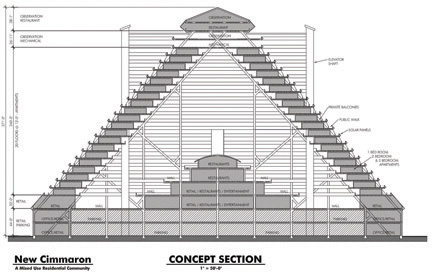
In the last day or so a story about the proposed construction of a pyramid (bigger than the Luxor, Las Vegas) in Williston, North Dakota by a Georgia firm (Camp and Associates) has gained increased attention (The Fargo Forum reports on it here). I hope everything works out a-okay on this project, and it appears local city planners and officials in Williston are generating questions for Camp and Associates. It’s important to be plugged in.

The proposed commercial pyramid for Williston, North Dakota.

The proposed pyramid in Williston got me thinking about another pyramid on the northern Great Plains, this built during some understandably paranoid Cold War times in world history. That pyramid, the Stanley R. Mickelsen Safeguard Complex just north of Nekoma, North Dakota (or not too far south of Langdon, ND), stands as an artifact of the great struggle between the USSR and the US, or as we used to more broadly say, The West.

In Nekoma, I remember a local tavern that with the name, “The Pain Reliever,” or the equivalent, and it reflects a social-psyche from a period in world history when one had to learn how to not only live with but also love the bomb — embracing what one cannot control, or the absurd, is crucial to that.

Below are a couple photos of the safeguard complex from early spring 2012. Today wind turbines surround the SRM Safeguard Complex. When walking around the SRM Safeguard Complex pyramid (at least when I did some years back for an archaeological investigation and inventory), a thought that ran through my brain was the juxtaposition of architecture: the potential for 20th century global nuclear holocaust symbolized by the SRM Safeguard Complex, this in contrast to the green and renewable energy wind turbines of the 21st century. Pyramids aren’t just for Ancient Aztec and Egyptian civilizations…

A 20th century archaeological relic from the Cold War with 21st century Green energy turbines at the right.

MRS signage to the SRM ICBM Cold War relic in North Dakota.


Pedestrian Polemic

I like to walk. Seriously. I’ve been thinking about it for quite some time (often while walking). So this evening I typed “pedestrian” into the Oxford American Dictionary search engine, and it returned with the following noun: “a person walking along a road or in a developed area.” These thoughts in turn have induced a kind of cursory search around the flat for works of fiction or non-fiction that reflect The Walk. At least one Russian and one Greenwich Village author have gone on at length on what it feels like to be a pedestrian, this being Leo Tolstoy and Anatole Broyard. This is what was produced.

After the end of the Napoleonic Wars, and with EuRussiAsia in disorder, Leo Tolstoy set down the pedestrian imagination of Pierre Buzehov, a captured aristocrat from a generation prior — W&P is Tolstoy’s ode to his Greatest Generation — who acted way more attentively and sensibly than the later House of Romanov could ever have imagined (perhaps Tolstoy is

A photo taken of Autumn 2012 colors in Fargo while walking.

suggesting that before a leader becomes a leader, they ought to actually endure some protracted struggle?… perhaps). After barely escaping a Napoleonic execution, the Russian Buzehov found himself in a bare-footed forced march and encampment, and this is how Tolstoy (through the Constance Garnett translation) laid out Pierre’s experience:

…Of all that he did himself afterwards call sufferings, though at the time he hardly felt them so, the chief was the state of his bare, blistered, sore feet. The horse-flesh was savoury and nourishing, the saltpetre flavour given it by the gunpowder they used instead of salt was positively agreeable; there was no great degree of cold, it was always warm in the daytime on the march, and at night there were the camp-fires, and the lice that devoured him helped to keep him warm. One thing was painful in the earlier days — that was his feet.

On the second day of the march, as he examined his blisters by the camp-fire, Pierre thought he could not possibly walk on them; but when they [the Russian prisoners] all got up, he set off limping, and later on, when he got warm, he walked without pain, though his feet looked even more terrible that evening. But he did not look at them, and thought of something else.

Leo Tolstoy, War and Peace, Constance Garnett translation, (New York: The Modern Library, 2002), page 1,207.

And this is all true. When the feet are sore in the morning from the previous day’s overland trek, all that is required is to get up and out of bed, jam the feet into the boots, and get them up and moving. This will limber them up for sure.

Pedestrian archaeology. Redwing Boot collection that extends back to 2005 to present (October 2012).

For at least 150,000-to-200,000 years, Homo sapiens (which, in Latin, means “Wise man” — it often feels like I’m letting that Latin definition down) have embraced her and his biped origins. One could make the argument that our brains are still hard-wired to be in a walking way, at least in our ability to process everything that is coming at us. Perhaps this is why it’s so easy to fall into a trance when whipping along the Eisenhower Interstate System at no less than 70 MPH. Our brains are incapable of processing everything, so we’re forced to either suck down coffee or pull over and nap.

Before this blog entry gets too long, I better lay out a couple quotes from Broyard, at least what he said in his essay, “A Most Unpedestrian Walker” (in Aroused by Books, 1971). Broyard reminds us that mendicant friars, beggars, pilgrims, bards and traveling artisans have been walking for ages. And that walking is shunned in our post-Industrial world:

…we have found ourselves more and more often in transit instead of simply in, more talented in getting somewhere than in being somewhere. We have developed the surface habits of the hurried as against the earned experiences and destinations of those who do their traveling on their own power.

At least in the late- ’60s, Broyard thought it good to critique the walkers, and the trance-induced hipsters (note: Broyard understood that it was hip to critique hipsters, himself among others, which is why he wrote a Portrait of the Hipster in June 1948). Here is one of Broyard’s critiques:

People who live in the country are used to the sight of teenagers at the peak of their physical powers hitching a ride rather than walk a quarter of a mile.

This is true, and it caused me to think about how only after we lose the power of our legs (resigned to a wheelchair at worst, or a walker at best) will we longingly think of how nice it would be to take a walk under our own power. Anyhow, it seemed necessary to set these ideas about walking out. Fellow comrades understandably offer me automobile rides when they see me walking, or catch that I will be walking. Other comrades insist that I get a bicycle. Automobilists miss so much more than bicyclists, and bicyclists miss so much more than pedestrians.

With that said, the Oxford American Dictionary noun of pedestrian is a person walking along a road or in a developed area. The adjective definition of a pedestrian is “lacking inspiration or excitement; dull.” For some reason this definition induces laughter. Broyard understood, as did Tolstoy. So does Dr. Caraher today at U of North Dakota today. Here’s to the walking-scape. If you see me during a northern Great Plains blizzard, please ignore the above tangent and offer me a ride.


Raw Notes from Nicosia, Cyprus

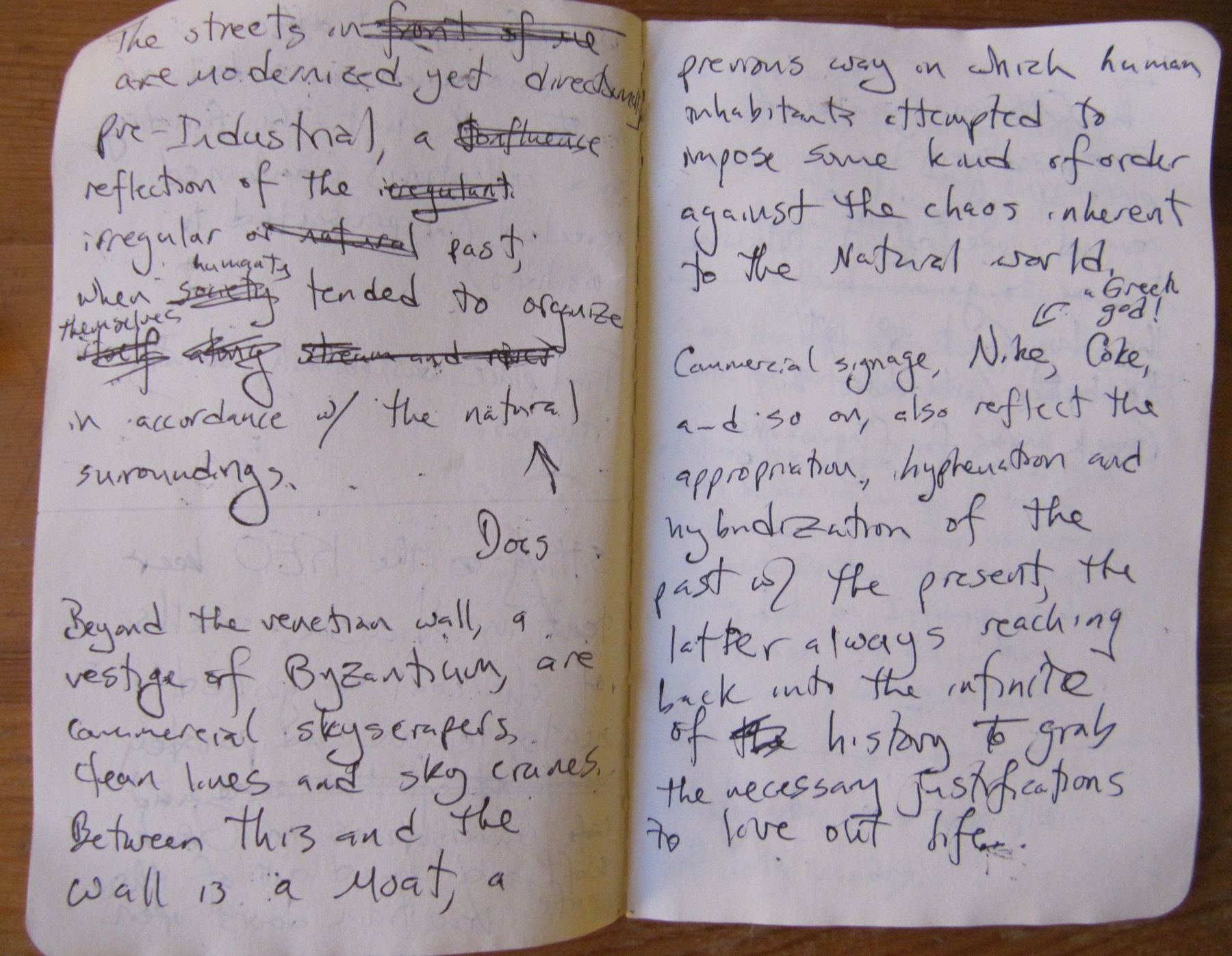
Subjective data collection is different in draft form from what is ultimately presented as a finalized product. Just last evening, while sitting on my futon in the living room (at the time, Iron Man 2 was for some reason streaming through on the AppleTV), I began flipping through the notes I had jotted down while in Nicosia, Cyprus, on May 18, 2012. When these notes were scribbled down, little thought was given to how they would be viewed in the near future. But last night there the notes were, igniting in my memory thoughts that had otherwise gone dormant, and also the process by which these immediate thoughts are set down, and what they look like in rough form. Here is a page of notes, scribbled down with pen while sitting at a KEO beer tent, taking in some regular sounds of the city.

Raw notes taken down at a KEO beer tent in Nicosia, Cyprus (eastern Mediterranean) on May 18, 2012.

The above reads:

The streets are modernized yet directionally pre-Industrial, a reflection of the irregular past, when humanity tended to organize themselves in accordance with the natural surroundings… Beyond the Venetian wall, a vestige of Byzantium, are commercial skyscrapers, clean lines and sky cranes. Between this and the wall is a moat, a previous way in which human inhabitants attempted to impose some kind of order against the chaos inherent to the natural world. Commercial signage, Nike (Greek god!), Coke, and so on, also reflect the appropriation, hyphenation and hybridization of the past with the present, the latter always reaching back into the infinite of history to grab the necessary justifications to live out life…

Sometimes it’s important to not try and slam the day full with one consecutive tourist attraction after another. Knowing what a place is like often requires us to find a corner cafe or some sidewalk seating, sit down, not worry about a time-table or schedule, and simply observe what is going on around us for a good hour or so. Or more. I often have to remind myself of that.


SAT Scores 2012 and Social Media

On September 24, 2012, about the 15:30 CST hour (that’s 3:30PM), I posted the following consideration to my social media/facebook page, with the following NPR story link:

Do you think the reason SAT reading scores are crap is because incessant and spastic social media updates have — and without anyone really noticing it — replaced taking the time to detach from said social media for hours on end and read solid literature at length? Yes, I’m posting this question on social media. Thoughts? Here’s the NPR link.

Social media and personal friends were kind enough to offer thoughtful responses. The first came in from Robert K. Kurtz, Marine Corps veteran of the First Gulf War. Unless he is talking about earth homes and the history of earth homes, Kurtz is often brief and to the point.

yes…… nuff said.

The second response came in from Bill Caraher, who is a colleague, friend, mentor, tangent-reciprocator (and I mean that in a good way), and associate professor of history at the University of North Dakota. Caraher said:

Yeah, we forget that for most of human history people didn’t read and when they did, they read in short blasts excerpting seemingly relevant passages from densely nuanced (and largely ignored) texts.

We’ve romanced the idea of solitary, sustained, silent reading and tried to somehow normalize it. As someone who does a good bit of it, I think this is just silly. And the historical precedents for this behavior are temporally pretty shallow.

Social media engages people in their communities, in the world of texts (albeit short ones), and in the life of the mind, and the sooner people get over their turn of the (20th century) notions of intellectualism (and elitism) the better.

SHEESH.

Caraher raises a good point, at least hinting at the idea of literacy today and literacy in the pre-Industrial world. At no point in human history has the planet been so populated, and at no point have we lived so long (which, in the evolutionary-biological sense is why we get cancer, since the cells in our body have yet to figure out a way to live this long).
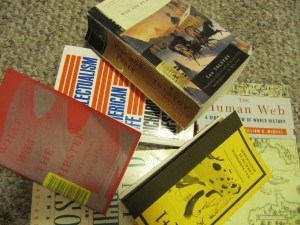
A smattering of dialectically opposed works. Hammers and anvils are necessary components to the grand march of ideas throughout history.

As well, at no point have we been so largely able to access information through the technology that is literacy. You get hints of it in the pre-Industrial world, but not to the standardized and wide-spread degree of today. But that doesn’t necessarily mean we should all be sitting down and reading Gargantua and Pantagruel from the 16th century, or from the 19th century War and Peace (the latter of which was published in pamphlet and serial form when first produced in the 1860s, rather than in one big, protracted, burst; this was Tolstoy’s ode to his Greatest Generation, the veterans and fallen of the Napoleonic Wars from 1805-1815. Every generation harkens back to the previous generation, often nostalgically, definitively to memorialize and never forget.). If everyone would sit down and read W&P, the planet would — ahem — literally — ahem — come to a halt (much in the same way that the planet would come to a halt if we all sat down and incessantly updated our social media statuses — or is the plural statusi?).

Anyhow, the third response came from another friend and practicing lawyer, John Ward:

I blame disco and the sh#t music that is currently popular.

Ward is indeed not a fan of disco, nor pop music. In many ways, Ward is pushing back against a historical precedent (the now) that has created a sub-cultural movement of accepting everything and anything on equal footing. This point comes up in n+1’s P.S.1 Symposium: A Practical Avant-Garde (2006), one of the speakers noting that we are right here and now in an age of research (thus, while we are all researching, we are all individualistically compartmentalized, or something like that). But Ward is saying no, at least to disco and music that is currently popular. I have punk rock Joe Strummer and the Mescaleros playing “Coma Girl” right now as I type, and I’m uncertain if this is what is being played right now on any major (and corporate-owned) radio station. But it’s likely being played on thousands (if not hundreds of thousands) home computers and iPods. And if we didn’t have disco, we wouldn’t have had the punk reaction. So in a side-stepping way, I’m thanking disco, while perpetually refusing to listen to it. Ever.

The fourth response came in from another colleague, friend, mentor, tangent-reciprocator (and I mean that in a good way), and former associate professor of history at St. Cloud State University, Richard Rothaus. Rothaus now pushes global cultural resource discovery, interpretation and management in new directions. Rothaus said:

What was HS [High School] in 1972 now extends into [the] first two years of college. The proliferation of colleges desperate for enrollment provides a system where the lack of standards has no real consequences. Junior can’t read, but he will get admitted somewhere. When he doesn’t complete the degree, that will be the college’s fault, not his HS. The private sector had already calibrated for this. You need a college degree to do work that used to take a high school degree. This exacerbates this problem because everyone thus thinks they have to go to and will succeed in college.

This is another solid point, and something I try to convey to university freshmen and sophomores, this analogy relayed to me through Nick Steffens (who currently resides in SLC, Utah): treat college the same way that you would treat a gym membership. You can purchase the membership, but if you don’t show up and lift weights, swim laps, engage in yoga, or slam it out on that tread mill, then you will see absolutely no benefits in the money you’re forking over for access to the gym. The same goes for university, which is merely trying to cultivate and codify intellect (codified intellect is what we call a “degree,” and degrees require discipline, both in the gym and in academy).

Charles Bauer-Gitter, bibliophile, friend and engaged conversationalist, pushed forward a bit of humility (which we also need, lest we slip into the un-human realm), saying,

For fear of showing my own ineptitude, I’m just going to agree with what Bill and Richard stated above.

Charles leaves us wondering about his thoughts on disco and pop music, but I think he’d be fine with us presuming that he is not all that cool with disco.

Kenneth L. Smith (whom I only know through Social Media — at least I don’t think Kenneth and I have ever met in person) provided literary polemic, at least by way of Mark Bauerlein. Kenneth said,

Mark Bauerlein has done a good job exploring this topic. Incidentally his book title is more inflammatory than his actual thesis. [Kenneth provided a link to Bauerlein, The Dumbest Generation: How the Digital Age Stupefies Young Americans and Jeopardizes Our Future (2009).

Polemics are often important to generating conversation. And note how the 2009 Bauerlein title falls into thematic continuity with Allan Bloom, The Closing of the American Mind (1987), or even Richard Hofstadter’s 1964 work, Anti-Intellectualism in American Life. Thinking about this historically, by 1964 the first of the Baby Boomers were entering college and university, and by 1987 the offspring of those Baby Boomers were also entering college and university. I have nothing more to add here. Analysis and interpretation is open.

Rothaus provided the final remark (at least up to this point in my blogging), saying:

Among the learning-to-crowd, the ability to navigate computer games is a huge incentive to learn to read. They almost all can spell MINECRAFT. [caps are Rothaus]

Yes, it is frustrating when you ask someone if they want to read a book with you, and they agree, and then they don’t read the book because they were level-upping the entire time in a role-playing-game. You ask them, “Hey, what did you think about McNeill and McNeill, The Human Web: A Bird’s-Eye View of World History (2003)?” The true gamer will side-step this question, and delve into some kind of talk about how he has a bird’s-eye view of history through role-playing-games, leveling up with Mario jumps and so on. Blank stares often follow. Then the two depart and return to their respective research projects.


Humanizing Man Camps: Type III in the Bakken

The Grand Forks Herald ran a nice story here on the August 2012 field work of Man Camps, this spearheaded by U of North Dakota’s Bret Weber and Bill Caraher. To further humanize Type III Man Camps in western North Dakota, the following is an elaboration on this photo here:

The name of the lady in the purple shirt is Karina Woodford, and she came to North Dakota from Napa, Idaho. In her words, before she made it to the Bakken, Karina said she was “Wasting away… I was homeless for the last couple years,” this largely reflective of the tough economic times in non-North Dakota. Her brother

Photo by John Holmgren.

purchased her a bus ticket, and she arrived in Dickinson in August 2011.

Karina expressed gratitude toward what you might call North Dakota Nice: “These complete strangers in a totally different state saw strong potential in me,” and they have given her work. She eventually made her way up to the Type III camp just south of Tioga, which is where the interview took place. When I interviewed Karina, she had returned from a shower to this Type III camp. She said they often go for days if not weeks before they can find the time to locate and access a shower, and this is something Bret Weber addressed in the Grand Forks Herald article linked above, and something the private sector has started to address here (there may be room for quite a few more of these shower outfits).

Prior to moving here, she said “I was sleeping in a garage.” With the winter approaching, Karina said she and others hope to get into something more substantial than the trailers and tents they are currently living in. Workers in Type III camps often wear a variety of professional hats, and as Karina said, “We don’t worry about tomorrow until tomorrow gets here.”


The Archaeology of Fargo’s Hotel Bison

In preparation for the transition from summer to winter (which, on the northern Great Plains, is often preceded by at least two solid weeks of autumn), it is necessary to pull all a/c units from the windows and take them to hibernate, usually in basement storage rooms. While doing that this evening, I decided to photograph the hand-painted signage next to my storage space, a grand piece of commercial radio artwork that reflects some of the

Early and undated Bison Building signage, when KVOX 1280AM occupied the building.

earlier years of Hotel Bison, or the Bison Building, this located about the 400 block on Broadway Avenue in downtown Fargo. The angle the art portrays is of the northwest corner, and the Art Deco facade affixed to this commercial brick building reflects what had to be one of the earliest phases of modernization to the original Bison Hotel. In the painting, the facade and marquee notified passersby of the good food and coffee within. That marquee, at least in 2012, has long since been removed, as have any large or small KVOX radio towers on its roof. A quick search and cursory sampling this evening of the North Dakota Institute for Regional Studies (Fargo) database for “Bernie Ostrum” did not yield any specific results (just a broad barrage of digitized daily papers from North Dakota Agricultural College’s The Spectrum, among other items). You’ll note the radio persons on the painting as well, “Rod” the Disc Clerk, Manny Marget, Bernie Ostrum and Loehle Gast (quite likely radio namesakes).

Then and today, the Hotel Bison is situated immediate to the railroad passenger train in Fargo (this just across the parking lot to the north), and a person can imagine how many Fargo arrivals and outgoing passengers utilized the hotel. For a variety of reasons, the historic private and public economic and city forces of Fargo decided to continuously re-adapt and re-use Hotel Bison, so as of today it stands as one of the recognizable building-marks in the downtown area. In many ways this sign can be thought of in the same way as a cross-section of stratigraphy is in an archaeological test unit. The signage preserves particular perceptions in space and time, and so long as it is around (either in material or digitized form), we can glean information from it. I’ve been meaning to digitize that signage for a while, and it’s fascinating to capture how this building was used — and perceived — at a particular place and time in history. Finally got around to doing it in preparation for winter.


Socrates Was a Hipster. We Think. We’re Pretty Sure. Sort of.

Thanks to fellow-blogger Bill Caraher and his Punk Archaeology blogspot (in collaboration with Kostis the Greek), a couple weeks ago I came within the gravitational pull of the 2010 publication, What Was the Hipster?: A Sociological Investigation (New York: n+1 Foundation Publishing). While sitting in a coffee shop on the NDSU campus in Fargo this morning, I pushed through the conversational elaboration about what was the hipster, what is hipsterism, and what the future might be for the kingdom of hipsterdom. This all came from a 2010 round table discussion between folks who have thought good and hard about hipsterism today and yesterday.

Anyhow, this following scene of protracted discomfort played out during the round table:

…There were some uncomfortable moments: the one guy sporting a trucker hat stared straight ahead as Mr. Grief talked about how guys in trucker hats were striving for some sort of faux-authenticity. And when Mr. Grief hit upon the prevalence of pornographic and pedophilic mustaches among hipsters, one heavily mustachioed man seemed to listen more intently, while his thinly ‘stached friend mustered an awkward laugh.

That does sound tense, and there is much within that ought to be unpacked in future conversations. After reading this book (and it ought to be read in its entirety, since several working theses are developed that eventually are used to implode themselves), I tended to my graduate teaching assistant duties and sat in on a

Reading “What Was The Hipster?: A Sociological Investigation” (2010) while sipping a hipster Pabst Blue Ribbon beer at a fairly hipster tavern in Fargo, North Dakota.

Western Civilization course, the topic today taking freshmen and sophomores into the 7-5th BCE Levantine world of Assyrian, Chaldean and Israeli empires and/or kingdoms.

During the lecture and while scribbling down notes, I wondered whether or not Socrates was the original hipster, at least before it became un-hip to be called a hipster (it’s now hipster to claim that you are not a hipster). One of the main complaints that hipster haters have toward hipsters, at least in the book, is that the original hipster shirked style because they were devoting their energy to reading and thinking and conversation. Eventually, though, hipsterism was appropriated, commercialized, and mainstreamed, which is why factories in southeast Asia crank out skinny jeans and middle-men inflate the prices and sell them to young, white Americans born into wealth (it was not their fault). Another complaint, though, was that hipster haters said more about themselves in hating on hipsters than they did about the actual hipster. It’s unhealthy to hate. Find something more productive to do with that time — perhaps by finding out how to market hipsterdom to up-and-coming hipsters.

Why I continued wondering about how Socrates may have been a hipster came by way of how he was always on the cusp of asking the next question. He wasn’t all too interested in the most suave tunic (why would he be, since time is better spent philosophizing). There most certainly were those that made the aesthetic equation that if Socrates looked drab and was a high-powered intellect, then one could simply purchase drab and thus be some kind of high-powered intellect (where people would follow you around and write down what you said). A fallacy to be sure. If this is so, then does that mean Hellenism was a variation of mass-produced hipsterism? After all, to be hellenic meant to be, or want to be, Greek. And once again we return to the fallacy of authenticity, or even purity, two dangerous words that are tossed about quite a bit. Is there such a thing as an authentic hipster? Who knows. The conversations are important, but try to embrace the irony and absurdity of it all, a far more constructive outlet than the hipster haters seem to be carrying on with.