Monthly Archives: August 2025

Clell Gannon “SoBGA” Re-Release

I thought I’d prep some mental notes, or quotes, in this blog post as it regards what I’ll send up to Bill Caraher at The Digital Press at University of North Dakota. Caraher prompted me to think of some quotes to include in the release, or re-release (1924 to 2025), of Clell Gannon, Songs of the Bunch Grass Acres and “A Short Account of a Rowboat Journey from Medora to Bismarck” (Grand Forks: The Digital Press at U of North Dakota, 2025). Below are potential quotes.

  1. “If you love the Northern Plains, and are in any of these arts, crafts, or trades, you will want to make time to read Clell Gannon, as his life and poetry intersected with them all: farmer, star gazer, kayaker, rancher (cowgirl and cowboy), canoe-er, lawyer, cow-boy or -girl poet, architect, Boy Scout troop leader, tourism coordinator/planner/guide, landscape architect, administrator (private or public), underwriter (banking or insurance), artist (digital or graphic, folk, traditional commercial, print-maker, muralist), elected policy maker (county), Great Plains-ist, historical interpreter, judge (appointed or elected), architectural historian, conservationist (hunting and fishing), park supervisor (city, county, state, federal), Theodore Roosevelt-iophile, historian, horticulturalist, archaeologist, or anthropologist. This list is not exhaustive.”
    • The above narrative touches on a lot of correct points. But it’s way too long. Brevity is needed. Perhaps with a question prompt to the reader.
  2. “Ever float a kayak or canoe from Medora to Bismarck, down the Little Missouri River and Missouri River? Clell Gannon, George Will, and Russell Reid did. In the 1920s. And Gannon explained a lot of historical and cultural sites along the way.”
    • The above is better for brevity. It hits a certain demographic, too. Not everyone imagines or physically floats down inland continental waterways. I mean everyone should. But they don’t.
  3. “Clell Gannon is a window into how we all shape the landscape we live in, and how that same landscape shapes us. Gannon explains this in philosophy, manifesto and his art of life by and for the Northern Plains.”
    • This is getting closer. Below I try to craft another one using the lexicon from modern politics.
  4. “Anyone who doesn’t read this book is a loser, plain and simple. Not a winner. A total loser. And why would anyone want to be a loser? There’s no reason. Buy this book from The Digital Press. It’s so wonderful. Probably one of the best if not thee best book out there on the Northern Plains. Easily. No contest.”
    • I won’t go with the above. But it was joyously absurd to craft. It’s important to wrap one’s arms around absurdity. Own it. Otherwise it’ll own you.

Era Bell Thompson Local and Global: Windshield Reconnoiter in Driscoll, Burleigh County, North Dakota

A week or so ago (August 3, 2025), I pulled off a section of Interstate 94 in North Dakota, I-94 Exit 190, in eastern Burleigh County. I’ve been reading the two published works by Era Bell Thompson, American Daughter (Chicago: University of Chicago Press, 1946), and Africa: Land of My Fathers (Garden City, New York: Doubleday & Company, Inc.: 1954).

Published in Post-WWII America, in a span of 8 years, these works take the reader from the Iowa to the Northern Plains to Chicago, and across the Atlantic Ocean to Thompson’s attempts at ancestral genesis locus. While reading the latter, last night Thompson was navigating 1950 (or thereabouts) Dar es Salaam, Tanzania, and layers upon layers of colonization that arrived to the present.

At page 201, Thompson republished verbatim the slip of paper that prevented her from being able to freely see this section of East Africa:

“NOTICE TO PROHIBITED IMMIGRANT

…Take notice that I have decided that you are a prohibited immigrant on the grounds that your entry in Zanzibar is undesirable. You are hereby ordered to remain on board and to leave Zanzibar by the aircraft in which you arrived at Zanzibar.” 

Thompson says it was signed by an agent of the Principal Immigration Officer of Zanzibar. Reading this felt like similar wine, but different bottle. History resonates that way.

It also got me thinking about how, as the time barge continues pulling us into new iterations of the present, how historians might think of ways to communicate the past to present and future generations. And provide theoretical models in which to understand those infinite pasts. How does one, for example, teach the long nineteenth century to, say, a 4th or 8th grader? It can, at that last sentence, initially feel just completely overwhelming. I mean, so much happened: empires (British, French, Spanish, Portuguese, Netherlands) duking it out. Locals and globals on the ground, perhaps carrying the flag of their dwindling empire, or hoisting a new flag of this or that nation or nation state. And all this, trying to navigate the rubric of global capitalism, locals with traditional barter trade systems that remained relevant for generations upon generations, these same barter systems now swimming in similar waters as industrial global capitalism. 

But getting back to it: this is where sense of place really matters. A person should pick up Era Bell Thompson’s books. Read them. And then consider relocating themselves, in the present, as approximately close as they can safely and legally get to her global and local footprints. I’ll keep on that course. 

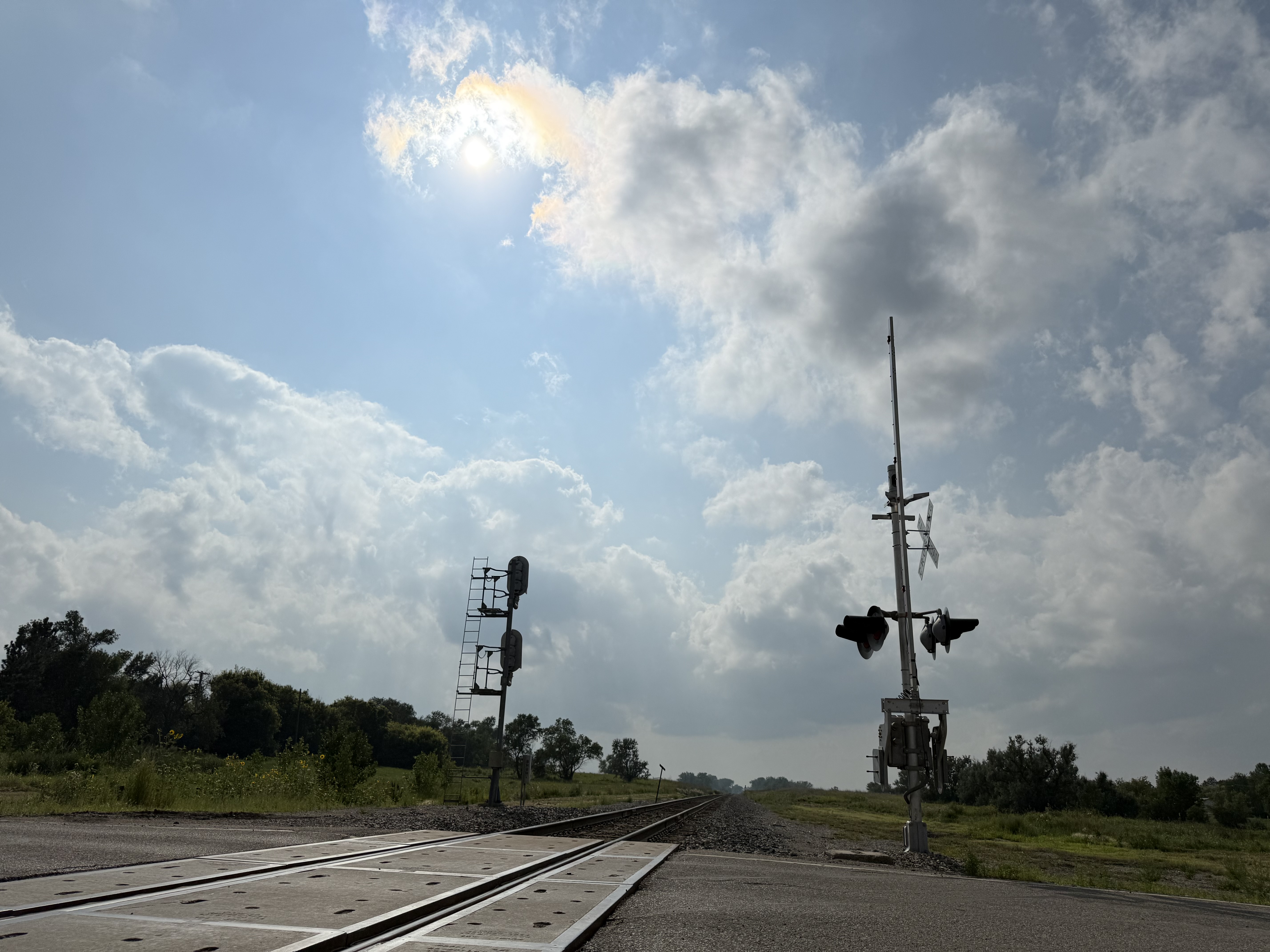
View to the west, at Driscoll, along a section of the historic Northern Pacific Railroad, the historic linear corridor that would have been used by passenger rail car and brought Era Bell Thompson’s family to this area of Driscoll, Burleigh County, North Dakota, in the 1910s.